Flutter Developer Jobs in 2026: Where to Look, Salary Ranges, How to Prepare
Find Flutter developer jobs in 2026. Job board listings, salary ranges by region, remote opportunities, and interview preparation strategies for mobile developers.
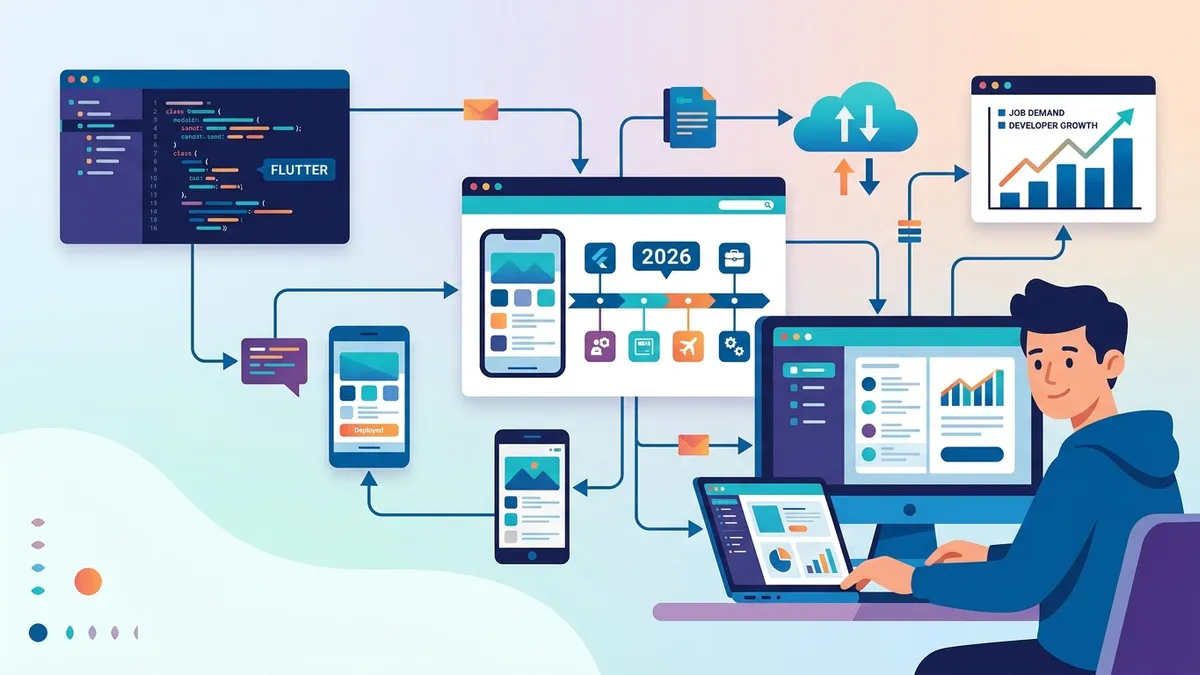
Flutter developer jobs continue to grow as companies prioritize cross-platform mobile development over maintaining separate iOS and Android codebases. The framework's single codebase approach cuts development time, and hiring managers look for developers who can ship to both platforms without duplicating effort.
On the SharpSkill job board: 46 active Flutter positions, 46% fully remote, 22% freelance contracts. 24% of listings publish salary ranges.
Where Flutter developer jobs are posted in 2026
Flutter positions appear across several channels, each with distinct characteristics that affect application strategy.
Company career pages and ATS platforms remain the primary source. Greenhouse, Lever, Ashby, and Workday host most startup and scale-up roles. These listings often include salary bands and detailed tech stack requirements, which helps filter opportunities before applying. The SharpSkill job board aggregates offers from employer career sites and ATS platforms, updated every three hours, saving the manual work of checking dozens of company pages.
Specialized tech job boards like Flutter Jobs and FlutterFlow Jobs focus exclusively on Dart and Flutter roles. These tend to skew toward remote positions and smaller teams building new products. The advantage: less competition from generalist mobile developers.
LinkedIn carries volume but mixes direct employer posts with recruiter listings. Many recruiter posts omit salary ranges and duplicate the same role across multiple agencies. The signal-to-noise ratio improves by following company pages directly and filtering for "Easy Apply" posts from verified employers.
Freelance platforms such as Malt, Upwork, and Toptal list Flutter contracts. The SharpSkill data shows 22% of current Flutter listings are freelance or contractor positions. Toptal requires a technical screening before accessing their marketplace, which filters for higher-quality contracts.
| Channel | What to expect | Watch out for |
|---|---|---|
| Employer career sites | Salary bands, detailed requirements | Slower response times, longer pipelines |
| Specialized tech boards | Remote-friendly, startups, product focus | Smaller sample size |
| Volume, brand-name companies | Recruiter duplicates, hidden salaries | |
| Freelance platforms | Contract rates visible, short-term work | Platform fees (10-20%), payment delays |
What Flutter job postings ask for in 2026
The SharpSkill job board data for September 2026 shows a clear seniority distribution: 41% senior roles, 30% mid-level, 11% junior, and 7% lead or principal positions. The skew toward senior roles reflects Flutter's maturation: companies now hire for production experience, not framework exploration.
Core skills that appear consistently across listings:
- Dart language proficiency including null safety, async/await, and Streams
- State management: Riverpod, Bloc, or Provider (listings often specify one)
- Platform channels for native iOS and Android integration
- CI/CD pipelines for mobile (Fastlane, Codemagic, GitHub Actions, Bitrise)
- Testing: unit tests with
flutter_test, widget tests, and integration tests withintegration_test - Git workflows and code review practices
Differentiators that move a resume to the top of the pile:
- Experience shipping apps to both App Store and Google Play, with evidence of handling review processes
- Performance optimization using Flutter DevTools, profiling widget rebuilds, and reducing jank
- Firebase integration (Auth, Firestore, Cloud Functions, Crashlytics)
- Familiarity with native development (Swift/Kotlin) for implementing platform-specific features that Flutter cannot cover
- Experience with monetization SDKs (RevenueCat, in-app purchases, ads)
- Accessibility implementation: semantic widgets, screen reader support, dynamic text sizing
Red flags in job descriptions:
- Listings that require "React Native OR Flutter OR Kotlin Multiplatform" often indicate the employer has not decided on a stack. These roles may pivot away from Flutter.
- Vague requirements like "mobile experience" without specific framework mentions suggest a generalist role where Flutter might not be the priority.
- Listings that specify Flutter with concrete version requirements ("Flutter 3.24+") signal a team that already uses the framework in production and knows what they need.
Flutter developer salary ranges in 2026
Salary data for Flutter roles remains fragmented. On the SharpSkill job board, 24% of listings include compensation, too small a sample to compute reliable medians. Published salary surveys and aggregated data provide broader context.
United States: The 2024 Stack Overflow Developer Survey reported median compensation for mobile developers around $120,000 USD annually. Flutter-specific roles in the US typically range from $100,000 to $160,000 for mid to senior positions, based on Levels.fyi submissions. FAANG companies and well-funded startups pay at the higher end; agencies and consultancies trend lower.
Western Europe: German and French Flutter developer salaries range from EUR 55,000 to EUR 85,000 annually for experienced developers. The Robert Half 2024 Salary Guide and Glassdoor DE listings confirm this range. UK salaries for senior Flutter developers sit between GBP 60,000 and GBP 90,000.
Remote roles from US or EU companies: Fully remote positions from US or EU companies often pay above local market rates when hiring in lower-cost regions. The 46% remote share in current listings reflects employer willingness to access global talent. Developers in Eastern Europe, Latin America, or Southeast Asia working for US startups report salaries 1.5 to 2 times local benchmarks.
Freelance day rates vary significantly by region and experience:
- Western Europe: EUR 450 to EUR 650 per day for senior profiles
- US: $600 to $1,000 daily for experienced contractors
- UK: GBP 400 to GBP 600 per day
The 22% freelance share in current Flutter listings suggests steady demand for contract work, particularly for app rebuilds, MVP development, and temporary team augmentation.
When a listing omits salary, research the company on Glassdoor and Levels.fyi before the first call. Recruiters often ask for "salary expectations" early; having a data-backed range prevents anchoring too low.
Browse Flutter developer jobs
Active Flutter positions from employer career sites, updated every 3 hours. Review interview questions for each role.
Remote, hybrid, and onsite Flutter roles
The SharpSkill job board shows 46% of Flutter positions as fully remote, 22% hybrid, and 4% strictly onsite (28% unspecified). This distribution reflects mobile development's flexibility: unlike roles requiring physical hardware or on-premise systems, Flutter development needs only a laptop and test devices.
What "remote" actually means in job postings:
- Geographic restrictions: Many "remote" roles require residence in specific countries for tax and legal compliance. A US company offering remote work may still require US residency or specific state residence. EU companies hiring "remote" often limit to EU or EEA countries.
- Time zone overlap: European companies often require 4 to 6 hours of overlap with CET. US companies may specify Pacific or Eastern time availability. A "remote" role with 9am PST standup limits candidates in Asia and Europe.
- Occasional travel: Some remote roles expect quarterly on-site gatherings, team offsites, or annual company retreats. Budget 1 to 4 weeks of travel per year for these roles.
Hybrid roles typically mean 2 to 3 days per week in office. The SharpSkill data shows Paris (4 listings), Madrid (2), Seville (2), and Nancy (2) as the top cities for Flutter positions in the current dataset. Hybrid roles cluster in tech hubs where companies maintain offices.
Questions to ask about remote work:
- Which countries or states are eligible for hire?
- What time zone overlap is expected daily?
- How often does the team meet in person?
- Does the company provide equipment (MacBook, test devices) or stipends?
During initial recruiter calls, confirm: required residence country, expected time zone overlap, and travel expectations. These constraints often appear only in the final offer, wasting weeks of interview time.
How to prepare for a Flutter interview in 2026
Flutter interviews combine mobile development fundamentals with Dart-specific patterns. The structure typically spans 3 to 5 rounds over 2 to 4 weeks.
Typical interview structure:
- Recruiter screen (30 min): Background, motivation, salary expectations, timeline. No technical content, but the recruiter gates access to technical rounds.
- Technical screening (45-60 min): Dart syntax, null safety, async/await patterns, basic widget composition. Often conducted via shared coding environment.
- System design (60 min): Architecting a mobile app with offline support, state management, API integration, and caching strategies.
- Live coding (60-90 min): Building a small feature or fixing a bug in an existing codebase. Tests behavior under time pressure.
- Behavioral round (45 min): Collaboration, debugging stories, experience shipping to production, handling app store rejections.
Common technical topics and what to prepare:
- Widget lifecycle: When to use StatelessWidget vs StatefulWidget. Lifecycle methods (initState, dispose, didUpdateWidget). Why StatelessWidget is preferred when possible.
- State management trade-offs: When Riverpod fits better than Bloc, and vice versa. How to migrate between them. Why setState alone does not scale.
- Platform channels: How to call native iOS or Android code from Dart. MethodChannel vs EventChannel. Error handling across the bridge.
- Performance: Identifying jank using Flutter DevTools timeline. Reducing widget rebuilds with const constructors, keys, and selective rebuilding. ListView.builder vs Column for long lists.
- Testing strategies: The difference between unit, widget, and integration tests. Mocking with Mockito. Golden tests for UI regression.
Resources for preparation:
- The Flutter documentation on testing covers the testing pyramid with concrete examples
- Riverpod documentation for modern state management patterns
- Bloc library documentation for event-driven state management
- SharpSkill's Flutter interview questions on state management cover fundamentals that appear in most interviews
- The Provider pattern module addresses dependency injection and InheritedWidget patterns, a common source of interview questions
Landing a Flutter role: the action checklist
- Set up job alerts on employer career sites for "Flutter" and "Dart" keywords. The SharpSkill job board consolidates listings from multiple ATS platforms, reducing manual tracking.
- Review job descriptions for specific Flutter versions and state management libraries. Tailor each application to match the stack mentioned.
- Prepare two or three portfolio apps with source code on GitHub. Include testing, CI/CD configuration, and App Store or Play Store links if available. Deployed apps demonstrate shipping ability.
- Practice explaining state management decisions out loud. Interviewers ask why a project chose Riverpod over Bloc, or vice versa. A clear, reasoned answer signals seniority.
- Brush up on platform channels if the role involves native integrations. A working example of calling Swift or Kotlin from Dart demonstrates practical cross-platform experience.
- Use the SharpSkill cheatsheet to review Dart syntax and Flutter widget patterns before technical screens. The /technologies/flutter page collects core concepts.
- Clarify remote terms, salary bands, and growth paths during initial calls. Roles without transparency on compensation often lag on other fronts too.
Start practicing!
Test your knowledge with our interview simulators and technical tests.
Can you spot the bug in Flutter?
One real snippet, one hidden bug, one attempt a day. No account needed to try.

Written by
Anthony Fillion-MailletFounder of SharpSkill
Full-stack developer for over 10 years. Runs SharpSkill and answers for everything published here.
Updated on September 23, 2026
Tags
Share
Related articles
Flutter vs React Native in 2026: Architecture, Performance, and When to Choose Each
A detailed comparison of Flutter 3.44 and React Native 0.86 covering rendering architecture, performance benchmarks, developer experience, and hiring considerations for cross-platform mobile development in 2026.
Flutter Navigation 2.0 and GoRouter in 2026: Deep Linking and Interview Questions
Master Flutter navigation with GoRouter 17.5: declarative routing, deep linking, ShellRoute, route guards, and common interview questions with practical examples.
Flutter State Management: Riverpod vs BLoC - Complete Comparison Guide
In-depth comparison between Riverpod 3.x and BLoC 9.x for Flutter state management. Architecture, automatic retry, testability and use cases to choose the best solution.