Apache Beam vs Spark in 2026: Unified Pipelines and Interview Questions
Compare Apache Beam 2.76 and Spark 4.2 for data pipeline development. Covers portability, performance, real interview questions, and when to choose each framework.
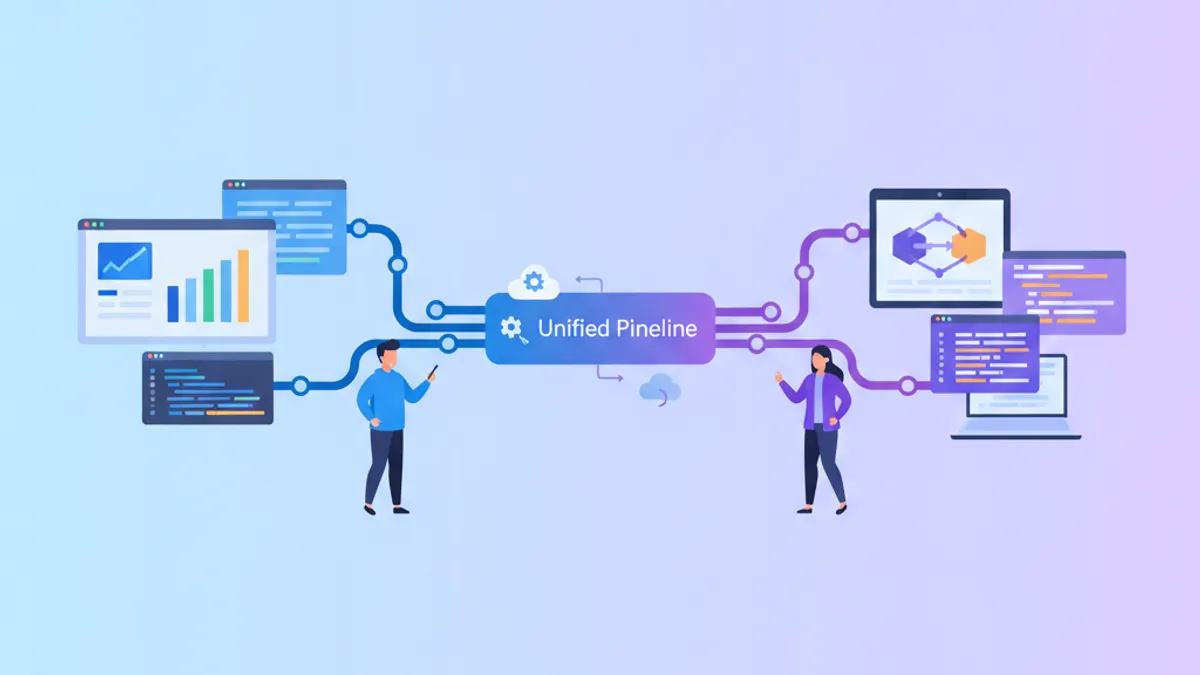
Apache Beam vs Spark represents one of the most common architectural decisions in modern data engineering. Beam 2.76 (August 2026) and Spark 4.2 (July 2026) both handle batch and streaming workloads, but their design philosophies differ fundamentally: Beam abstracts away the execution engine, while Spark provides a tightly integrated runtime.
Choose Beam when portability across runners (Dataflow, Flink, Spark) matters or when using Google Cloud Dataflow. Choose Spark when operating a self-managed cluster, using Databricks, or needing ML integration with MLlib.
Beam's Portability Model vs Spark's Unified Engine
Apache Beam separates the programming model from execution. A single pipeline definition runs on Google Cloud Dataflow, Apache Flink, Apache Spark, or other runners without code changes. This abstraction comes from the Beam SDK generating a portable pipeline representation that any compatible runner interprets.
Spark 4.2 takes the opposite approach. The DataFrame API, Structured Streaming, and MLlib share the same Catalyst optimizer and Tungsten execution engine. This tight coupling enables optimizations like Adaptive Query Execution that adjust plans at runtime based on actual data statistics.
# beam_pipeline.py
import apache_beam as beam
from apache_beam.options.pipeline_options import PipelineOptions

# Same code runs on Dataflow, Flink, or Spark runner
options = PipelineOptions([
    '--runner=DataflowRunner',  # Switch to FlinkRunner or SparkRunner
    '--project=my-project',
    '--region=us-central1',
    '--temp_location=gs://my-bucket/temp'
])

with beam.Pipeline(options=options) as pipeline:
    (pipeline
     | 'ReadEvents' >> beam.io.ReadFromPubSub(topic='projects/p/topics/events')
     | 'ParseJSON' >> beam.Map(lambda x: json.loads(x))
     | 'FilterValid' >> beam.Filter(lambda e: e.get('status') == 'valid')
     | 'WindowByMinute' >> beam.WindowInto(beam.window.FixedWindows(60))
     | 'CountPerWindow' >> beam.combiners.Count.Globally()
     | 'WriteToBQ' >> beam.io.WriteToBigQuery('project:dataset.table'))
The Spark equivalent ties directly to the Spark runtime:
# spark_streaming.py
from pyspark.sql import SparkSession
from pyspark.sql.functions import from_json, col, window

spark = SparkSession.builder \
    .appName("EventProcessing") \
    .config("spark.sql.adaptive.enabled", "true") \
    .getOrCreate()

# Spark 4.2: ANSI mode enabled by default, stricter type checking
events = spark.readStream \
    .format("kafka") \
    .option("kafka.bootstrap.servers", "broker:9092") \
    .option("subscribe", "events") \
    .load()

processed = events \
    .select(from_json(col("value").cast("string"), schema).alias("data")) \
    .filter(col("data.status") == "valid") \
    .groupBy(window(col("data.timestamp"), "1 minute")) \
    .count()

processed.writeStream \
    .format("bigquery") \
    .option("table", "project.dataset.table") \
    .outputMode("append") \
    .start()
Beam's portability enables cloud-agnostic architectures but adds a translation layer. Spark's direct execution typically shows lower latency for equivalent operations on the same hardware.
Windowing and Event-Time Processing Compared
Both frameworks handle event-time semantics, but their APIs reflect different heritage. Beam's windowing model comes from the Dataflow Model paper (2015), treating windows as first-class pipeline elements. Spark adapted its windowing for Structured Streaming, integrating it with the DataFrame API.
| Feature | Beam 2.76 | Spark 4.2 |
|---|---|---|
| Fixed windows | FixedWindows(duration) | window(col, duration) |
| Sliding windows | SlidingWindows(size, period) | window(col, size, period) |
| Session windows | Sessions(gap) | Not native (use flatMapGroupsWithState) |
| Custom windows | WindowFn subclass | Limited |
| Late data handling | Built-in triggers | Watermark delays |
| Allowed lateness | Per-window configuration | Global watermark |
Session windows reveal the difference most clearly. Beam treats sessions as a native windowing strategy:
# beam_sessions.py
from apache_beam import window

# 30-minute session gap, allow 1 hour late data
windowed = (
    events
    | 'SessionWindow' >> beam.WindowInto(
        window.Sessions(30 * 60),  # 30 min gap closes session
        trigger=beam.trigger.AfterWatermark(
            early=beam.trigger.AfterProcessingTime(60),
            late=beam.trigger.AfterCount(1)
        ),
        allowed_lateness=3600,  # Accept data up to 1 hour late
        accumulation_mode=beam.trigger.AccumulationMode.ACCUMULATING
    )
)
Spark requires stateful processing for sessions:
# spark_sessions.py
from pyspark.sql.streaming import GroupState, GroupStateTimeout

def update_session(key, events, state: GroupState):
    # Manual session management with state API
    session_data = state.getOption() or {"count": 0, "start": None, "end": None}

    for event in events:
        ts = event.timestamp
        if session_data["end"] and (ts - session_data["end"]).seconds > 1800:
            # Gap exceeded 30 min, emit previous session
            yield session_data
            session_data = {"count": 0, "start": ts, "end": ts}

        session_data["count"] += 1
        session_data["end"] = ts
        if not session_data["start"]:
            session_data["start"] = ts

    state.update(session_data)
    state.setTimeoutDuration(30 * 60 * 1000)  # 30 min timeout

# Spark 4.2 Arbitrary State API v2
result = events \
    .groupByKey(lambda e: e.user_id) \
    .flatMapGroupsWithState(
        update_session,
        outputMode="append",
        stateType=session_schema,
        timeoutConf=GroupStateTimeout.ProcessingTimeTimeout
    )
For interview preparation on these topics, see the Apache Beam and Dataflow interview questions module.
Performance: Benchmark Data from 2026
Direct comparisons require careful setup since Beam runs on top of Spark as one runner option. The relevant comparison is Beam-on-Dataflow vs native Spark.
Recent benchmarks from Databricks and Google Cloud show:
| Workload | Spark 4.2 (Databricks) | Beam 2.76 (Dataflow) | Notes |
|---|---|---|---|
| Batch ETL (1TB Parquet) | 4.2 min | 5.1 min | Spark's Photon engine advantage |
| Streaming (100K events/sec) | 45ms p99 latency | 120ms p99 latency | Dataflow autoscaling overhead |
| Exactly-once sink writes | Native | Native | Both support since 2024 |
| Cost (sustained workload) | $0.12/GB processed | $0.08/GB processed | Dataflow Flex pricing |
Spark 4.2's performance gains come from several features:
- ANSI mode by default: stricter SQL semantics catch errors earlier
- VARIANT data type: native semi-structured data handling
- Adaptive Query Execution: runtime plan optimization
- Java 21 support: virtual threads reduce overhead
Beam 2.76 counters with:
- Flink 2.0 runner support: production-grade stateful streaming
- CDC offset persistence: DebeziumIO FileSystemOffsetRetainer
- ADK integration: Google Agent Development Kit support in Python SDK
Ready to ace your Data Engineering interviews?
Practice with our interactive simulators, flashcards, and technical tests.
Common Interview Questions: Beam vs Spark
Technical interviews for data engineering roles frequently compare these frameworks. Here are questions that appear in 2026 interviews, with expected answer depth.
Q1: When would you choose Beam over native Spark?
Expected answer points:
- Multi-cloud or hybrid deployments where pipeline code must run unchanged
- Google Cloud environments where Dataflow provides managed infrastructure
- Complex event-time semantics requiring session windows or custom triggers
- Teams with existing Beam expertise from Dataflow background
Red flag answer: "Beam is always better because it's portable." Portability has overhead costs.
Q2: How does Beam's runner abstraction affect debugging?
Expected answer points:
- Stack traces reference both Beam SDK and runner implementation
- Runner-specific optimizations may behave differently (Flink checkpoints vs Spark checkpoints)
- Metrics API provides unified monitoring, but runner dashboards show different detail
- Testing with DirectRunner before deploying to production runner
Q3: Explain exactly-once semantics in both frameworks.
Expected answer:
# Beam: exactly-once via runner guarantees
# Dataflow provides exactly-once for both sources and sinks
# The SDK handles deduplication and checkpoint coordination

with beam.Pipeline() as p:
    (p
     | beam.io.ReadFromPubSub(subscription='...')  # Exactly-once read
     | beam.Map(process)
     | beam.io.WriteToBigQuery(...)  # Exactly-once write with retries
    )

# Spark: exactly-once via checkpointing and idempotent sinks
spark.readStream \
    .format("kafka") \
    .load() \
    .writeStream \
    .option("checkpointLocation", "/checkpoint")  # State recovery
    .foreachBatch(idempotent_write)  # Application-level deduplication
    .start()
For more streaming interview topics, check the PySpark module.
Q4: How would you migrate a Spark batch job to Beam?
This question tests understanding of both APIs. Key points:
- Map DataFrame operations to PCollections and transforms
- Replace
spark.readwith appropriate Beam I/O connectors - Convert UDFs to
beam.Maporbeam.ParDofunctions - Handle partitioning differently (Beam's
Reshufflevs Spark'srepartition) - Test with DirectRunner before deploying to production runner
Choosing the Right Tool: Decision Matrix
The choice depends on organizational context more than technical capabilities. Both frameworks handle most data engineering workloads competently.
| Factor | Favors Beam | Favors Spark |
|---|---|---|
| Cloud provider | Google Cloud | AWS EMR, Databricks, on-prem |
| Team expertise | Existing Dataflow experience | Existing Spark/PySpark skills |
| ML integration | Limited (separate tools) | MLlib, Spark ML |
| Interactive analysis | Not designed for this | Spark SQL, notebooks |
| Session windows | Native support | Manual state management |
| Cost model | Pay-per-use (Dataflow) | Cluster provisioning |
| Vendor lock-in | Lower (multiple runners) | Higher (Spark-specific code) |
For ETL/ELT pattern decisions, consider the data volume and latency requirements before selecting a framework.
Real-World Architecture: Hybrid Approach
Many organizations use both frameworks. A common pattern:
[Streaming Ingestion]     [Batch Processing]     [ML Training]
        |                        |                    |
   Beam/Dataflow           Spark on Databricks    Spark MLlib
        |                        |                    |
        v                        v                    v
    BigQuery  <----- dbt -----> Delta Lake -----> Model Registry
Beam handles streaming ingestion where Dataflow's autoscaling matches traffic patterns. Spark processes batch workloads where cluster economics favor sustained compute. Both feed into a unified data warehouse.
This architecture appears in the Apache Spark tutorial with implementation details.
Start practicing!
Test your knowledge with our interview simulators and technical tests.
Key Takeaways for Beam vs Spark Selection
- Beam 2.76 provides runner portability across Dataflow, Flink 2.0, and Spark, trading some performance for deployment flexibility
- Spark 4.2 delivers tighter integration between SQL, streaming, and ML workloads with features like VARIANT types and Adaptive Query Execution
- Session windows and complex triggers favor Beam's native windowing model
- Batch performance on equivalent hardware typically favors Spark due to Catalyst/Tungsten optimization
- Interview questions focus on trade-offs rather than declaring one framework superior
- Hybrid architectures using both frameworks are common in production environments
- Cost comparison depends on workload patterns: Dataflow's per-GB pricing vs Spark cluster provisioning
Can you spot the bug in Data Engineering?
One real snippet, one hidden bug, one attempt a day. No account needed to try.

Written by
Anthony Fillion-MailletFounder of SharpSkill
Full-stack developer for over 10 years. Runs SharpSkill and answers for everything published here.
Updated on September 10, 2026
Tags
Share
Related articles
Apache Spark 4.2 vs Databricks in 2026: Architecture, Performance and Interview Questions
Compare Apache Spark 4.2 and Databricks in 2026. Understand their architectures, performance characteristics, and master common interview questions for data engineering roles.
Apache Spark 4 in 2026: New Features, Structured Streaming and Interview Questions
A comprehensive guide to Apache Spark 4.x covering ANSI mode, VARIANT type, Real-Time Mode streaming, Spark Connect, and common data engineering interview questions with code examples.
Top 25 Data Engineering Interview Questions in 2026
The 25 most asked data engineering interview questions in 2026, covering SQL, data pipelines, ETL/ELT, Spark, Kafka, data modeling, and system design with detailed answers.