Apache Spark 4.2 vs Databricks in 2026: Architecture, Performance and Interview Questions
Compare Apache Spark 4.2 and Databricks in 2026. Understand their architectures, performance characteristics, and master common interview questions for data engineering roles.

Apache Spark 4.2 and Databricks represent two paths to distributed data processing in 2026. Spark offers maximum flexibility as an open-source framework, while Databricks wraps Spark in a fully managed lakehouse platform with proprietary enhancements. Understanding the differences between these options is essential for data engineering interviews and architectural decisions.
Apache Spark is a distributed computing framework. Databricks is a commercial platform built on top of Spark. Comparing them directly is like comparing Linux to Red Hat Enterprise Linux: one is the foundation, the other is a productized version with enterprise features.
Apache Spark 4.2: New Features and Architecture
Apache Spark 4.2, released on July 14, 2026, introduces several features that change how data pipelines operate. The most significant additions target change data capture, AI integration, and streaming workloads.
Auto CDC and the CHANGES Clause
Spark 4.2 makes change data capture native to the engine. Previously, tracking data changes required custom solutions involving timestamps, hash comparisons, or external CDC tools. The new Auto CDC feature handles this automatically.
-- changes-query.sql
-- Query changes to a Delta table since version 10
SELECT * FROM orders CHANGES SINCE VERSION 10;

-- Track changes within a time window
SELECT * FROM customers
CHANGES BETWEEN TIMESTAMP '2026-07-01' AND TIMESTAMP '2026-07-15';
The CHANGES clause returns rows with metadata columns indicating whether each row was inserted, updated, or deleted. This eliminates the need to maintain separate CDC infrastructure for most use cases.
Metric Views: Native Semantic Layer
Metric Views create governed business definitions directly in Spark SQL. Teams define metrics once, ensuring consistent calculations across dashboards, reports, and AI applications.
-- metric-views.sql
-- Define a metric view for revenue calculations
CREATE METRIC VIEW monthly_revenue AS
SELECT
    DATE_TRUNC('month', order_date) AS month,
    SUM(amount) AS total_revenue,
    COUNT(DISTINCT customer_id) AS unique_customers,
    SUM(amount) / COUNT(DISTINCT customer_id) AS revenue_per_customer
FROM orders
WHERE status = 'completed'
GROUP BY DATE_TRUNC('month', order_date);

-- Query the metric view
SELECT * FROM monthly_revenue WHERE month >= '2026-01-01';
Metric Views enforce calculation consistency. When the finance team queries monthly_revenue, they get the same numbers as the data science team building ML models.
Real-Time Mode for PySpark
Spark 4.2 introduces Real-Time Mode, simplifying streaming workflows in PySpark. The Databricks announcement highlights how this reduces the operational burden of checkpoint management and failure recovery.
# streaming_pipeline.py
from pyspark.sql import SparkSession
from pyspark.sql.functions import col, window

spark = SparkSession.builder.appName("RealTimeOrders").getOrCreate()

# Enable Real-Time Mode for simplified streaming
orders_stream = spark.readStream \
    .format("kafka") \
    .option("kafka.bootstrap.servers", "kafka:9092") \
    .option("subscribe", "orders") \
    .option("realtimeMode", "true") \
    .load()

# Aggregate orders in 5-minute windows
aggregated = orders_stream \
    .withWatermark("event_time", "10 minutes") \
    .groupBy(window(col("event_time"), "5 minutes"), col("region")) \
    .agg({"amount": "sum", "order_id": "count"})

# Write to Delta Lake
aggregated.writeStream \
    .format("delta") \
    .outputMode("append") \
    .option("checkpointLocation", "/checkpoints/orders") \
    .toTable("order_aggregates")
Real-Time Mode handles checkpoint management internally, reducing boilerplate code and operational complexity for streaming applications.
Databricks Platform Architecture in 2026
Databricks extends Spark with proprietary features that address enterprise requirements. The platform combines Delta Lake, Unity Catalog, Mosaic AI, and the new Lakebase OLTP engine into an integrated lakehouse.
Unity Catalog: Centralized Governance
Unity Catalog provides fine-grained access control across all data assets. Column-level security, row filters, and data masking apply consistently across SQL queries, notebooks, and ML training jobs.
-- unity-catalog-policies.sql
-- Grant read access to specific columns
GRANT SELECT (customer_id, order_date, product_id)
ON TABLE sales.orders
TO `analyst-team`;

-- Create row-level security policy
CREATE ROW FILTER policy_regional_access
ON sales.orders
AS (region STRING) -> region = current_user_region();

-- Apply the filter
ALTER TABLE sales.orders SET ROW FILTER policy_regional_access ON (region);
With self-managed Spark, equivalent functionality requires integrating Apache Ranger for access control, Apache Atlas for metadata, and custom solutions for lineage tracking.
Serverless Compute Economics
Databricks serverless SQL eliminates cluster idle costs. According to Flexera's pricing analysis, SQL Serverless costs $0.70 per DBU on AWS Premium, but for bursty BI workloads, total costs often land 20-35% below SQL Pro because idle hours disappear.
| Compute Type | DBU Rate (AWS Premium) | Best For | |--------------|------------------------|----------| | Jobs Classic | $0.15 | Batch ETL, overnight processing | | Jobs Serverless | $0.28 | Variable workloads, unpredictable schedules | | SQL Pro | $0.55 | Sustained BI queries, predictable patterns | | SQL Serverless | $0.70 | Bursty queries, on-demand dashboards | | Model Serving | $0.08 | ML inference endpoints |
The trade-off is straightforward: serverless commands a 20-40% DBU premium versus classic compute, but eliminates the cluster spin-up and idle costs that can dominate total spend for variable workloads.
Ready to ace your Data Engineering interviews?
Practice with our interactive simulators, flashcards, and technical tests.
Architecture Comparison for Interview Preparation
Data engineering interviews frequently explore the trade-offs between self-managed Spark and managed platforms like Databricks. The following comparison covers the most common interview topics.
Cluster Management and Scaling
Self-managed Spark requires explicit cluster configuration. Teams choose instance types, configure autoscaling policies, and manage spot instance interruptions.
# spark_cluster_config.py
from pyspark import SparkConf

conf = SparkConf() \
    .setAppName("ProductionETL") \
    .set("spark.executor.instances", "10") \
    .set("spark.executor.cores", "4") \
    .set("spark.executor.memory", "16g") \
    .set("spark.dynamicAllocation.enabled", "true") \
    .set("spark.dynamicAllocation.minExecutors", "2") \
    .set("spark.dynamicAllocation.maxExecutors", "50") \
    .set("spark.shuffle.service.enabled", "true")
Databricks abstracts much of this complexity. Cluster policies enforce organizational standards, and photon-optimized instances automatically select appropriate configurations.
Data Lineage and Observability
Databricks Unity Catalog tracks lineage automatically across tables, notebooks, and ML models. Every read and write operation creates an auditable trail.
With self-managed Spark, lineage tracking requires additional tooling. Common approaches include integrating with Apache Atlas or building custom solutions using Spark listeners.
# custom_lineage_listener.py
from pyspark import SparkContext
from pyspark.sql import SparkSession

class LineageListener:
    def __init__(self, spark: SparkSession):
        self.spark = spark

    def track_read(self, table_name: str, query_id: str):
        # Log read operation to lineage store
        lineage_record = {
            "operation": "read",
            "table": table_name,
            "query_id": query_id,
            "timestamp": datetime.now().isoformat(),
            "user": self.spark.sparkContext.sparkUser()
        }
        self._persist_lineage(lineage_record)

    def track_write(self, table_name: str, query_id: str, row_count: int):
        # Log write operation with affected row count
        lineage_record = {
            "operation": "write",
            "table": table_name,
            "query_id": query_id,
            "rows_affected": row_count,
            "timestamp": datetime.now().isoformat()
        }
        self._persist_lineage(lineage_record)
Storage Layer Options
Both approaches support open table formats. Delta Lake originated from Databricks but is fully open source. Apache Iceberg provides an alternative with strong community support.
| Feature | Delta Lake | Apache Iceberg | |---------|------------|----------------| | ACID Transactions | Yes | Yes | | Time Travel | Yes | Yes | | Schema Evolution | Yes | Yes | | Partition Evolution | Limited | Full | | Hidden Partitioning | No | Yes | | Primary Integration | Databricks | Multiple engines |
For deeper analysis of these formats, see the Delta Lake vs Apache Iceberg comparison.
Common Interview Questions
The following questions appear frequently in data engineering interviews. Each question includes the context interviewers seek and structured response frameworks.
Question 1: When would you choose self-managed Spark over Databricks?
What interviewers assess: Cost awareness, operational maturity, and understanding of organizational constraints.
Strong response framework:
- Cost predictability: Self-managed Spark eliminates per-DBU charges. For organizations with consistent, predictable workloads running 24/7, capital expenditure on reserved instances often costs less than consumption-based pricing.
- Data sovereignty: Some industries require data to remain on-premises or in specific jurisdictions. Self-managed deployments on dedicated infrastructure satisfy these requirements.
- Existing expertise: Teams with strong Kubernetes and Spark operations capabilities may prefer the flexibility of self-managed deployments.
- Multi-engine workloads: Organizations using Spark alongside Presto, Flink, or custom engines benefit from unified cluster management through YARN or Kubernetes.
Question 2: How does Databricks optimize Spark performance?
What interviewers assess: Understanding of the Delta Engine, Photon, and platform-specific optimizations.
Key points to cover:
- Photon: Native C++ vectorized execution engine that replaces the JVM-based Spark SQL engine for supported operations. Provides 2-8x speedup for scan-heavy and aggregation workloads.
- Delta Cache: SSD-based caching layer that accelerates repeated reads from cloud storage.
- Adaptive Query Execution: Enhanced version of Spark's AQE with additional optimizations for data skew handling and join strategy selection.
- IO optimization: Automatic data layout optimization, including Z-ordering and file compaction.
Question 3: Explain the trade-offs of serverless compute
What interviewers assess: Cost modeling skills and understanding of workload characteristics.
# cost_comparison.py
def estimate_monthly_cost(workload_type: str, daily_dbus: float, hours_active: float):
    """Compare serverless vs classic compute costs."""

    # DBU rates (AWS Premium tier)
    rates = {
        "sql_classic": 0.55,
        "sql_serverless": 0.70,
        "jobs_classic": 0.15,
        "jobs_serverless": 0.28
    }

    # Classic clusters incur idle costs
    cluster_hours_per_day = 10  # Cluster runs 10 hours for 4 hours of actual work
    serverless_hours = hours_active  # Only pay for actual compute

    classic_monthly = daily_dbus * cluster_hours_per_day * rates[f"{workload_type}_classic"] * 30
    serverless_monthly = daily_dbus * serverless_hours * rates[f"{workload_type}_serverless"] * 30

    return {
        "classic": classic_monthly,
        "serverless": serverless_monthly,
        "savings_percent": (classic_monthly - serverless_monthly) / classic_monthly * 100
    }
Serverless suits bursty, unpredictable workloads. Classic compute wins for sustained, predictable processing where clusters run near capacity.
Question 4: How does Spark 4.2's Auto CDC compare to traditional CDC tools?
What interviewers assess: Understanding of change data capture patterns and operational trade-offs.
Comparison points:
The Apache Spark 4.2 release embeds CDC into the query engine:
| Aspect | Spark 4.2 Auto CDC | Debezium/Kafka | Custom Timestamp CDC | |--------|-------------------|----------------|---------------------| | Setup Complexity | Low | High | Medium | | Real-time Latency | Minutes | Seconds | Minutes to hours | | Source Database Load | None | Log reading | Query-based | | Historical Queries | Built-in | Requires retention | Limited | | Schema Evolution | Automatic | Configuration needed | Manual |
Auto CDC excels for analytical workloads where minute-level latency is acceptable. For sub-second requirements, Debezium with Kafka remains the standard approach.
Practical Decision Framework
Use this framework when evaluating Spark vs Databricks for a specific organization or project.
Choose Self-Managed Spark When:
- The team has existing Spark and Kubernetes expertise
- Workloads are predictable and run continuously
- Data must remain on-premises or in specific regions
- The organization already operates data platform infrastructure
- Cost sensitivity outweighs operational convenience
Choose Databricks When:
- Time-to-production matters more than per-query costs
- The team lacks deep Spark operations expertise
- Governance and compliance requirements demand audit trails
- ML workflows need integrated experiment tracking and model serving
- BI workloads benefit from serverless scaling
For interview preparation on Apache Airflow pipeline orchestration and ETL patterns, the SharpSkill question modules provide structured practice.
Start practicing!
Test your knowledge with our interview simulators and technical tests.
Conclusion
- Apache Spark 4.2 brings Auto CDC, Metric Views, and Real-Time Mode as native features, reducing the need for external tooling
- Databricks adds Unity Catalog governance, Photon acceleration, and serverless compute on top of the Spark foundation
- Self-managed Spark offers lower costs for predictable workloads and maximum architectural flexibility
- Databricks reduces operational burden and accelerates time-to-production for teams without deep Spark expertise
- Interview success requires understanding both the technical differences and the business trade-offs driving platform selection
- The right choice depends on team capabilities, cost model, compliance requirements, and workload characteristics

Written by
Anthony Fillion-MailletFull-stack developer, founder of SharpSkill
Full-stack developer for over 10 years. Runs SharpSkill and answers for everything published here.
Updated on August 19, 2026
Tags
Share
Related articles
Delta Lake vs Apache Iceberg in 2026: Lakehouse Architecture and Interview Questions
Compare Delta Lake and Apache Iceberg table formats for data lakehouse architecture. Covers ACID transactions, partition evolution, time travel, and common interview questions.
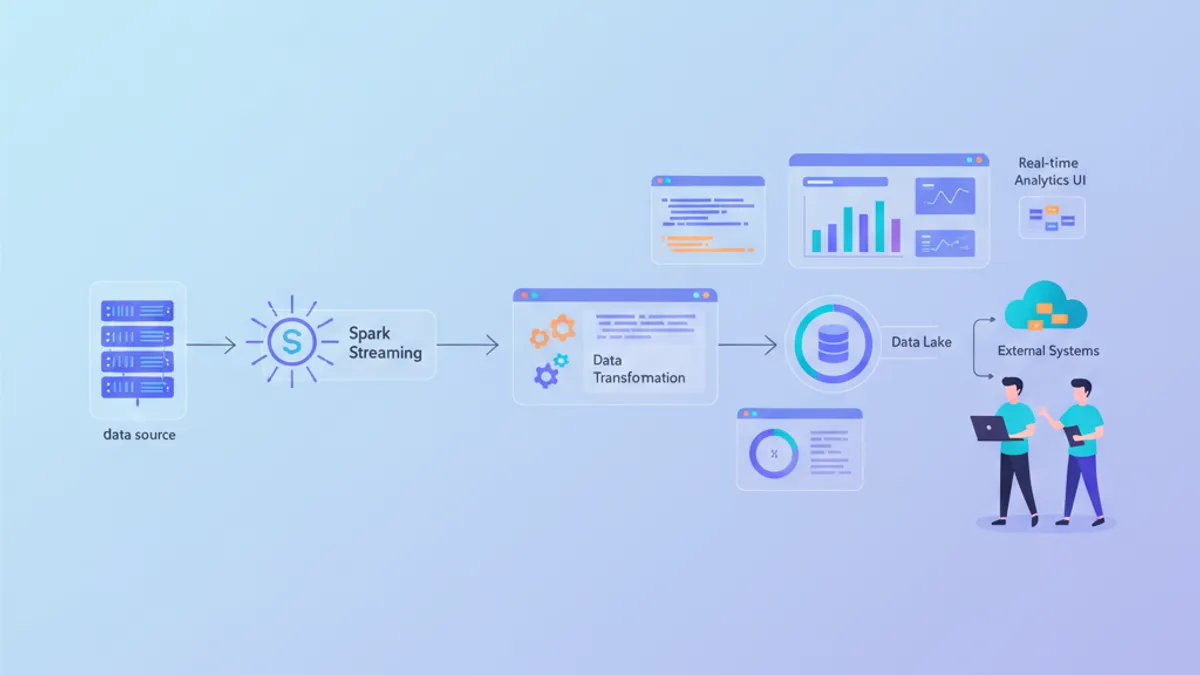
Apache Spark 4 in 2026: New Features, Structured Streaming and Interview Questions
A comprehensive guide to Apache Spark 4.x covering ANSI mode, VARIANT type, Real-Time Mode streaming, Spark Connect, and common data engineering interview questions with code examples.

Apache Airflow in 2026: Pipeline Orchestration, DAGs and Interview Questions
Master Apache Airflow 3.2 with this hands-on tutorial covering DAG authoring with the Task SDK, pipeline orchestration patterns, asset partitions, and real interview questions for data engineering roles in 2026.