Freelance Java Spring Boot developer jobs in 2026: where to find contracts, day rates, how to prepare
Where to find freelance Spring Boot contracts in 2026, current day rates across Europe, and how to prepare for technical interviews.
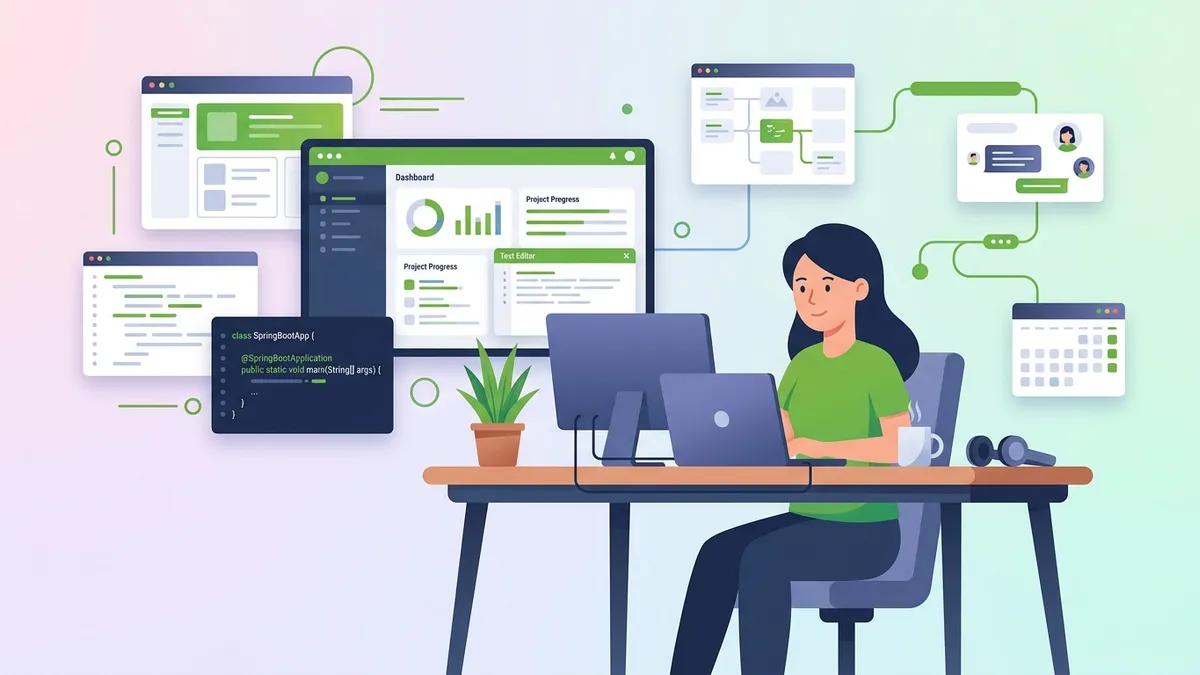
Freelance Java Spring Boot developer contracts have grown steadily throughout 2026, driven by enterprises migrating monoliths to microservices and fintech companies scaling their transaction platforms. This guide covers where to find these contracts, what day rates look like across Europe, and how to prepare for technical interviews.
607 active Spring Boot positions, 29% freelance or contract. Median daily rate 440 EUR (97 postings with published rates). 24% fully remote, 44% hybrid.
Where freelance Spring Boot contracts are posted in 2026
Contract opportunities for Spring Boot developers appear on multiple channels, each with distinct characteristics.
| Channel | What you find | Notes |
|---|---|---|
| Freelance marketplaces (Free-Work, Malt, Comet) | Short to mid-term contracts, TJM visible | High volume, fast turnaround |
| Company career pages via ATS | Direct contracts with end clients | Often longer engagements, better rates |
| Specialist tech recruiters | Consulting firm placements, banking/insurance | Intermediary takes a cut but handles admin |
| LinkedIn Jobs | Mix of direct and agency posts | Filter by "Contract" and "Remote" |
| Hacker News Who is Hiring | Startups, often US-based with EU contractors | Monthly threads, high signal-to-noise |
Free-Work currently accounts for the largest share of indexed Spring Boot freelance postings. The SharpSkill job board lists publicly posted developer jobs, updated daily.
For freelancers based in France, Free-Work and Malt remain primary sources. German contractors often find contracts through Freelancermap and Gulp. UK-based developers should monitor Technojobs alongside LinkedIn.
What Spring Boot contract postings ask for
The 607 active Spring Boot listings on the SharpSkill job board on 27 September 2026 show clear patterns in required skills and seniority expectations.
Seniority distribution:
- Senior: 53% of postings
- Mid-level: 25%
- Lead/Staff: 8%
- Junior: 3%
Most freelance contracts target senior developers with 5+ years of Spring Boot experience. Junior freelance positions are rare: companies hiring contractors expect immediate productivity.
Technical requirements that appear most frequently:
| Skill | Frequency | Why it matters |
|---|---|---|
| Core Java | High | Spring Boot runs on the JVM; deep Java knowledge is assumed |
| Apache Kafka | 28 postings | Event-driven architectures dominate new builds |
| Angular/React | 58/24 postings | Full-stack contracts exist, but backend-only is more common |
| Kubernetes | 22 postings | Container orchestration for microservices deployment |
| CI/CD | 23 postings | Jenkins, GitLab CI, GitHub Actions for pipeline automation |
| SQL | 23 postings | PostgreSQL and MySQL remain standard |
A posting that lists "Spring Boot" without mentioning testing frameworks, observability tools, or CI/CD pipelines often signals a less mature engineering organization. Contracts with explicit mentions of Spring Boot Actuator, Prometheus/Grafana, and test coverage requirements tend to come from teams that value code quality.
Spring Boot freelance day rates in 2026
The SharpSkill job board indexes 97 Spring Boot postings with published daily rates as of 27 September 2026.
| Percentile | Daily rate (EUR) |
|---|---|
| 25th | 380 |
| Median | 440 |
| 75th | 475 |
These figures aggregate contracts across Western Europe. Rates vary by geography, contract duration, and whether the engagement is through an intermediary.
By location:
Lyon, Paris, and Île-de-France account for 81 Spring Boot postings. French market rates for senior Spring Boot freelancers typically range from 450 to 550 EUR/day for direct contracts, dropping to 380 to 420 EUR when an ESN (consulting firm) sits between the contractor and the client. The 2026 Hays IT Salary Guide places senior Java/Spring developers in the 480 to 580 EUR bracket for Paris-based contracts.
London shows 25 active postings. UK day rates for equivalent profiles run between 400 and 600 GBP, according to ITJobsWatch data. Berlin and Munich combined account for 26 postings; German contracts often pay between 70 and 95 EUR/hour, translating to 560 to 760 EUR/day.
Portage vs. company formation:
French freelancers choosing portage salarial typically retain 45 to 55% of gross billings after the umbrella company takes its fee and social charges are paid. Creating an EURL or SASU improves net retention but adds administrative overhead. The choice affects take-home pay more than the nominal TJM suggests.
Browse the SharpSkill job board
Publicly posted developer jobs, updated daily, each linked to the interview questions it calls for.
Remote, hybrid, and on-site Spring Boot contracts
Among the 607 active Spring Boot positions on the SharpSkill job board:
- 24% fully remote
- 44% hybrid
- 7% on-site only
- 25% unspecified
"Remote" in job postings often comes with restrictions. A contract advertised as remote may require residence in a specific country for tax and legal compliance, or expect availability during CET business hours. Contracts through French ESNs typically allow remote work 2 to 3 days per week but require periodic on-site presence at the client's offices.
Fully distributed teams are more common among startups and US-based companies hiring EU contractors. Large enterprises in banking and insurance sectors prefer hybrid arrangements due to regulatory requirements around data access.
When evaluating a remote contract, clarify:
- Required timezone overlap
- On-site days per month or quarter
- Hardware and expense policies
- Contract renewal terms
How to prepare for a Spring Boot freelance interview in 2026
Technical interviews for freelance Spring Boot contracts differ from permanent hire interviews. Clients expect contractors to be productive from day one, so interviews focus on practical experience rather than algorithmic puzzles.
What interviewers ask:
-
Spring Boot internals: How does auto-configuration work? What triggers conditional bean creation? Reviewing the Spring Boot reference documentation on auto-configuration provides the canonical answers.
-
Exception handling patterns: Global exception handling with
@ControllerAdvice, custom error responses, validation error formatting. The exception handling module covers the questions that appear most frequently. -
Spring Security configuration: OAuth2 resource servers, JWT validation, method-level security. Clients in fintech and healthcare ask about security configurations in nearly every interview.
-
Testing strategy: Unit tests with JUnit and Mockito, integration tests with
@SpringBootTest, testcontainers for database tests. The testing with JUnit and Mockito module breaks down the expected answers. -
Observability: Actuator endpoints, Prometheus metrics, distributed tracing with Micrometer. Production-ready applications expose health checks and metrics; interviewers verify candidates know how to configure them.
Practical exercises:
Some clients send take-home assignments instead of live coding. Common tasks include building a REST API with pagination, implementing Kafka consumers, or adding integration tests to an existing codebase. These exercises typically take 2 to 4 hours and evaluate code organization as much as correctness.
For a structured review of Spring Boot concepts, the Spring Boot technology page organizes interview questions by module, from basics through security and testing.
Landing a Spring Boot freelance contract: the checklist
- Monitor multiple channels weekly: Free-Work and Malt for French contracts, LinkedIn and company career pages for direct opportunities, Freelancermap for German market
- Target senior-level contracts: 53% of postings seek senior profiles; junior freelance positions are scarce
- Expect 440 EUR/day median: Rates range from 380 EUR at the 25th percentile to 475 EUR at the 75th; direct contracts pay more than intermediated ones
- Prepare for Spring internals questions: Auto-configuration, bean lifecycle, and conditional annotations come up consistently
- Review security and testing modules: Spring Security basics and Spring Boot testing cover the most common interview topics
- Clarify remote terms before signing: Timezone requirements, on-site expectations, and contract duration affect the actual value of the engagement
- Use the cheatsheet before calls: The developer cheatsheet compiles quick-reference material for last-minute review
Start practicing!
Test your knowledge with our interview simulators and technical tests.
Can you spot the bug in Spring Boot?
One real snippet, one hidden bug, one attempt a day. No account needed to try.

Written by
Anthony Fillion-MailletFounder of SharpSkill
Full-stack developer for over 10 years. Runs SharpSkill and answers for everything published here.
Updated on September 29, 2026
Tags
Share
Related articles

Spring Boot Observability in 2026: OpenTelemetry, Distributed Tracing and Interview Questions
Master Spring Boot observability with OpenTelemetry and Micrometer Tracing. Learn distributed tracing setup, the Observation API, OTLP export configuration, and prepare for technical interviews.
Spring Boot YAML vs Properties: Configuration Comparison and Interview Questions 2026
Compare application.yml and application.properties in Spring Boot 3.4. Learn when to use each format, understand the differences, and prepare for configuration-related interview questions.

Spring Modulith: Modular Monolith Architecture Explained
Learn Spring Modulith to build modular monoliths in Java. Architecture, modules, async events, testing and observability with Spring Boot 3 and 4 code examples.