ETL vs ELT in 2026: Data Pipeline Architecture Explained
ETL vs ELT comparison for modern data pipelines. Understand the architectural differences, performance trade-offs, and when to use each approach with Snowflake, BigQuery, and dbt in 2026.
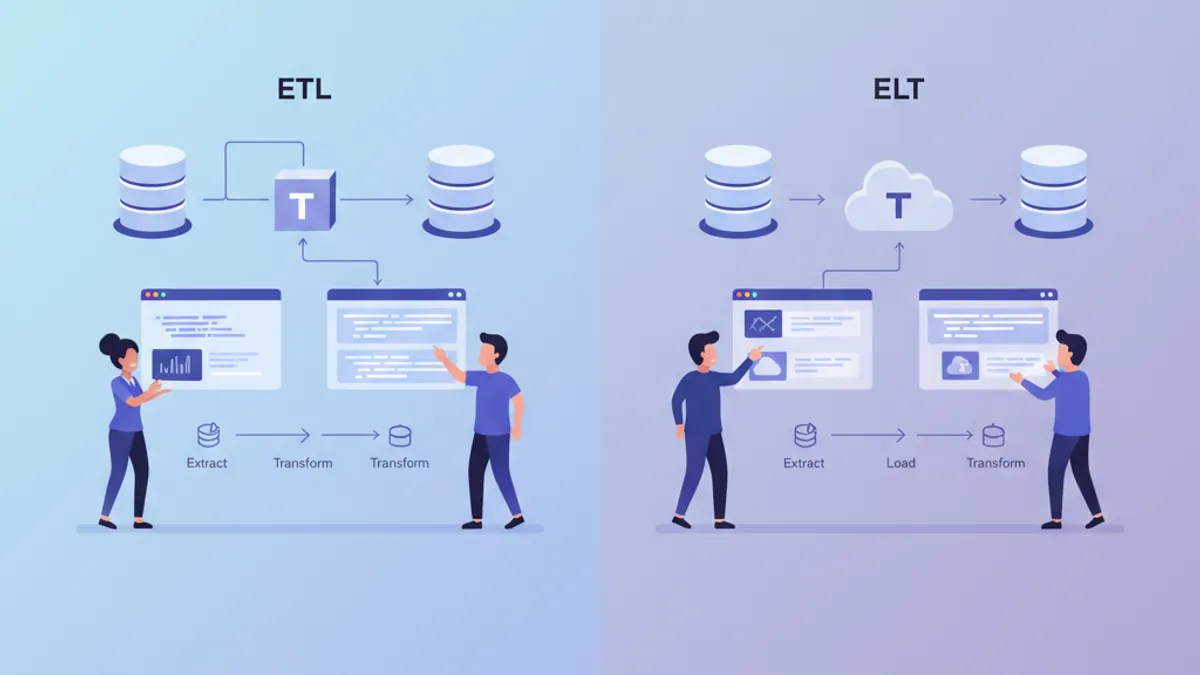
ETL vs ELT defines how data moves through a pipeline, and the choice between them shapes an entire data platform's cost, speed, and flexibility. Both acronyms describe the same three operations — Extract, Transform, Load — but the order of Transform and Load changes everything about the architecture.
ETL transforms data before loading it into the target system. ELT loads raw data first, then transforms it inside the destination warehouse. The shift from ETL to ELT mirrors the shift from expensive on-premise compute to cheap, elastic cloud storage and processing.
How ETL Pipelines Process Data
In an ETL pipeline, data passes through a dedicated transformation layer between extraction and loading. A staging server or processing engine receives raw data from source systems, applies cleaning, filtering, aggregation, and schema mapping, then writes the transformed output to the target database.
This architecture emerged when storage was expensive and compute was fixed. Transforming data before loading reduced storage costs and ensured only clean, structured data entered the warehouse.
# etl_pipeline.py
import pandas as pd
from sqlalchemy import create_engine

def extract(source_url: str) -> pd.DataFrame:
    """Extract raw data from source system."""
    return pd.read_csv(source_url)

def transform(df: pd.DataFrame) -> pd.DataFrame:
    """Clean and reshape data before loading."""
    # Remove rows with missing revenue
    df = df.dropna(subset=["revenue"])
    # Normalize currency to USD
    df["revenue_usd"] = df.apply(
        lambda row: row["revenue"] * get_exchange_rate(row["currency"]),
        axis=1
    )
    # Aggregate to daily granularity
    return df.groupby("date").agg({"revenue_usd": "sum"}).reset_index()

def load(df: pd.DataFrame, engine) -> None:
    """Write transformed data to the warehouse."""
    df.to_sql("daily_revenue", engine, if_exists="append", index=False)

# Pipeline execution: Extract -> Transform -> Load
engine = create_engine("postgresql://warehouse:5432/analytics")
raw = extract("s3://data-lake/sales/2026-04-13.csv")
cleaned = transform(raw)
load(cleaned, engine)
The transformation happens on a separate server. If the pipeline fails mid-transform, no partial data reaches the warehouse. This isolation is an advantage for regulated industries where raw data must never exist in certain environments.
How ELT Pipelines Leverage Cloud Warehouses
ELT reverses the last two steps. Raw data lands in the warehouse first, then transformations run inside the warehouse using its native compute engine. Snowflake, BigQuery, Redshift, and Databricks all provide the processing power to handle transformations at scale without a separate staging server.
-- models/daily_revenue.sql (dbt model)
-- Transforms raw sales data inside the warehouse

WITH raw_sales AS (
    SELECT
        sale_date,
        revenue,
        currency,
        exchange_rate
    FROM {{ source('raw', 'sales_events') }}
    WHERE revenue IS NOT NULL
),

normalized AS (
    SELECT
        sale_date,
        revenue * exchange_rate AS revenue_usd
    FROM raw_sales
)

SELECT
    sale_date,
    SUM(revenue_usd) AS total_revenue_usd,
    COUNT(*) AS transaction_count
FROM normalized
GROUP BY sale_date
dbt has become the standard transformation layer for ELT pipelines. It runs SQL models directly in the warehouse, version-controls every transformation, and builds a dependency graph that ensures models execute in the correct order.
Architectural Comparison: ETL vs ELT Side by Side
| Dimension | ETL | ELT |
|---|---|---|
| Transform location | Separate staging server | Inside the destination warehouse |
| Data in warehouse | Pre-cleaned, structured only | Raw + transformed layers |
| Storage cost model | Lower warehouse storage | Higher warehouse storage, but cloud storage is cheap |
| Compute cost model | Dedicated ETL server (always on) | On-demand warehouse compute (pay per query) |
| Schema flexibility | Schema defined before load | Schema-on-read, flexible iteration |
| Reprocessing | Re-extract from source required | Re-run transforms on stored raw data |
| Latency | Higher (transform bottleneck) | Lower (load first, transform async) |
| Data freshness | Limited by transform pipeline speed | Near real-time possible |
| Compliance | Raw data never reaches warehouse | Raw data stored in warehouse (encryption/masking needed) |
| Typical tools | Informatica, Talend, SSIS, custom scripts | Fivetran + dbt, Airbyte + dbt, Stitch + dbt |
The table reveals a clear pattern: ETL trades flexibility for control, while ELT trades control for flexibility. Neither approach is universally superior.
When ETL Remains the Right Choice
ETL is not obsolete. Several scenarios demand transforming data before it reaches the warehouse.
Regulatory compliance: GDPR, HIPAA, and PCI-DSS sometimes require that personally identifiable information (PII) never exists in raw form within certain systems. An ETL pipeline can mask, hash, or remove sensitive fields before loading.
Fixed target schemas: Legacy systems with rigid schemas — mainframe databases, ERP systems, third-party APIs — require data in an exact format. Transforming before load ensures compatibility without modifying the target.
Small data volumes: When processing a few thousand records daily, standing up a cloud warehouse for ELT adds unnecessary infrastructure. A simple Python script or Apache Spark pipeline running ETL is cheaper and simpler.
Network-constrained environments: IoT edge deployments or air-gapped networks benefit from transforming data locally before transmitting smaller, cleaner payloads to a central system.
Ready to ace your Data Engineering interviews?
Practice with our interactive simulators, flashcards, and technical tests.
When ELT Delivers Superior Results
ELT dominates modern data platforms for good reasons, and 2026 data confirms the trend. The data pipeline tools market is projected to reach $48.3 billion by 2030, with cloud deployment capturing over 71% of market revenue.
Iterative analytics: Business requirements change. With ELT, the raw data stays in the warehouse permanently. When a new metric is needed, a new dbt model reads from the same raw layer — no re-extraction required.
High data volume: Cloud warehouses scale compute independently from storage. Loading terabytes of raw event data costs pennies per gigabyte in Snowflake or BigQuery. Transformations run on elastic compute that scales to match the workload.
Cross-source joins: Raw data from CRM, payment processor, product analytics, and marketing platforms all land in the same warehouse. Joining across sources happens in SQL without building custom extraction logic for each combination.
ML feature engineering: Data science teams need access to raw, granular data. Pre-aggregated ETL output limits what features can be derived. ELT preserves every field, enabling data engineering teams to build feature stores directly from raw tables.
The Modern ELT Stack: Fivetran, dbt, and the Warehouse
The dominant pattern in 2026 follows a three-layer architecture: ingestion, transformation, and consumption.
# dbt_project.yml - Modern ELT project configuration
name: analytics_pipeline
version: "1.0.0"

models:
  analytics_pipeline:
    staging:             # 1:1 mappings from raw sources
      +materialized: view
      +schema: staging
    intermediate:        # Business logic, joins, calculations
      +materialized: ephemeral
    marts:               # Final tables consumed by BI tools
      +materialized: table
      +schema: analytics
Ingestion layer: Fivetran or Airbyte extracts data from source systems and loads raw records into the warehouse. Over 600 pre-built connectors eliminate custom extraction code. Fivetran alone serves 6,300+ customers at $300M ARR, reflecting how standardized this layer has become.
Transformation layer: dbt models organize SQL transformations into staging, intermediate, and mart layers. Each model is version-controlled, tested, and documented. The ref() function manages dependencies automatically.
Consumption layer: BI tools (Looker, Tableau, Metabase) and ML platforms read from the mart tables. Reverse ETL tools like Census or Hightouch push warehouse data back into operational systems.
The Fivetran-dbt merger announced in 2025 signals further consolidation of the ingestion and transformation layers into a single platform.
Hybrid Pipelines: Combining ETL and ELT
Real-world architectures rarely use pure ETL or pure ELT. Hybrid pipelines apply light transformations during extraction — PII masking, deduplication, format normalization — then run heavy analytical transformations inside the warehouse.
# hybrid_pipeline.py
# Light ETL at extraction + heavy ELT in warehouse

def extract_and_mask(source: str) -> pd.DataFrame:
    """Extract with minimal transformation: PII masking only."""
    df = pd.read_json(source)
    # Mask email addresses before loading
    df["email"] = df["email"].apply(lambda e: hash_pii(e))
    # Remove raw IP addresses
    df.drop(columns=["ip_address"], inplace=True)
    return df

def load_raw(df: pd.DataFrame, warehouse) -> None:
    """Load masked but otherwise raw data to warehouse."""
    df.to_sql("raw_user_events", warehouse, if_exists="append", index=False)

# Heavy transformations happen in dbt inside the warehouse
# See: models/marts/user_engagement.sql
This hybrid approach satisfies compliance requirements at the extraction boundary while preserving the analytical flexibility of ELT within the warehouse.
Performance and Cost Trade-offs in Practice
Cost modeling depends on the specific platform and data volume. A few benchmarks from production pipelines illustrate the differences.
| Metric | ETL (EC2 + RDS) | ELT (Fivetran + Snowflake + dbt) |
|---|---|---|
| Monthly ingestion (1TB/day) | $2,400 (c5.4xlarge) | $1,800 (Fivetran usage-based) |
| Transformation compute | $2,400 (dedicated server) | $600-1,200 (Snowflake on-demand) |
| Storage (raw + transformed) | $200 (EBS) | $460 (Snowflake storage) |
| Engineering maintenance | 40+ hrs/month | 5-10 hrs/month |
| Total monthly cost | ~$5,000 + engineering time | ~$3,000-3,500 + minimal engineering |
The engineering maintenance difference matters most. Custom ETL pipelines break when source schemas change, when API rate limits shift, or when data volumes spike. Managed ELT platforms like Fivetran and Airbyte handle these automatically.
Data Quality and Testing Strategies
ELT pipelines require explicit data quality checks because raw data enters the warehouse without validation. dbt provides built-in testing capabilities that catch issues before they propagate to dashboards.
# models/staging/stg_orders.yml
version: 2

models:
  - name: stg_orders
    description: "Cleaned orders from raw source"
    columns:
      - name: order_id
        tests:
          - unique           # No duplicate orders
          - not_null         # Every row has an ID
      - name: order_total
        tests:
          - not_null
          - dbt_utils.accepted_range:
              min_value: 0   # No negative totals
              max_value: 100000
      - name: customer_id
        tests:
          - not_null
          - relationships:   # Foreign key integrity
              to: ref('stg_customers')
              field: customer_id
Every dbt model should include schema tests. Running dbt test after each transformation build catches data quality regressions immediately — a capability that traditional ETL pipelines typically lack without custom tooling.
Loading raw data into the warehouse means every schema change in a source system propagates downstream. Fivetran and Airbyte detect schema changes automatically, but transformation models in dbt must be updated to handle new or removed columns. Monitoring source freshness with dbt source freshness prevents stale data from silently corrupting reports.
Real-Time Considerations: Streaming vs Batch
The ETL vs ELT comparison traditionally applies to batch processing. Streaming architectures (Kafka, Kinesis, Pub/Sub) introduce a third paradigm where transformations happen in-flight.
Batch ELT remains the practical choice for most analytics workloads in 2026. Real-time streaming adds complexity that only pays off for use cases like fraud detection, live dashboards, or operational alerting. For teams evaluating data pipeline interview questions, understanding when batch ELT is sufficient versus when streaming is necessary separates senior candidates from junior ones.
Some teams adopt ETLT: extract, apply lightweight transforms (PII masking, deduplication), load into the warehouse, then run heavy analytical transforms with dbt. This pattern captures the compliance benefits of ETL with the analytical power of ELT.
Conclusion
- ELT is the default architecture for cloud-native data platforms in 2026, driven by cheap storage and elastic warehouse compute
- ETL remains necessary for compliance-sensitive pipelines, legacy integrations, and edge/IoT deployments where data must be transformed before it leaves the source
- The Fivetran + dbt + cloud warehouse stack (Snowflake, BigQuery, Redshift) has become the standard modern ELT implementation
- Hybrid pipelines that mask PII during extraction and run analytics in the warehouse combine the strengths of both approaches
- dbt's testing framework solves the data quality gap that ELT introduces by loading raw data without validation
- Batch ELT handles the majority of analytics use cases; reserve streaming for fraud detection, operational alerting, and sub-second latency requirements
- Choose based on constraints (compliance, data volume, team size, existing infrastructure), not industry trends
Start practicing!
Test your knowledge with our interview simulators and technical tests.
Can you spot the bug in Data Engineering?
One real snippet, one hidden bug, one attempt a day. No account needed to try.

Written by
Anthony Fillion-MailletFounder of SharpSkill
Full-stack developer for over 10 years. Runs SharpSkill and answers for everything published here.
Updated on April 13, 2026
Tags
Share
Related articles
Apache Spark with Python: Building Data Pipelines Step by Step
A hands-on PySpark tutorial covering DataFrame operations, ETL pipeline construction, and Spark 4.0 features. Includes production-ready code examples for data engineers preparing for technical interviews.

Snowflake in 2026: Architecture, SQL and Data Engineer Interview Questions
A 2026 guide to Snowflake architecture for data engineers: how storage and compute separate, how virtual warehouses and micro-partitions work, and the interview questions that test production experience.

Apache Airflow in 2026: Pipeline Orchestration, DAGs and Interview Questions
Master Apache Airflow 3.2 with this hands-on tutorial covering DAG authoring with the Task SDK, pipeline orchestration patterns, asset partitions, and real interview questions for data engineering roles in 2026.