RxJS in Angular 2026: Operators, Subjects and Signals Interop
RxJS in Angular 2026: master the operators, Subjects, and Signals interop patterns Angular developers use in production, plus the interview questions that come up most.

RxJS in Angular remains the backbone of asynchronous programming in 2026, even as Signals reshape how Angular components track synchronous state. Knowing when to reach for an Observable, when a Signal fits better, and how the two interoperate is now a core skill for any Angular developer. This deep dive walks through the operators, Subjects, and interop patterns that separate a confident interview answer from a stalled one.
Signals model synchronous state that always has a current value; Observables model asynchronous streams of events over time. Angular 20 keeps both, and the @angular/core/rxjs-interop package is the official bridge between them.
Why RxJS still matters alongside Angular Signals
The introduction of Signals led many teams to ask whether RxJS was on its way out. The answer, three major versions later, is no. Signals excel at representing state that has a value right now: a counter, a form field, a selected tab. Observables excel at modeling events that arrive over time and may need transformation, cancellation, or combination: HTTP responses, WebSocket messages, keyboard input, router events, and timers.
Angular's own APIs make the split visible. HttpClient still returns Observables. Reactive forms expose valueChanges and statusChanges as Observables. Router events stream through an Observable. Anywhere multiple asynchronous events flow through the same channel, RxJS operators remain the most expressive tool available. The official Angular reactivity guide treats the two models as complementary rather than competing, and the RxJS documentation continues to be a required reference for any non-trivial data flow.
The practical rule that holds up in code review: use Signals for local component state read in templates, and use Observables for asynchronous pipelines that need operators. The interop layer connects the two so neither model becomes a wall.
Combination operators reinforce the point. Coordinating several asynchronous sources, such as merging route parameters with a user's saved filters and a live price feed, is exactly what combineLatest, withLatestFrom, and forkJoin were built for. Signals can derive computed values from other signals, but they cannot express time-based coordination like "emit only after all three sources have produced at least one value." That declarative composition over time is the enduring reason RxJS stays in the toolbox.
Core RxJS operators every Angular developer relies on
Operators are pure functions that take an Observable and return a new one. The classic interview scenario is search-as-you-type, because it exercises four operators at once: throttling input, skipping duplicates, cancelling stale requests, and recovering from errors.
import { Component, inject } from '@angular/core';
import { FormControl, ReactiveFormsModule } from '@angular/forms';
import { HttpClient } from '@angular/common/http';
import { debounceTime, distinctUntilChanged, switchMap, catchError } from 'rxjs/operators';
import { of } from 'rxjs';

@Component({
  selector: 'app-search',
  imports: [ReactiveFormsModule],
  template: `<input [formControl]="query" placeholder="Search repositories" />`,
})
export class SearchComponent {
  private http = inject(HttpClient);
  query = new FormControl('');

  results$ = this.query.valueChanges.pipe(
    debounceTime(300),               // wait until typing pauses for 300ms
    distinctUntilChanged(),          // ignore emissions that repeat the last value
    switchMap((term) =>              // cancel the in-flight request, start a fresh one
      this.http.get(`/api/search?q=${term}`).pipe(
        catchError(() => of([]))     // recover from a failed request without killing the stream
      )
    )
  );
}
The subtle detail interviewers probe is why switchMap sits at the outer level while catchError is nested inside it. Placing catchError on the inner HTTP Observable means a failed request returns an empty array and the outer stream keeps flowing. Moving catchError to the outer pipe would terminate the entire search after the first error, breaking every subsequent keystroke. The four flattening operators each answer a different concurrency question, and choosing the wrong one is one of the most common sources of race conditions in Angular apps.
Use switchMap to cancel the previous inner request and keep only the latest (typeahead search). Use mergeMap to run every inner request concurrently (independent parallel uploads). Use concatMap to queue requests in strict order (sequential writes that must not overlap). Use exhaustMap to ignore new inputs until the current one finishes (blocking a double-clicked submit button).
Getting this choice right is what turns a flaky feature into a predictable one. The SharpSkill RxJS operators module drills these distinctions with graded questions that reproduce the exact race conditions each operator prevents.
Subjects and multicasting: BehaviorSubject, ReplaySubject, and Subject
A plain Observable is unicast: each subscriber triggers a fresh execution. A Subject is both an Observable and an Observer, which makes it multicast. That property makes Subjects the standard way to build a lightweight state store or an event bus inside a service.
The three variants differ in what they replay to late subscribers. A plain Subject emits nothing from the past, so a subscriber only sees values that arrive after it subscribes. A BehaviorSubject stores the current value and immediately replays it, which is why it needs an initial value. A ReplaySubject buffers a configurable number of past emissions and replays all of them.
import { Injectable } from '@angular/core';
import { BehaviorSubject } from 'rxjs';

@Injectable({ providedIn: 'root' })
export class CartService {
  // BehaviorSubject holds the latest value and replays it to new subscribers
  private readonly itemsSubject = new BehaviorSubject<string[]>([]);

  // expose a read-only stream, never the writable Subject itself
  readonly items$ = this.itemsSubject.asObservable();

  add(item: string): void {
    const current = this.itemsSubject.value;    // synchronous access to the last value
    this.itemsSubject.next([...current, item]); // emit the next immutable state
  }
}
Two habits matter here. First, exposing asObservable() rather than the Subject prevents outside code from calling next() and mutating state through the back door. Second, emitting a new array reference instead of mutating in place keeps change detection and equality checks predictable. This pattern predates Signals and still works well for shared, injectable state that multiple unrelated components consume.
That said, a BehaviorSubject used purely to hold a single current value read in templates is now often better expressed as a writable Signal, which removes the subscription and the asObservable() ceremony. The Subject stays the stronger choice when the store also needs to transform, debounce, or combine its emissions with other streams, since those operators have no direct Signal equivalent. Deciding between the two per use case, rather than defaulting to one everywhere, is a mark of fluency that interviewers reward.
RxJS signals interop with toSignal and toObservable
The interop package ships two headline functions. toSignal converts an Observable into a read-only Signal that a template can consume directly, and it manages the subscription lifecycle automatically. toObservable does the reverse, turning a Signal into an Observable so RxJS operators can process its changes.
import { Component, signal, inject } from '@angular/core';
import { HttpClient } from '@angular/common/http';
import { toSignal, toObservable } from '@angular/core/rxjs-interop';
import { switchMap } from 'rxjs/operators';

@Component({ selector: 'app-dashboard', template: `{{ user()?.name }}` })
export class DashboardComponent {
  private http = inject(HttpClient);

  // a Signal drives the query; toObservable turns each change into a stream event
  readonly userId = signal(1);
  private readonly user$ = toObservable(this.userId).pipe(
    switchMap((id) => this.http.get<{ name: string }>(`/api/users/${id}`))
  );

  // toSignal subscribes immediately and unsubscribes on destroy, no manual teardown
  readonly user = toSignal(this.user$, { initialValue: null });
}
The initialValue option deserves attention. Without it, toSignal returns a Signal typed as the value or undefined, because nothing has emitted yet. Passing initialValue: null gives the template a defined starting state and a cleaner type. For synchronous sources such as a BehaviorSubject, requireSync: true guarantees a value is available on the first read and drops undefined from the type entirely. This bidirectional bridge is what lets a codebase adopt Signals incrementally without rewriting every existing Observable pipeline. The companion Angular Signals interview module covers the reactivity model in depth, and the Angular 18 Signals feature overview traces how these primitives evolved.
Ready to ace your Angular interviews?
Practice with our interactive simulators, flashcards, and technical tests.
Bridging Observables to signal resources with rxResource
Angular 20 promotes rxResource as the declarative way to load asynchronous data from an Observable into signal-based state. It tracks loading, error, and resolved status as signals, which removes most of the manual subscription bookkeeping that HTTP calls used to require.
import { Component, signal, inject } from '@angular/core';
import { rxResource } from '@angular/core/rxjs-interop';
import { HttpClient } from '@angular/common/http';

@Component({ selector: 'app-products', template: `` })
export class ProductsComponent {
  private http = inject(HttpClient);
  readonly category = signal('laptops');

  // Angular 20 renamed the fields: request -> params and loader -> stream
  readonly products = rxResource({
    params: () => ({ category: this.category() }),
    stream: ({ params }) =>
      this.http.get<Product[]>(`/api/products?category=${params.category}`),
  });
  // products.value(), products.isLoading() and products.error() are all signals
}
The renaming from request/loader in Angular 19 to params/stream in Angular 20 is a frequent trip-up, so mentioning the current field names signals up-to-date knowledge in an interview. When the category signal changes, rxResource cancels the previous request and starts a new stream, giving switchMap semantics for free. The rxResource API reference documents the full status lifecycle.
Avoiding memory leaks with takeUntilDestroyed
Any manual subscribe() that outlives its component leaks memory and can fire callbacks against a destroyed view. The historical fix was a takeUntil(this.destroy$) pattern with a Subject completed in ngOnDestroy. Angular replaced that boilerplate with takeUntilDestroyed, an operator that ties the subscription to the current injection context or an explicit DestroyRef.
import { Component, inject, DestroyRef } from '@angular/core';
import { takeUntilDestroyed } from '@angular/core/rxjs-interop';
import { interval } from 'rxjs';

@Component({ selector: 'app-live-feed', template: `` })
export class LiveFeedComponent {
  private destroyRef = inject(DestroyRef);

  constructor() {
    interval(1000)
      // completes the subscription automatically when the component is destroyed
      .pipe(takeUntilDestroyed(this.destroyRef))
      .subscribe((tick) => console.log('tick', tick));
  }
}
Called inside a constructor or a field initializer, takeUntilDestroyed() needs no argument because it reads the ambient DestroyRef. Called anywhere else, such as inside a method, it requires an explicit DestroyRef passed in, as shown above. Preferring toSignal and rxResource avoids manual subscriptions entirely, which is the cleanest way to sidestep leaks; when a raw subscription is genuinely needed, takeUntilDestroyed is the correct guard.
Calling takeUntilDestroyed() without an argument outside an injection context throws a runtime error. Subscribing inside an event handler, a setTimeout, or an RxJS callback is outside that context, so the DestroyRef must be captured earlier (typically as an injected field) and passed explicitly. Forgetting this is the most frequent cause of the "takeUntilDestroyed() can only be used within an injection context" error.
Angular RxJS interview questions worth rehearsing
Interviewers tend to circle the same high-signal topics. Being able to answer these crisply separates candidates who have used RxJS from those who have only read about it.
- Hot versus cold Observables. A cold Observable starts its producer per subscription, so each subscriber gets an independent execution (a fresh HTTP request). A hot Observable shares one producer across subscribers, which is what Subjects and
share()create. - switchMap versus mergeMap versus concatMap versus exhaustMap.
switchMapcancels the previous inner Observable (ideal for search).mergeMapruns all inner Observables concurrently.concatMapqueues them in order.exhaustMapignores new inputs while one is running (ideal for preventing double form submissions). - How to prevent memory leaks. Prefer
toSignal,rxResource, or theasyncpipe, all of which unsubscribe automatically; for manual subscriptions, usetakeUntilDestroyed. - When to convert an Observable to a Signal. Reach for
toSignalwhen a template needs a value synchronously and the source is asynchronous, letting change detection read the latest value without anasyncpipe.
Working through graded versions of these under time pressure is the fastest way to internalize them. The Angular technology hub groups the RxJS, Signals, and change-detection modules that map directly onto these questions.
Start practicing!
Test your knowledge with our interview simulators and technical tests.
Conclusion
RxJS and Signals are partners in the modern Angular stack, not rivals. The takeaways worth carrying into the next project or interview:
- Use Signals for synchronous component state and Observables for asynchronous event pipelines that need operators.
- Reach for
switchMapto cancel stale work,exhaustMapto block duplicates, and keepcatchErroron the inner Observable so the outer stream survives failures. - Expose Subject state through
asObservable()and emit immutable values to keep change detection predictable. - Bridge the two models with
toSignalandtoObservable, and passinitialValueorrequireSyncfor clean types. - Load asynchronous data declaratively with
rxResourcein Angular 20, remembering theparamsandstreamfield names. - Guard every remaining manual subscription with
takeUntilDestroyedto eliminate leaks.
Can you spot the bug in Angular?
One real snippet, one hidden bug, one attempt a day. No account needed to try.

Written by
Anthony Fillion-MailletFounder of SharpSkill
Full-stack developer for over 10 years. Runs SharpSkill and answers for everything published here.
Updated on July 6, 2026
Tags
Share
Related articles
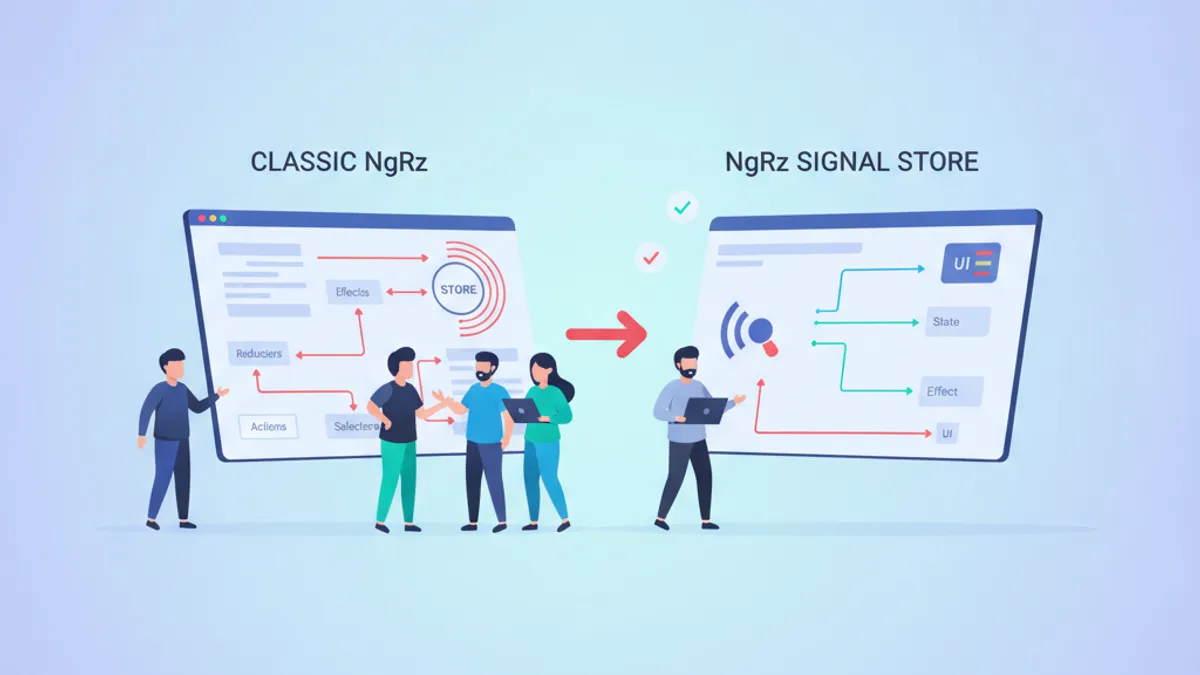
NgRx Signal Store vs Classic NgRx in 2026: Which Should You Choose?
A comprehensive comparison of NgRx Signal Store and Classic NgRx for Angular state management. Learn when to use each approach with practical code examples.

Angular Signals and Computed in 2026: Fine-Grained Reactivity and Interview Questions
Master Angular Signals, computed, effect, and linkedSignal in Angular 20+. Learn fine-grained reactivity patterns, performance optimizations, and prepare for technical interviews.
Angular @defer in 2026: Declarative Lazy Loading for Faster Apps
Master Angular @defer blocks for declarative lazy loading. Deep dive into triggers, prefetching, incremental hydration, SSR behavior, and real-world performance patterns.