Rails API Mode in 2026: RESTful APIs, Serialization and Best Practices
Master Rails API mode with best practices for RESTful design, JSON serialization with Alba and jsonapi-serializer, authentication strategies, and error handling in Rails 8.

Full-stack web framework built with Ruby offering a "Convention over Configuration" and "Don't Repeat Yourself" approach to maximize productivity. Mature MVC architecture with Active Record ORM, automatic scaffolding, robust migration system and complete ecosystem for REST APIs and modern web applications.
Modern Ruby with elegant syntax, blocks, metaprogramming and gems
Active Record ORM with associations, validations, callbacks and migrations
Convention over Configuration for maximum productivity
Rails generators for rapid scaffolding (models, controllers, migrations)
Action Cable for real-time WebSockets natively integrated
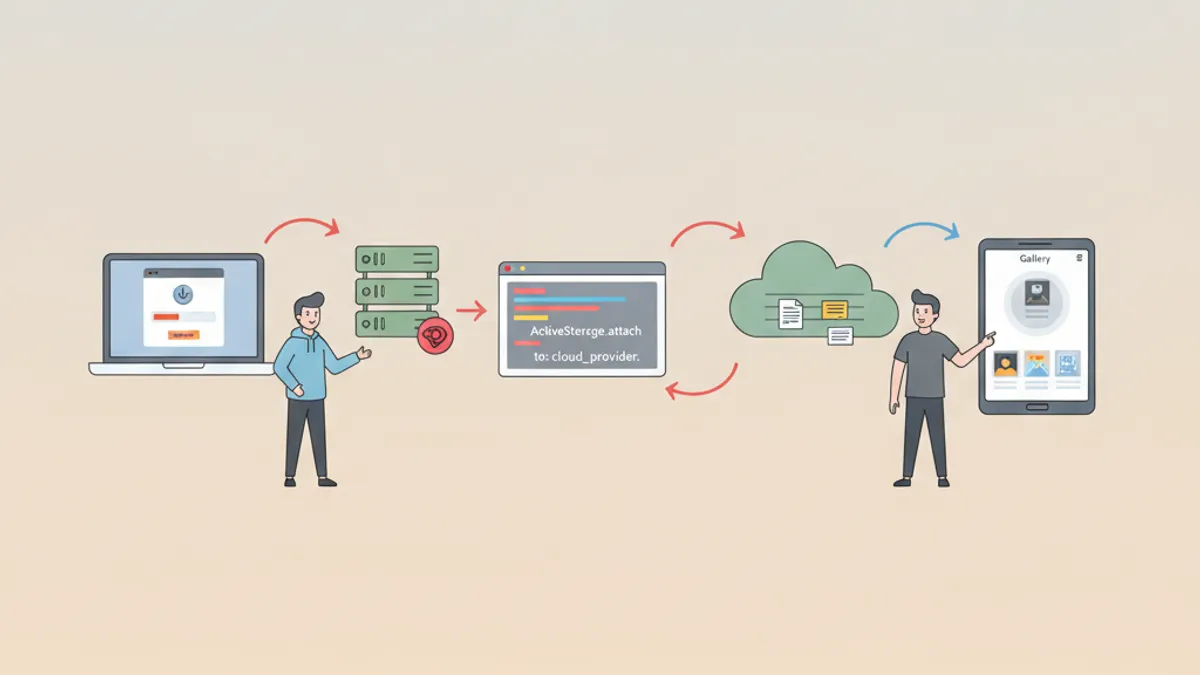
Active Storage for file uploads with cloud storage (S3, GCS)
Action Mailer for transactional emails with ERB templates
Active Job for background jobs with adapters (Sidekiq, Resque, Delayed Job)
Comprehensive testing (RSpec, Minitest, fixtures, factories with FactoryBot)
Performance with caching (Redis, Memcached), eager loading and turbo-rails
The most important concepts to understand this technology and ace your interviews
Ruby: blocks, procs, lambdas, symbols, metaprogramming, modules and mixins
Rails architecture: MVC pattern, config/routes.rb, autoloading, Zeitwerk
Active Record: models, associations (has_many, belongs_to, has_and_belongs_to_many)
AR validations: presence, uniqueness, custom validators, validation contexts
AR callbacks: before_save, after_create, around_update, lifecycle hooks
Migrations: create_table, add_column, change_column, rollback, schema.rb
Routing: resources, nested routes, namespaces, constraints, route helpers
Controllers: params, strong parameters, filters (before_action), respond_to
Views: ERB templates, partials, helpers, layouts, content_for/yield
Active Record Query: where, joins, includes, preload, eager_load (N+1 prevention)
Rails API mode: API-only applications, serializers (ActiveModel::Serializers, jbuilder)
Authentication: Devise gem, has_secure_password, session management, cookies
Authorization: Pundit gem, CanCanCan, policies, role-based access control
Action Cable: channels, streams, broadcasting, WebSocket connections
Active Job: perform_later, queue adapters (Sidekiq), job priorities, retry logic
Active Storage: attachments (has_one_attached, has_many_attached), variants, direct uploads
Testing: RSpec (describe, context, it), FactoryBot, fixtures, request specs, system tests
Concerns: ActiveSupport::Concern, code reusability, module composition
Rails engines: mountable engines, namespacing, gem development
Performance: fragment caching, Russian doll caching, query optimization, bullet gem
Security: CSRF protection, SQL injection prevention, mass assignment protection (strong params)
Deployment: Capistrano, Heroku, Docker, Puma/Unicorn servers, assets pipeline

Discover our latest articles and guides on Ruby on Rails

Master Rails API mode with best practices for RESTful design, JSON serialization with Alba and jsonapi-serializer, authentication strategies, and error handling in Rails 8.

Deep dive into Solid Queue and Solid Cache, the database-backed defaults in Rails 8. Architecture, configuration, concurrency controls, and interview-ready knowledge for 2026.

Deep dive into Action Cable and WebSockets in Ruby on Rails. Covers connections, channels, broadcasting, Solid Cable in Rails 8, scaling with Redis, and common interview questions with code examples.