LangChain for Data Scientists in 2026: LLMs, Agents and Interview Questions
Master LangChain 0.3 for data science: LCEL chains, RAG patterns, ReAct agents, and memory systems. Includes interview questions and production deployment strategies.
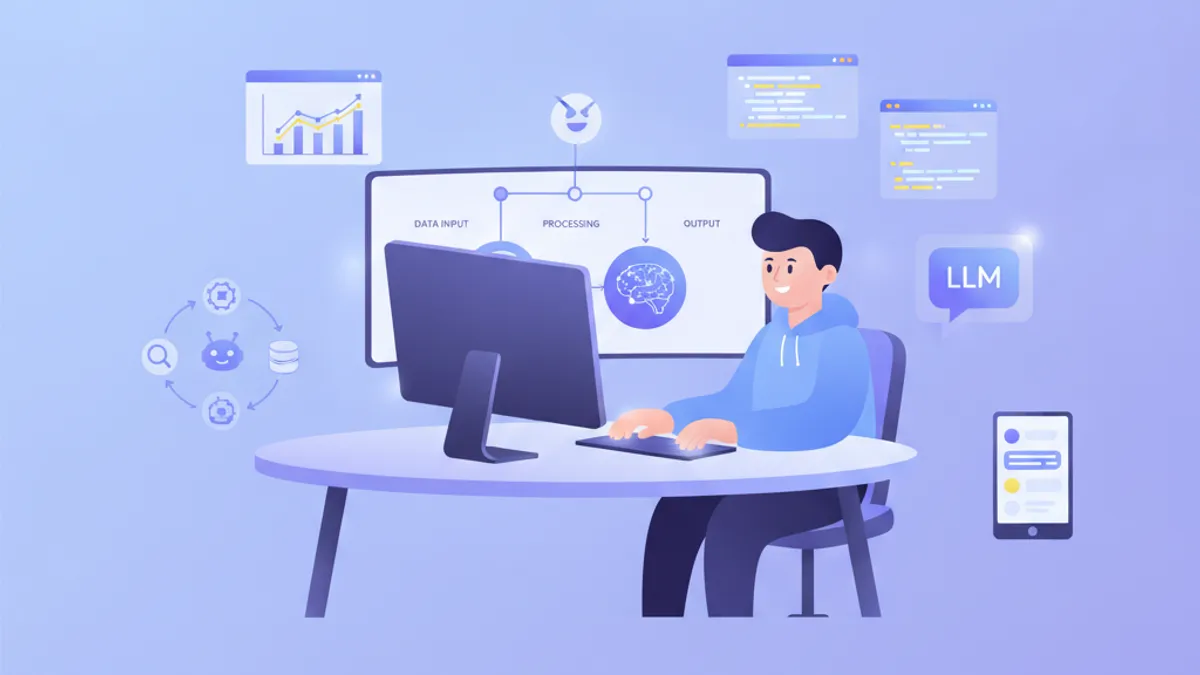
LangChain 0.3 has become the de facto framework for building LLM-powered applications in production data science workflows. This tutorial covers the core abstractions, agent architectures, and retrieval patterns that data scientists encounter both in real projects and technical interviews.
LangChain Expression Language (LCEL) enables declarative chain composition with streaming, parallelization, and fallbacks. Master LCEL syntax before diving into agents—most interview questions assume familiarity with pipe operators and runnables.
Understanding LangChain Core Components
LangChain organizes LLM orchestration into four primary abstractions: Models, Prompts, Chains, and Agents. Each abstraction builds on the previous one, creating a composable system for complex AI workflows.
The Model layer wraps different LLM providers (OpenAI, Anthropic, local models) behind a unified interface. This abstraction allows swapping providers without changing application logic—critical for cost optimization and vendor flexibility.
# langchain_setup.py
from langchain_openai import ChatOpenAI
from langchain_anthropic import ChatAnthropic
from langchain_core.messages import HumanMessage, SystemMessage

# Initialize with specific model and temperature
openai_model = ChatOpenAI(
    model="gpt-4o",
    temperature=0.1,  # Lower temperature for deterministic outputs
    max_tokens=2048
)

# Anthropic model with same interface
anthropic_model = ChatAnthropic(
    model="claude-sonnet-4-20250514",
    temperature=0.1
)

# Both models accept identical message format
messages = [
    SystemMessage(content="You are a data science expert."),
    HumanMessage(content="Explain gradient boosting in one sentence.")
]

# Swap models without changing message structure
response = openai_model.invoke(messages)
The unified interface means data pipelines can switch between providers based on cost, latency, or capability requirements.
Building Chains with LCEL Pipe Syntax
LangChain Expression Language replaces the legacy LLMChain class with a more flexible pipe-based syntax. LCEL chains are runnables that support streaming, batching, and async execution by default.
# lcel_chain.py
from langchain_openai import ChatOpenAI
from langchain_core.prompts import ChatPromptTemplate
from langchain_core.output_parsers import StrOutputParser, JsonOutputParser
from pydantic import BaseModel, Field

# Define structured output schema
class DataInsight(BaseModel):
    metric: str = Field(description="The metric being analyzed")
    trend: str = Field(description="Upward, downward, or stable")
    confidence: float = Field(description="Confidence score 0-1")

# Create prompt template with variables
prompt = ChatPromptTemplate.from_messages([
    ("system", "Analyze the following data and extract insights."),
    ("human", "Dataset: {dataset_description}\nFocus on: {metric}")
])

# LCEL chain with pipe operator
model = ChatOpenAI(model="gpt-4o", temperature=0)
parser = JsonOutputParser(pydantic_object=DataInsight)

chain = prompt | model | parser  # Pipe syntax composes runnables

# Invoke with input dictionary
result = chain.invoke({
    "dataset_description": "Monthly sales data showing 15% increase",
    "metric": "revenue growth"
})
# Returns: DataInsight(metric='revenue growth', trend='upward', confidence=0.85)
LCEL chains automatically handle type coercion between components. The prompt template outputs a PromptValue, which the model converts to a response, which the parser structures into the Pydantic schema.
Retrieval-Augmented Generation for Data Applications
RAG patterns enhance LLM responses with domain-specific context retrieved from vector databases. For data science applications, RAG enables querying documentation, previous analyses, or domain knowledge bases.
# rag_pipeline.py
from langchain_openai import OpenAIEmbeddings, ChatOpenAI
from langchain_chroma import Chroma
from langchain_core.prompts import ChatPromptTemplate
from langchain_core.runnables import RunnablePassthrough

# Initialize embeddings and vector store
embeddings = OpenAIEmbeddings(model="text-embedding-3-small")
vectorstore = Chroma(
    collection_name="data_docs",
    embedding_function=embeddings,
    persist_directory="./chroma_db"
)

# Create retriever with relevance threshold
retriever = vectorstore.as_retriever(
    search_type="similarity_score_threshold",
    search_kwargs={"score_threshold": 0.7, "k": 4}
)

# RAG prompt with context injection
rag_prompt = ChatPromptTemplate.from_messages([
    ("system", """Answer based on the provided context only.
Context: {context}
If the context doesn't contain relevant information, say so."""),
    ("human", "{question}")
])

# Format documents into context string
def format_docs(docs):
    return "\n\n".join(doc.page_content for doc in docs)

# RAG chain with parallel retrieval
rag_chain = (
    {"context": retriever | format_docs, "question": RunnablePassthrough()}
    | rag_prompt
    | ChatOpenAI(model="gpt-4o", temperature=0)
)

# Query with automatic retrieval
answer = rag_chain.invoke("What normalization method works best for skewed distributions?")
The RunnablePassthrough preserves the original question while the retriever fetches context in parallel. This pattern scales to production workloads with minimal latency overhead.
Ready to ace your Data Science & ML interviews?
Practice with our interactive simulators, flashcards, and technical tests.
Implementing ReAct Agents for Data Tasks
Agents extend chains with tool-calling capabilities and reasoning loops. The ReAct (Reasoning + Acting) pattern interleaves thought and action steps, allowing agents to solve multi-step problems.
# react_agent.py
from langchain_openai import ChatOpenAI
from langchain_core.tools import tool
from langgraph.prebuilt import create_react_agent
import pandas as pd
import numpy as np

# Define data analysis tools
@tool
def calculate_statistics(data: str, column: str) -> str:
    """Calculate descriptive statistics for a column in CSV data."""
    df = pd.read_csv(pd.io.common.StringIO(data))
    stats = df[column].describe()
    return stats.to_string()

@tool
def detect_outliers(data: str, column: str, method: str = "iqr") -> str:
    """Detect outliers using IQR or Z-score method."""
    df = pd.read_csv(pd.io.common.StringIO(data))
    values = df[column]

    if method == "iqr":
        q1, q3 = values.quantile([0.25, 0.75])
        iqr = q3 - q1
        outliers = values[(values < q1 - 1.5 * iqr) | (values > q3 + 1.5 * iqr)]
    else:  # z-score
        z_scores = np.abs((values - values.mean()) / values.std())
        outliers = values[z_scores > 3]

    return f"Found {len(outliers)} outliers: {outliers.tolist()[:10]}"

@tool
def correlation_analysis(data: str, col1: str, col2: str) -> str:
    """Calculate Pearson correlation between two columns."""
    df = pd.read_csv(pd.io.common.StringIO(data))
    corr = df[col1].corr(df[col2])
    return f"Correlation between {col1} and {col2}: {corr:.4f}"

# Create ReAct agent with tools
model = ChatOpenAI(model="gpt-4o", temperature=0)
tools = [calculate_statistics, detect_outliers, correlation_analysis]

agent = create_react_agent(
    model=model,
    tools=tools,
    state_modifier="You are a data analyst. Use tools to analyze data step by step."
)

# Agent reasons about which tools to use
result = agent.invoke({
    "messages": [("human", "Analyze the sales column for outliers and basic stats")]
})
The @tool decorator registers functions as agent tools with automatic schema generation from type hints and docstrings. The agent decides when to call each tool based on the task requirements.
Memory Patterns for Conversational Analytics
Long-running data analysis sessions require conversation memory to maintain context across interactions. LangChain provides multiple memory strategies optimized for different use cases.
# memory_patterns.py
from langchain_openai import ChatOpenAI
from langchain_core.prompts import ChatPromptTemplate, MessagesPlaceholder
from langchain_core.chat_history import InMemoryChatMessageHistory
from langchain_core.runnables.history import RunnableWithMessageHistory

# Initialize model and prompt with history placeholder
model = ChatOpenAI(model="gpt-4o", temperature=0.1)

prompt = ChatPromptTemplate.from_messages([
    ("system", "You are a data science assistant helping with analysis."),
    MessagesPlaceholder(variable_name="history"),  # Inject conversation history
    ("human", "{input}")
])

chain = prompt | model

# Session-based message store
message_stores = {}

def get_session_history(session_id: str):
    if session_id not in message_stores:
        message_stores[session_id] = InMemoryChatMessageHistory()
    return message_stores[session_id]

# Wrap chain with message history
chain_with_history = RunnableWithMessageHistory(
    chain,
    get_session_history,
    input_messages_key="input",
    history_messages_key="history"
)

# Conversation maintains context across invocations
config = {"configurable": {"session_id": "analysis_session_1"}}

response1 = chain_with_history.invoke(
    {"input": "I'm analyzing customer churn data with 50k rows"},
    config=config
)
# Later in the same session
response2 = chain_with_history.invoke(
    {"input": "What sampling strategy should I use for this dataset size?"},
    config=config
)  # Agent remembers the 50k rows context
Production deployments typically replace InMemoryChatMessageHistory with Redis or PostgreSQL-backed stores for persistence across server restarts.
LangChain Interview Questions and Answers
Technical interviews for ML engineering and data science roles increasingly include LangChain questions. These typically assess understanding of core abstractions, production considerations, and debugging strategies.
Interviewers focus on three areas: chain composition patterns, RAG optimization techniques, and agent reliability strategies. Expect to whiteboard a retrieval pipeline or debug a hallucination scenario.
Q: Explain the difference between chains and agents in LangChain.
Chains execute a predetermined sequence of operations—prompt to model to parser—with no runtime decision-making. Agents add a reasoning loop that dynamically selects tools based on intermediate results. Chains suit structured workflows like data transformation pipelines; agents handle open-ended tasks requiring adaptive tool selection.
Q: How do you reduce hallucinations in a RAG application?
Multiple strategies work together: increase retrieval precision with hybrid search (combining dense and sparse retrievers), add relevance scoring to filter low-confidence chunks, include source attribution in prompts, implement answer verification against retrieved context, and use lower temperature settings for factual queries. The feature engineering patterns for embedding quality also affect retrieval accuracy.
Q: What are runnables and why does LangChain use them?
Runnables are the base abstraction implementing the Runnable protocol with invoke, stream, batch, and ainvoke methods. Every component—prompts, models, parsers, retrievers—is a runnable. This uniformity enables composition with the pipe operator, where output types automatically match input expectations. Runnables also provide built-in parallelization, retry logic, and streaming without additional code.
Q: How would you implement streaming responses for a chat interface?
# streaming_example.py
from langchain_openai import ChatOpenAI
from langchain_core.prompts import ChatPromptTemplate

prompt = ChatPromptTemplate.from_template("Explain {concept} in detail")
model = ChatOpenAI(model="gpt-4o", streaming=True)

chain = prompt | model

# Stream yields chunks as they arrive
for chunk in chain.stream({"concept": "backpropagation"}):
    print(chunk.content, end="", flush=True)
The stream method yields AIMessageChunk objects containing partial responses. For web applications, these chunks typically feed into Server-Sent Events or WebSocket connections.
Q: Describe strategies for testing LangChain applications.
Testing LLM applications requires multiple approaches: unit tests with mocked model responses for deterministic chain behavior, integration tests with real models for prompt effectiveness, evaluation datasets with expected outputs for regression detection, and tracing tools like LangSmith for production debugging. Mock the model layer during CI to avoid API costs and flakiness.
Production Deployment Considerations
Deploying LangChain applications requires attention to latency, cost, and reliability beyond what development environments reveal.
Production RAG applications can generate significant token costs. Implement token counting middleware, set budget alerts, and consider caching strategies for repeated queries. A single agent loop with multiple tool calls can consume thousands of tokens per request.
Caching reduces both latency and cost for repeated queries. LangChain's caching layer stores model responses keyed by prompt hash:
# caching_setup.py
from langchain_core.globals import set_llm_cache
from langchain_community.cache import RedisCache
import redis

# Redis cache for distributed deployments
redis_client = redis.Redis(host="localhost", port=6379)
set_llm_cache(RedisCache(redis_client))

# Subsequent identical queries hit cache
model = ChatOpenAI(model="gpt-4o")
response1 = model.invoke("What is gradient descent?")  # API call
response2 = model.invoke("What is gradient descent?")  # Cache hit
For MLOps pipelines, integrate LangChain with experiment tracking to monitor prompt versions, model configurations, and response quality metrics over time.
Start practicing!
Test your knowledge with our interview simulators and technical tests.
Conclusion
- LangChain 0.3 organizes LLM orchestration into Models, Prompts, Chains, and Agents—each abstraction composable via LCEL pipe syntax
- RAG implementations require tuned retrieval thresholds, relevance scoring, and context formatting for production accuracy
- ReAct agents handle multi-step data tasks by reasoning about tool selection at runtime
- Memory patterns maintain conversation context across analysis sessions using session-keyed message stores
- Interview preparation should cover chain vs agent distinctions, hallucination reduction strategies, and runnable composition patterns
- Production deployments need caching, token budgeting, and observability tooling for cost and reliability management
Can you spot the bug in Data Science & ML?
One real snippet, one hidden bug, one attempt a day. No account needed to try.

Written by
Anthony Fillion-MailletFounder of SharpSkill
Full-stack developer for over 10 years. Runs SharpSkill and answers for everything published here.
Updated on July 22, 2026
Tags
Share
Related articles

Statistics for Data Science in 2026: Probability, Hypothesis Testing and Interview Questions
Master statistics for data science interviews: probability distributions, hypothesis testing, p-values, confidence intervals, and the questions interviewers actually ask.
MLOps in 2026: MLflow, Model Registry and Technical Interview Questions
MLOps interview questions covering the ML lifecycle, MLflow experiment tracking, model registry promotion, deployment patterns, drift monitoring, and system design for 2026, with Python code and answers.
Top 25 Data Science Interview Questions in 2026
Data science interview questions covering statistics, machine learning, feature engineering, deep learning, SQL, and system design — with Python code examples and detailed answers for 2026.