Hugging Face Transformers in 2026: NLP, Fine-Tuning and Interview Questions
Hugging Face Transformers tutorial covering the v5 API, fine-tuning with LoRA, NLP pipelines, and the most common interview questions asked in data science roles in 2026.
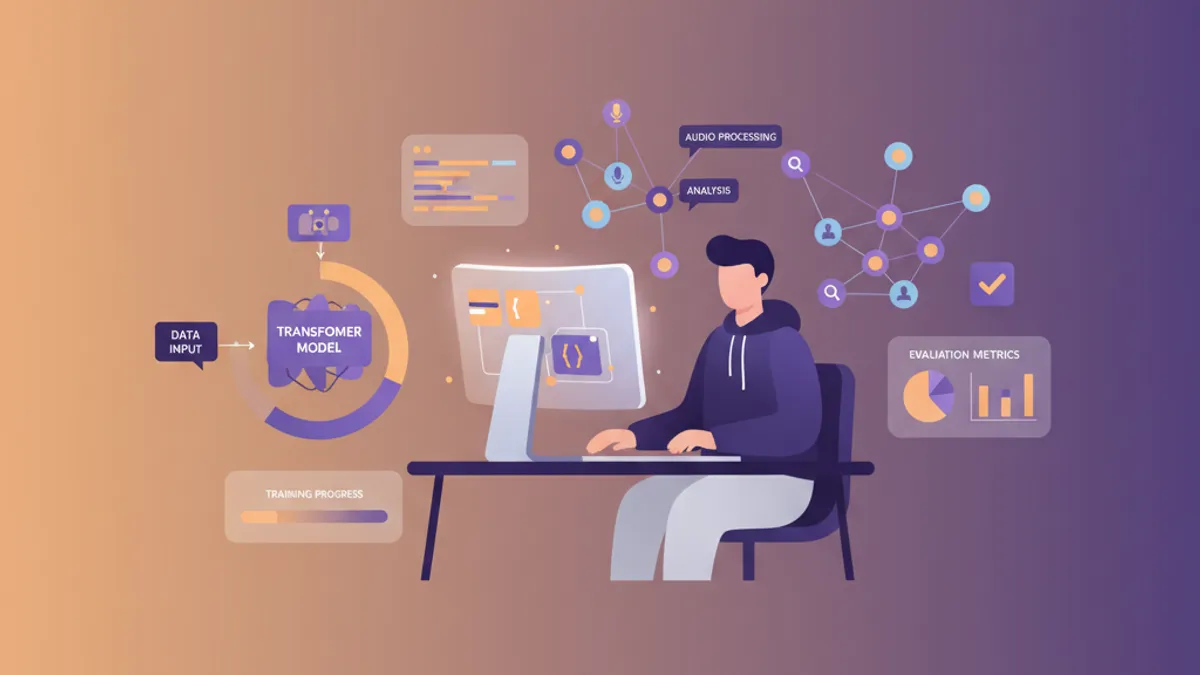
Hugging Face Transformers has become the standard library for working with transformer-based models across NLP, computer vision, and audio tasks. With the release of Transformers v5 and over 1 million model checkpoints on the Hub, understanding this ecosystem is now a baseline expectation in data science interviews.
Transformers v5 drops TensorFlow and Flax support in favor of a PyTorch-first approach. The library now ships continuous batching, paged attention for inference, and a unified processor object for multimodal models. Fine-tuning workflows remain compatible with tools like Unsloth, TRL, and Axolotl.
Transformers v5 Architecture and Core API Changes
The jump from v4 to v5 represents the largest structural change since the library's creation. Daily installations grew from 20,000 to over 3 million during v4's five-year lifespan, and much of the codebase accumulated technical debt that v5 addresses directly.
Three changes matter most for practitioners:
- PyTorch-only backend — TensorFlow and Flax model implementations have been removed. JAX compatibility is maintained through partner libraries, but all model definitions in Transformers now target PyTorch exclusively.
- Unified processor — Multimodal models (vision-language, audio-language) previously required ad-hoc combinations of tokenizers and feature extractors. A single
processorobject now handles all preprocessing. - Inference server built-in — The
transformers servecommand exposes an OpenAI-compatible API with continuous batching and paged attention, eliminating the need for separate serving infrastructure in many cases.
# serve_model.py
# Start an OpenAI-compatible inference server from the command line
# transformers serve --model meta-llama/Llama-4-Scout-17B-16E-Instruct --compile

# Or use the Python API directly
from transformers import pipeline

# The pipeline API remains the fastest way to get predictions
classifier = pipeline("sentiment-analysis", model="distilbert-base-uncased-finetuned-sst-2-english")
results = classifier(["Transformers v5 simplifies everything.", "Legacy code migration is painful."])
print(results)
# [{'label': 'POSITIVE', 'score': 0.9998}, {'label': 'NEGATIVE', 'score': 0.9994}]
The pipeline API hides tokenization, model loading, and post-processing behind a single function call. For production workloads, transformers serve provides the same simplicity with proper batching and concurrency.
Loading and Using Pre-Trained Models from the Hub
The Hugging Face Hub hosts over 1 million model checkpoints. Loading any of them requires two lines of code, but knowing which model to pick and how to configure it separates beginners from experienced practitioners.
AutoModel classes detect the correct architecture from the model card metadata. This means the same loading code works for BERT, GPT, T5, Llama, or any other architecture:
# load_model.py
from transformers import AutoTokenizer, AutoModelForSequenceClassification
import torch

# Load tokenizer and model — architecture detected automatically
tokenizer = AutoTokenizer.from_pretrained("bert-base-uncased")
model = AutoModelForSequenceClassification.from_pretrained("bert-base-uncased", num_labels=3)

# Tokenize input text with padding and truncation
inputs = tokenizer(
    "Hugging Face makes NLP accessible.",
    return_tensors="pt",     # Return PyTorch tensors
    padding=True,
    truncation=True,
    max_length=128
)

# Run inference with no gradient computation
with torch.no_grad():
    outputs = model(**inputs)
    predictions = torch.softmax(outputs.logits, dim=-1)
    print(f"Class probabilities: {predictions}")
The from_pretrained method downloads the model weights, configuration, and tokenizer vocabulary on first call, then caches them locally. Subsequent calls load from the cache without network requests.
Fine-Tuning with LoRA and the Trainer API
Full fine-tuning of large models requires substantial GPU memory — a 7B parameter model needs roughly 28 GB just for the weights in FP32. LoRA (Low-Rank Adaptation) reduces memory requirements by 60-80% by freezing the pre-trained weights and injecting small trainable matrices into each layer.
The PEFT library integrates directly with Transformers to make LoRA fine-tuning straightforward:
# finetune_lora.py
from transformers import AutoModelForCausalLM, AutoTokenizer, TrainingArguments, Trainer
from peft import LoraConfig, get_peft_model, TaskType
from datasets import load_dataset

# Load base model and tokenizer
model_name = "Qwen/Qwen3-0.6B"
tokenizer = AutoTokenizer.from_pretrained(model_name)
model = AutoModelForCausalLM.from_pretrained(model_name, torch_dtype="auto")

# Configure LoRA — only 0.5-2% of parameters become trainable
lora_config = LoraConfig(
    task_type=TaskType.CAUSAL_LM,
    r=16,                   # Rank of the low-rank matrices
    lora_alpha=32,          # Scaling factor
    lora_dropout=0.05,      # Dropout for regularization
    target_modules=["q_proj", "v_proj"],  # Which attention layers to adapt
)

# Wrap the model with LoRA adapters
model = get_peft_model(model, lora_config)
model.print_trainable_parameters()
# trainable params: 1,572,864 || all params: 631,000,000 || trainable%: 0.25

# Load and tokenize dataset
dataset = load_dataset("tatsu-lab/alpaca", split="train[:5000]")

def tokenize(example):
    return tokenizer(example["text"], truncation=True, max_length=512, padding="max_length")

tokenized = dataset.map(tokenize, batched=True, remove_columns=dataset.column_names)

# Configure training
training_args = TrainingArguments(
    output_dir="./lora-qwen",
    num_train_epochs=3,
    per_device_train_batch_size=4,
    gradient_accumulation_steps=4,  # Effective batch size = 16
    learning_rate=2e-4,
    bf16=True,                      # Use bfloat16 mixed precision
    logging_steps=50,
    save_strategy="epoch",
)

# Train
trainer = Trainer(model=model, args=training_args, train_dataset=tokenized)
trainer.train()
LoRA adapters are saved separately from the base model (typically 10-50 MB vs several GB). Multiple adapters can be swapped at inference time without reloading the base weights, which makes LoRA particularly useful for serving multiple specialized models from a single deployment.
Ready to ace your Data Science & ML interviews?
Practice with our interactive simulators, flashcards, and technical tests.
Building an NLP Pipeline: Tokenization to Inference
Every NLP task in Transformers follows the same three-step pattern: tokenize the input, run it through the model, and decode the output. Understanding this flow is essential for debugging production systems and answering interview questions about the transformer architecture.
Tokenization converts raw text into numerical IDs that the model understands. Different model families use different tokenization strategies — BERT uses WordPiece, GPT models use BPE, and T5 uses SentencePiece:
# tokenization_demo.py
from transformers import AutoTokenizer

tokenizer = AutoTokenizer.from_pretrained("bert-base-uncased")
text = "Transformers handle tokenization automatically."

# Step-by-step tokenization
tokens = tokenizer.tokenize(text)          # Split into subwords
print(f"Tokens: {tokens}")
# ['transformers', 'handle', 'token', '##ization', 'automatically', '.']

ids = tokenizer.convert_tokens_to_ids(tokens)  # Convert to numeric IDs
print(f"IDs: {ids}")
# [19081, 5765, 19204, 6032, 8073, 1012]

# The encode method does both steps plus adds special tokens
encoded = tokenizer.encode(text, add_special_tokens=True)
print(f"Encoded with special tokens: {encoded}")
# [101, 19081, 5765, 19204, 6032, 8073, 1012, 102]
# 101 = [CLS], 102 = [SEP]
The ##ization token demonstrates subword tokenization — rare words get split into known subwords, which is how models handle vocabulary they have not seen during pre-training without resorting to character-level fallbacks.
Quantization for Efficient Deployment
Quantization reduces model size and inference latency by converting weights from 32-bit floating point to lower precision formats. The most practical approach in 2026 uses bitsandbytes for 4-bit quantization, which fits a 7B parameter model into roughly 4 GB of GPU memory:
# quantize_model.py
from transformers import AutoModelForCausalLM, AutoTokenizer, BitsAndBytesConfig
import torch

# Configure 4-bit quantization
quant_config = BitsAndBytesConfig(
    load_in_4bit=True,                      # Use 4-bit precision
    bnb_4bit_compute_dtype=torch.bfloat16,  # Compute in bfloat16
    bnb_4bit_quant_type="nf4",              # NormalFloat4 quantization
    bnb_4bit_use_double_quant=True,         # Quantize the quantization constants
)

# Load quantized model — fits in ~4GB VRAM instead of ~14GB
model = AutoModelForCausalLM.from_pretrained(
    "mistralai/Mistral-7B-Instruct-v0.3",
    quantization_config=quant_config,
    device_map="auto",  # Automatically distribute across available GPUs
)

tokenizer = AutoTokenizer.from_pretrained("mistralai/Mistral-7B-Instruct-v0.3")

# Inference works identically to the non-quantized model
inputs = tokenizer("Explain quantization in one sentence:", return_tensors="pt").to(model.device)
outputs = model.generate(**inputs, max_new_tokens=50)
print(tokenizer.decode(outputs[0], skip_special_tokens=True))
4-bit quantization typically reduces quality by less than 1% on standard benchmarks while cutting memory usage by 75%. Combined with LoRA, it enables fine-tuning models that would otherwise require multi-GPU setups on a single consumer GPU — a technique known as QLoRA.
Common Hugging Face Interview Questions and Answers
Data science interviews in 2026 increasingly test practical Transformers knowledge alongside theoretical understanding. The following questions appear frequently in technical screenings for ML engineer and data scientist roles.
Interviewers typically probe three areas: (1) architecture knowledge — self-attention, positional encoding, encoder vs decoder; (2) practical skills — fine-tuning, quantization, model selection; (3) system design — serving, batching, memory optimization.
What is self-attention, and how does multi-head attention extend it?
Self-attention computes a weighted representation of each token based on its relationship to every other token in the sequence. For each token, the model produces three vectors: query (Q), key (K), and value (V). The attention score between two tokens equals the dot product of the query of one with the key of the other, scaled by the square root of the key dimension, then passed through softmax. The output is the weighted sum of value vectors.
Multi-head attention runs this process multiple times in parallel with different learned projections. Each "head" can learn to attend to different types of relationships — syntactic structure in one head, coreference in another, positional proximity in a third. The outputs are concatenated and projected back to the model dimension.
Why do transformers need positional encoding?
Unlike RNNs and LSTMs, transformers process all tokens simultaneously rather than sequentially. Without positional information, the model treats the input as a bag of tokens with no notion of order. Positional encodings (either fixed sinusoidal functions or learned embeddings) are added to the token embeddings before the first attention layer. Modern models like LLaMA and Qwen use Rotary Position Embeddings (RoPE), which encode relative rather than absolute positions and generalize better to sequences longer than those seen during training.
When should LoRA be preferred over full fine-tuning?
LoRA is the better choice when GPU memory is limited, when the base model is large (7B+ parameters), or when multiple task-specific adapters need to be served from a single base model. Full fine-tuning produces marginally better results on benchmarks (typically 0.5-2% higher accuracy) but requires 4-8x more memory and creates a complete model copy for each task. In practice, LoRA achieves comparable quality for most downstream tasks while reducing training time and infrastructure costs significantly.
What is the difference between encoder-only, decoder-only, and encoder-decoder models?
| Architecture | Examples | Best For | Attention Pattern |
|---|---|---|---|
| Encoder-only | BERT, RoBERTa, DeBERTa | Classification, NER, embeddings | Bidirectional (sees full context) |
| Decoder-only | GPT, LLaMA, Mistral, Qwen | Text generation, chat, code | Causal (left-to-right only) |
| Encoder-decoder | T5, BART, mBART | Translation, summarization | Cross-attention between encoder and decoder |
Encoder-only models excel at understanding tasks because bidirectional attention lets each token attend to all other tokens. Decoder-only models dominate generation tasks because causal masking naturally produces one token at a time. Encoder-decoder models combine both capabilities but have largely been superseded by decoder-only models that achieve comparable results with simpler architectures.
Candidates often confuse model size with capability. A well-fine-tuned 3B parameter model frequently outperforms a generic 70B model on specific tasks. Interviewers look for candidates who understand when smaller, specialized models are the better engineering choice.
How does the Trainer API handle distributed training?
The Trainer class automatically detects available GPUs and configures data parallelism. For multi-node training, it integrates with PyTorch's DistributedDataParallel and supports DeepSpeed ZeRO stages 1-3 through a single configuration file. Setting deepspeed="ds_config.json" in TrainingArguments is sufficient to enable ZeRO-3 offloading, which shards optimizer states, gradients, and model parameters across GPUs and optionally offloads to CPU RAM.
What metrics matter when evaluating an NLP model?
The choice depends on the task. For classification: accuracy, F1-score (especially macro-F1 for imbalanced classes), precision, and recall. For generation: BLEU, ROUGE, and increasingly BERTScore which correlates better with human judgment. For retrieval and embeddings: recall@k, NDCG, and mean reciprocal rank. Production systems should also track inference latency (p50/p99), throughput (tokens/second), and memory usage alongside quality metrics.
Preparing for Hugging Face and NLP Interviews
Technical preparation for NLP-focused data science interviews benefits from hands-on practice with the Transformers library rather than purely theoretical study. The most effective approach combines three elements:
- Build end-to-end projects — a sentiment classifier, a named entity recognizer, or a summarization pipeline. Each forces decisions about preprocessing, model selection, and evaluation that interviewers directly probe.
- Read model cards — the Hub's model cards document training data, intended use, limitations, and evaluation results. Interviewers expect candidates to evaluate model cards critically rather than blindly picking the most downloaded checkpoint.
- Profile memory and latency — understanding the tradeoffs between FP32, FP16, BF16, and INT4 inference across different hardware configurations separates senior candidates from juniors.
The SharpSkill NLP and Hugging Face practice module covers these topics through targeted interview questions with detailed explanations. For broader preparation across the transformer attention mechanisms and deep learning fundamentals, the data science track provides structured practice paths.
Start practicing!
Test your knowledge with our interview simulators and technical tests.
Conclusion
- Transformers v5 consolidates the library around PyTorch, removes legacy backends, and introduces built-in serving with
transformers servefor production inference. - The
AutoModeland pipeline APIs remain the fastest path from zero to working predictions — two lines of code load any of the 1M+ models on the Hub. - LoRA fine-tuning through PEFT reduces GPU memory requirements by 60-80% while maintaining within 1-2% of full fine-tuning quality on most tasks.
- 4-bit quantization via bitsandbytes fits 7B parameter models into 4 GB of VRAM, and QLoRA combines both techniques for consumer-GPU fine-tuning.
- Interview questions focus on three areas: architecture knowledge (self-attention, positional encoding, encoder vs decoder), practical skills (fine-tuning, quantization, model selection), and system design (distributed training, serving, memory optimization).
- Understanding tokenization internals (WordPiece, BPE, SentencePiece) and being able to debug tokenizer behavior is a frequently underestimated interview differentiator.
Start practicing!
Test your knowledge with our interview simulators and technical tests.
Can you spot the bug in Data Science & ML?
One real snippet, one hidden bug, one attempt a day. No account needed to try.

Written by
Anthony Fillion-MailletFounder of SharpSkill
Full-stack developer for over 10 years. Runs SharpSkill and answers for everything published here.
Updated on May 19, 2026
Tags
Share
Related articles

Statistics for Data Science in 2026: Probability, Hypothesis Testing and Interview Questions
Master statistics for data science interviews: probability distributions, hypothesis testing, p-values, confidence intervals, and the questions interviewers actually ask.
MLOps in 2026: MLflow, Model Registry and Technical Interview Questions
MLOps interview questions covering the ML lifecycle, MLflow experiment tracking, model registry promotion, deployment patterns, drift monitoring, and system design for 2026, with Python code and answers.
Top 25 Data Science Interview Questions in 2026
Data science interview questions covering statistics, machine learning, feature engineering, deep learning, SQL, and system design — with Python code examples and detailed answers for 2026.