PyTorch vs TensorFlow in 2026: Which Deep Learning Framework Should You Choose?
PyTorch vs TensorFlow comparison for 2026 covering PyTorch 2.13 features, deployment options, ecosystem maturity, and real-world use cases to help pick the right deep learning framework.
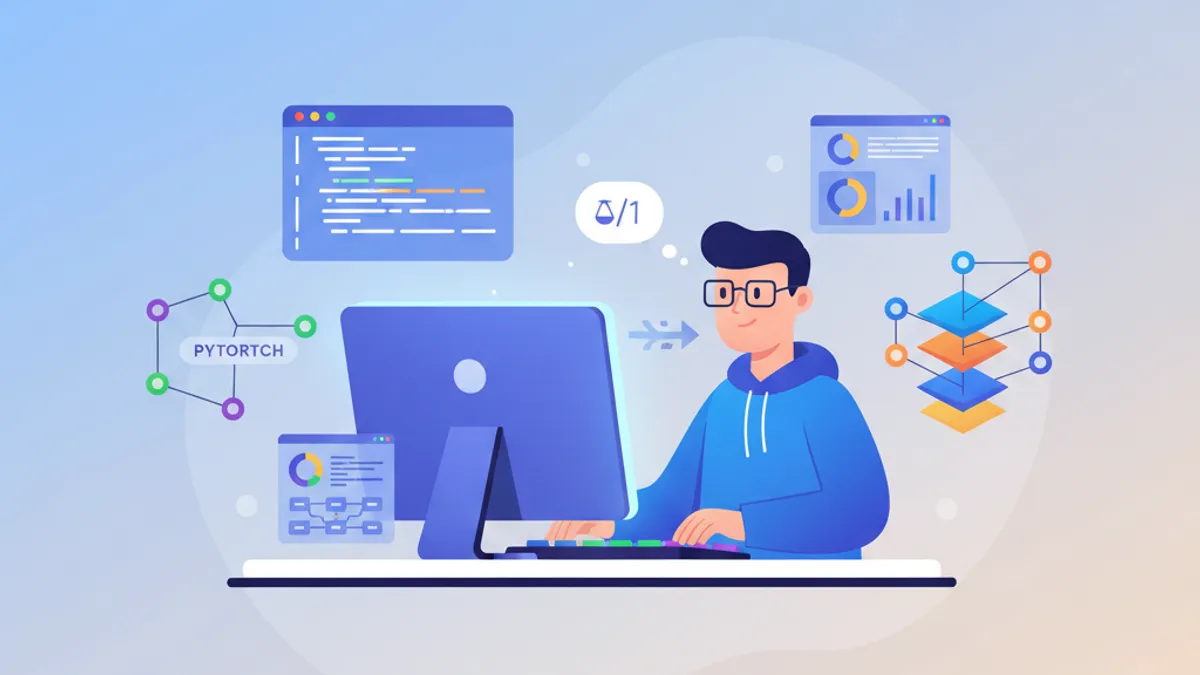
PyTorch vs TensorFlow remains the most debated framework choice in deep learning. With PyTorch 2.13 shipping FlexAttention on Apple Silicon and nn.LinearCrossEntropyLoss for memory-efficient LLM training, while TensorFlow 2.21 enters stability mode, both frameworks have matured significantly — but they serve increasingly different audiences.
PyTorch dominates research (85% of published papers) and is the default for new projects in 2026. TensorFlow retains advantages in mobile/edge deployment via LiteRT and Google Cloud TPU integration. Choose based on deployment target, not hype.
Market Share and Adoption Trends in 2026
Raw adoption numbers tell only part of the story. TensorFlow holds 37.5% market share with over 25,000 companies using it globally, while PyTorch sits at 25.7% with roughly 17,000 companies. However, this gap reflects TensorFlow's six-year head start in enterprise adoption, not current momentum.
The research landscape paints a different picture entirely. PyTorch powers 85% of deep learning papers published in top-tier venues. Job postings mentioning PyTorch now outnumber TensorFlow listings (37.7% vs 32.9%), and over 60% of developers starting in deep learning choose PyTorch first.
The trend is clear: TensorFlow's installed base remains large, but new projects overwhelmingly start with PyTorch. Organizations still running TensorFlow in production often maintain it for legacy reasons rather than active preference.
Performance Benchmarks: torch.compile vs XLA
The performance gap between both frameworks has narrowed considerably. On standardized benchmarks, PyTorch holds a 3.6% to 10.5% training speed advantage depending on workload. The difference comes down to compiler strategy.
PyTorch 2.13's torch.compile works with most existing code out of the box:
# train_resnet.py
import torch
import torchvision.models as models

model = models.resnet50().cuda()
# One line to enable compilation — no code restructuring needed
compiled_model = torch.compile(model, mode="reduce-overhead")

# Training loop remains unchanged
optimizer = torch.optim.AdamW(compiled_model.parameters(), lr=1e-3)
for images, labels in train_loader:
    images, labels = images.cuda(), labels.cuda()
    loss = torch.nn.functional.cross_entropy(compiled_model(images), labels)
    loss.backward()
    optimizer.step()
    optimizer.zero_grad()
The mode="reduce-overhead" flag tells the compiler to optimize for latency by reducing kernel launch overhead. On an A100 GPU with FP16, this setup processes approximately 1,050 images per second on ResNet-50.
TensorFlow's XLA compiler achieves roughly 980 images per second on the same benchmark, but often requires code restructuring to avoid graph breaks:
# train_resnet_tf.py
import tensorflow as tf

model = tf.keras.applications.ResNet50()
model.compile(
    optimizer=tf.keras.optimizers.AdamW(learning_rate=1e-3),
    loss="categorical_crossentropy",
    # XLA compilation via jit_compile flag
    jit_compile=True,
)

# XLA requires static shapes — dynamic batching needs extra handling
model.fit(train_dataset, epochs=10)
The practical difference: torch.compile delivers 30-60% speedups with minimal code changes, while XLA typically provides 20-40% gains but may require restructuring code to eliminate graph breaks.
New in PyTorch 2.13: Memory Efficiency for LLM Training
PyTorch 2.13 introduces nn.LinearCrossEntropyLoss, which fuses the final linear projection and cross-entropy computation into a single module. For large-vocabulary language model training (100K+ tokens), this cuts peak GPU memory by up to 4x by never materializing the full logits matrix:
# memory_efficient_lm.py
import torch
import torch.nn as nn

# Instead of separate nn.Linear + nn.CrossEntropyLoss
# Use fused version for large vocabularies
loss_fn = nn.LinearCrossEntropyLoss(
    in_features=4096,
    num_classes=128000,  # Large vocabulary
    label_smoothing=0.1,
)

# Hidden states from transformer, labels from tokenizer
loss = loss_fn(hidden_states, labels)
This is particularly relevant for fine-tuning LLMs with Hugging Face Transformers where memory constraints often limit batch size.
Developer Experience and Debugging
PyTorch's eager execution model makes debugging straightforward — standard Python debuggers, print statements, and stack traces work exactly as expected. This matters enormously during research and prototyping, where rapid iteration beats raw throughput.
TensorFlow has improved significantly with eager mode as the default since TF 2.x, but @tf.function-decorated code still behaves differently from regular Python. Tracing semantics, AutoGraph transformations, and shape inference errors can produce confusing error messages that point to generated code rather than the original source.
PyTorch 2.13 retained the torch.compiler.set_stance API introduced in 2.11 to control compilation behavior dynamically:
# debug_session.py
import torch

# During development: skip recompilation, fall back to eager
torch.compiler.set_stance("eager_on_recompile")

@torch.compile
def train_step(model, batch):
    # Breakpoints and print() work normally in eager fallback
    logits = model(batch["input_ids"])
    return torch.nn.functional.cross_entropy(logits, batch["labels"])

# Switch to full compilation for benchmarking
torch.compiler.set_stance("default")
This flexibility — switching between eager debugging and compiled performance without changing model code — has no direct equivalent in TensorFlow.
Deployment and Production Serving
Deployment is where TensorFlow historically dominated, but the landscape shifted dramatically in 2025-2026.
TensorFlow's strengths:
- LiteRT (formerly TF Lite) remains the most mature solution for mobile and edge deployment, with dedicated NPU/GPU acceleration on Android and iOS
- TFX provides end-to-end ML pipelines for enterprise workflows
- TPU integration on Google Cloud is seamless and optimized
PyTorch's evolution:
- TorchServe was archived in August 2025 — the official recommendation is to use vLLM for LLM serving or NVIDIA Triton for general model serving
- AOTInductor now provides stable ABI-compatible compiled artifacts that deploy without Python
- ExecuTorch became part of PyTorch Core in July 2026, making on-device inference a first-class capability with a 50KB runtime and 12+ hardware backends
| Deployment Target | Recommended Stack | Notes |
|---|---|---|
| Cloud GPU inference | vLLM (LLMs) or Triton (general) | Both frameworks supported |
| Mobile / Edge | LiteRT (TF) or ExecuTorch (PT) | ExecuTorch now in PyTorch Core |
| Google Cloud TPU | TensorFlow + XLA | Native optimization |
| Compiled artifacts | AOTInductor (PT) | No Python runtime needed |
| Enterprise pipelines | TFX (TF) or Kubeflow | TFX more battle-tested |
Ready to ace your Data Science & ML interviews?
Practice with our interactive simulators, flashcards, and technical tests.
Ecosystem and Library Support
The library ecosystem increasingly favors PyTorch, particularly in generative AI.
Hugging Face Transformers, the dominant library for NLP and LLM work, provides first-class PyTorch support. TensorFlow support exists but lags behind in feature coverage and community contributions. Most new model architectures ship with PyTorch weights first (and sometimes exclusively).
The same pattern applies across the ecosystem:
- Computer Vision: torchvision, Detectron2, and ultralytics (YOLO) are PyTorch-native
- Generative AI: Diffusers, Stable Diffusion, and most LLM tooling target PyTorch
- Scientific computing: PyTorch Geometric, DGL, and domain-specific libraries prefer PyTorch
- AutoML / NAS: frameworks like Optuna and Ray Tune integrate deeply with both, but PyTorch examples dominate
TensorFlow retains advantages in specific verticals:
- TensorFlow.js for browser-based ML has no PyTorch equivalent at the same maturity level
- TFX for production ML pipelines remains more complete than any PyTorch-native alternative
- TensorFlow Probability for probabilistic programming, though PyTorch has Pyro
TensorFlow's Strategic Direction
TensorFlow 2.21 focuses on stability, security patches, and dependency updates rather than new features. Google's forward investment has shifted to JAX for research and LiteRT for edge deployment. NVIDIA discontinued optimized TensorFlow containers after the 25.02 release.
This does not mean TensorFlow is abandoned — it remains actively maintained and receives critical bug fixes. But teams starting new projects should understand that Google recommends exploring Keras 3, JAX, or PyTorch for new work in generative AI.
Keras 3: The Cross-Framework Bridge
Keras 3.0 decoupled from TensorFlow to become a backend-agnostic API that runs on TensorFlow, PyTorch, and JAX. This changes the migration calculus for teams with existing Keras codebases.
# keras_multibackend.py
import os
# Switch backend without changing model code
os.environ["KERAS_BACKEND"] = "torch"  # or "tensorflow" or "jax"

import keras

# Same model definition works across all backends
model = keras.Sequential([
    keras.layers.Dense(256, activation="relu"),
    keras.layers.Dropout(0.3),
    keras.layers.Dense(10, activation="softmax"),
])

model.compile(optimizer="adam", loss="categorical_crossentropy")
model.fit(x_train, y_train, epochs=5)
For organizations currently on TensorFlow with significant Keras usage, migrating to Keras 3 with the PyTorch backend offers the lowest-risk path to the PyTorch ecosystem while preserving existing model code and training scripts.
Keras 3 abstracts away framework-specific features. Custom training loops, advanced gradient manipulation, and framework-specific optimizations require dropping down to the native API. For straightforward supervised learning, Keras 3 works well across backends.
Interview Perspective: What Hiring Managers Expect
In data science interviews, framework knowledge signals practical experience. The expectation varies by role and company:
Research roles almost universally expect PyTorch proficiency. Implementing papers, custom architectures, and training loops in PyTorch is table stakes. TensorFlow knowledge is a bonus, not a requirement.
Production ML / MLOps roles value framework-agnostic thinking. Understanding model compilation (torch.compile, XLA), serving infrastructure (Triton, vLLM), and deployment pipelines matters more than framework loyalty. Questions often focus on classification algorithms and model evaluation rather than framework-specific APIs.
Full-stack ML roles benefit from knowing both frameworks at a conceptual level. Being able to explain the trade-offs — eager vs graph execution, deployment options, ecosystem differences — demonstrates maturity beyond "which framework is better" debates.
Saying "PyTorch is better than TensorFlow" without context is a red flag. Strong candidates explain when each framework excels and make recommendations based on requirements, not personal preference.
Migration Considerations: TensorFlow to PyTorch
For teams evaluating a migration, the key factors are codebase size, deployment constraints, and team expertise.
Migrate when:
- The research team struggles to implement recent papers in TensorFlow
- New hires consistently prefer PyTorch and ramp up slower on TensorFlow
- The project needs libraries that only support PyTorch (most generative AI tooling)
Stay on TensorFlow when:
- Heavy investment in TFX pipelines that are working well
- Mobile deployment via LiteRT is a core requirement
- TPU infrastructure on Google Cloud is locked in
- The team is productive and the framework choice is not blocking progress
Hybrid approach:
- Use Keras 3 to write framework-agnostic model code
- Evaluate PyTorch for new projects while maintaining TensorFlow for existing systems
- Train in PyTorch, export via ONNX for production serving on Triton
Sources
- PyTorch 2.13 Release Blog — nn.LinearCrossEntropyLoss, FlexAttention on MPS, torchcomms backend
- PyTorch 2.12 Release Blog — torch.accelerator.Graph API, Microscaling quantization
- ExecuTorch Becomes Part of PyTorch Core — on-device inference integration
- TensorFlow 2.21 Release Notes — LiteRT graduation, stability focus
Conclusion
- PyTorch 2.13 is the default for new deep learning projects in 2026, backed by 85% research share, stronger library ecosystem, and features like nn.LinearCrossEntropyLoss cutting LLM training memory by 4x
- TensorFlow 2.21 enters stability mode with Google's innovation focus shifting to JAX; it retains clear advantages in mobile/edge deployment (LiteRT), TPU integration, and enterprise pipelines (TFX)
- ExecuTorch's integration into PyTorch Core makes on-device inference a first-class capability, narrowing the deployment gap with LiteRT
- The performance gap has closed to single digits — framework choice should be driven by deployment target and team expertise, not benchmark numbers
- Keras 3 provides a practical migration bridge for teams moving from TensorFlow to PyTorch without rewriting model code
- Interview preparation should cover both frameworks conceptually, with depth in whichever one matches the target role
Start practicing!
Test your knowledge with our interview simulators and technical tests.
Can you spot the bug in Data Science & ML?
One real snippet, one hidden bug, one attempt a day. No account needed to try.

Written by
Anthony Fillion-MailletFounder of SharpSkill
Full-stack developer for over 10 years. Runs SharpSkill and answers for everything published here.
Updated on August 19, 2026
Tags
Share
Related articles

Computer Vision with PyTorch in 2026: CNNs, Transfer Learning and Interview Questions
Master computer vision with PyTorch through practical CNN implementations, transfer learning techniques, and real interview questions asked at top tech companies.
MLOps in 2026: MLflow, Model Registry and Technical Interview Questions
MLOps interview questions covering the ML lifecycle, MLflow experiment tracking, model registry promotion, deployment patterns, drift monitoring, and system design for 2026, with Python code and answers.

Machine Learning Algorithms Explained: Complete Guide for Technical Interviews
Master the core machine learning algorithms tested in 2026 technical interviews. Covers supervised and unsupervised learning, ensemble methods, evaluation metrics, and regularization with Python implementations.