คำถามสัมภาษณ์ Rust: คู่มือฉบับสมบูรณ์ 2026
25 คำถามสัมภาษณ์ Rust ที่พบบ่อยที่สุด Ownership, borrowing, lifetime, trait, async และ concurrency พร้อมคำตอบละเอียดและตัวอย่างโค้ด

การสัมภาษณ์ Rust ประเมินความเข้าใจในระบบ ownership ที่เป็นเอกลักษณ์ การจัดการหน่วยความจำโดยไม่ต้องใช้ garbage collector และความสามารถในการเขียนโค้ด concurrent ที่ปลอดภัย คู่มือนี้ครอบคลุมคำถามสำคัญตั้งแต่พื้นฐาน ownership ไปจนถึง pattern ของ async และ concurrency ขั้นสูง
ผู้สัมภาษณ์ให้ความสำคัญกับคำอธิบายที่แสดงถึงความเข้าใจในการรับประกันความปลอดภัยของหน่วยความจำใน Rust การอธิบายวิธีที่ compiler ป้องกันบั๊กตั้งแต่ตอน compile ถือเป็นจุดที่สร้างความแตกต่าง
Ownership และ Borrowing
คำถามที่ 1: อธิบายระบบ ownership ของ Rust
Ownership เป็นแนวคิดหลักของ Rust ที่ช่วยให้จัดการหน่วยความจำได้โดยไม่ต้องใช้ garbage collector พร้อมรับประกันความปลอดภัยของหน่วยความจำตั้งแต่ตอน compile
// The three fundamental rules of ownership

fn main() {
    // Rule 1: Each value has a single owner
    let s1 = String::from("hello");  // s1 is the owner

    // Rule 2: Only one variable can own a value at a time
    let s2 = s1;  // s1 is MOVED to s2
    // println!("{}", s1);  // ERROR: s1 is no longer valid
    println!("{}", s2);  // OK: s2 is now the owner

    // Rule 3: When the owner goes out of scope, the value is dropped
    {
        let s3 = String::from("world");
        // s3 is valid here
    }  // s3 goes out of scope, memory is automatically freed

    // Copy types: simple types are copied, not moved
    let x = 5;
    let y = x;  // x is COPIED, not moved
    println!("x = {}, y = {}", x, y);  // Both are valid
}

// Move in action with functions
fn take_ownership(s: String) {
    // s takes ownership of the String
    println!("{}", s);
}  // s is dropped here, memory freed

fn makes_copy(i: i32) {
    // i is a copy of the argument
    println!("{}", i);
}  // i goes out of scope, nothing special (Copy type)

fn ownership_with_functions() {
    let s = String::from("hello");
    take_ownership(s);  // s is moved into the function
    // println!("{}", s);  // ERROR: s is no longer valid

    let x = 5;
    makes_copy(x);  // x is copied
    println!("{}", x);  // OK: x is still valid
}
Ownership กำจัดบั๊กด้านหน่วยความจำที่พบบ่อย ได้แก่ use-after-free, double-free และ memory leak โดย compiler รับประกันคุณสมบัติเหล่านี้ตั้งแต่ตอน compile
คำถามที่ 2: ความแตกต่างระหว่าง immutable borrowing กับ mutable borrowing คืออะไร?
Borrowing อนุญาตให้ใช้ค่าโดยไม่ต้องรับ ownership โดยมีกฎที่เข้มงวดเพื่อป้องกัน data race
// Immutable and mutable references

fn main() {
    let mut s = String::from("hello");

    // IMMUTABLE REFERENCES (&T)
    // Can coexist in unlimited numbers
    let r1 = &s;  // immutable reference
    let r2 = &s;  // another immutable reference
    println!("{} and {}", r1, r2);  // OK

    // MUTABLE REFERENCE (&mut T)
    // Only one at a time, and no simultaneous immutable references
    let r3 = &mut s;  // mutable reference
    // let r4 = &s;  // ERROR: cannot have both immutable and mutable
    // let r5 = &mut s;  // ERROR: only one mutable reference allowed
    r3.push_str(" world");
    println!("{}", r3);

    // Reference scopes are limited to their last use
    let r6 = &s;  // OK because r3 is no longer used
    println!("{}", r6);
}

// Practical example: modifying a struct
struct User {
    name: String,
    age: u32,
}

impl User {
    // &self: read-only access
    fn get_name(&self) -> &str {
        &self.name
    }

    // &mut self: modification access
    fn set_name(&mut self, name: String) {
        self.name = name;
    }

    // self: takes ownership (consumes the instance)
    fn into_name(self) -> String {
        self.name  // The User instance no longer exists after this
    }
}

fn borrowing_with_structs() {
    let mut user = User {
        name: String::from("Alice"),
        age: 30,
    };

    // Reading
    println!("Name: {}", user.get_name());

    // Modifying
    user.set_name(String::from("Bob"));

    // Consuming
    let name = user.into_name();
    // user.age;  // ERROR: user has been consumed
}
กฎเหล่านี้รับประกันว่าจะไม่เกิด data race ตั้งแต่ตอน compile ไม่มีภาษาอื่นที่ให้การรับประกันนี้โดยไม่เสียประสิทธิภาพ
ตั้งแต่ Rust 2018 compiler ใช้ NLL (Non-Lexical Lifetimes) เพื่อกำหนดอย่างแม่นยำยิ่งขึ้นว่า reference ไม่ถูกใช้งานอีกต่อไปเมื่อใด ทำให้มีความยืดหยุ่นมากขึ้น
คำถามที่ 3: Lifetime คืออะไร และเมื่อไหร่ที่ต้อง annotate?
Lifetime เป็น annotation ที่บอก compiler ว่า reference มีอายุนานเท่าใด เพื่อป้องกัน dangling reference
// Understanding and annotating lifetimes

// ERROR: dangling reference
// fn dangling() -> &String {
//     let s = String::from("hello");
//     &s  // s is dropped at function end, reference invalid
// }

// The compiler often infers lifetimes automatically
fn first_word(s: &str) -> &str {
    // Elided lifetime: compiler understands the return
    // has the same lifetime as the input
    match s.find(' ') {
        Some(i) => &s[..i],
        None => s,
    }
}

// Explicit annotation needed with multiple references
fn longest<'a>(x: &'a str, y: &'a str) -> &'a str {
    // 'a means: the return lives at least as long
    // as the shorter of the two inputs
    if x.len() > y.len() { x } else { y }
}

fn lifetime_example() {
    let string1 = String::from("long string");
    let result;

    {
        let string2 = String::from("xyz");
        result = longest(&string1, &string2);
        println!("Longest: {}", result);  // OK here
    }
    // println!("{}", result);  // ERROR: string2 is dropped
}

// Lifetimes in structs
struct ImportantExcerpt<'a> {
    part: &'a str,  // Struct cannot outlive part
}

impl<'a> ImportantExcerpt<'a> {
    // Method returning a reference with the same lifetime
    fn level(&self) -> i32 {
        3
    }

    // Elided lifetime for &self returning a new reference
    fn announce_and_return_part(&self, announcement: &str) -> &str {
        println!("Attention: {}", announcement);
        self.part  // Returns with lifetime 'a
    }
}

// Static lifetime: lives for the entire program duration
fn static_lifetime() {
    let s: &'static str = "hello";  // Stored in the binary

    // Constants have implicit 'static lifetime
    const MAX_POINTS: u32 = 100_000;
}

// Combining lifetimes and generics
fn longest_with_announcement<'a, T>(
    x: &'a str,
    y: &'a str,
    ann: T,
) -> &'a str
where
    T: std::fmt::Display,
{
    println!("Announcement: {}", ann);
    if x.len() > y.len() { x } else { y }
}
Lifetime ถูกตรวจสอบตั้งแต่ตอน compile หากโค้ด compile สำเร็จ reference ได้รับการรับประกันว่าถูกต้อง
Trait และ Generics
คำถามที่ 4: Trait ทำงานอย่างไรใน Rust?
Trait กำหนดพฤติกรรมร่วมระหว่าง type ต่างๆ คล้ายกับ interface แต่มีคุณสมบัติเพิ่มเติม
// Defining and implementing traits

// Trait definition
trait Summary {
    // Required method (no body)
    fn summarize(&self) -> String;

    // Method with default implementation
    fn summarize_author(&self) -> String {
        String::from("(Anonymous)")
    }

    // Default method that calls a required method
    fn full_summary(&self) -> String {
        format!("By {} - {}", self.summarize_author(), self.summarize())
    }
}

// Implementation for different types
struct NewsArticle {
    headline: String,
    location: String,
    author: String,
    content: String,
}

impl Summary for NewsArticle {
    fn summarize(&self) -> String {
        format!("{}, by {} ({})", self.headline, self.author, self.location)
    }

    fn summarize_author(&self) -> String {
        format!("@{}", self.author)
    }
}

struct Tweet {
    username: String,
    content: String,
    reply: bool,
    retweet: bool,
}

impl Summary for Tweet {
    fn summarize(&self) -> String {
        format!("{}: {}", self.username, self.content)
    }
}

// Trait bounds: constraining generics
fn notify<T: Summary>(item: &T) {
    println!("Breaking news! {}", item.summarize());
}

// Alternative syntax with where
fn notify_verbose<T>(item: &T)
where
    T: Summary,
{
    println!("Breaking news! {}", item.summarize());
}

// Multiple trait bounds
fn notify_complex<T: Summary + Clone + std::fmt::Display>(item: &T) {
    println!("{}", item);
}

// Return a type that implements a trait
fn create_summarizable() -> impl Summary {
    Tweet {
        username: String::from("rust_lang"),
        content: String::from("Rust 2026 is amazing!"),
        reply: false,
        retweet: false,
    }
}
Trait ทำให้เกิด polymorphism โดยไม่ต้องสืบทอดคลาส เน้น composition มากกว่า inheritance
คำถามที่ 5: อธิบายความแตกต่างระหว่าง generics แบบ static และ dynamic
Rust มีสองแนวทางสำหรับ polymorphism: monomorphization (static) และ trait object (dynamic)
// Static vs dynamic dispatch

trait Animal {
    fn speak(&self) -> String;
    fn name(&self) -> &str;
}

struct Dog { name: String }
struct Cat { name: String }

impl Animal for Dog {
    fn speak(&self) -> String { String::from("Woof!") }
    fn name(&self) -> &str { &self.name }
}

impl Animal for Cat {
    fn speak(&self) -> String { String::from("Meow!") }
    fn name(&self) -> &str { &self.name }
}

// STATIC DISPATCH (monomorphization)
// Compiler generates a version for each concrete type
fn make_speak_static<T: Animal>(animal: &T) {
    // At compile time, becomes make_speak_Dog and make_speak_Cat
    println!("{} says {}", animal.name(), animal.speak());
}

// Advantages: inlining possible, no runtime overhead
// Disadvantages: larger binary, type must be known at compile time

// DYNAMIC DISPATCH (trait objects)
// Uses a vtable to resolve methods at runtime
fn make_speak_dynamic(animal: &dyn Animal) {
    // Resolved via a pointer table (vtable) at runtime
    println!("{} says {}", animal.name(), animal.speak());
}

// Advantages: can store different types, smaller binary
// Disadvantages: indirection overhead, no inlining

fn main() {
    let dog = Dog { name: String::from("Rex") };
    let cat = Cat { name: String::from("Whiskers") };

    // Static: type is known at compile time
    make_speak_static(&dog);
    make_speak_static(&cat);

    // Dynamic: type is resolved at runtime
    make_speak_dynamic(&dog);
    make_speak_dynamic(&cat);

    // Heterogeneous collection (requires dynamic dispatch)
    let animals: Vec<Box<dyn Animal>> = vec![
        Box::new(Dog { name: String::from("Buddy") }),
        Box::new(Cat { name: String::from("Luna") }),
    ];

    for animal in animals.iter() {
        println!("{} says {}", animal.name(), animal.speak());
    }
}

// Object safety: not all traits can become trait objects
trait ObjectSafe {
    fn method(&self);
    // No Self in return type
    // No generic parameters
}

// NOT object safe (cannot be dyn NotObjectSafe)
trait NotObjectSafe {
    fn create() -> Self;  // Self in return
    fn generic<T>(&self, t: T);  // Generic
}
Static dispatch เหมาะสำหรับประสิทธิภาพ Dynamic dispatch มีประโยชน์สำหรับ collection ที่ไม่เป็นเนื้อเดียวกันและความยืดหยุ่น
พร้อมที่จะพิชิตการสัมภาษณ์ Rust แล้วหรือยังครับ?
ฝึกฝนด้วยตัวจำลองแบบโต้ตอบ, flashcards และแบบทดสอบเทคนิคครับ
การจัดการ Error
คำถามที่ 6: จัดการ error ด้วย Result และ Option อย่างไร?
Rust ไม่มี exception การจัดการ error ทำผ่าน type Result<T, E> และ Option<T> ด้วย pattern matching
// Idiomatic error handling in Rust

use std::fs::File;
use std::io::{self, Read};

// Option<T>: presence or absence of a value
fn find_user(id: u32) -> Option<String> {
    match id {
        1 => Some(String::from("Alice")),
        2 => Some(String::from("Bob")),
        _ => None,  // No user found
    }
}

// Result<T, E>: success or error
fn divide(a: f64, b: f64) -> Result<f64, String> {
    if b == 0.0 {
        Err(String::from("Division by zero"))
    } else {
        Ok(a / b)
    }
}

fn option_combinators() {
    let user = find_user(1);

    // Pattern matching
    match user {
        Some(name) => println!("Found: {}", name),
        None => println!("Not found"),
    }

    // unwrap_or: default value
    let name = find_user(99).unwrap_or(String::from("Unknown"));

    // map: transform the value if present
    let upper = find_user(1).map(|n| n.to_uppercase());

    // and_then (flatMap): chain Options
    let first_char = find_user(1).and_then(|n| n.chars().next());

    // if let: simplified pattern matching
    if let Some(name) = find_user(2) {
        println!("User 2 is {}", name);
    }
}

fn result_handling() -> Result<(), Box<dyn std::error::Error>> {
    // The ? operator propagates errors automatically
    let result = divide(10.0, 2.0)?;
    println!("Result: {}", result);

    // Equivalent to:
    // let result = match divide(10.0, 2.0) {
    //     Ok(v) => v,
    //     Err(e) => return Err(e.into()),
    // };

    Ok(())
}

// File reading with error propagation
fn read_file_contents(path: &str) -> Result<String, io::Error> {
    let mut file = File::open(path)?;  // Propagates error if failure
    let mut contents = String::new();
    file.read_to_string(&mut contents)?;
    Ok(contents)
}

// Custom errors
#[derive(Debug)]
enum AppError {
    IoError(io::Error),
    ParseError(String),
    NotFound(String),
}

impl std::fmt::Display for AppError {
    fn fmt(&self, f: &mut std::fmt::Formatter) -> std::fmt::Result {
        match self {
            AppError::IoError(e) => write!(f, "IO error: {}", e),
            AppError::ParseError(s) => write!(f, "Parse error: {}", s),
            AppError::NotFound(s) => write!(f, "Not found: {}", s),
        }
    }
}

impl std::error::Error for AppError {}

// Automatic conversion with From
impl From<io::Error> for AppError {
    fn from(error: io::Error) -> Self {
        AppError::IoError(error)
    }
}

fn complex_operation() -> Result<String, AppError> {
    let contents = std::fs::read_to_string("config.txt")?;  // Auto-convert

    if contents.is_empty() {
        return Err(AppError::NotFound(String::from("Config is empty")));
    }

    Ok(contents)
}
ตัวดำเนินการ ? ทำให้โค้ดกระชับพร้อมบังคับให้จัดการ error อย่างชัดเจน ไม่มีความประหลาดใจตอน runtime
unwrap() และ expect() จะ panic หากค่าเป็น None หรือ Err ควรใช้เฉพาะตอน prototyping หรือกรณีที่เป็นไปไม่ได้ที่จะล้มเหลว ใน production ควรใช้การ propagation ด้วย ? หรือ combinator
คำถามที่ 7: สร้าง custom error ด้วย thiserror อย่างไร?
Crate thiserror ช่วยให้การสร้าง custom error ที่ใช้งานง่ายเป็นเรื่องง่าย
// Custom errors with thiserror

use thiserror::Error;

// Error definition with derive macro
#[derive(Error, Debug)]
pub enum DataStoreError {
    #[error("connection failed: {0}")]
    ConnectionFailed(String),

    #[error("query failed: {query}")]
    QueryFailed { query: String, source: std::io::Error },

    #[error("record not found: id={id}")]
    NotFound { id: u64 },

    #[error("invalid data: {0}")]
    InvalidData(#[from] serde_json::Error),

    #[error(transparent)]  // Delegates Display to source
    Other(#[from] anyhow::Error),
}

// Implementation with rich context
pub struct DataStore {
    connection_string: String,
}

impl DataStore {
    pub fn connect(conn_str: &str) -> Result<Self, DataStoreError> {
        if conn_str.is_empty() {
            return Err(DataStoreError::ConnectionFailed(
                "Empty connection string".into()
            ));
        }
        Ok(Self { connection_string: conn_str.to_string() })
    }

    pub fn get_record(&self, id: u64) -> Result<Record, DataStoreError> {
        // Query simulation
        if id == 0 {
            return Err(DataStoreError::NotFound { id });
        }
        Ok(Record { id, data: format!("Record {}", id) })
    }
}

pub struct Record {
    pub id: u64,
    pub data: String,
}

// Usage with anyhow for applications
use anyhow::{Context, Result};

fn application_code() -> Result<()> {
    let store = DataStore::connect("postgres://localhost/db")
        .context("Failed to connect to database")?;

    let record = store.get_record(42)
        .context("Failed to fetch user record")?;

    println!("Got: {}", record.data);
    Ok(())
}

// Pattern: converting errors with context
fn read_config() -> Result<Config> {
    let contents = std::fs::read_to_string("config.toml")
        .context("Failed to read config file")?;

    let config: Config = toml::from_str(&contents)
        .context("Failed to parse config file")?;

    Ok(config)
}

#[derive(Debug)]
struct Config {
    // ...
}
thiserror เหมาะสำหรับ library (error ที่มี type ชัดเจน) ในขณะที่ anyhow เหมาะสำหรับ application (ความยืดหยุ่นสูงสุด)
Smart Pointer
คำถามที่ 8: อธิบาย Box, Rc, Arc และ RefCell
Smart pointer จัดการหน่วยความจำ heap และเปิดโอกาสให้ใช้ pattern ที่ ownership ธรรมดาทำไม่ได้
// Main smart pointers in Rust

use std::rc::Rc;
use std::sync::Arc;
use std::cell::RefCell;

// BOX<T>: heap allocation
// Used for: recursive types, large types, trait objects
fn box_example() {
    // Simple heap allocation
    let b = Box::new(5);
    println!("b = {}", b);

    // Recursive type (impossible without Box)
    #[derive(Debug)]
    enum List {
        Cons(i32, Box<List>),
        Nil,
    }

    let list = List::Cons(1,
        Box::new(List::Cons(2,
            Box::new(List::Cons(3,
                Box::new(List::Nil))))));
    println!("{:?}", list);
}

// RC<T>: Reference Counting (single-threaded)
// Multiple owners for the same data
fn rc_example() {
    let data = Rc::new(vec![1, 2, 3]);

    // Clone increments the reference counter
    let data_clone1 = Rc::clone(&data);  // count = 2
    let data_clone2 = Rc::clone(&data);  // count = 3

    println!("Reference count: {}", Rc::strong_count(&data));  // 3

    // Each clone can read the data
    println!("data_clone1: {:?}", data_clone1);

    // Data is freed when the last Rc is dropped
}

// ARC<T>: Atomic Reference Counting (thread-safe)
// Like Rc but usable across threads
fn arc_example() {
    use std::thread;

    let data = Arc::new(vec![1, 2, 3, 4, 5]);
    let mut handles = vec![];

    for i in 0..3 {
        let data_clone = Arc::clone(&data);
        let handle = thread::spawn(move || {
            // Each thread has its own Arc
            println!("Thread {}: {:?}", i, data_clone);
        });
        handles.push(handle);
    }

    for handle in handles {
        handle.join().unwrap();
    }
}

// REFCELL<T>: Interior Mutability
// Allows mutation even with an immutable reference
fn refcell_example() {
    let data = RefCell::new(5);

    // borrow() returns an immutable reference
    println!("Value: {}", *data.borrow());

    // borrow_mut() returns a mutable reference
    *data.borrow_mut() += 1;
    println!("After mutation: {}", *data.borrow());

    // Borrowing rules are checked at RUNTIME
    // Panics if rules are violated
    // let r1 = data.borrow();
    // let r2 = data.borrow_mut();  // PANIC: already borrowed
}

// Common combination: Rc<RefCell<T>>
// Multiple owners with possible mutation
fn rc_refcell_example() {
    #[derive(Debug)]
    struct Node {
        value: i32,
        children: Vec<Rc<RefCell<Node>>>,
    }

    let node1 = Rc::new(RefCell::new(Node {
        value: 1,
        children: vec![],
    }));

    let node2 = Rc::new(RefCell::new(Node {
        value: 2,
        children: vec![Rc::clone(&node1)],  // node1 is child of node2
    }));

    // Modify node1 from anywhere
    node1.borrow_mut().value = 10;

    println!("node2 child value: {}",
        node2.borrow().children[0].borrow().value);  // 10
}

// For threads: Arc<Mutex<T>> or Arc<RwLock<T>>
fn arc_mutex_example() {
    use std::sync::Mutex;
    use std::thread;

    let counter = Arc::new(Mutex::new(0));
    let mut handles = vec![];

    for _ in 0..10 {
        let counter = Arc::clone(&counter);
        let handle = thread::spawn(move || {
            let mut num = counter.lock().unwrap();
            *num += 1;
        });
        handles.push(handle);
    }

    for handle in handles {
        handle.join().unwrap();
    }

    println!("Final count: {}", *counter.lock().unwrap());  // 10
}
เลือก smart pointer ที่เหมาะสมตามบริบท: Box สำหรับ heap ง่ายๆ, Rc/Arc สำหรับการแชร์, RefCell/Mutex สำหรับ interior mutability
Concurrency
คำถามที่ 9: Rust รับประกันความปลอดภัยของ thread อย่างไร?
ระบบ type ของ Rust ป้องกัน data race ตั้งแต่ตอน compile ผ่าน trait Send และ Sync
// Concurrent safety guarantees

use std::thread;
use std::sync::{Arc, Mutex, mpsc};

// SEND: a type can be transferred to another thread
// SYNC: a type can be shared between threads via references

// Most types are Send and Sync automatically
// Exceptions: Rc (not Send/Sync), RefCell (not Sync), raw pointers

fn send_example() {
    let data = vec![1, 2, 3];

    // Vec is Send, so it can be moved to another thread
    let handle = thread::spawn(move || {
        println!("Data in thread: {:?}", data);
    });

    handle.join().unwrap();
}

// The compiler prevents concurrency errors
fn compile_time_safety() {
    // This would NOT compile:
    // let data = std::rc::Rc::new(5);
    // thread::spawn(move || {
    //     println!("{}", data);  // ERROR: Rc is not Send
    // });

    // Solution: use Arc
    let data = Arc::new(5);
    let data_clone = Arc::clone(&data);

    thread::spawn(move || {
        println!("{}", data_clone);  // OK: Arc is Send
    });
}

// Mutex for thread-safe shared mutation
fn mutex_pattern() {
    let counter = Arc::new(Mutex::new(0));
    let mut handles = vec![];

    for _ in 0..10 {
        let counter = Arc::clone(&counter);
        let handle = thread::spawn(move || {
            // lock() blocks until exclusive access is obtained
            let mut num = counter.lock().unwrap();
            *num += 1;
            // MutexGuard is dropped here, releasing the lock
        });
        handles.push(handle);
    }

    for handle in handles {
        handle.join().unwrap();
    }

    println!("Result: {}", *counter.lock().unwrap());
}

// RwLock for multiple reads / exclusive write
fn rwlock_example() {
    use std::sync::RwLock;

    let data = Arc::new(RwLock::new(vec![1, 2, 3]));
    let mut handles = vec![];

    // Multiple simultaneous readers
    for i in 0..3 {
        let data = Arc::clone(&data);
        handles.push(thread::spawn(move || {
            let read = data.read().unwrap();
            println!("Reader {}: {:?}", i, *read);
        }));
    }

    // Only one writer at a time
    {
        let data = Arc::clone(&data);
        handles.push(thread::spawn(move || {
            let mut write = data.write().unwrap();
            write.push(4);
            println!("Writer added 4");
        }));
    }

    for handle in handles {
        handle.join().unwrap();
    }
}

// Channels for inter-thread communication
fn channel_example() {
    let (tx, rx) = mpsc::channel();  // Multi-producer, single-consumer

    // Clone the sender for multiple producers
    let tx1 = tx.clone();
    thread::spawn(move || {
        tx1.send("from thread 1").unwrap();
    });

    thread::spawn(move || {
        tx.send("from thread 2").unwrap();
    });

    // Receive messages
    for received in rx {
        println!("Got: {}", received);
    }
}
"Fearless concurrency": หากโค้ด compile สำเร็จ ก็ไม่มี data race โดย compiler เป็นแนวป้องกันด่านแรก
หาก thread เกิด panic ขณะถือครอง Mutex จะทำให้ Mutex ถูก "poisoned" การเรียก lock() ครั้งถัดไปจะคืนค่า error ซึ่งสามารถกู้คืนได้ด้วย into_inner()
คำถามที่ 10: Async/await ทำงานอย่างไรใน Rust?
Async ใน Rust ใช้ zero-cost Futures โดยไม่มี runtime ในตัวภาษา
// Asynchronous programming in Rust

use tokio::time::{sleep, Duration};

// async fn returns a Future that must be executed
async fn fetch_data(url: &str) -> Result<String, reqwest::Error> {
    // await suspends execution without blocking the thread
    let response = reqwest::get(url).await?;
    let body = response.text().await?;
    Ok(body)
}

// Futures are lazy: nothing executes without await or poll
async fn lazy_example() {
    let future = async {
        println!("This won't print yet");
    };
    // Nothing happened

    future.await;  // Now it executes
}

// Parallel execution of futures
async fn parallel_execution() {
    // join! executes multiple futures in parallel
    let (result1, result2) = tokio::join!(
        fetch_data("https://api.example.com/1"),
        fetch_data("https://api.example.com/2"),
    );

    println!("Results: {:?}, {:?}", result1, result2);
}

// select! for the first completed future
async fn race_example() {
    tokio::select! {
        result = fetch_data("https://api1.example.com") => {
            println!("API 1 responded first: {:?}", result);
        }
        result = fetch_data("https://api2.example.com") => {
            println!("API 2 responded first: {:?}", result);
        }
        _ = sleep(Duration::from_secs(5)) => {
            println!("Timeout!");
        }
    }
}

// Streams: asynchronous iterators
use tokio_stream::StreamExt;

async fn stream_example() {
    let mut stream = tokio_stream::iter(vec![1, 2, 3, 4, 5]);

    while let Some(value) = stream.next().await {
        println!("Got: {}", value);
    }
}

// Spawn for background tasks
async fn spawn_tasks() {
    let handle = tokio::spawn(async {
        sleep(Duration::from_secs(1)).await;
        "Task completed"
    });

    println!("Task spawned, doing other work...");

    let result = handle.await.unwrap();
    println!("Result: {}", result);
}

// Entry point with tokio
#[tokio::main]
async fn main() {
    // The tokio runtime executes futures
    parallel_execution().await;
}

// Alternative: multi-threaded or single-threaded runtime
#[tokio::main(flavor = "current_thread")]
async fn main_single_thread() {
    // Everything runs on a single thread
}

#[tokio::main(flavor = "multi_thread", worker_threads = 4)]
async fn main_multi_thread() {
    // Pool of 4 worker threads
}
Rust async ใช้หลักการ "bring your own runtime": tokio, async-std หรือ smol ความยืดหยุ่นนี้ช่วยให้ปรับแต่งให้เหมาะกับกรณีการใช้งานเฉพาะ
พร้อมที่จะพิชิตการสัมภาษณ์ Rust แล้วหรือยังครับ?
ฝึกฝนด้วยตัวจำลองแบบโต้ตอบ, flashcards และแบบทดสอบเทคนิคครับ
Pattern ขั้นสูง
คำถามที่ 11: อธิบาย Builder pattern ใน Rust
Builder pattern เป็นรูปแบบ idiomatic ใน Rust สำหรับสร้าง struct ที่ซับซ้อนที่มี field เสริมจำนวนมาก
// Idiomatic Builder pattern in Rust

#[derive(Debug, Clone)]
pub struct Server {
    host: String,
    port: u16,
    max_connections: usize,
    timeout_seconds: u64,
    tls_enabled: bool,
    tls_cert_path: Option<String>,
}

// Builder with consuming approach (ownership)
#[derive(Default)]
pub struct ServerBuilder {
    host: String,
    port: u16,
    max_connections: usize,
    timeout_seconds: u64,
    tls_enabled: bool,
    tls_cert_path: Option<String>,
}

impl ServerBuilder {
    pub fn new() -> Self {
        Self {
            host: String::from("localhost"),
            port: 8080,
            max_connections: 100,
            timeout_seconds: 30,
            tls_enabled: false,
            tls_cert_path: None,
        }
    }

    // Each method takes self and returns Self for chaining
    pub fn host(mut self, host: impl Into<String>) -> Self {
        self.host = host.into();
        self
    }

    pub fn port(mut self, port: u16) -> Self {
        self.port = port;
        self
    }

    pub fn max_connections(mut self, max: usize) -> Self {
        self.max_connections = max;
        self
    }

    pub fn timeout(mut self, seconds: u64) -> Self {
        self.timeout_seconds = seconds;
        self
    }

    pub fn enable_tls(mut self, cert_path: impl Into<String>) -> Self {
        self.tls_enabled = true;
        self.tls_cert_path = Some(cert_path.into());
        self
    }

    // build() consumes the builder and creates the final structure
    pub fn build(self) -> Result<Server, String> {
        if self.tls_enabled && self.tls_cert_path.is_none() {
            return Err("TLS enabled but no certificate path provided".into());
        }

        Ok(Server {
            host: self.host,
            port: self.port,
            max_connections: self.max_connections,
            timeout_seconds: self.timeout_seconds,
            tls_enabled: self.tls_enabled,
            tls_cert_path: self.tls_cert_path,
        })
    }
}

// Fluent usage
fn create_server() -> Result<Server, String> {
    ServerBuilder::new()
        .host("0.0.0.0")
        .port(443)
        .max_connections(1000)
        .timeout(60)
        .enable_tls("/etc/ssl/cert.pem")
        .build()
}

// Alternative with derive macro (typed-builder crate)
// #[derive(TypedBuilder)]
// pub struct Config {
//     #[builder(default = "localhost".to_string())]
//     host: String,
//     #[builder(default = 8080)]
//     port: u16,
// }

// Pattern with type-level validation (typestate pattern)
pub struct Unvalidated;
pub struct Validated;

pub struct Request<State = Unvalidated> {
    url: String,
    method: String,
    headers: Vec<(String, String)>,
    _state: std::marker::PhantomData<State>,
}

impl Request<Unvalidated> {
    pub fn new(url: &str) -> Self {
        Self {
            url: url.to_string(),
            method: "GET".to_string(),
            headers: vec![],
            _state: std::marker::PhantomData,
        }
    }

    pub fn method(mut self, method: &str) -> Self {
        self.method = method.to_string();
        self
    }

    // validate() changes the state type
    pub fn validate(self) -> Result<Request<Validated>, String> {
        if self.url.is_empty() {
            return Err("URL cannot be empty".into());
        }
        Ok(Request {
            url: self.url,
            method: self.method,
            headers: self.headers,
            _state: std::marker::PhantomData,
        })
    }
}

impl Request<Validated> {
    // send() is only available on validated requests
    pub async fn send(self) -> Result<Response, reqwest::Error> {
        // Implementation...
        todo!()
    }
}

struct Response;
Typestate pattern รับประกันตั้งแต่ตอน compile ว่าการดำเนินการบางอย่างสามารถเรียกได้เฉพาะในสถานะที่ถูกต้องเท่านั้น
คำถามที่ 12: Implement trait สำหรับ type ภายนอกอย่างไร?
"Orphan rule" ป้องกันการ implement trait ภายนอกสำหรับ type ภายนอก แต่มีวิธีแก้ไข
// The Newtype pattern to work around the orphan rule

use std::fmt;

// ORPHAN RULE: cannot implement Display (std) for Vec (std)
// impl fmt::Display for Vec<i32> { ... }  // ERROR

// SOLUTION 1: Newtype wrapper
struct Wrapper(Vec<String>);

impl fmt::Display for Wrapper {
    fn fmt(&self, f: &mut fmt::Formatter) -> fmt::Result {
        write!(f, "[{}]", self.0.join(", "))
    }
}

fn newtype_example() {
    let w = Wrapper(vec![
        String::from("hello"),
        String::from("world"),
    ]);
    println!("{}", w);  // [hello, world]
}

// Transparent access with Deref
use std::ops::Deref;

impl Deref for Wrapper {
    type Target = Vec<String>;

    fn deref(&self) -> &Self::Target {
        &self.0
    }
}

fn deref_example() {
    let w = Wrapper(vec![String::from("test")]);
    println!("Length: {}", w.len());  // Calls Vec::len via Deref
}

// SOLUTION 2: Extension trait (to add methods)
trait VecExt<T> {
    fn first_or_default(&self) -> Option<&T>;
}

impl<T> VecExt<T> for Vec<T> {
    fn first_or_default(&self) -> Option<&T> {
        self.first()
    }
}

fn extension_trait_example() {
    let v = vec![1, 2, 3];
    println!("First: {:?}", v.first_or_default());
}

// Newtype with domain semantics
#[derive(Debug, Clone, PartialEq, Eq, Hash)]
struct Email(String);

impl Email {
    pub fn new(email: &str) -> Result<Self, &'static str> {
        if email.contains('@') && email.contains('.') {
            Ok(Self(email.to_string()))
        } else {
            Err("Invalid email format")
        }
    }

    pub fn as_str(&self) -> &str {
        &self.0
    }
}

impl fmt::Display for Email {
    fn fmt(&self, f: &mut fmt::Formatter) -> fmt::Result {
        write!(f, "{}", self.0)
    }
}

#[derive(Debug, Clone, PartialEq, Eq, PartialOrd, Ord)]
struct UserId(u64);

impl UserId {
    pub fn new(id: u64) -> Self {
        Self(id)
    }
}

// Newtypes add type safety without runtime overhead
fn process_user(id: UserId, email: Email) {
    println!("Processing user {} with email {}", id.0, email);
}

fn type_safety_example() {
    let id = UserId::new(42);
    let email = Email::new("user@example.com").unwrap();

    process_user(id, email);

    // This would not compile:
    // process_user(email, id);  // Types reversed
    // process_user(UserId::new(42), "string");  // String instead of Email
}
Newtype ไม่มีค่าใช้จ่าย runtime เนื่องจากการรับประกัน memory representation ที่เหมือนกัน
คำถามที่ 13: ใช้ procedural macro อย่างไร?
Procedural macro ช่วยให้สร้างโค้ดตอน compile ได้ เช่น custom derive
// Understanding procedural macros

// Proc macros are defined in a separate crate with proc-macro = true

// Crate: my_derive (Cargo.toml: proc-macro = true)
use proc_macro::TokenStream;
use quote::quote;
use syn::{parse_macro_input, DeriveInput};

// DERIVE MACRO: #[derive(MyTrait)]
#[proc_macro_derive(MyDebug)]
pub fn my_debug_derive(input: TokenStream) -> TokenStream {
    // Parse input as a type definition
    let input = parse_macro_input!(input as DeriveInput);
    let name = input.ident;

    // Generate implementation code
    let expanded = quote! {
        impl std::fmt::Debug for #name {
            fn fmt(&self, f: &mut std::fmt::Formatter) -> std::fmt::Result {
                write!(f, stringify!(#name))
            }
        }
    };

    TokenStream::from(expanded)
}

// ATTRIBUTE MACRO: #[my_attribute]
#[proc_macro_attribute]
pub fn route(attr: TokenStream, item: TokenStream) -> TokenStream {
    // attr contains the attribute arguments
    // item contains the annotated element (function, struct, etc.)

    let method_path = attr.to_string();  // "GET, /users"
    let input = parse_macro_input!(item as syn::ItemFn);
    let fn_name = &input.sig.ident;

    let expanded = quote! {
        #input

        // Additionally generated code
        fn register_#fn_name() {
            println!("Registered route: {}", #method_path);
        }
    };

    TokenStream::from(expanded)
}

// FUNCTION-LIKE MACRO: my_macro!(...)
#[proc_macro]
pub fn make_answer(_input: TokenStream) -> TokenStream {
    "fn answer() -> u32 { 42 }".parse().unwrap()
}

// --- Usage in client code ---

// Derive macro
#[derive(MyDebug)]
struct Point {
    x: i32,
    y: i32,
}

// Attribute macro
#[route("GET", "/users")]
fn get_users() -> Vec<User> {
    vec![]
}

// Function-like macro
make_answer!();  // Generates fn answer() -> u32 { 42 }

fn main() {
    let p = Point { x: 1, y: 2 };
    println!("{:?}", p);  // Uses our MyDebug

    println!("Answer: {}", answer());  // 42
}

struct User;
Procedural macro มีประโยชน์อย่างมากสำหรับโค้ดที่ซ้ำกัน: serialization, web routing, validation และอื่นๆ
ความปลอดภัยของหน่วยความจำและ Unsafe
คำถามที่ 14: เมื่อไหร่และอย่างไรที่ควรใช้ unsafe?
Block unsafe อนุญาตให้ข้ามการตรวจสอบบางอย่างของ compiler สำหรับโค้ดระดับต่ำ
// Understanding unsafe and its guarantees

// The 5 superpowers of unsafe:
// 1. Dereference raw pointers
// 2. Call unsafe functions
// 3. Access/modify mutable static variables
// 4. Implement unsafe traits
// 5. Access union fields

// RAW POINTERS
fn raw_pointers() {
    let mut num = 5;

    // Creating raw pointers is safe
    let r1 = &num as *const i32;
    let r2 = &mut num as *mut i32;

    // Dereferencing requires unsafe
    unsafe {
        println!("r1 is: {}", *r1);
        *r2 = 10;
        println!("r2 is: {}", *r2);
    }
}

// UNSAFE FUNCTION
// The function guarantees safety IF preconditions are met
unsafe fn dangerous() {
    // Code that assumes the caller verified invariants
}

fn call_dangerous() {
    // Must be in an unsafe block
    unsafe {
        dangerous();
    }
}

// SAFE ABSTRACTION over unsafe code
fn split_at_mut(values: &mut [i32], mid: usize) -> (&mut [i32], &mut [i32]) {
    let len = values.len();
    let ptr = values.as_mut_ptr();

    assert!(mid <= len);  // Runtime check

    unsafe {
        // We know the two slices don't overlap
        (
            std::slice::from_raw_parts_mut(ptr, mid),
            std::slice::from_raw_parts_mut(ptr.add(mid), len - mid),
        )
    }
}

// FFI: calling C code
extern "C" {
    fn abs(input: i32) -> i32;
}

fn call_c_function() {
    unsafe {
        println!("Absolute value: {}", abs(-3));
    }
}

// Export a function for C
#[no_mangle]
pub extern "C" fn call_from_c() {
    println!("Called from C!");
}

// MUTABLE STATIC
static mut COUNTER: u32 = 0;

fn increment_counter() {
    unsafe {
        COUNTER += 1;
        println!("COUNTER: {}", COUNTER);
    }
}

// UNSAFE TRAIT
unsafe trait Dangerous {
    // Implementers guarantee invariants
}

unsafe impl Dangerous for i32 {
    // Implementer asserts respecting the trait's invariants
}

// Practical example: structure with internal pointer
pub struct MyVec<T> {
    ptr: *mut T,
    len: usize,
    capacity: usize,
}

impl<T> MyVec<T> {
    pub fn new() -> Self {
        Self {
            ptr: std::ptr::null_mut(),
            len: 0,
            capacity: 0,
        }
    }

    pub fn push(&mut self, value: T) {
        if self.len == self.capacity {
            self.grow();
        }

        unsafe {
            std::ptr::write(self.ptr.add(self.len), value);
        }
        self.len += 1;
    }

    fn grow(&mut self) {
        // Unsafe allocation/reallocation...
    }
}

impl<T> Drop for MyVec<T> {
    fn drop(&mut self) {
        unsafe {
            // Properly free memory
            for i in 0..self.len {
                std::ptr::drop_in_place(self.ptr.add(i));
            }
            if self.capacity > 0 {
                let layout = std::alloc::Layout::array::<T>(self.capacity).unwrap();
                std::alloc::dealloc(self.ptr as *mut u8, layout);
            }
        }
    }
}ลดพื้นที่โค้ด unsafe ให้น้อยที่สุด ห่อหุ้มโค้ด unsafe ใน abstraction ที่ปลอดภัยซึ่งรับประกัน invariant โค้ด unsafe ต้องไม่ทำลายหน่วยความจำ safe โดยรอบ
คำถามที่ 15: Borrow checker ทำงานอย่างไร?
Borrow checker เป็นหัวใจของ compiler Rust ที่ตรวจสอบกฎ ownership และ borrowing
// Understanding how the borrow checker works

fn borrow_checker_basics() {
    let mut v = vec![1, 2, 3];

    // RULE 1: Either multiple immutable references or one mutable
    let r1 = &v;
    let r2 = &v;
    println!("{:?} {:?}", r1, r2);  // OK: multiple immutable references

    // From here, r1 and r2 are no longer used (NLL)

    let r3 = &mut v;  // OK thanks to Non-Lexical Lifetimes
    r3.push(4);
}

// The borrow checker tracks lifetimes
fn lifetime_tracking() {
    let mut data = String::from("hello");

    let slice = &data[..];  // Immutable borrow starts
    // data.push_str(" world");  // ERROR: cannot mutate during borrow
    println!("{}", slice);  // Last use of slice

    data.push_str(" world");  // OK: borrow ended
}

// Common problems and solutions
mod common_patterns {
    // Problem: borrowing two mutable fields
    struct Data {
        field1: Vec<i32>,
        field2: Vec<i32>,
    }

    fn problem(data: &mut Data) {
        // This sometimes doesn't compile directly:
        // let f1 = &mut data.field1;
        // let f2 = &mut data.field2;

        // Solution: destructuring
        let Data { field1, field2 } = data;
        field1.push(1);
        field2.push(2);
    }

    // Problem: iterate and modify
    fn iterate_and_modify() {
        let mut v = vec![1, 2, 3, 4, 5];

        // Does not compile:
        // for &x in &v {
        //     if x % 2 == 0 {
        //         v.push(x * 2);  // ERROR: borrowed by iterator
        //     }
        // }

        // Solution 1: collect indices first
        let to_add: Vec<i32> = v.iter()
            .filter(|&&x| x % 2 == 0)
            .map(|&x| x * 2)
            .collect();
        v.extend(to_add);

        // Solution 2: use explicit indices
        let len = v.len();
        for i in 0..len {
            if v[i] % 2 == 0 {
                let new_val = v[i] * 2;
                v.push(new_val);
            }
        }
    }

    // Problem: self-referential struct
    // struct SelfRef {
    //     data: String,
    //     slice: &str,  // Reference to data - IMPOSSIBLE
    // }

    // Solution: use indices or crates like ouroboros
    struct SafeSelfRef {
        data: String,
        slice_start: usize,
        slice_end: usize,
    }

    impl SafeSelfRef {
        fn get_slice(&self) -> &str {
            &self.data[self.slice_start..self.slice_end]
        }
    }
}

// Patterns to work around limitations
mod workarounds {
    use std::cell::RefCell;

    // Interior mutability when borrow checker is too restrictive
    struct Graph {
        nodes: RefCell<Vec<Node>>,
    }

    struct Node {
        value: i32,
    }

    impl Graph {
        fn add_node(&self, value: i32) {
            // Mutation possible despite &self
            self.nodes.borrow_mut().push(Node { value });
        }

        fn get_node(&self, index: usize) -> Option<i32> {
            self.nodes.borrow().get(index).map(|n| n.value)
        }
    }
}
Borrow checker อาจดูเข้มงวดในตอนแรก แต่ข้อจำกัดเหล่านี้กำจัดบั๊กทั้งหมวดหมู่ที่มีอยู่ในภาษาอื่น
สรุป
การสัมภาษณ์ Rust ประเมินความเข้าใจเชิงลึกในระบบ ownership การรับประกันความปลอดภัยของหน่วยความจำ และความสามารถในการเขียนโค้ด concurrent โดยไม่มี data race การเชี่ยวชาญแนวคิดเหล่านี้สร้างความแตกต่างให้กับนักพัฒนาที่สามารถใช้ข้อได้เปรียบเฉพาะของ Rust
รายการเตรียมตัว
- เข้าใจ ownership, borrowing และกฎพื้นฐานสามข้อ
- รู้ว่าเมื่อไหร่และอย่างไรที่ต้อง annotate lifetime
- เชี่ยวชาญ trait และความแตกต่างระหว่าง static กับ dynamic dispatch
- จัดการ error อย่าง idiomatic ด้วย Result และ Option
- เลือก smart pointer ที่เหมาะสมตามบริบท
- เขียนโค้ด concurrent ด้วย Arc, Mutex และ channel
- เข้าใจ async/await และ runtime เช่น tokio
- รู้ว่าเมื่อไหร่และอย่างไรที่ควรใช้ unsafe อย่างปลอดภัย
เริ่มฝึกซ้อมเลย!
ทดสอบความรู้ของคุณด้วยตัวจำลองสัมภาษณ์และแบบทดสอบเทคนิคครับ
การเตรียมสัมภาษณ์ Rust ต้องอาศัยการฝึกฝนกับแนวคิด ownership ที่เป็นเอกลักษณ์ แบบฝึกหัดบน Exercism โปรเจกต์ส่วนตัว และการมีส่วนร่วมในระบบนิเวศ Rust จะช่วยเสริมสร้างความรู้นี้สำหรับการสัมภาษณ์ทางเทคนิคที่ท้าทายที่สุด
คุณหาบั๊กใน Rust เจอไหม
โค้ดจริงหนึ่งชิ้น บั๊กที่ซ่อนอยู่หนึ่งจุด วันละหนึ่งครั้ง ลองได้โดยไม่ต้องมีบัญชี

เขียนโดย
Anthony Fillion-Mailletผู้ก่อตั้ง SharpSkill
เป็นนักพัฒนาฟูลสแตกมากว่า 10 ปี ดูแล SharpSkill และรับผิดชอบทุกสิ่งที่เผยแพร่ที่นี่
อัปเดตเมื่อ 1 เมษายน 2569
แท็ก
แชร์
บทความที่เกี่ยวข้อง

ทำความเข้าใจ Ownership และ Borrowing ใน Rust อย่างลึกซึ้ง สำหรับนักพัฒนาและผู้เตรียมสอบสัมภาษณ์
บทความเจาะลึกระบบ Ownership และ Borrowing ของ Rust ตั้งแต่พื้นฐานจนถึงขั้นสูง พร้อมตัวอย่างโค้ดจริงและแนวทางแก้ปัญหา Compiler Error ที่พบบ่อย เหมาะสำหรับการเตรียมสัมภาษณ์งาน
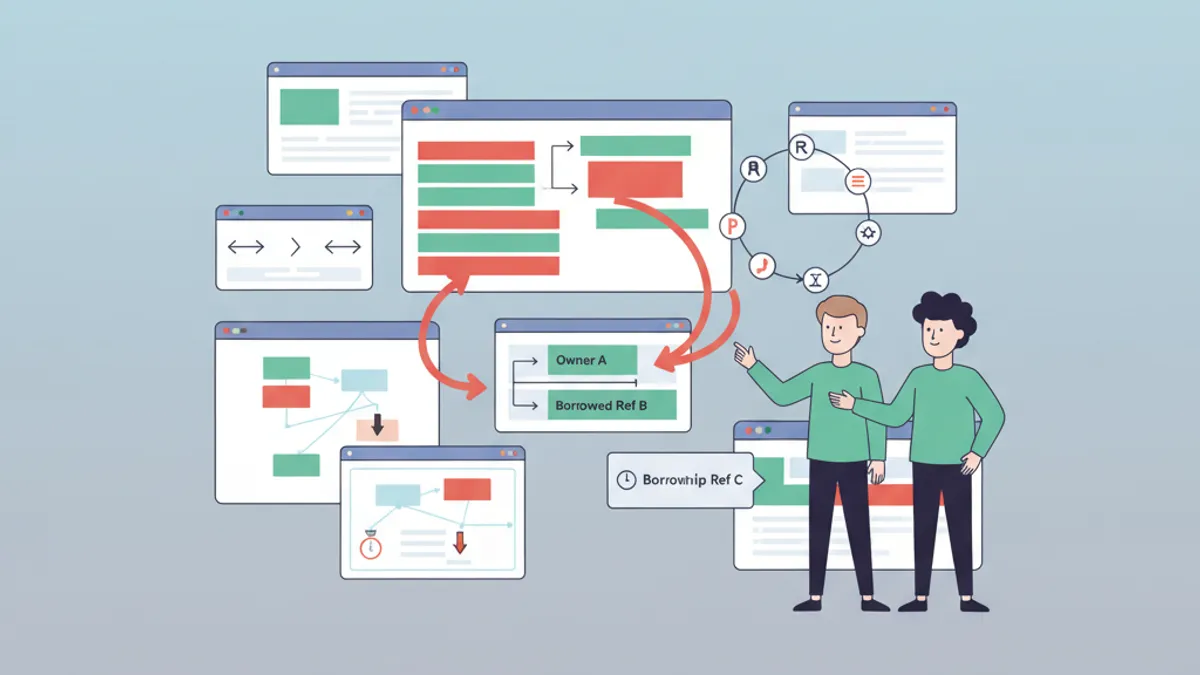
Ownership และ Borrowing ใน Rust: คู่มือฉบับสมบูรณ์
เชี่ยวชาญระบบ ownership และ borrowing ของ Rust กฎความเป็นเจ้าของ การอ้างอิง lifetime และรูปแบบการจัดการหน่วยความจำขั้นสูง

Rust: พื้นฐานสำหรับนักพัฒนาที่มีประสบการณ์ในปี 2026
เรียนรู้ Rust ได้อย่างรวดเร็วโดยอาศัยความรู้ด้านการเขียนโปรแกรมที่มีอยู่ Ownership, borrowing, lifetimes และ pattern ที่จำเป็นอธิบายไว้สำหรับนักพัฒนาที่มาจาก C++, Java หรือ Python