Rust의 소유권과 빌림: 완벽 가이드
Rust의 소유권과 빌림 시스템을 마스터합니다. 소유권 규칙, 참조, 라이프타임, 고급 메모리 관리 패턴을 다룹니다.
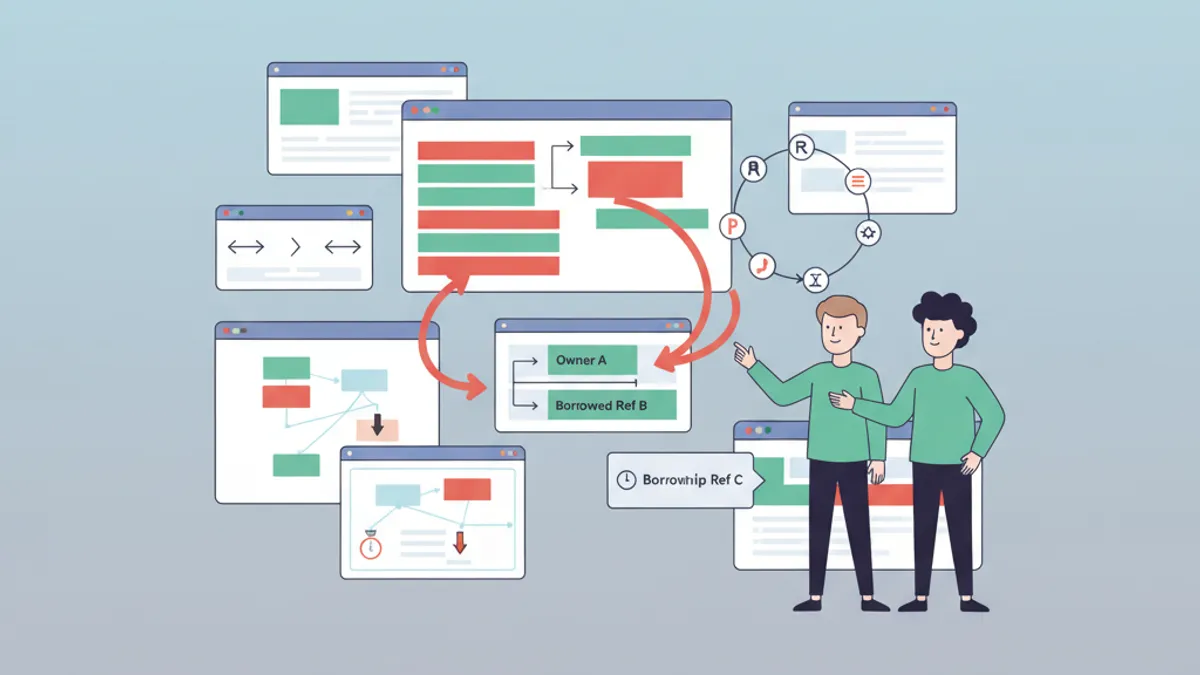
소유권 시스템은 Rust를 다른 모든 프로그래밍 언어와 구별짓는 특징입니다. 이 독특한 접근 방식은 가비지 컬렉터 없이 메모리 안전성을 보장하며, 런타임이 아닌 컴파일 타임에 버그를 잡아냅니다. 이 심층 가이드는 소유권과 빌림의 메커니즘을 기초부터 고급 프로덕션 패턴까지 다룹니다.
Rust 컴파일러는 까다로운 프로그래밍 보조자처럼 작동합니다. 컴파일 타임에 차단된 모든 소유권 오류는 프로덕션에서 방지된 잠재적 버그를 의미합니다.
소유권의 세 가지 기본 규칙
소유권 시스템은 단순하지만 엄격한 세 가지 규칙에 기반합니다. 이 규칙들이 체화되면 Rust의 멘탈 모델은 자연스럽고 예측 가능해집니다.
// Demonstration of the three fundamental rules

fn main() {
    // Rule 1: Each value has exactly ONE owner
    let s1 = String::from("hello");  // s1 is the sole owner

    // Rule 2: There can only be one owner at a time
    let s2 = s1;  // Ownership transferred (moved) from s1 to s2
    // println!("{}", s1);  // Compile ERROR: s1 no longer exists
    println!("s2 = {}", s2);  // Only s2 is valid now

    // Rule 3: When the owner goes out of scope, the value is dropped
    {
        let s3 = String::from("temporary");
        println!("s3 inside block = {}", s3);
    }  // s3 is automatically freed here (drop is called)
    // println!("{}", s3);  // ERROR: s3 no longer exists
}
이 세 가지 규칙은 use-after-free, double-free, 메모리 누수와 같은 버그 카테고리 전체를 제거합니다. 컴파일러는 이 규칙들이 준수되는지 정적으로 검증합니다.
Move 대 Copy: 전송 의미론 이해하기
할당의 동작은 데이터 타입에 따라 달라집니다. Copy 트레이트를 구현하는 타입은 복제되고, 그 외의 타입은 move를 통해 전송됩니다.
// Distinction between Copy types and Move types

fn main() {
    // Copy types: values stored on the stack, known size
    let x: i32 = 42;
    let y = x;  // x is COPIED, not moved
    println!("x = {}, y = {}", x, y);  // Both are valid

    // Other Copy types: f64, bool, char, tuples of Copy types
    let point = (3.0, 4.0);
    let point_copy = point;  // Tuple copy
    println!("Original: {:?}, Copy: {:?}", point, point_copy);

    // Move types: values on the heap, dynamic size
    let s1 = String::from("owned");
    let s2 = s1;  // s1 is MOVED to s2
    // println!("{}", s1);  // ERROR: value moved
    println!("s2 = {}", s2);

    // Vec, HashMap, Box are also Move types
    let vec1 = vec![1, 2, 3];
    let vec2 = vec1;  // Move, not copy
    // println!("{:?}", vec1);  // ERROR
    println!("vec2 = {:?}", vec2);
}

// Explicit clone to duplicate Move types
fn explicit_clone() {
    let original = String::from("important data");
    let clone = original.clone();  // Explicit duplication (memory cost)

    println!("Original: {}", original);  // Still valid
    println!("Clone: {}", clone);  // Independent copy
}
Move/Copy의 구분은 기본적입니다. 할당이 소유권을 전송하는지, 아니면 독립적인 복사본을 생성하는지를 결정합니다.
.clone() 호출은 의도적이어야 합니다. clone으로 가득 찬 코드는 설계상의 문제를 시사할 수 있습니다. 빌림이 종종 더 나은 해결책입니다.
빌림: 불변 참조와 가변 참조
빌림은 소유권을 가져가지 않고 값에 접근할 수 있게 해줍니다. 이 메커니즘은 Rust 코드를 안전하면서도 고성능으로 만듭니다.
// Immutable and mutable references

fn main() {
    let s = String::from("hello");

    // Immutable reference: read-only, multiple allowed
    let len = calculate_length(&s);  // Immutable borrow
    println!("'{}' has {} characters", s, len);  // s still valid

    // Multiple simultaneous immutable references: OK
    let r1 = &s;
    let r2 = &s;
    let r3 = &s;
    println!("r1={}, r2={}, r3={}", r1, r2, r3);
}

fn calculate_length(s: &String) -> usize {
    // s is a reference, not the owner
    s.len()
}  // s goes out of scope but doesn't drop anything (not owner)

// Mutable references: modification allowed
fn mutable_borrowing() {
    let mut s = String::from("hello");

    change(&mut s);  // Mutable borrow
    println!("After modification: {}", s);
}

fn change(s: &mut String) {
    s.push_str(", world!");  // Modification via mutable reference
}
빌림의 황금 규칙: 여러 개의 불변 참조 또는 단 하나의 가변 참조이며, 결코 두 가지가 동시에 존재할 수 없습니다.
Borrow Checker의 규칙
Borrow checker는 빌림 규칙을 검증하는 컴파일러 컴포넌트입니다. 그 오류를 이해하면 문제를 빠르게 해결할 수 있습니다.
// Strict borrow checker rules

fn main() {
    // RULE 1: No mutable reference with immutable references
    let mut s = String::from("hello");

    let r1 = &s;      // Immutable reference: OK
    let r2 = &s;      // Another immutable reference: OK
    // let r3 = &mut s;  // ERROR: cannot borrow as mutable
    println!("{} and {}", r1, r2);

    // AFTER using r1 and r2, they are "dead"
    let r3 = &mut s;  // Now OK: r1 and r2 no longer used
    r3.push_str(" world");
    println!("{}", r3);

    // RULE 2: Only one mutable reference at a time
    let mut data = String::from("exclusive");
    let ref1 = &mut data;
    // let ref2 = &mut data;  // ERROR: already borrowed mutably
    ref1.push_str("!");
    println!("{}", ref1);
}

// RULE 3: References cannot outlive the data
fn dangling_reference_prevented() {
    let reference;
    {
        let s = String::from("short-lived");
        // reference = &s;  // ERROR: s doesn't live long enough
    }
    // s is dropped here, reference would be invalid

    // Solution: move the value out of the scope
    let owned_outside;
    {
        let s = String::from("moved out");
        owned_outside = s;  // Move, not reference
    }
    println!("{}", owned_outside);  // OK: owned_outside is the owner
}
Borrow checker는 Non-Lexical Lifetimes(NLL)를 사용합니다. 참조는 마지막 사용까지만 활성화된 것으로 간주되며, 스코프 끝까지 유지되지 않습니다.
Rust 면접 준비가 되셨나요?
인터랙티브 시뮬레이터, flashcards, 기술 테스트로 연습하세요.
라이프타임: 참조의 지속 시간 표기하기
라이프타임은 참조가 유효하게 유지되는지 컴파일러가 검증할 수 있도록 돕는 표기입니다. 대부분의 경우 자동으로 추론됩니다.
// Explicit lifetime annotations

// Without annotation: compiler infers lifetimes
fn first_word(s: &str) -> &str {
    match s.find(' ') {
        Some(i) => &s[..i],
        None => s,
    }
}

// With explicit annotation: same function
fn first_word_explicit<'a>(s: &'a str) -> &'a str {
    // 'a means: returned reference lives as long as the input
    match s.find(' ') {
        Some(i) => &s[..i],
        None => s,
    }
}

// When annotations are necessary: multiple references
fn longest<'a>(x: &'a str, y: &'a str) -> &'a str {
    // Compiler cannot guess which reference is returned
    if x.len() > y.len() {
        x
    } else {
        y
    }
}

fn main() {
    let string1 = String::from("long string");
    let result;
    {
        let string2 = String::from("xyz");
        result = longest(&string1, &string2);
        println!("Longest: {}", result);  // OK here
    }
    // println!("{}", result);  // ERROR if uncommented: string2 dropped
}
라이프타임은 데이터가 살아있는 기간을 변경하지 않습니다. 서로 다른 참조의 라이프타임 간의 관계를 기술할 뿐입니다.
구조체에서의 라이프타임
구조체가 참조를 포함할 때, 구조체가 참조된 데이터보다 오래 살지 않도록 보장하기 위해 라이프타임을 표기해야 합니다.
// Structs containing references

// Struct with reference: lifetime required
struct ImportantExcerpt<'a> {
    part: &'a str,  // This reference must live at least as long as the struct
}

impl<'a> ImportantExcerpt<'a> {
    // Method returning a reference with the same lifetime
    fn level(&self) -> i32 {
        3
    }

    // Elision rule: &self implies the output lifetime
    fn announce_and_return_part(&self, announcement: &str) -> &str {
        println!("Attention: {}", announcement);
        self.part  // Returns with 'a lifetime from self
    }
}

fn main() {
    let novel = String::from("Call me Ishmael. Some years ago...");
    let first_sentence = novel.split('.').next().unwrap();

    let excerpt = ImportantExcerpt {
        part: first_sentence,  // OK: novel outlives excerpt
    };

    println!("Excerpt: {}", excerpt.part);
    println!("Level: {}", excerpt.level());
}

// Static lifetime: reference valid for the entire program duration
fn static_lifetime_example() {
    let s: &'static str = "This string is in the binary";
    // String literals always have 'static lifetime
    println!("{}", s);
}
라이프타임 생략 규칙은 일반적인 경우에 표기를 생략할 수 있게 해주어 코드를 더 읽기 쉽게 만듭니다.
고급 패턴: 내부 가변성
때로는 가변성이 컴파일 타임이 아닌 런타임에 검증되어야 합니다. Rust는 이 패턴을 위한 타입을 제공합니다: RefCell과 Cell입니다.
// Interior mutability with RefCell and Cell

use std::cell::{Cell, RefCell};

// Cell: for Copy types, replaces the entire value
struct Counter {
    count: Cell<u32>,  // Mutable despite &self
}

impl Counter {
    fn new() -> Counter {
        Counter { count: Cell::new(0) }
    }

    fn increment(&self) {
        // Modification via immutable reference!
        self.count.set(self.count.get() + 1);
    }

    fn get(&self) -> u32 {
        self.count.get()
    }
}

// RefCell: for non-Copy types, checks at runtime
struct CachedValue {
    value: RefCell<Option<String>>,
}

impl CachedValue {
    fn new() -> CachedValue {
        CachedValue { value: RefCell::new(None) }
    }

    fn get_or_compute(&self, compute: impl FnOnce() -> String) -> String {
        // borrow() for reading, borrow_mut() for writing
        if self.value.borrow().is_none() {
            *self.value.borrow_mut() = Some(compute());
        }
        self.value.borrow().as_ref().unwrap().clone()
    }
}

fn main() {
    let counter = Counter::new();
    counter.increment();
    counter.increment();
    println!("Counter: {}", counter.get());  // 2

    let cache = CachedValue::new();
    let result = cache.get_or_compute(|| {
        println!("Expensive computation...");
        String::from("result")
    });
    println!("Value: {}", result);

    // Second call: no recomputation
    let result2 = cache.get_or_compute(|| String::from("never executed"));
    println!("Cache hit: {}", result2);
}
RefCell과 Cell은 빌림 검증을 런타임으로 옮깁니다. 규칙 위반은 컴파일 오류 대신 panic을 발생시킵니다.
RefCell::borrow_mut()은 값이 이미 빌려진 경우 panic을 발생시킵니다. 명시적인 오류 처리를 위해서는 try_borrow_mut()을 사용하는 것이 좋습니다.
스마트 포인터와 소유권
Box, Rc, Arc와 같은 스마트 포인터는 특정 사용 사례에 대해 서로 다른 소유권 전략을 제공합니다.
// Box, Rc, and Arc for different ownership patterns

use std::rc::Rc;
use std::sync::Arc;
use std::thread;

// Box: single owner, data on the heap
fn box_example() {
    let boxed = Box::new(vec![1, 2, 3, 4, 5]);
    println!("Boxed vec: {:?}", boxed);
    // Useful for: recursive types, large objects, trait objects
}

// Rc: reference counting, multiple owners (single-thread)
fn rc_example() {
    let data = Rc::new(String::from("shared data"));

    let clone1 = Rc::clone(&data);  // Increments the counter
    let clone2 = Rc::clone(&data);

    println!("Count: {}", Rc::strong_count(&data));  // 3
    println!("All share: {}, {}, {}", data, clone1, clone2);
}  // Freed when counter reaches 0

// Arc: thread-safe Rc (Atomic Reference Counting)
fn arc_example() {
    let data = Arc::new(vec![1, 2, 3]);

    let handles: Vec<_> = (0..3).map(|i| {
        let data_clone = Arc::clone(&data);
        thread::spawn(move || {
            println!("Thread {}: {:?}", i, data_clone);
        })
    }).collect();

    for handle in handles {
        handle.join().unwrap();
    }
}

fn main() {
    box_example();
    rc_example();
    arc_example();
}
스마트 포인터의 선택은 소유권 패턴에 따라 달라집니다: 단일(Box), 단일 스레드 공유(Rc), 또는 멀티 스레드 공유(Arc)입니다.
실용적인 소유권 패턴
다음은 소유권 시스템을 중심으로 코드를 구조화하기 위한 일반적인 패턴들입니다.
// Practical patterns for ownership management

// Pattern 1: Builder pattern with chained ownership
struct RequestBuilder {
    url: String,
    headers: Vec<(String, String)>,
    timeout: Option<u64>,
}

impl RequestBuilder {
    fn new(url: &str) -> Self {
        RequestBuilder {
            url: url.to_string(),
            headers: Vec::new(),
            timeout: None,
        }
    }

    // Consumes self and returns the new self
    fn header(mut self, key: &str, value: &str) -> Self {
        self.headers.push((key.to_string(), value.to_string()));
        self  // Returns ownership
    }

    fn timeout(mut self, seconds: u64) -> Self {
        self.timeout = Some(seconds);
        self
    }

    fn build(self) -> Request {
        Request {
            url: self.url,
            headers: self.headers,
            timeout: self.timeout.unwrap_or(30),
        }
    }
}

struct Request {
    url: String,
    headers: Vec<(String, String)>,
    timeout: u64,
}

// Pattern 2: Cow (Copy-on-Write) to avoid allocations
use std::borrow::Cow;

fn process_text(input: &str) -> Cow<str> {
    if input.contains("REPLACE") {
        // Allocation only if modification needed
        Cow::Owned(input.replace("REPLACE", "NEW"))
    } else {
        // No allocation, returns a reference
        Cow::Borrowed(input)
    }
}

// Pattern 3: Take to extract from an Option
fn extract_value(data: &mut Option<String>) -> String {
    data.take().unwrap_or_else(|| String::from("default"))
    // take() replaces with None and returns ownership of the value
}

fn main() {
    // Builder pattern
    let request = RequestBuilder::new("https://api.example.com")
        .header("Authorization", "Bearer token")
        .header("Content-Type", "application/json")
        .timeout(60)
        .build();

    println!("URL: {}, Timeout: {}s", request.url, request.timeout);

    // Cow pattern
    let text1 = process_text("hello world");  // No allocation
    let text2 = process_text("hello REPLACE");  // Allocation
    println!("{} | {}", text1, text2);

    // Take pattern
    let mut optional = Some(String::from("extracted"));
    let value = extract_value(&mut optional);
    println!("Value: {}, Option: {:?}", value, optional);  // None
}
이 패턴들은 소유권 시스템을 활용하여 사용하기 편리하고 고성능인 API를 만듭니다.
연습을 시작하세요!
면접 시뮬레이터와 기술 테스트로 지식을 테스트하세요.
결론
Rust의 소유권과 빌림 시스템은 메모리 관리에서 패러다임의 전환을 나타냅니다. 한번 마스터하면 고성능이면서 안전한 코드를 작성하기 위한 강력한 동맹이 됩니다.
핵심 포인트:
✅ 세 가지 소유권 규칙: 단일 소유자, 소유권 전송, 자동 drop
✅ 빌림: 여러 개의 불변 참조 또는 단 하나의 배타적 가변 참조
✅ 라이프타임: 참조 라이프타임 간의 관계 표기
✅ 내부 가변성: 런타임에 검증되는 가변성을 위한 RefCell과 Cell
✅ 스마트 포인터: Box(단일), Rc(공유), Arc(thread-safe)
✅ 실용적인 패턴: 관용적인 API를 위한 Builder, Cow, Take
Borrow checker는 처음에는 엄격해 보일 수 있지만, 보고하는 모든 오류는 회피된 잠재적 버그를 의미합니다. 연습을 통해 소유권 관점에서 사고하는 것이 자연스러워지고, 모든 언어에서 코드 품질이 향상됩니다.
연습을 시작하세요!
면접 시뮬레이터와 기술 테스트로 지식을 테스트하세요.
Rust 코드의 버그를 찾을 수 있나요
실제 코드 한 조각, 숨은 버그 하나, 하루 한 번. 계정 없이 바로 도전할 수 있습니다.

작성자
Anthony Fillion-MailletSharpSkill 창업자
10년 이상 풀스택 개발을 해왔습니다. SharpSkill을 운영하며 이곳에 게시되는 모든 내용에 책임을 집니다.
2026년 4월 29일 업데이트
태그
공유
관련 기사

Rust 소유권과 빌림: 메모리 안전성의 핵심 원리 완벽 해설
Rust의 소유권(Ownership), 빌림(Borrowing), 라이프타임(Lifetime) 개념을 체계적으로 분석합니다. 빌림 검사기의 동작 원리와 실무 패턴, 기술 면접 대비 핵심 포인트를 다룹니다.

Rust 면접 질문: 2026년 완벽 가이드
Rust 기술 면접에서 자주 출제되는 25개 질문을 완벽하게 다룹니다. 소유권, 빌림, 라이프타임, 트레이트, async/await, 동시성에 대한 상세한 답변과 코드 예제를 제공합니다.

Rust 기초: 경험 있는 개발자를 위한 2026년 가이드
C++, Java, Python 경험을 활용하여 Rust를 효율적으로 학습하는 가이드입니다. 소유권, 빌림, 라이프타임 등 Rust 핵심 개념을 체계적으로 설명합니다.