Swift Testing Framework Interview 2026: #expect and #require Macros vs XCTest
Master the new Swift Testing Framework for iOS interviews: #expect and #require macros, XCTest migration, advanced patterns, and common pitfalls.
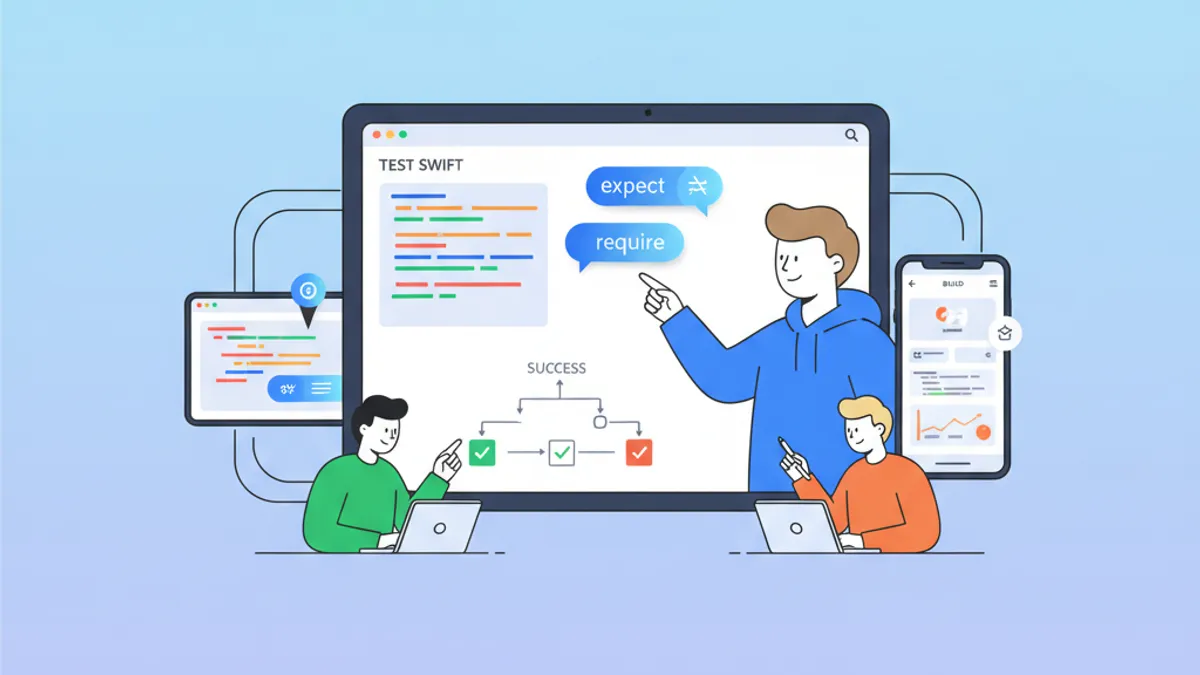
Introduced at WWDC 2024 and shipped with Swift 6 and Xcode 16, Swift Testing represents a complete reimagining of how testing works in Swift. This framework replaces XCTest's 40+ assertions with just two macros: #expect and #require. Interviewers now regularly test this knowledge during iOS technical interviews.
Each section mirrors a technical interview question with detailed answers and working code. The progression moves from fundamental concepts to advanced patterns.
Swift Testing Fundamentals
Question 1: What are the major differences between Swift Testing and XCTest?
Swift Testing brings five fundamental changes compared to XCTest:
- Declarative syntax:
@Testattribute instead oftestprefixes - Two universal macros:
#expectand#requirereplace 40+ assertions - Parallel by default: all tests run concurrently
- Native async support: complete Swift Concurrency integration
- Cross-platform: works on Apple platforms, Linux, and Windows
import XCTest
import Testing

// ❌ Legacy XCTest pattern
class UserServiceXCTests: XCTestCase {
    // Must start with "test"
    func testUserCreation() {
        let user = User(name: "Alice", age: 25)

        // Multiple verbose assertions
        XCTAssertNotNil(user)
        XCTAssertEqual(user.name, "Alice")
        XCTAssertGreaterThan(user.age, 18)
        XCTAssertTrue(user.isValid)
    }
}

// ✅ Modern Swift Testing pattern
@Test("User creation with valid data")
func userCreation() {
    let user = User(name: "Alice", age: 25)

    // Single macro for all verifications
    #expect(user.name == "Alice")
    #expect(user.age > 18)
    #expect(user.isValid)
}
The key difference lies in expressiveness: Swift Testing uses standard Swift expressions instead of specialized assertions, making tests more readable and error messages more informative.
Question 2: How does the #expect macro work?
The #expect macro validates that a boolean expression is true. It automatically captures evaluated values to provide detailed error messages. Unlike XCTAssert, it uses native Swift syntax.
import Testing

@Test func basicExpectations() {
    let numbers = [1, 2, 3, 4, 5]
    let user = User(name: "Bob", email: "bob@example.com")

    // Simple comparisons - standard Swift expression
    #expect(numbers.count == 5)
    #expect(user.name == "Bob")

    // Comparisons with operators
    #expect(numbers.first! < numbers.last!)
    #expect(user.email.contains("@"))

    // Nil checking
    #expect(numbers.first != nil)

    // Collection verification
    #expect(numbers.contains(3))
    #expect(!numbers.isEmpty)
}

@Test func expectWithCustomMessage() {
    let balance = 150.0
    let withdrawAmount = 200.0

    // Custom message to clarify intent
    #expect(
        balance >= withdrawAmount,
        "Insufficient funds: balance \(balance) < withdrawal \(withdrawAmount)"
    )
}
When an #expect fails, the test continues execution. This characteristic allows collecting multiple failures in a single test run, facilitating diagnosis.
Question 3: What's the difference between #expect and #require?
The fundamental difference concerns behavior after failure:
#expect: records the failure and continues execution#require: records the failure and stops the test immediately
#require must always be used with try because it can throw an error.
import Testing

struct ApiResponse {
    let data: Data?
    let items: [Item]?
}

@Test func demonstrateExpectContinues() {
    let values = [1, 2, 3]

    // First #expect fails but test continues
    #expect(values.count == 10)  // ❌ Failure recorded

    // These verifications still execute
    #expect(values.first == 1)   // ✅ Success
    #expect(values.last == 3)    // ✅ Success

    // Result: 1 failure, 2 successes in the same test
}

@Test func demonstrateRequireStops() throws {
    let response = ApiResponse(data: nil, items: nil)

    // #require stops immediately if condition fails
    let data = try #require(response.data)  // ❌ Failure and STOP

    // This code NEVER executes if data is nil
    let json = try JSONDecoder().decode(User.self, from: data)
    #expect(json.name == "Alice")
}
In practice, #require perfectly replaces XCTUnwrap for safe optional unwrapping.
Use #require when subsequent steps depend on the result (unwrapping, preconditions). Use #expect for independent verifications that can fail without blocking the rest of the test.
Advanced Patterns with #require
Question 4: How to use #require for optional unwrapping?
#require excels at optional unwrapping. It returns the non-optional value if it exists, or immediately fails the test if nil.
import Testing

struct UserProfile {
    let id: Int
    let name: String
    let settings: Settings?
}

struct Settings {
    let theme: String
    let notifications: Bool
}

@Test func unwrapOptionalChain() throws {
    let profile = UserProfile(
        id: 1,
        name: "Alice",
        settings: Settings(theme: "dark", notifications: true)
    )

    // Safe unwrap - stops if nil
    let settings = try #require(profile.settings)

    // Now settings is no longer optional
    #expect(settings.theme == "dark")
    #expect(settings.notifications == true)
}

@Test func unwrapArrayElement() throws {
    let users = ["Alice", "Bob", "Charlie"]

    // Unwrap first element
    let firstUser = try #require(users.first)
    #expect(firstUser == "Alice")

    // Unwrap with safe index
    let secondUser = try #require(users[safe: 1])
    #expect(secondUser == "Bob")
}

@Test func unwrapDictionaryValue() throws {
    let config: [String: Any] = [
        "apiUrl": "https://api.example.com",
        "timeout": 30,
        "retryCount": 3
    ]

    // Unwrap and cast in a single operation
    let apiUrl = try #require(config["apiUrl"] as? String)
    let timeout = try #require(config["timeout"] as? Int)

    #expect(apiUrl.contains("https"))
    #expect(timeout > 0)
}
This approach eliminates guard let pyramids and makes test code linear and readable.
Question 5: How to test that a function throws an error?
Swift Testing offers #expect(throws:) to verify that a function throws a specific error.
import Testing

enum ValidationError: Error, Equatable {
    case emptyName
    case invalidEmail
    case underAge(minimum: Int)
}

struct Validator {
    static func validateUser(name: String, email: String, age: Int) throws {
        guard !name.isEmpty else {
            throw ValidationError.emptyName
        }
        guard email.contains("@") else {
            throw ValidationError.invalidEmail
        }
        guard age >= 18 else {
            throw ValidationError.underAge(minimum: 18)
        }
    }
}

@Test func testThrowsSpecificError() {
    // Verify a specific error is thrown
    #expect(throws: ValidationError.emptyName) {
        try Validator.validateUser(name: "", email: "test@mail.com", age: 25)
    }

    #expect(throws: ValidationError.invalidEmail) {
        try Validator.validateUser(name: "Alice", email: "invalid", age: 25)
    }
}

@Test func testThrowsErrorType() {
    // Verify error type without specific value
    #expect(throws: ValidationError.self) {
        try Validator.validateUser(name: "Bob", email: "bob@mail.com", age: 15)
    }
}

@Test func testThrowsWithInspection() throws {
    // Capture error for detailed inspection
    let error = try #require(
        throws: ValidationError.self
    ) {
        try Validator.validateUser(name: "Charlie", email: "charlie@mail.com", age: 16)
    }

    // Verify error details
    if case .underAge(let minimum) = error {
        #expect(minimum == 18)
    }
}
This syntax replaces XCTAssertThrowsError with a clearer, type-safe API.
Ready to ace your iOS interviews?
Practice with our interactive simulators, flashcards, and technical tests.
Test Organization with @Test and @Suite
Question 6: How to organize tests with @Suite?
@Suite logically groups related tests. Unlike XCTestCase, it doesn't require class inheritance.
import Testing

// Suite for authentication tests
@Suite("Authentication Tests")
struct AuthenticationTests {

    // Shared property for all tests in the suite
    let authService = AuthService()

    @Test("Login with valid credentials succeeds")
    func loginWithValidCredentials() async throws {
        let result = try await authService.login(
            email: "user@example.com",
            password: "validPass123"
        )

        #expect(result.isSuccess)
        let token = try #require(result.token)
        #expect(!token.isEmpty)
    }

    @Test("Login with invalid password fails")
    func loginWithInvalidPassword() async {
        let result = await authService.login(
            email: "user@example.com",
            password: "wrong"
        )

        #expect(!result.isSuccess)
        #expect(result.error == .invalidCredentials)
    }
}

// Nested suites for hierarchical organization
@Suite("User Management")
struct UserManagementTests {

    @Suite("Creation")
    struct CreationTests {
        @Test func createUserWithValidData() {
            // Creation test
        }

        @Test func createUserWithDuplicateEmail() {
            // Duplicate error test
        }
    }

    @Suite("Deletion")
    struct DeletionTests {
        @Test func deleteExistingUser() {
            // Deletion test
        }

        @Test func deleteNonExistentUser() {
            // Error test
        }
    }
}
Suites allow running test subsets and organizing reports in a readable way.
Question 7: How to use traits to configure tests?
Traits modify test behavior: execution conditions, tags, timeouts, etc.
import Testing

@Suite("API Integration Tests")
struct APITests {

    // Temporarily disabled test
    @Test(.disabled("Backend under maintenance"))
    func fetchUserProfile() async {
        // Does not execute
    }

    // Conditional test based on platform
    @Test
    @available(iOS 17, *)
    func useNewAPIFeature() {
        // Executes only on iOS 17+
    }

    // Test with tags for filtering
    @Test(.tags(.critical, .network))
    func criticalNetworkOperation() async throws {
        // Tagged test for filtering
    }

    // Test with custom timeout
    @Test(.timeLimit(.minutes(2)))
    func longRunningOperation() async {
        // Must complete within 2 minutes
    }

    // Trait combination
    @Test(
        "Complex data sync",
        .tags(.slow),
        .timeLimit(.minutes(5)),
        .bug("JIRA-1234", "Flaky on CI")
    )
    func complexDataSync() async throws {
        // Test documented with known bug
    }
}

// Custom tag definitions
extension Tag {
    @Tag static var critical: Self
    @Tag static var network: Self
    @Tag static var slow: Self
}
Traits make tests self-documenting and enable selective execution via command line.
Parameterized Tests
Question 8: How to create parameterized tests?
Swift Testing allows running the same test with different inputs via parameters.
import Testing

struct EmailValidator {
    static func isValid(_ email: String) -> Bool {
        let pattern = #"^[\w-\.]+@([\w-]+\.)+[\w-]{2,4}$"#
        return email.range(of: pattern, options: .regularExpression) != nil
    }
}

// Parameterized test with a collection
@Test(arguments: [
    "user@example.com",
    "test.name@domain.org",
    "contact@company.co.uk"
])
func validEmailsAreAccepted(email: String) {
    #expect(EmailValidator.isValid(email))
}

@Test(arguments: [
    "invalid",
    "@nodomain.com",
    "no@tld",
    "spaces in@email.com"
])
func invalidEmailsAreRejected(email: String) {
    #expect(!EmailValidator.isValid(email))
}

// Test with tuples for input/output cases
@Test(arguments: [
    ("hello", "HELLO"),
    ("World", "WORLD"),
    ("Swift", "SWIFT")
])
func uppercaseConversion(input: String, expected: String) {
    #expect(input.uppercased() == expected)
}

// Test with Cartesian product of two collections
@Test(arguments: [1, 2, 3], ["a", "b"])
func combinationTest(number: Int, letter: String) {
    // Runs for (1,"a"), (1,"b"), (2,"a"), (2,"b"), (3,"a"), (3,"b")
    let combined = "\(number)\(letter)"
    #expect(combined.count == 2)
}
Each parameter combination generates an independent test, making it easy to identify failing cases.
Question 9: How to test asynchronous code?
Swift Testing natively integrates async/await, drastically simplifying asynchronous tests.
import Testing

actor DataStore {
    private var items: [String] = []

    func add(_ item: String) {
        items.append(item)
    }

    func getAll() -> [String] {
        items
    }

    func clear() {
        items.removeAll()
    }
}

@Suite("Async Operations")
struct AsyncTests {

    @Test func basicAsyncOperation() async {
        // No need for expectation or wait
        let result = await fetchData()
        #expect(!result.isEmpty)
    }

    @Test func asyncWithTimeout() async throws {
        // Use Task.sleep to simulate delay
        try await Task.sleep(for: .milliseconds(100))

        let data = await loadConfiguration()
        let config = try #require(data)
        #expect(config.isValid)
    }

    @Test func testActorIsolation() async {
        let store = DataStore()

        // Operations on actor sequentially
        await store.add("Item 1")
        await store.add("Item 2")

        let items = await store.getAll()
        #expect(items.count == 2)
        #expect(items.contains("Item 1"))
    }

    @Test func testConcurrentOperations() async {
        let store = DataStore()

        // Concurrent execution with TaskGroup
        await withTaskGroup(of: Void.self) { group in
            for i in 1...10 {
                group.addTask {
                    await store.add("Item \(i)")
                }
            }
        }

        let items = await store.getAll()
        #expect(items.count == 10)
    }
}

// Async helpers for tests
func fetchData() async -> [String] {
    try? await Task.sleep(for: .milliseconds(50))
    return ["data1", "data2"]
}

func loadConfiguration() async -> Configuration? {
    Configuration(isValid: true)
}

struct Configuration {
    let isValid: Bool
}Swift Testing runs tests in parallel by default. For tests that modify shared state, use .serialized on the suite or isolate state with actors.
XCTest to Swift Testing Migration
Question 10: How to migrate progressively from XCTest?
Both frameworks coexist in the same project. A progressive migration is recommended.
import XCTest
import Testing

// ⚠️ CRITICAL RULE: Never mix frameworks in the same test

// ❌ INCORRECT - Mixing forbidden
class BadMixedTest: XCTestCase {
    func testMixed() {
        #expect(true)  // Does not work in XCTestCase
    }
}

// ✅ CORRECT - Pure XCTest for existing tests
class LegacyUserTests: XCTestCase {
    func testUserCreation() {
        let user = User(name: "Test")
        XCTAssertNotNil(user)
        XCTAssertEqual(user.name, "Test")
    }
}

// ✅ CORRECT - Swift Testing for new tests
@Suite("User Tests - Modern")
struct ModernUserTests {
    @Test func userCreation() {
        let user = User(name: "Test")
        #expect(user.name == "Test")
    }
}

// Migration strategy by file
// 1. Identify tests to migrate (start with simplest)
// 2. Create new file with @Suite
// 3. Rewrite tests one by one
// 4. Delete old XCTest file once validated| XCTest | Swift Testing |
|---|---|
XCTAssertTrue(x) | #expect(x) |
XCTAssertFalse(x) | #expect(!x) |
XCTAssertEqual(a, b) | #expect(a == b) |
XCTAssertNil(x) | #expect(x == nil) |
XCTAssertNotNil(x) | #expect(x != nil) |
XCTUnwrap(x) | try #require(x) |
XCTAssertThrowsError | #expect(throws:) |
Question 11: What XCTest features are not yet in Swift Testing?
Swift Testing (Swift 6) doesn't yet cover all XCTest use cases.
// ❌ NOT SUPPORTED: Performance tests
// Stick with XCTest for measuring performance
class PerformanceTests: XCTestCase {
    func testPerformance() {
        measure {
            // Code to measure
            _ = (0..<1000).map { $0 * 2 }
        }
    }
}

// ❌ NOT SUPPORTED: UI tests (XCUITest)
// Continue using XCUITest for interface tests
class UITests: XCTestCase {
    func testLoginFlow() {
        let app = XCUIApplication()
        app.launch()
        // UI tests...
    }
}

// ✅ SUPPORTED: Async integration tests
@Test func integrationTest() async throws {
    let api = APIClient()
    let response = try await api.fetchUsers()
    #expect(!response.isEmpty)
}

// ✅ SUPPORTED: Mocking with protocols
@Test func mockingWithProtocols() async {
    let mockService = MockUserService()
    let viewModel = UserViewModel(service: mockService)

    await viewModel.loadUser(id: 1)

    #expect(viewModel.user?.name == "Mock User")
}
For projects with UI or performance tests, maintain XCTest for those specific cases.
Ready to ace your iOS interviews?
Practice with our interactive simulators, flashcards, and technical tests.
Tricky Interview Questions
Question 12: Why does #require need try but not #expect?
#require can throw an error if the condition fails because it must interrupt the test. #expect only records the failure and continues, so it doesn't throw.
import Testing

@Test func explainTryRequirement() throws {
    let optionalValue: String? = nil

    // #expect returns Void - no error thrown
    // Test continues even if it fails
    #expect(optionalValue != nil)  // No try

    // #require can throw ExpectationFailedError
    // Test stops if it fails
    // Must be marked with try
    let value = try #require(optionalValue)  // Requires try

    // If we reach here, optionalValue was not nil
    #expect(!value.isEmpty)
}

// The internal signature resembles:
// func #expect(_ condition: Bool) -> Void
// func #require<T>(_ value: T?) throws -> T
This architectural distinction allows the compiler to guarantee correct failure handling.
Question 13: How does Swift Testing handle parallelism?
By default, all tests run in parallel, which speeds up test suites but requires proper state isolation.
import Testing

// ❌ PROBLEM: Mutable shared state
var sharedCounter = 0  // Dangerous in parallel!

@Suite("Problematic Parallel Tests")
struct ProblematicTests {
    @Test func incrementCounter1() {
        sharedCounter += 1  // Race condition!
    }

    @Test func incrementCounter2() {
        sharedCounter += 1  // Race condition!
    }
}

// ✅ SOLUTION 1: Force sequential execution
@Suite("Sequential Tests", .serialized)
struct SequentialTests {
    static var counter = 0

    @Test func first() {
        Self.counter += 1
        #expect(Self.counter == 1)
    }

    @Test func second() {
        Self.counter += 1
        #expect(Self.counter == 2)
    }
}

// ✅ SOLUTION 2: Isolate state per test
@Suite("Isolated Tests")
struct IsolatedTests {
    @Test func independentTest1() {
        var localCounter = 0
        localCounter += 1
        #expect(localCounter == 1)
    }

    @Test func independentTest2() {
        var localCounter = 0
        localCounter += 1
        #expect(localCounter == 1)
    }
}

// ✅ SOLUTION 3: Use actor for shared state
actor TestState {
    var value = 0

    func increment() -> Int {
        value += 1
        return value
    }
}

@Suite("Actor-based Tests")
struct ActorTests {
    let state = TestState()

    @Test func safeIncrement() async {
        let result = await state.increment()
        #expect(result > 0)
    }
}
The .serialized trait guarantees sequential execution of an entire suite.
Question 14: How to use confirmations for callbacks?
For APIs with callbacks (non-async), Swift Testing offers confirmation.
import Testing

// Legacy service with callback
class LegacyService {
    func fetchData(completion: @escaping (Result<String, Error>) -> Void) {
        DispatchQueue.global().asyncAfter(deadline: .now() + 0.1) {
            completion(.success("Data loaded"))
        }
    }
}

@Test func testCallbackWithConfirmation() async {
    let service = LegacyService()

    // confirmation waits for it to be called
    await confirmation("Data callback received") { confirm in
        service.fetchData { result in
            if case .success(let data) = result {
                #expect(data == "Data loaded")
                confirm()  // Signals callback was executed
            }
        }
    }
}

// For callbacks called multiple times
@Test func testMultipleCallbacks() async {
    let publisher = EventPublisher()

    // expectedCount specifies expected call count
    await confirmation("Events received", expectedCount: 3) { confirm in
        publisher.onEvent = { event in
            #expect(!event.isEmpty)
            confirm()  // Called 3 times
        }

        publisher.emit("Event 1")
        publisher.emit("Event 2")
        publisher.emit("Event 3")
    }
}

class EventPublisher {
    var onEvent: ((String) -> Void)?

    func emit(_ event: String) {
        DispatchQueue.global().async {
            self.onEvent?(event)
        }
    }
}
confirmation elegantly replaces XCTestExpectation and wait(for:timeout:).
Conclusion
Swift Testing represents the future of testing on Apple platforms. The two macros #expect and #require dramatically simplify test writing while improving error message quality.
Key points to remember for interviews:
- ✅
#expectcontinues after failure,#requirestops immediately - ✅
#requirerequirestrybecause it can throw an error - ✅ Swift Testing runs in parallel by default
- ✅ Both frameworks coexist but must not be mixed in the same test
- ✅ XCTest remains necessary for UI and performance tests
- ✅ Traits allow fine-grained test behavior configuration
- ✅ Parameterized tests avoid code duplication
Migration to Swift Testing can be done progressively, file by file, starting with the simplest tests.
Start practicing!
Test your knowledge with our interview simulators and technical tests.
Can you spot the bug in iOS?
One real snippet, one hidden bug, one attempt a day. No account needed to try.

Written by
Anthony Fillion-MailletFounder of SharpSkill
Full-stack developer for over 10 years. Runs SharpSkill and answers for everything published here.
Updated on March 31, 2026
Tags
Share
Related articles

StoreKit 2 Interview: Subscription Management and Receipt Validation
Master iOS interview questions on StoreKit 2, subscription management, receipt validation, and in-app purchase implementation with practical Swift code examples.
iOS Push Notifications Interview in 2026: APNs, Tokens and Troubleshooting
Prepare for iOS interviews with this comprehensive guide on Push Notifications, APNs, token management and troubleshooting. Common questions with detailed answers.

iOS Senior Interview 2026: Architecture and Design Patterns Questions
Prepare for iOS senior interviews with key questions on MVVM, VIPER, Clean Architecture and design patterns. Complete guide with Swift code examples.