Rust: Fundamentos para Desenvolvedores Experientes em 2026
Aprenda Rust aproveitando sua experiencia previa. Ownership, borrowing, lifetimes e padroes essenciais explicados para quem vem de C++, Java ou Python.

Rust continua ganhando espaco entre desenvolvedores profissionais, e os motivos sao evidentes: seguranca de memoria garantida em tempo de compilacao, desempenho no nivel de C++ e um ecossistema moderno em constante evolucao. Para quem vem de C++, Java ou Python, Rust pode parecer desconcertante no inicio, mas os conceitos fundamentais se tornam intuitivos assim que compreendidos.
Rust tem sido a linguagem mais amada no Stack Overflow por 8 anos consecutivos. Adotada por Microsoft, Google, Amazon e Meta para componentes criticos, oferece seguranca de memoria sem a necessidade de um coletor de lixo.
Configuracao do Ambiente de Desenvolvimento Rust
Antes de escrever codigo, e necessario instalar o Rust por meio do rustup, a ferramenta oficial de gerenciamento de versoes.
# install.sh
# Install Rust via rustup (macOS, Linux)
curl --proto '=https' --tlsv1.2 -sSf https://sh.rustup.rs | sh

# Verify installation
rustc --version
cargo --version
O Cargo e o gerenciador de pacotes e ferramenta de build do Rust. Combina a funcionalidade do npm, Maven e Make em uma unica ferramenta coerente.
# project-setup.sh
# Create a new project
cargo new my_project
cd my_project

# Generated structure:
# my_project/
# ├── Cargo.toml    # Manifest (like package.json)
# └── src/
#     └── main.rs   # Entry point

# Essential commands
cargo build          # Compile the project
cargo run            # Compile and run
cargo test           # Run tests
cargo check          # Check without building (faster)
Variaveis e Imutabilidade por Padrao no Rust
Rust inverte a convencao habitual: variaveis sao imutaveis por padrao. Essa abordagem obriga a pensar explicitamente sobre mutabilidade e previne diversos bugs.
fn main() {
    // Immutable by default
    let x = 5;
    // x = 6;  // Compile error!

    // Explicitly mutable variable
    let mut y = 5;
    y = 6;  // OK

    // Shadowing: redeclaration in the same scope
    let x = x + 1;  // Creates a new variable x
    let x = x * 2;  // x is now 12

    // Shadowing also allows changing the type
    let spaces = "   ";         // &str
    let spaces = spaces.len();  // usize
}O shadowing cria uma nova variavel, ao contrario de mut que modifica o valor existente. O shadowing permite transformar um valor mantendo um nome claro.
Tipos de Dados Fundamentais na Linguagem Rust
Rust e uma linguagem com tipagem estatica e excelente inferencia de tipos. A seguir, os tipos primitivos essenciais que todo desenvolvedor precisa conhecer.
fn main() {
    // Signed integers: i8, i16, i32, i64, i128, isize
    let age: i32 = 30;

    // Unsigned integers: u8, u16, u32, u64, u128, usize
    let count: u64 = 1_000_000;  // Underscores for readability

    // Floats: f32, f64 (default)
    let pi: f64 = 3.14159;

    // Boolean
    let active: bool = true;

    // Unicode character (4 bytes)
    let emoji: char = '🦀';

    // Tuple: fixed collection of different types
    let person: (String, i32) = (String::from("Alice"), 28);
    let (name, age) = person;  // Destructuring

    // Array: fixed size, same type
    let numbers: [i32; 5] = [1, 2, 3, 4, 5];
    let first = numbers[0];

    // Slice: view into a portion of data
    let slice: &[i32] = &numbers[1..4];  // [2, 3, 4]
}
Ownership: O Conceito Revolucionario do Rust
O ownership e A inovacao do Rust. Esse sistema garante seguranca de memoria sem coletor de lixo, ao custo de uma curva de aprendizado inicial.
As Tres Regras do Ownership
fn main() {
    // Rule 1: Each value has a single owner
    let s1 = String::from("hello");

    // Rule 2: When the owner goes out of scope, the value is freed
    {
        let s2 = String::from("world");
        // s2 is valid here
    }
    // s2 is dropped, no longer accessible

    // Rule 3: Only one ownership at a time (move)
    let s3 = s1;  // s1 is MOVED to s3
    // println!("{}", s1);  // Error: s1 is no longer valid!
    println!("{}", s3);     // OK: s3 is the owner
}
Move vs Clone no Rust
fn main() {
    // Simple types (stack): automatic Copy
    let x = 5;
    let y = x;  // Copy, not move
    println!("x = {}, y = {}", x, y);  // Both are valid

    // Complex types (heap): Move by default
    let s1 = String::from("hello");
    let s2 = s1;  // Move
    // s1 is no longer usable

    // Explicit clone to duplicate
    let s3 = String::from("world");
    let s4 = s3.clone();  // Deep copy
    println!("s3 = {}, s4 = {}", s3, s4);  // Both valid
}Passar um valor para uma funcao transfere o ownership. A funcao se torna a proprietaria e o valor deixa de ser acessivel apos a chamada, a menos que seja retornado.
fn main() {
    let s = String::from("hello");
    takes_ownership(s);
    // println!("{}", s);  // Error: s has been moved

    let x = 5;
    makes_copy(x);
    println!("{}", x);  // OK: i32 implements Copy

    // To regain ownership, return the value
    let s2 = String::from("hello");
    let s3 = takes_and_gives_back(s2);
    println!("{}", s3);  // OK
}

fn takes_ownership(s: String) {
    println!("{}", s);
}  // s is dropped here

fn makes_copy(x: i32) {
    println!("{}", x);
}

fn takes_and_gives_back(s: String) -> String {
    s  // Returns ownership
}
Borrowing: Referencias sem Transferencia de Propriedade
O borrowing permite utilizar um valor sem assumir o ownership. E o mecanismo mais utilizado no dia a dia com Rust.
fn main() {
    let s1 = String::from("hello");

    // Immutable reference: read-only
    let len = calculate_length(&s1);
    println!("Length of '{}': {}", s1, len);  // s1 still valid

    // Mutable reference: modification allowed
    let mut s2 = String::from("hello");
    change(&mut s2);
    println!("{}", s2);  // "hello, world"
}

fn calculate_length(s: &String) -> usize {
    s.len()
}  // s goes out of scope but doesn't drop (it's a reference)

fn change(s: &mut String) {
    s.push_str(", world");
}
Regras do Borrowing no Rust
fn main() {
    let mut s = String::from("hello");

    // Rule 1: Multiple immutable references simultaneously OK
    let r1 = &s;
    let r2 = &s;
    println!("{} and {}", r1, r2);

    // Rule 2: ONLY ONE mutable reference at a time
    let r3 = &mut s;
    // let r4 = &mut s;  // Error: already borrowed mutably
    println!("{}", r3);

    // Rule 3: No mutable ref if immutable ref exists
    let r5 = &s;
    // let r6 = &mut s;  // Error: r5 is still active
    println!("{}", r5);

    // Once r5 is used for the last time, mutable borrow is allowed
    let r7 = &mut s;  // OK: r5 is no longer used after this
    r7.push_str("!");
}
Pronto para mandar bem nas entrevistas de Rust?
Pratique com nossos simuladores interativos, flashcards e testes tecnicos.
Lifetimes: Garantindo a Validade das Referencias
Os lifetimes asseguram que as referencias permanecam validas. O compilador os infere automaticamente na maioria dos casos, mas em determinadas situacoes a anotacao explicita se faz necessaria.
// Classic error: reference to freed data
// fn dangling() -> &String {
//     let s = String::from("hello");
//     &s  // Error: s will be dropped, invalid reference!
// }

// Solution: return the owned value
fn no_dangle() -> String {
    let s = String::from("hello");
    s  // Ownership transferred, no problem
}
Anotacoes Explicitas de Lifetime
// The compiler can't figure out which reference will be returned
// fn longest(x: &str, y: &str) -> &str { ... }  // Error!

// Explicit annotation: return lives as long as BOTH x AND y
fn longest<'a>(x: &'a str, y: &'a str) -> &'a str {
    if x.len() > y.len() {
        x
    } else {
        y
    }
}

fn main() {
    let string1 = String::from("long string");
    let result;
    {
        let string2 = String::from("xyz");
        result = longest(&string1, &string2);
        println!("Longest: {}", result);  // OK here
    }
    // println!("{}", result);  // Error: string2 dropped
}Rust aplica regras de elisao para evitar anotacoes em casos simples. Para quem esta comecando, basta seguir as mensagens explicitas do compilador.
Structs e Implementacoes no Rust
As structs sao os blocos de construcao para tipos personalizados em Rust.
// Struct definition
#[derive(Debug)]  // Enables printing with {:?}
struct User {
    username: String,
    email: String,
    active: bool,
    sign_in_count: u64,
}

// Implementation block for methods
impl User {
    // Constructor (convention: fn new or descriptive name)
    fn new(username: String, email: String) -> Self {
        Self {
            username,
            email,
            active: true,
            sign_in_count: 1,
        }
    }

    // Method: takes &self (reference to instance)
    fn is_active(&self) -> bool {
        self.active
    }

    // Method with mutation: takes &mut self
    fn deactivate(&mut self) {
        self.active = false;
    }

    // Method consuming self (rare)
    fn into_username(self) -> String {
        self.username
    }
}

fn main() {
    let mut user = User::new(
        String::from("alice"),
        String::from("alice@example.com"),
    );

    println!("Active: {}", user.is_active());
    user.deactivate();
    println!("Active: {}", user.is_active());

    // Debug print
    println!("{:?}", user);
}
Enums e Pattern Matching: Tipos Algebricos no Rust
Os enums do Rust sao muito mais poderosos do que na maioria das linguagens: cada variante pode conter dados associados.
// Simple enum
enum Direction {
    North,
    South,
    East,
    West,
}

// Enum with data (algebraic data type)
enum Message {
    Quit,
    Move { x: i32, y: i32 },
    Write(String),
    ChangeColor(u8, u8, u8),
}

impl Message {
    fn process(&self) {
        match self {
            Message::Quit => println!("Quitting"),
            Message::Move { x, y } => println!("Moving to ({}, {})", x, y),
            Message::Write(text) => println!("Writing: {}", text),
            Message::ChangeColor(r, g, b) => {
                println!("Color: rgb({}, {}, {})", r, g, b)
            }
        }
    }
}

fn main() {
    let msg = Message::Move { x: 10, y: 20 };
    msg.process();

    let msg2 = Message::Write(String::from("Hello Rust!"));
    msg2.process();
}
Option e Result: Tratamento de Erros sem Excecoes
use std::fs::File;
use std::io::{self, Read};

fn main() {
    // Option<T>: present or absent value (replaces null)
    let numbers = vec![1, 2, 3];
    let first: Option<&i32> = numbers.first();

    match first {
        Some(n) => println!("First: {}", n),
        None => println!("Empty list"),
    }

    // Utility methods
    let value = first.unwrap_or(&0);
    let doubled = first.map(|n| n * 2);

    // Result<T, E>: success or error
    let result = read_file("config.txt");
    match result {
        Ok(content) => println!("Content: {}", content),
        Err(e) => println!("Error: {}", e),
    }
}

fn read_file(path: &str) -> Result<String, io::Error> {
    let mut file = File::open(path)?;  // ? propagates the error
    let mut content = String::new();
    file.read_to_string(&mut content)?;
    Ok(content)
}
O operador ? e acucar sintatico para propagacao de erros. Retorna automaticamente o erro se o Result for Err; caso contrario, desembrulha o valor Ok.
Traits: Polimorfismo no Estilo Rust
Os traits definem comportamento compartilhado, de forma similar as interfaces do Java ou aos protocolos do Swift.
// Trait definition
trait Summary {
    fn summarize(&self) -> String;

    // Method with default implementation
    fn preview(&self) -> String {
        format!("{}...", &self.summarize()[..50.min(self.summarize().len())])
    }
}

struct Article {
    title: String,
    author: String,
    content: String,
}

struct Tweet {
    username: String,
    content: String,
}

// Implementation for Article
impl Summary for Article {
    fn summarize(&self) -> String {
        format!("{} by {}", self.title, self.author)
    }
}

// Implementation for Tweet
impl Summary for Tweet {
    fn summarize(&self) -> String {
        format!("@{}: {}", self.username, self.content)
    }
}

// Function accepting any type implementing Summary
fn notify(item: &impl Summary) {
    println!("Breaking news: {}", item.summarize());
}

// Equivalent syntax with trait bound
fn notify_generic<T: Summary>(item: &T) {
    println!("Breaking news: {}", item.summarize());
}

fn main() {
    let article = Article {
        title: String::from("Rust 2026"),
        author: String::from("Community"),
        content: String::from("..."),
    };

    let tweet = Tweet {
        username: String::from("rustlang"),
        content: String::from("Rust is awesome!"),
    };

    notify(&article);
    notify(&tweet);
}
Colecoes Essenciais da Biblioteca Padrao
Rust oferece colecoes poderosas em sua biblioteca padrao.
use std::collections::HashMap;

fn main() {
    // Vec<T>: dynamic array
    let mut numbers: Vec<i32> = Vec::new();
    numbers.push(1);
    numbers.push(2);
    numbers.push(3);

    // vec! macro for initialization
    let nums = vec![1, 2, 3, 4, 5];

    // Iteration
    for n in &nums {
        println!("{}", n);
    }

    // Functional methods
    let doubled: Vec<i32> = nums.iter().map(|x| x * 2).collect();
    let sum: i32 = nums.iter().sum();
    let evens: Vec<&i32> = nums.iter().filter(|x| *x % 2 == 0).collect();

    // String: growable UTF-8 string
    let mut s = String::from("Hello");
    s.push_str(", World!");
    s.push('!');

    // Concatenation
    let s1 = String::from("Hello, ");
    let s2 = String::from("World!");
    let s3 = s1 + &s2;  // s1 moved, s2 borrowed
    // or with format!
    let s4 = format!("{}{}", "Hello, ", "World!");

    // HashMap<K, V>
    let mut scores: HashMap<String, i32> = HashMap::new();
    scores.insert(String::from("Blue"), 10);
    scores.insert(String::from("Red"), 50);

    // Access with get (returns Option)
    if let Some(score) = scores.get("Blue") {
        println!("Blue: {}", score);
    }

    // Entry API for conditional insertion
    scores.entry(String::from("Yellow")).or_insert(25);
}
Tratamento Idiomatico de Erros no Rust
O tratamento correto de erros e fundamental em Rust. A seguir, os padroes recomendados.
use std::fs::File;
use std::io::{self, Read};
use std::num::ParseIntError;

// Define a custom error type
#[derive(Debug)]
enum AppError {
    Io(io::Error),
    Parse(ParseIntError),
    Custom(String),
}

// Implement From for automatic conversion
impl From<io::Error> for AppError {
    fn from(err: io::Error) -> Self {
        AppError::Io(err)
    }
}

impl From<ParseIntError> for AppError {
    fn from(err: ParseIntError) -> Self {
        AppError::Parse(err)
    }
}

// Function returning Result with custom error
fn read_number_from_file(path: &str) -> Result<i32, AppError> {
    let mut file = File::open(path)?;  // io::Error -> AppError
    let mut content = String::new();
    file.read_to_string(&mut content)?;
    let number: i32 = content.trim().parse()?;  // ParseIntError -> AppError
    Ok(number)
}

fn main() {
    match read_number_from_file("number.txt") {
        Ok(n) => println!("Number: {}", n),
        Err(AppError::Io(e)) => println!("IO error: {}", e),
        Err(AppError::Parse(e)) => println!("Parse error: {}", e),
        Err(AppError::Custom(msg)) => println!("Error: {}", msg),
    }
}Para projetos reais, o crate thiserror (para bibliotecas) e anyhow (para aplicacoes) simplificam enormemente o tratamento de erros.
Testes Integrados na Linguagem Rust
Rust integra um framework de testes diretamente na linguagem.
pub fn add(a: i32, b: i32) -> i32 {
    a + b
}

pub fn divide(a: i32, b: i32) -> Result<i32, String> {
    if b == 0 {
        Err(String::from("Division by zero"))
    } else {
        Ok(a / b)
    }
}

// Test module (compiled only for `cargo test`)
#[cfg(test)]
mod tests {
    use super::*;

    #[test]
    fn test_add() {
        assert_eq!(add(2, 3), 5);
    }

    #[test]
    fn test_add_negative() {
        assert_eq!(add(-1, 1), 0);
    }

    #[test]
    fn test_divide_success() {
        assert_eq!(divide(10, 2), Ok(5));
    }

    #[test]
    fn test_divide_by_zero() {
        assert!(divide(10, 0).is_err());
    }

    #[test]
    #[should_panic(expected = "index out of bounds")]
    fn test_panic() {
        let v = vec![1, 2, 3];
        let _ = v[99];  // Panic!
    }
}
Conclusao
Rust oferece um paradigma unico que combina seguranca de memoria e alto desempenho. Os conceitos de ownership e borrowing parecem restritivos no inicio, mas se tornam naturais com a pratica. O compilador do Rust e um aliado inestimavel: suas mensagens de erro estao entre as melhores da industria.
Checklist para Comecar
- Instalar Rust via rustup e dominar o Cargo
- Compreender a diferenca entre imutabilidade e mutabilidade explicita
- Dominar as tres regras do ownership
- Praticar borrowing com referencias
&e&mut - Utilizar
OptioneResultem vez de null e excecoes - Escrever testes com
#[test]
Comece a praticar!
Teste seus conhecimentos com nossos simuladores de entrevista e testes tecnicos.
A comunidade Rust e acolhedora e os recursos sao abundantes. O livro oficial "The Rust Programming Language" esta disponivel gratuitamente online. Com esses fundamentos solidos, o caminho esta aberto para explorar topicos avancados como async/await, macros e WebAssembly.
Você saberia encontrar o bug em Rust?
Um trecho real, um bug escondido, uma tentativa por dia. Sem conta para testar.

Escrito por
Anthony Fillion-MailletFundador da SharpSkill
Desenvolvedor fullstack há mais de 10 anos. Dirige a SharpSkill e responde por tudo o que é publicado aqui.
Atualizado em 1 de abril de 2026
Tags
Compartilhar
Artigos relacionados
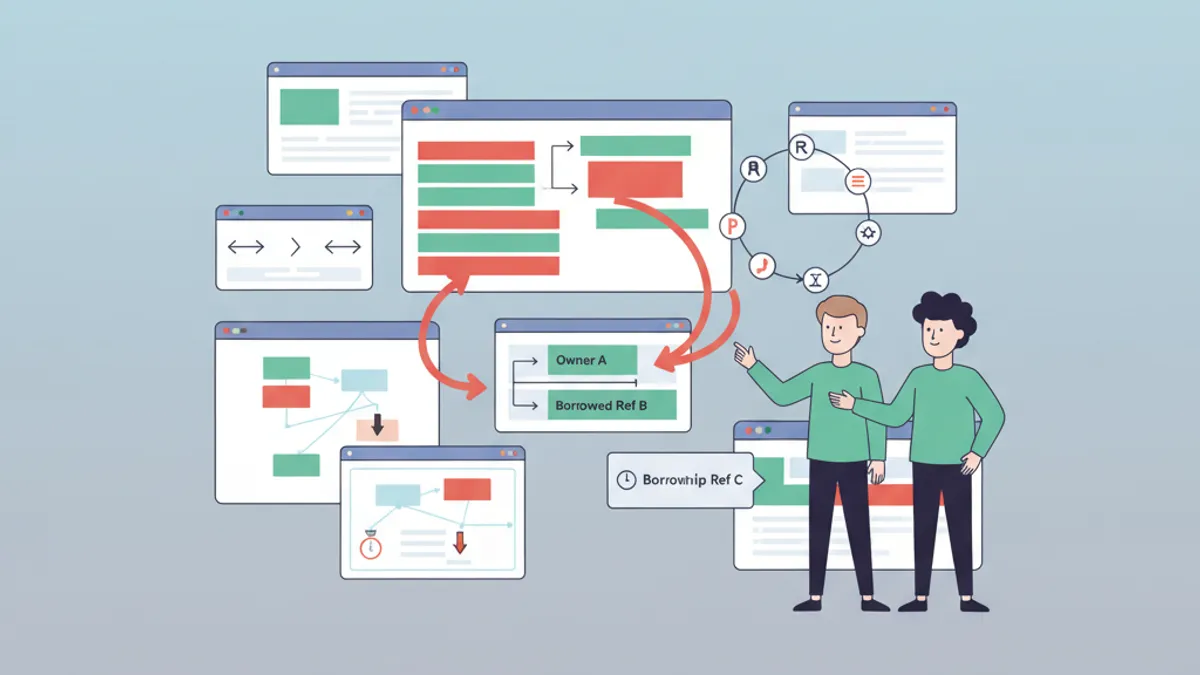
Ownership e Borrowing em Rust: Guia Completo
Domine o sistema de ownership e borrowing do Rust. Regras de propriedade, referências, lifetimes e padrões avançados de gerenciamento de memória.

Perguntas de Entrevista sobre Rust: Guia Completo 2026
As 25 perguntas mais comuns em entrevistas sobre Rust. Ownership, borrowing, lifetimes, traits, async e concorrencia com respostas detalhadas e exemplos de codigo.

Ownership e Borrowing em Rust: Guia Completo para Entrevistas Tecnicas
Domine os conceitos de ownership, borrowing e lifetimes em Rust. Guia pratico com exemplos de codigo para se preparar para entrevistas tecnicas de programacao de sistemas.