Ownership e Borrowing em Rust: Guia Completo
Domine o sistema de ownership e borrowing do Rust. Regras de propriedade, referências, lifetimes e padrões avançados de gerenciamento de memória.
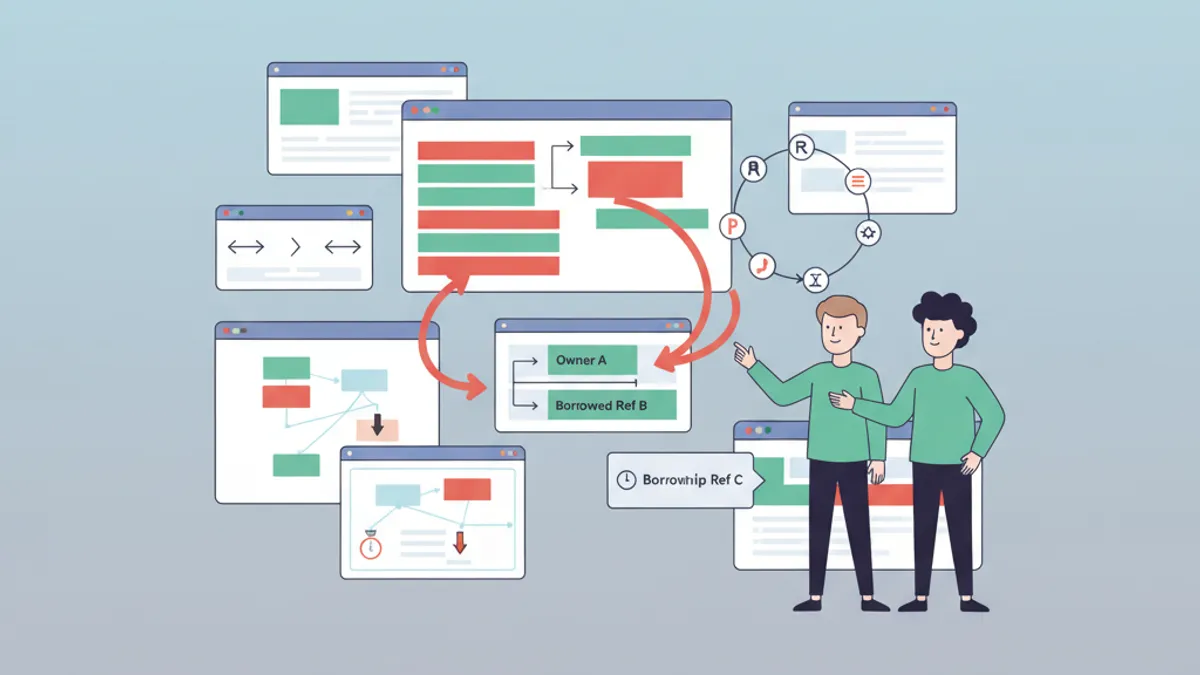
O sistema de ownership é o que diferencia o Rust de qualquer outra linguagem de programação. Essa abordagem única garante segurança de memória sem coletor de lixo, capturando bugs em tempo de compilação em vez de em tempo de execução. Este guia aprofundado explora os mecanismos de ownership e borrowing, dos fundamentos aos padrões avançados de produção.
O compilador do Rust age como um assistente de programação exigente: cada erro de ownership bloqueado em tempo de compilação representa um bug potencial evitado em produção.
As Três Regras Fundamentais do Ownership
O sistema de ownership repousa sobre três regras simples mas estritas. Uma vez interiorizadas, o modelo mental do Rust torna-se natural e previsível.
// Demonstration of the three fundamental rules

fn main() {
    // Rule 1: Each value has exactly ONE owner
    let s1 = String::from("hello");  // s1 is the sole owner

    // Rule 2: There can only be one owner at a time
    let s2 = s1;  // Ownership transferred (moved) from s1 to s2
    // println!("{}", s1);  // Compile ERROR: s1 no longer exists
    println!("s2 = {}", s2);  // Only s2 is valid now

    // Rule 3: When the owner goes out of scope, the value is dropped
    {
        let s3 = String::from("temporary");
        println!("s3 inside block = {}", s3);
    }  // s3 is automatically freed here (drop is called)
    // println!("{}", s3);  // ERROR: s3 no longer exists
}
Essas três regras eliminam categorias inteiras de bugs: use-after-free, double-free e vazamentos de memória. O compilador verifica estaticamente que essas regras são respeitadas.
Move vs Copy: Compreender a Semântica de Transferência
O comportamento da atribuição depende do tipo de dado. Os tipos que implementam o trait Copy são duplicados, enquanto os outros sofrem move.
// Distinction between Copy types and Move types

fn main() {
    // Copy types: values stored on the stack, known size
    let x: i32 = 42;
    let y = x;  // x is COPIED, not moved
    println!("x = {}, y = {}", x, y);  // Both are valid

    // Other Copy types: f64, bool, char, tuples of Copy types
    let point = (3.0, 4.0);
    let point_copy = point;  // Tuple copy
    println!("Original: {:?}, Copy: {:?}", point, point_copy);

    // Move types: values on the heap, dynamic size
    let s1 = String::from("owned");
    let s2 = s1;  // s1 is MOVED to s2
    // println!("{}", s1);  // ERROR: value moved
    println!("s2 = {}", s2);

    // Vec, HashMap, Box are also Move types
    let vec1 = vec![1, 2, 3];
    let vec2 = vec1;  // Move, not copy
    // println!("{:?}", vec1);  // ERROR
    println!("vec2 = {:?}", vec2);
}

// Explicit clone to duplicate Move types
fn explicit_clone() {
    let original = String::from("important data");
    let clone = original.clone();  // Explicit duplication (memory cost)

    println!("Original: {}", original);  // Still valid
    println!("Clone: {}", clone);  // Independent copy
}
A distinção Move/Copy é fundamental: determina se a atribuição transfere a propriedade ou cria uma cópia independente.
Chamar .clone() deve ser intencional. Um código repleto de clones pode indicar um problema de design. O borrowing costuma ser uma solução melhor.
Borrowing: Referências Imutáveis e Mutáveis
O borrowing permite acessar um valor sem tomar a sua propriedade. Esse mecanismo torna o código Rust seguro e performático ao mesmo tempo.
// Immutable and mutable references

fn main() {
    let s = String::from("hello");

    // Immutable reference: read-only, multiple allowed
    let len = calculate_length(&s);  // Immutable borrow
    println!("'{}' has {} characters", s, len);  // s still valid

    // Multiple simultaneous immutable references: OK
    let r1 = &s;
    let r2 = &s;
    let r3 = &s;
    println!("r1={}, r2={}, r3={}", r1, r2, r3);
}

fn calculate_length(s: &String) -> usize {
    // s is a reference, not the owner
    s.len()
}  // s goes out of scope but doesn't drop anything (not owner)

// Mutable references: modification allowed
fn mutable_borrowing() {
    let mut s = String::from("hello");

    change(&mut s);  // Mutable borrow
    println!("After modification: {}", s);
}

fn change(s: &mut String) {
    s.push_str(", world!");  // Modification via mutable reference
}
A regra de ouro do borrowing: ou múltiplas referências imutáveis OU uma única referência mutável, nunca ambas simultaneamente.
Regras do Borrow Checker
O borrow checker é o componente do compilador que verifica as regras de borrowing. Compreender seus erros permite resolver problemas rapidamente.
// Strict borrow checker rules

fn main() {
    // RULE 1: No mutable reference with immutable references
    let mut s = String::from("hello");

    let r1 = &s;      // Immutable reference: OK
    let r2 = &s;      // Another immutable reference: OK
    // let r3 = &mut s;  // ERROR: cannot borrow as mutable
    println!("{} and {}", r1, r2);

    // AFTER using r1 and r2, they are "dead"
    let r3 = &mut s;  // Now OK: r1 and r2 no longer used
    r3.push_str(" world");
    println!("{}", r3);

    // RULE 2: Only one mutable reference at a time
    let mut data = String::from("exclusive");
    let ref1 = &mut data;
    // let ref2 = &mut data;  // ERROR: already borrowed mutably
    ref1.push_str("!");
    println!("{}", ref1);
}

// RULE 3: References cannot outlive the data
fn dangling_reference_prevented() {
    let reference;
    {
        let s = String::from("short-lived");
        // reference = &s;  // ERROR: s doesn't live long enough
    }
    // s is dropped here, reference would be invalid

    // Solution: move the value out of the scope
    let owned_outside;
    {
        let s = String::from("moved out");
        owned_outside = s;  // Move, not reference
    }
    println!("{}", owned_outside);  // OK: owned_outside is the owner
}
O borrow checker utiliza Non-Lexical Lifetimes (NLL): uma referência é considerada ativa apenas até seu último uso, não até o fim do escopo.
Pronto para mandar bem nas entrevistas de Rust?
Pratique com nossos simuladores interativos, flashcards e testes tecnicos.
Lifetimes: Anotar a Duração das Referências
Lifetimes são anotações que ajudam o compilador a verificar que as referências permanecem válidas. Na maioria das vezes, são inferidas automaticamente.
// Explicit lifetime annotations

// Without annotation: compiler infers lifetimes
fn first_word(s: &str) -> &str {
    match s.find(' ') {
        Some(i) => &s[..i],
        None => s,
    }
}

// With explicit annotation: same function
fn first_word_explicit<'a>(s: &'a str) -> &'a str {
    // 'a means: returned reference lives as long as the input
    match s.find(' ') {
        Some(i) => &s[..i],
        None => s,
    }
}

// When annotations are necessary: multiple references
fn longest<'a>(x: &'a str, y: &'a str) -> &'a str {
    // Compiler cannot guess which reference is returned
    if x.len() > y.len() {
        x
    } else {
        y
    }
}

fn main() {
    let string1 = String::from("long string");
    let result;
    {
        let string2 = String::from("xyz");
        result = longest(&string1, &string2);
        println!("Longest: {}", result);  // OK here
    }
    // println!("{}", result);  // ERROR if uncommented: string2 dropped
}
Lifetimes não alteram quanto tempo os dados vivem; descrevem relações entre os tempos de vida de diferentes referências.
Lifetimes em Structs
Quando uma struct contém referências, os lifetimes devem ser anotados para garantir que a struct não sobreviva aos dados referenciados.
// Structs containing references

// Struct with reference: lifetime required
struct ImportantExcerpt<'a> {
    part: &'a str,  // This reference must live at least as long as the struct
}

impl<'a> ImportantExcerpt<'a> {
    // Method returning a reference with the same lifetime
    fn level(&self) -> i32 {
        3
    }

    // Elision rule: &self implies the output lifetime
    fn announce_and_return_part(&self, announcement: &str) -> &str {
        println!("Attention: {}", announcement);
        self.part  // Returns with 'a lifetime from self
    }
}

fn main() {
    let novel = String::from("Call me Ishmael. Some years ago...");
    let first_sentence = novel.split('.').next().unwrap();

    let excerpt = ImportantExcerpt {
        part: first_sentence,  // OK: novel outlives excerpt
    };

    println!("Excerpt: {}", excerpt.part);
    println!("Level: {}", excerpt.level());
}

// Static lifetime: reference valid for the entire program duration
fn static_lifetime_example() {
    let s: &'static str = "This string is in the binary";
    // String literals always have 'static lifetime
    println!("{}", s);
}
As regras de elisão de lifetimes geralmente permitem omitir as anotações em casos comuns, tornando o código mais legível.
Padrões Avançados: Mutabilidade Interior
Às vezes a mutabilidade precisa ser verificada em tempo de execução em vez de em tempo de compilação. O Rust fornece tipos para esse padrão: RefCell e Cell.
// Interior mutability with RefCell and Cell

use std::cell::{Cell, RefCell};

// Cell: for Copy types, replaces the entire value
struct Counter {
    count: Cell<u32>,  // Mutable despite &self
}

impl Counter {
    fn new() -> Counter {
        Counter { count: Cell::new(0) }
    }

    fn increment(&self) {
        // Modification via immutable reference!
        self.count.set(self.count.get() + 1);
    }

    fn get(&self) -> u32 {
        self.count.get()
    }
}

// RefCell: for non-Copy types, checks at runtime
struct CachedValue {
    value: RefCell<Option<String>>,
}

impl CachedValue {
    fn new() -> CachedValue {
        CachedValue { value: RefCell::new(None) }
    }

    fn get_or_compute(&self, compute: impl FnOnce() -> String) -> String {
        // borrow() for reading, borrow_mut() for writing
        if self.value.borrow().is_none() {
            *self.value.borrow_mut() = Some(compute());
        }
        self.value.borrow().as_ref().unwrap().clone()
    }
}

fn main() {
    let counter = Counter::new();
    counter.increment();
    counter.increment();
    println!("Counter: {}", counter.get());  // 2

    let cache = CachedValue::new();
    let result = cache.get_or_compute(|| {
        println!("Expensive computation...");
        String::from("result")
    });
    println!("Value: {}", result);

    // Second call: no recomputation
    let result2 = cache.get_or_compute(|| String::from("never executed"));
    println!("Cache hit: {}", result2);
}
RefCell e Cell movem a verificação do borrowing para o tempo de execução. Uma violação de regra causa um panic em vez de um erro de compilação.
RefCell::borrow_mut() causa panic se o valor já estiver emprestado. Convém usar try_borrow_mut() para um tratamento explícito de erros.
Smart Pointers e Ownership
Smart pointers como Box, Rc e Arc oferecem diferentes estratégias de ownership para casos de uso específicos.
// Box, Rc, and Arc for different ownership patterns

use std::rc::Rc;
use std::sync::Arc;
use std::thread;

// Box: single owner, data on the heap
fn box_example() {
    let boxed = Box::new(vec![1, 2, 3, 4, 5]);
    println!("Boxed vec: {:?}", boxed);
    // Useful for: recursive types, large objects, trait objects
}

// Rc: reference counting, multiple owners (single-thread)
fn rc_example() {
    let data = Rc::new(String::from("shared data"));

    let clone1 = Rc::clone(&data);  // Increments the counter
    let clone2 = Rc::clone(&data);

    println!("Count: {}", Rc::strong_count(&data));  // 3
    println!("All share: {}, {}, {}", data, clone1, clone2);
}  // Freed when counter reaches 0

// Arc: thread-safe Rc (Atomic Reference Counting)
fn arc_example() {
    let data = Arc::new(vec![1, 2, 3]);

    let handles: Vec<_> = (0..3).map(|i| {
        let data_clone = Arc::clone(&data);
        thread::spawn(move || {
            println!("Thread {}: {:?}", i, data_clone);
        })
    }).collect();

    for handle in handles {
        handle.join().unwrap();
    }
}

fn main() {
    box_example();
    rc_example();
    arc_example();
}
A escolha do smart pointer depende do padrão de ownership: único (Box), compartilhado em uma única thread (Rc) ou compartilhado entre threads (Arc).
Padrões Práticos de Ownership
A seguir, padrões comuns para estruturar código em torno do sistema de ownership.
// Practical patterns for ownership management

// Pattern 1: Builder pattern with chained ownership
struct RequestBuilder {
    url: String,
    headers: Vec<(String, String)>,
    timeout: Option<u64>,
}

impl RequestBuilder {
    fn new(url: &str) -> Self {
        RequestBuilder {
            url: url.to_string(),
            headers: Vec::new(),
            timeout: None,
        }
    }

    // Consumes self and returns the new self
    fn header(mut self, key: &str, value: &str) -> Self {
        self.headers.push((key.to_string(), value.to_string()));
        self  // Returns ownership
    }

    fn timeout(mut self, seconds: u64) -> Self {
        self.timeout = Some(seconds);
        self
    }

    fn build(self) -> Request {
        Request {
            url: self.url,
            headers: self.headers,
            timeout: self.timeout.unwrap_or(30),
        }
    }
}

struct Request {
    url: String,
    headers: Vec<(String, String)>,
    timeout: u64,
}

// Pattern 2: Cow (Copy-on-Write) to avoid allocations
use std::borrow::Cow;

fn process_text(input: &str) -> Cow<str> {
    if input.contains("REPLACE") {
        // Allocation only if modification needed
        Cow::Owned(input.replace("REPLACE", "NEW"))
    } else {
        // No allocation, returns a reference
        Cow::Borrowed(input)
    }
}

// Pattern 3: Take to extract from an Option
fn extract_value(data: &mut Option<String>) -> String {
    data.take().unwrap_or_else(|| String::from("default"))
    // take() replaces with None and returns ownership of the value
}

fn main() {
    // Builder pattern
    let request = RequestBuilder::new("https://api.example.com")
        .header("Authorization", "Bearer token")
        .header("Content-Type", "application/json")
        .timeout(60)
        .build();

    println!("URL: {}, Timeout: {}s", request.url, request.timeout);

    // Cow pattern
    let text1 = process_text("hello world");  // No allocation
    let text2 = process_text("hello REPLACE");  // Allocation
    println!("{} | {}", text1, text2);

    // Take pattern
    let mut optional = Some(String::from("extracted"));
    let value = extract_value(&mut optional);
    println!("Value: {}, Option: {:?}", value, optional);  // None
}
Esses padrões aproveitam o sistema de ownership para criar APIs ergonômicas e performáticas.
Comece a praticar!
Teste seus conhecimentos com nossos simuladores de entrevista e testes tecnicos.
Conclusão
O sistema de ownership e borrowing do Rust representa uma mudança de paradigma no gerenciamento de memória. Uma vez dominado, torna-se um aliado poderoso para escrever código eficiente e seguro ao mesmo tempo.
Pontos-chave a reter:
✅ Três regras de ownership: proprietário único, transferência de propriedade, drop automático
✅ Borrowing: múltiplas referências imutáveis OU uma referência mutável exclusiva
✅ Lifetimes: anotar relações entre os tempos de vida das referências
✅ Mutabilidade interior: RefCell e Cell para mutabilidade verificada em runtime
✅ Smart pointers: Box (único), Rc (compartilhado), Arc (thread-safe)
✅ Padrões práticos: Builder, Cow, Take para APIs idiomáticas
O borrow checker pode parecer rígido no início, mas cada erro que sinaliza representa um bug potencial evitado. Com a prática, pensar em termos de ownership torna-se natural e melhora a qualidade do código em todas as linguagens.
Comece a praticar!
Teste seus conhecimentos com nossos simuladores de entrevista e testes tecnicos.
Você saberia encontrar o bug em Rust?
Um trecho real, um bug escondido, uma tentativa por dia. Sem conta para testar.

Escrito por
Anthony Fillion-MailletFundador da SharpSkill
Desenvolvedor fullstack há mais de 10 anos. Dirige a SharpSkill e responde por tudo o que é publicado aqui.
Atualizado em 29 de abril de 2026
Tags
Compartilhar
Artigos relacionados

Ownership e Borrowing em Rust: Guia Completo para Entrevistas Tecnicas
Domine os conceitos de ownership, borrowing e lifetimes em Rust. Guia pratico com exemplos de codigo para se preparar para entrevistas tecnicas de programacao de sistemas.

Perguntas de Entrevista sobre Rust: Guia Completo 2026
As 25 perguntas mais comuns em entrevistas sobre Rust. Ownership, borrowing, lifetimes, traits, async e concorrencia com respostas detalhadas e exemplos de codigo.

Rust: Fundamentos para Desenvolvedores Experientes em 2026
Aprenda Rust aproveitando sua experiencia previa. Ownership, borrowing, lifetimes e padroes essenciais explicados para quem vem de C++, Java ou Python.