Swift Testing Framework Sollicitatiegesprek 2026: Macro's #expect en #require vs XCTest
Beheers het nieuwe Swift Testing Framework voor iOS-sollicitaties: macro's #expect en #require, migratie vanuit XCTest, geavanceerde patronen en veelgemaakte fouten.
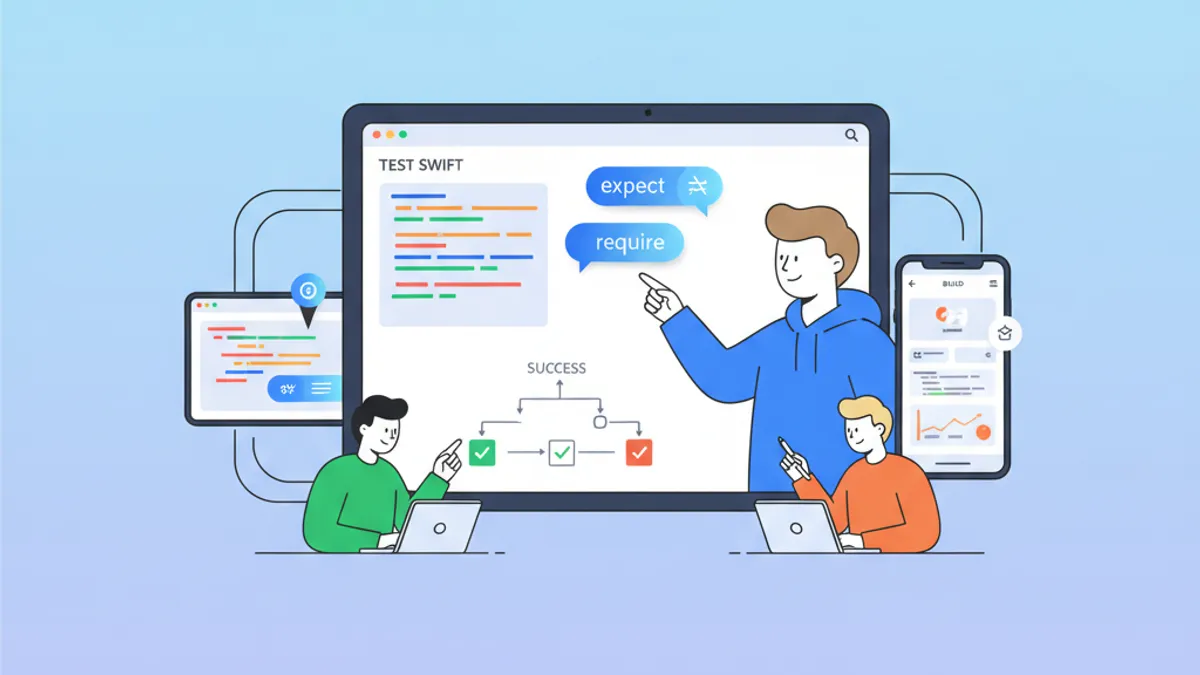
Geïntroduceerd op WWDC 2024 en uitgebracht met Swift 6 en Xcode 16, vormt Swift Testing een complete heroverweging van hoe testen werken in Swift. Dit framework vervangt de meer dan 40 assertions van XCTest door slechts twee macro's: #expect en #require. Interviewers toetsen deze kennis nu regelmatig tijdens technische iOS-sollicitatiegesprekken.
Elke sectie weerspiegelt een technische sollicitatievraag met gedetailleerde antwoorden en werkende code. De progressie loopt van fundamentele concepten naar geavanceerde patronen.
Fundamenten van Swift Testing
Vraag 1: Wat zijn de belangrijkste verschillen tussen Swift Testing en XCTest?
Swift Testing brengt vijf fundamentele veranderingen ten opzichte van XCTest:
- Declaratieve syntax:
@Test-attribuut in plaats vantest-prefixen - Twee universele macro's:
#expecten#requirevervangen meer dan 40 assertions - Standaard parallel: alle tests draaien gelijktijdig
- Native async-ondersteuning: volledige integratie met Swift Concurrency
- Cross-platform: werkt op Apple-platforms, Linux en Windows
import XCTest
import Testing

// ❌ Legacy XCTest pattern
class UserServiceXCTests: XCTestCase {
    // Must start with "test"
    func testUserCreation() {
        let user = User(name: "Alice", age: 25)

        // Multiple verbose assertions
        XCTAssertNotNil(user)
        XCTAssertEqual(user.name, "Alice")
        XCTAssertGreaterThan(user.age, 18)
        XCTAssertTrue(user.isValid)
    }
}

// ✅ Modern Swift Testing pattern
@Test("User creation with valid data")
func userCreation() {
    let user = User(name: "Alice", age: 25)

    // Single macro for all verifications
    #expect(user.name == "Alice")
    #expect(user.age > 18)
    #expect(user.isValid)
}
Het kernverschil zit in de expressiviteit: Swift Testing gebruikt standaard Swift-expressies in plaats van gespecialiseerde assertions, wat tests leesbaarder en foutmeldingen informatiever maakt.
Vraag 2: Hoe werkt de #expect-macro?
De #expect-macro valideert dat een booleaanse expressie waar is. Hij vangt automatisch geëvalueerde waarden op om gedetailleerde foutmeldingen te leveren. In tegenstelling tot XCTAssert gebruikt hij native Swift-syntax.
import Testing

@Test func basicExpectations() {
    let numbers = [1, 2, 3, 4, 5]
    let user = User(name: "Bob", email: "bob@example.com")

    // Simple comparisons - standard Swift expression
    #expect(numbers.count == 5)
    #expect(user.name == "Bob")

    // Comparisons with operators
    #expect(numbers.first! < numbers.last!)
    #expect(user.email.contains("@"))

    // Nil checking
    #expect(numbers.first != nil)

    // Collection verification
    #expect(numbers.contains(3))
    #expect(!numbers.isEmpty)
}

@Test func expectWithCustomMessage() {
    let balance = 150.0
    let withdrawAmount = 200.0

    // Custom message to clarify intent
    #expect(
        balance >= withdrawAmount,
        "Insufficient funds: balance \(balance) < withdrawal \(withdrawAmount)"
    )
}
Wanneer een #expect faalt, gaat de test door met uitvoeren. Dit kenmerk maakt het mogelijk om meerdere fouten in één run te verzamelen, wat de diagnose vergemakkelijkt.
Vraag 3: Wat is het verschil tussen #expect en #require?
Het fundamentele verschil betreft het gedrag na een fout:
#expect: registreert de fout en gaat door met de uitvoering#require: registreert de fout en stopt de test onmiddellijk
#require moet altijd met try gebruikt worden omdat het een error kan gooien.
import Testing

struct ApiResponse {
    let data: Data?
    let items: [Item]?
}

@Test func demonstrateExpectContinues() {
    let values = [1, 2, 3]

    // First #expect fails but test continues
    #expect(values.count == 10)  // ❌ Failure recorded

    // These verifications still execute
    #expect(values.first == 1)   // ✅ Success
    #expect(values.last == 3)    // ✅ Success

    // Result: 1 failure, 2 successes in the same test
}

@Test func demonstrateRequireStops() throws {
    let response = ApiResponse(data: nil, items: nil)

    // #require stops immediately if condition fails
    let data = try #require(response.data)  // ❌ Failure and STOP

    // This code NEVER executes if data is nil
    let json = try JSONDecoder().decode(User.self, from: data)
    #expect(json.name == "Alice")
}
In de praktijk vervangt #require XCTUnwrap perfect voor het veilig uitpakken van optionals.
Gebruik #require wanneer vervolgstappen afhangen van het resultaat (uitpakken, voorwaarden). Gebruik #expect voor onafhankelijke controles die mogen falen zonder de rest van de test te blokkeren.
Geavanceerde patronen met #require
Vraag 4: Hoe gebruik je #require om optionals uit te pakken?
#require excelleert in het uitpakken van optionals. Het retourneert de niet-optionele waarde als die bestaat, of laat de test direct falen bij nil.
import Testing

struct UserProfile {
    let id: Int
    let name: String
    let settings: Settings?
}

struct Settings {
    let theme: String
    let notifications: Bool
}

@Test func unwrapOptionalChain() throws {
    let profile = UserProfile(
        id: 1,
        name: "Alice",
        settings: Settings(theme: "dark", notifications: true)
    )

    // Safe unwrap - stops if nil
    let settings = try #require(profile.settings)

    // Now settings is no longer optional
    #expect(settings.theme == "dark")
    #expect(settings.notifications == true)
}

@Test func unwrapArrayElement() throws {
    let users = ["Alice", "Bob", "Charlie"]

    // Unwrap first element
    let firstUser = try #require(users.first)
    #expect(firstUser == "Alice")

    // Unwrap with safe index
    let secondUser = try #require(users[safe: 1])
    #expect(secondUser == "Bob")
}

@Test func unwrapDictionaryValue() throws {
    let config: [String: Any] = [
        "apiUrl": "https://api.example.com",
        "timeout": 30,
        "retryCount": 3
    ]

    // Unwrap and cast in a single operation
    let apiUrl = try #require(config["apiUrl"] as? String)
    let timeout = try #require(config["timeout"] as? Int)

    #expect(apiUrl.contains("https"))
    #expect(timeout > 0)
}
Deze aanpak elimineert guard let-piramides en maakt testcode lineair en leesbaar.
Vraag 5: Hoe test je dat een functie een error gooit?
Swift Testing biedt #expect(throws:) om te verifiëren dat een functie een specifieke error gooit.
import Testing

enum ValidationError: Error, Equatable {
    case emptyName
    case invalidEmail
    case underAge(minimum: Int)
}

struct Validator {
    static func validateUser(name: String, email: String, age: Int) throws {
        guard !name.isEmpty else {
            throw ValidationError.emptyName
        }
        guard email.contains("@") else {
            throw ValidationError.invalidEmail
        }
        guard age >= 18 else {
            throw ValidationError.underAge(minimum: 18)
        }
    }
}

@Test func testThrowsSpecificError() {
    // Verify a specific error is thrown
    #expect(throws: ValidationError.emptyName) {
        try Validator.validateUser(name: "", email: "test@mail.com", age: 25)
    }

    #expect(throws: ValidationError.invalidEmail) {
        try Validator.validateUser(name: "Alice", email: "invalid", age: 25)
    }
}

@Test func testThrowsErrorType() {
    // Verify error type without specific value
    #expect(throws: ValidationError.self) {
        try Validator.validateUser(name: "Bob", email: "bob@mail.com", age: 15)
    }
}

@Test func testThrowsWithInspection() throws {
    // Capture error for detailed inspection
    let error = try #require(
        throws: ValidationError.self
    ) {
        try Validator.validateUser(name: "Charlie", email: "charlie@mail.com", age: 16)
    }

    // Verify error details
    if case .underAge(let minimum) = error {
        #expect(minimum == 18)
    }
}
Deze syntax vervangt XCTAssertThrowsError door een helderdere, type-safe API.
Klaar om je iOS gesprekken te halen?
Oefen met onze interactieve simulatoren, flashcards en technische tests.
Tests organiseren met @Test en @Suite
Vraag 6: Hoe organiseer je tests met @Suite?
@Suite groepeert verwante tests logisch. Anders dan XCTestCase is geen klasse-overerving nodig.
import Testing

// Suite for authentication tests
@Suite("Authentication Tests")
struct AuthenticationTests {

    // Shared property for all tests in the suite
    let authService = AuthService()

    @Test("Login with valid credentials succeeds")
    func loginWithValidCredentials() async throws {
        let result = try await authService.login(
            email: "user@example.com",
            password: "validPass123"
        )

        #expect(result.isSuccess)
        let token = try #require(result.token)
        #expect(!token.isEmpty)
    }

    @Test("Login with invalid password fails")
    func loginWithInvalidPassword() async {
        let result = await authService.login(
            email: "user@example.com",
            password: "wrong"
        )

        #expect(!result.isSuccess)
        #expect(result.error == .invalidCredentials)
    }
}

// Nested suites for hierarchical organization
@Suite("User Management")
struct UserManagementTests {

    @Suite("Creation")
    struct CreationTests {
        @Test func createUserWithValidData() {
            // Creation test
        }

        @Test func createUserWithDuplicateEmail() {
            // Duplicate error test
        }
    }

    @Suite("Deletion")
    struct DeletionTests {
        @Test func deleteExistingUser() {
            // Deletion test
        }

        @Test func deleteNonExistentUser() {
            // Error test
        }
    }
}
Suites maken het mogelijk om subsets van tests te draaien en rapporten leesbaar te organiseren.
Vraag 7: Hoe gebruik je traits om tests te configureren?
Traits passen testgedrag aan: uitvoeringsvoorwaarden, tags, timeouts, enzovoort.
import Testing

@Suite("API Integration Tests")
struct APITests {

    // Temporarily disabled test
    @Test(.disabled("Backend under maintenance"))
    func fetchUserProfile() async {
        // Does not execute
    }

    // Conditional test based on platform
    @Test
    @available(iOS 17, *)
    func useNewAPIFeature() {
        // Executes only on iOS 17+
    }

    // Test with tags for filtering
    @Test(.tags(.critical, .network))
    func criticalNetworkOperation() async throws {
        // Tagged test for filtering
    }

    // Test with custom timeout
    @Test(.timeLimit(.minutes(2)))
    func longRunningOperation() async {
        // Must complete within 2 minutes
    }

    // Trait combination
    @Test(
        "Complex data sync",
        .tags(.slow),
        .timeLimit(.minutes(5)),
        .bug("JIRA-1234", "Flaky on CI")
    )
    func complexDataSync() async throws {
        // Test documented with known bug
    }
}

// Custom tag definitions
extension Tag {
    @Tag static var critical: Self
    @Tag static var network: Self
    @Tag static var slow: Self
}
Traits maken tests zelfdocumenterend en stellen selectieve uitvoering via de command line in staat.
Geparametriseerde tests
Vraag 8: Hoe maak je geparametriseerde tests?
Swift Testing maakt het mogelijk om dezelfde test met verschillende invoerwaarden via parameters uit te voeren.
import Testing

struct EmailValidator {
    static func isValid(_ email: String) -> Bool {
        let pattern = #"^[\w-\.]+@([\w-]+\.)+[\w-]{2,4}$"#
        return email.range(of: pattern, options: .regularExpression) != nil
    }
}

// Parameterized test with a collection
@Test(arguments: [
    "user@example.com",
    "test.name@domain.org",
    "contact@company.co.uk"
])
func validEmailsAreAccepted(email: String) {
    #expect(EmailValidator.isValid(email))
}

@Test(arguments: [
    "invalid",
    "@nodomain.com",
    "no@tld",
    "spaces in@email.com"
])
func invalidEmailsAreRejected(email: String) {
    #expect(!EmailValidator.isValid(email))
}

// Test with tuples for input/output cases
@Test(arguments: [
    ("hello", "HELLO"),
    ("World", "WORLD"),
    ("Swift", "SWIFT")
])
func uppercaseConversion(input: String, expected: String) {
    #expect(input.uppercased() == expected)
}

// Test with Cartesian product of two collections
@Test(arguments: [1, 2, 3], ["a", "b"])
func combinationTest(number: Int, letter: String) {
    // Runs for (1,"a"), (1,"b"), (2,"a"), (2,"b"), (3,"a"), (3,"b")
    let combined = "\(number)\(letter)"
    #expect(combined.count == 2)
}
Elke parametercombinatie genereert een onafhankelijke test, wat het identificeren van falende cases vereenvoudigt.
Vraag 9: Hoe test je asynchrone code?
Swift Testing integreert async/await native, wat asynchrone tests drastisch vereenvoudigt.
import Testing

actor DataStore {
    private var items: [String] = []

    func add(_ item: String) {
        items.append(item)
    }

    func getAll() -> [String] {
        items
    }

    func clear() {
        items.removeAll()
    }
}

@Suite("Async Operations")
struct AsyncTests {

    @Test func basicAsyncOperation() async {
        // No need for expectation or wait
        let result = await fetchData()
        #expect(!result.isEmpty)
    }

    @Test func asyncWithTimeout() async throws {
        // Use Task.sleep to simulate delay
        try await Task.sleep(for: .milliseconds(100))

        let data = await loadConfiguration()
        let config = try #require(data)
        #expect(config.isValid)
    }

    @Test func testActorIsolation() async {
        let store = DataStore()

        // Operations on actor sequentially
        await store.add("Item 1")
        await store.add("Item 2")

        let items = await store.getAll()
        #expect(items.count == 2)
        #expect(items.contains("Item 1"))
    }

    @Test func testConcurrentOperations() async {
        let store = DataStore()

        // Concurrent execution with TaskGroup
        await withTaskGroup(of: Void.self) { group in
            for i in 1...10 {
                group.addTask {
                    await store.add("Item \(i)")
                }
            }
        }

        let items = await store.getAll()
        #expect(items.count == 10)
    }
}

// Async helpers for tests
func fetchData() async -> [String] {
    try? await Task.sleep(for: .milliseconds(50))
    return ["data1", "data2"]
}

func loadConfiguration() async -> Configuration? {
    Configuration(isValid: true)
}

struct Configuration {
    let isValid: Bool
}Swift Testing draait tests standaard parallel. Voor tests die gedeelde state wijzigen, gebruik je .serialized op de suite of isoleer je de state met actors.
Migratie van XCTest naar Swift Testing
Vraag 10: Hoe migreer je geleidelijk van XCTest?
De twee frameworks bestaan naast elkaar in hetzelfde project. Een geleidelijke migratie is aan te raden.
import XCTest
import Testing

// ⚠️ CRITICAL RULE: Never mix frameworks in the same test

// ❌ INCORRECT - Mixing forbidden
class BadMixedTest: XCTestCase {
    func testMixed() {
        #expect(true)  // Does not work in XCTestCase
    }
}

// ✅ CORRECT - Pure XCTest for existing tests
class LegacyUserTests: XCTestCase {
    func testUserCreation() {
        let user = User(name: "Test")
        XCTAssertNotNil(user)
        XCTAssertEqual(user.name, "Test")
    }
}

// ✅ CORRECT - Swift Testing for new tests
@Suite("User Tests - Modern")
struct ModernUserTests {
    @Test func userCreation() {
        let user = User(name: "Test")
        #expect(user.name == "Test")
    }
}

// Migration strategy by file
// 1. Identify tests to migrate (start with simplest)
// 2. Create new file with @Suite
// 3. Rewrite tests one by one
// 4. Delete old XCTest file once validated| XCTest | Swift Testing |
|---|---|
XCTAssertTrue(x) | #expect(x) |
XCTAssertFalse(x) | #expect(!x) |
XCTAssertEqual(a, b) | #expect(a == b) |
XCTAssertNil(x) | #expect(x == nil) |
XCTAssertNotNil(x) | #expect(x != nil) |
XCTUnwrap(x) | try #require(x) |
XCTAssertThrowsError | #expect(throws:) |
Vraag 11: Welke XCTest-functies zitten nog niet in Swift Testing?
Swift Testing (Swift 6) dekt nog niet alle use cases van XCTest af.
// ❌ NOT SUPPORTED: Performance tests
// Stick with XCTest for measuring performance
class PerformanceTests: XCTestCase {
    func testPerformance() {
        measure {
            // Code to measure
            _ = (0..<1000).map { $0 * 2 }
        }
    }
}

// ❌ NOT SUPPORTED: UI tests (XCUITest)
// Continue using XCUITest for interface tests
class UITests: XCTestCase {
    func testLoginFlow() {
        let app = XCUIApplication()
        app.launch()
        // UI tests...
    }
}

// ✅ SUPPORTED: Async integration tests
@Test func integrationTest() async throws {
    let api = APIClient()
    let response = try await api.fetchUsers()
    #expect(!response.isEmpty)
}

// ✅ SUPPORTED: Mocking with protocols
@Test func mockingWithProtocols() async {
    let mockService = MockUserService()
    let viewModel = UserViewModel(service: mockService)

    await viewModel.loadUser(id: 1)

    #expect(viewModel.user?.name == "Mock User")
}
Voor projecten met UI- of performance-tests, blijf XCTest voor die specifieke gevallen gebruiken.
Klaar om je iOS gesprekken te halen?
Oefen met onze interactieve simulatoren, flashcards en technische tests.
Strikvragen tijdens sollicitaties
Vraag 12: Waarom heeft #require try nodig en #expect niet?
#require kan een error gooien als de conditie faalt omdat het de test moet onderbreken. #expect registreert de fout alleen en gaat door, dus gooit niets.
import Testing

@Test func explainTryRequirement() throws {
    let optionalValue: String? = nil

    // #expect returns Void - no error thrown
    // Test continues even if it fails
    #expect(optionalValue != nil)  // No try

    // #require can throw ExpectationFailedError
    // Test stops if it fails
    // Must be marked with try
    let value = try #require(optionalValue)  // Requires try

    // If we reach here, optionalValue was not nil
    #expect(!value.isEmpty)
}

// The internal signature resembles:
// func #expect(_ condition: Bool) -> Void
// func #require<T>(_ value: T?) throws -> T
Dit architectonisch onderscheid laat de compiler correct foutafhandeling garanderen.
Vraag 13: Hoe gaat Swift Testing om met parallellisme?
Standaard draaien alle tests parallel, wat suites versnelt maar correcte state-isolatie vereist.
import Testing

// ❌ PROBLEM: Mutable shared state
var sharedCounter = 0  // Dangerous in parallel!

@Suite("Problematic Parallel Tests")
struct ProblematicTests {
    @Test func incrementCounter1() {
        sharedCounter += 1  // Race condition!
    }

    @Test func incrementCounter2() {
        sharedCounter += 1  // Race condition!
    }
}

// ✅ SOLUTION 1: Force sequential execution
@Suite("Sequential Tests", .serialized)
struct SequentialTests {
    static var counter = 0

    @Test func first() {
        Self.counter += 1
        #expect(Self.counter == 1)
    }

    @Test func second() {
        Self.counter += 1
        #expect(Self.counter == 2)
    }
}

// ✅ SOLUTION 2: Isolate state per test
@Suite("Isolated Tests")
struct IsolatedTests {
    @Test func independentTest1() {
        var localCounter = 0
        localCounter += 1
        #expect(localCounter == 1)
    }

    @Test func independentTest2() {
        var localCounter = 0
        localCounter += 1
        #expect(localCounter == 1)
    }
}

// ✅ SOLUTION 3: Use actor for shared state
actor TestState {
    var value = 0

    func increment() -> Int {
        value += 1
        return value
    }
}

@Suite("Actor-based Tests")
struct ActorTests {
    let state = TestState()

    @Test func safeIncrement() async {
        let result = await state.increment()
        #expect(result > 0)
    }
}
De trait .serialized garandeert sequentiële uitvoering van een hele suite.
Vraag 14: Hoe gebruik je confirmations voor callbacks?
Voor API's met callbacks (niet-async) biedt Swift Testing confirmation.
import Testing

// Legacy service with callback
class LegacyService {
    func fetchData(completion: @escaping (Result<String, Error>) -> Void) {
        DispatchQueue.global().asyncAfter(deadline: .now() + 0.1) {
            completion(.success("Data loaded"))
        }
    }
}

@Test func testCallbackWithConfirmation() async {
    let service = LegacyService()

    // confirmation waits for it to be called
    await confirmation("Data callback received") { confirm in
        service.fetchData { result in
            if case .success(let data) = result {
                #expect(data == "Data loaded")
                confirm()  // Signals callback was executed
            }
        }
    }
}

// For callbacks called multiple times
@Test func testMultipleCallbacks() async {
    let publisher = EventPublisher()

    // expectedCount specifies expected call count
    await confirmation("Events received", expectedCount: 3) { confirm in
        publisher.onEvent = { event in
            #expect(!event.isEmpty)
            confirm()  // Called 3 times
        }

        publisher.emit("Event 1")
        publisher.emit("Event 2")
        publisher.emit("Event 3")
    }
}

class EventPublisher {
    var onEvent: ((String) -> Void)?

    func emit(_ event: String) {
        DispatchQueue.global().async {
            self.onEvent?(event)
        }
    }
}
confirmation vervangt XCTestExpectation en wait(for:timeout:) op elegante wijze.
Conclusie
Swift Testing vertegenwoordigt de toekomst van testen op Apple-platforms. De twee macro's #expect en #require vereenvoudigen het schrijven van tests drastisch en verbeteren tegelijk de kwaliteit van foutmeldingen.
Belangrijke punten om te onthouden voor sollicitaties:
- ✅
#expectgaat door na falen,#requirestopt direct - ✅
#requirevereisttryomdat het een error kan gooien - ✅ Swift Testing draait standaard parallel
- ✅ De twee frameworks bestaan naast elkaar maar mogen niet binnen dezelfde test gemengd worden
- ✅ XCTest blijft nodig voor UI- en performance-tests
- ✅ Traits maken fijnmazige configuratie van testgedrag mogelijk
- ✅ Geparametriseerde tests voorkomen codeduplicatie
Migratie naar Swift Testing kan geleidelijk gebeuren, bestand voor bestand, beginnend bij de eenvoudigste tests.
Begin met oefenen!
Test je kennis met onze gespreksimulatoren en technische tests.
Zie jij de bug in iOS?
Een echt codefragment, een verborgen bug, één poging per dag. Zonder account uit te proberen.

Geschreven door
Anthony Fillion-MailletOprichter van SharpSkill
Al meer dan 10 jaar fullstack-ontwikkelaar. Hij leidt SharpSkill en staat in voor alles wat hier verschijnt.
Bijgewerkt op 29 april 2026
Tags
Delen
Gerelateerde artikelen

StoreKit 2 Sollicitatiegesprek: Abonnementenbeheer en Bonvalidatie
Beheers iOS sollicitatievragen over StoreKit 2, abonnementenbeheer, bonvalidatie en de implementatie van in-app aankopen met praktische Swift-codevoorbeelden.
iOS Push Notifications-sollicitatiegesprek 2026: APNs, tokens en troubleshooting
Complete gids om je voor te bereiden op iOS-sollicitatiegesprekken over Push Notifications, APNs, tokenbeheer en troubleshooting. Veelgestelde vragen met uitgebreide antwoorden.

iOS Senior Sollicitatiegesprek 2026: Vragen over Architectuur en Design Patterns
Voorbereiding op iOS senior sollicitatiegesprekken met kernvragen over MVVM, VIPER, Clean Architecture en design patterns. Volledige gids met Swift-codevoorbeelden.