Flutter State Management in 2026: Riverpod vs Bloc vs GetX
A practical comparison of Flutter state management solutions in 2026. Riverpod 3.4, Bloc 9.1, and GetX evaluated with real code examples, performance benchmarks, and migration strategies.
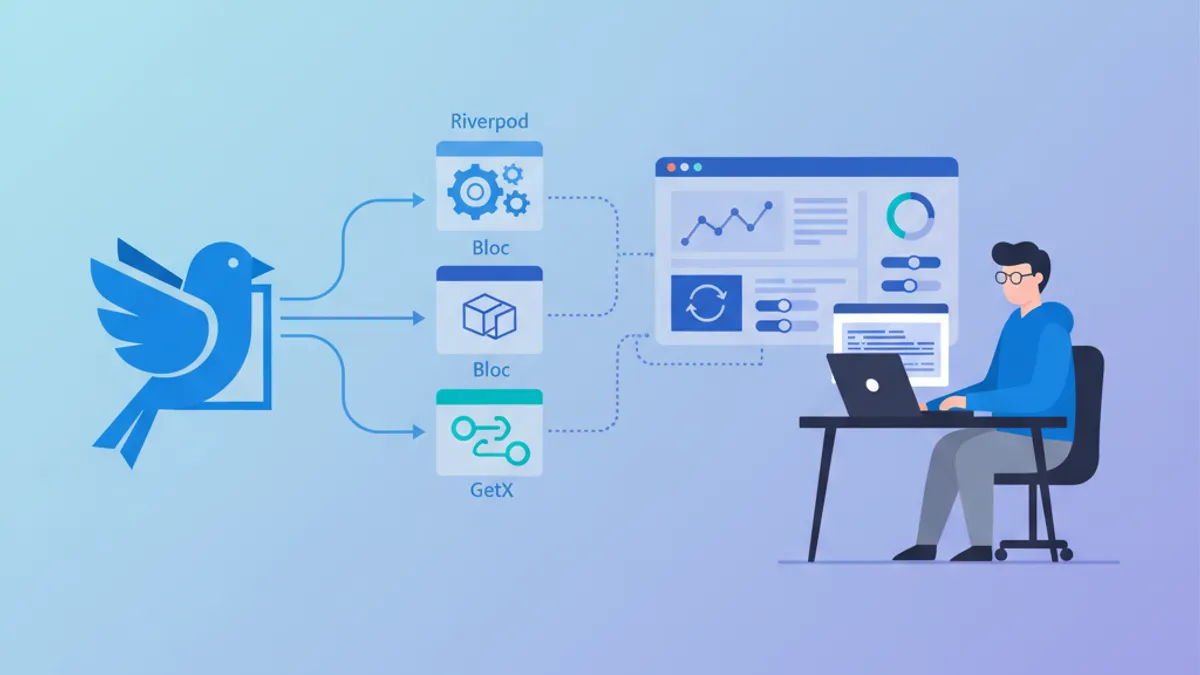
Flutter state management defines how an application handles data flow between widgets. In 2026, three solutions dominate the ecosystem: Riverpod 3.4 with compile-time safety and new provider extensions, Bloc 9.1 with enterprise-grade event tracing, and GetX with its declining but still-present footprint. Choosing the right one affects testability, scalability, and long-term maintenance cost.
Riverpod 3.4 fits most projects with its compile-time safety, minimal boilerplate, and new ValueListenable integration. Bloc 9.1 remains the standard for regulated industries needing event-driven audit trails. GetX should only be considered for maintaining existing codebases with no migration budget.
Riverpod 3.4: Compile-Time Safety, Auto-Retry and ValueListenable
Riverpod 3.4 introduced a fundamental shift in how Flutter applications declare and consume state. The annotation-based code generation catches dependency errors at compile time rather than runtime, eliminating an entire class of bugs that previously required manual testing to surface.
The auto-retry mechanism for failed providers handles transient network errors without manual intervention. When a provider computation fails, Riverpod automatically retries with configurable delay, reducing boilerplate error recovery code.
import 'package:riverpod_annotation/riverpod_annotation.dart';
part 'counter_provider.g.dart';
// Code generation ensures compile-time safety
class Counter extends _$Counter {
int build() => 0; // Initial state
void increment() => state = state + 1;
void decrement() => state = state - 1;
void reset() => state = 0;
}The @riverpod annotation generates all the provider boilerplate. Type mismatches, missing overrides, and circular dependencies surface during compilation.
import 'package:riverpod_annotation/riverpod_annotation.dart';
part 'user_repository_provider.g.dart';
Future<User> currentUser(Ref ref) async {
final authService = ref.watch(authServiceProvider);
final userId = authService.currentUserId;
// Auto-retry on network failure
final response = await ref.watch(
httpClientProvider,
).get('/api/users/$userId');
return User.fromJson(response.data);
}Riverpod 3.4 also pauses provider listeners automatically when a widget leaves the screen, reducing unnecessary computations and improving battery life on mobile devices.
New in Riverpod 3.4: ValueListenable and Provider Extensions
Riverpod 3.4 added CustomProviderListenable for building custom provider extensions and ValueListenable integration. The listenable property exposes providers to code that expects Flutter's native ValueListenable interface, enabling smoother integration with animation controllers and legacy widgets.
class AnimatedCounter extends ConsumerWidget {
Widget build(BuildContext context, WidgetRef ref) {
// Expose provider as ValueListenable for animation integration
final counterListenable = ref.watch(counterProvider.listenable);
return ValueListenableBuilder<int>(
valueListenable: counterListenable,
builder: (context, count, child) {
return AnimatedSwitcher(
duration: const Duration(milliseconds: 300),
child: Text(
'$count',
key: ValueKey(count),
style: Theme.of(context).textTheme.headlineLarge,
),
);
},
);
}
}The ProviderContainer.allProviders() method lists all active providers, useful for debugging and building developer tools. This addresses a common pain point when tracking down unexpected provider states in complex applications.
void debugPrintActiveProviders(ProviderContainer container) {
  final providers = container.allProviders();
  for (final provider in providers) {
    debugPrint('Active: ${provider.name ?? provider.runtimeType}');
  }
}
Bloc 9.1: Event-Driven Architecture for Enterprise Apps
Bloc 9.1 enforces strict separation between events, states, and business logic. Every state change maps to a specific event, creating an audit trail that regulated industries require. The mounted safety checks prevent callbacks from executing on disposed widgets.
sealed class AuthenticationEvent {}

final class LoginRequested extends AuthenticationEvent {
  final String email;
  final String password;
  LoginRequested({required this.email, required this.password});
}

final class LogoutRequested extends AuthenticationEvent {}

final class SessionRestored extends AuthenticationEvent {
  final String token;
  SessionRestored({required this.token});
}
Dart 3 sealed classes guarantee exhaustive pattern matching on events. The compiler enforces that every event type has a handler.
import 'package:flutter_bloc/flutter_bloc.dart';

class AuthenticationBloc
    extends Bloc<AuthenticationEvent, AuthenticationState> {
  final AuthRepository _authRepo;
  final TokenStorage _tokenStorage;

  AuthenticationBloc({
    required AuthRepository authRepo,
    required TokenStorage tokenStorage,
  })  : _authRepo = authRepo,
        _tokenStorage = tokenStorage,
        super(AuthenticationInitial()) {
    on<LoginRequested>(_onLoginRequested);
    on<LogoutRequested>(_onLogoutRequested);
    on<SessionRestored>(_onSessionRestored);
  }

  Future<void> _onLoginRequested(
    LoginRequested event,
    Emitter<AuthenticationState> emit,
  ) async {
    emit(AuthenticationLoading());
    try {
      final token = await _authRepo.login(
        email: event.email,
        password: event.password,
      );
      await _tokenStorage.save(token);
      emit(AuthenticationSuccess(token: token));
    } catch (e) {
      emit(AuthenticationFailure(message: e.toString()));
    }
  }

  Future<void> _onLogoutRequested(
    LogoutRequested event,
    Emitter<AuthenticationState> emit,
  ) async {
    await _tokenStorage.clear();
    emit(AuthenticationInitial());
  }

  Future<void> _onSessionRestored(
    SessionRestored event,
    Emitter<AuthenticationState> emit,
  ) async {
    emit(AuthenticationSuccess(token: event.token));
  }
}
Each event handler produces a clear state transition. Logging middleware can record every event for debugging or compliance purposes. Bloc 9.1 added the ability to expose dispose callbacks on RepositoryProvider, simplifying resource cleanup in complex dependency graphs.
Bloc Event Transformers: Handling High-Frequency Input
Bloc provides built-in event transformers that solve common concurrency problems. Search-as-you-type, rapid button taps, and real-time data streams all benefit from declarative event processing.
import 'package:bloc_concurrency/bloc_concurrency.dart';
import 'package:flutter_bloc/flutter_bloc.dart';

class SearchBloc extends Bloc<SearchEvent, SearchState> {
  final SearchRepository _repository;

  SearchBloc({required SearchRepository repository})
      : _repository = repository,
        super(SearchInitial()) {
    // restartable() cancels previous search on new input
    on<SearchQueryChanged>(
      _onQueryChanged,
      transformer: restartable(),
    );
    // droppable() ignores events while processing
    on<SearchResultSelected>(
      _onResultSelected,
      transformer: droppable(),
    );
  }

  Future<void> _onQueryChanged(
    SearchQueryChanged event,
    Emitter<SearchState> emit,
  ) async {
    if (event.query.length < 3) {
      emit(SearchInitial());
      return;
    }
    emit(SearchLoading());
    final results = await _repository.search(event.query);
    emit(SearchLoaded(results: results));
  }

  Future<void> _onResultSelected(
    SearchResultSelected event,
    Emitter<SearchState> emit,
  ) async {
    emit(SearchNavigating(result: event.result));
  }
}
The restartable() transformer cancels any in-flight search when new input arrives, preventing stale results from overwriting fresh ones. The droppable() transformer ignores duplicate taps while a navigation is in progress.
Ready to ace your Flutter interviews?
Practice with our interactive simulators, flashcards, and technical tests.
GetX: Technical Debt and Migration Realities
GetX gained popularity through rapid prototyping speed and minimal boilerplate. In 2026, the library faces a maintenance crisis: sporadic updates, a single-maintainer bottleneck, and growing incompatibilities with recent Flutter SDK versions. The last stable release (4.7.3) addressed Flutter 3.38 compatibility eight months ago. Production applications using GetX encounter controller lifecycle issues and memory leaks from implicit global singletons.
import 'package:get/get.dart';
// Global singleton - difficult to test and scope
class CounterController extends GetxController {
final count = 0.obs; // Reactive observable
void increment() => count.value++;
void decrement() => count.value--;
// Lifecycle hooks - disposal timing is unpredictable
void onClose() {
// Cleanup may not execute reliably
super.onClose();
}
}
// Usage in widget
class CounterPage extends StatelessWidget {
Widget build(BuildContext context) {
// Get.put creates a global singleton
final controller = Get.put(CounterController());
return Obx(() => Text('${controller.count}'));
}
}The Get.put() call registers controllers as global singletons. In complex navigation flows, controllers persist beyond their intended scope, consuming memory. The .obs reactive variables bypass Flutter's standard state notification system, making integration with other packages unreliable.
Migrating from GetX to Riverpod: Step-by-Step
For teams maintaining GetX codebases, migration to Riverpod can proceed incrementally. Both libraries coexist in the same project, allowing screen-by-screen conversion without a full rewrite.
// Step 1: Replace GetX controller with Riverpod notifier
// Before (GetX)
class ProductController extends GetxController {
final products = <Product>[].obs;
final isLoading = false.obs;
Future<void> loadProducts() async {
isLoading.value = true;
products.value = await ProductApi.fetchAll();
isLoading.value = false;
}
}
// After (Riverpod 3.4)
class ProductList extends _$ProductList {
Future<List<Product>> build() async {
// Auto-retry on failure, auto-pause when off-screen
return ProductApi.fetchAll();
}
Future<void> refresh() async {
ref.invalidateSelf();
}
}// Step 2: Replace widget bindings
// Before (GetX)
class ProductPage extends StatelessWidget {
Widget build(BuildContext context) {
final ctrl = Get.put(ProductController());
return Obx(() {
if (ctrl.isLoading.value) return CircularProgressIndicator();
return ListView.builder(
itemCount: ctrl.products.length,
itemBuilder: (_, i) => ProductTile(ctrl.products[i]),
);
});
}
}
// After (Riverpod 3.4)
class ProductPage extends ConsumerWidget {
Widget build(BuildContext context, WidgetRef ref) {
final productsAsync = ref.watch(productListProvider);
return productsAsync.when(
loading: () => const CircularProgressIndicator(),
error: (err, stack) => ErrorDisplay(error: err),
data: (products) => ListView.builder(
itemCount: products.length,
itemBuilder: (_, i) => ProductTile(products[i]),
),
);
}
}The Riverpod version handles loading, error, and data states explicitly through AsyncValue.when(). No global singletons, no manual lifecycle management, and automatic disposal when the widget unmounts.
Performance Comparison: Rebuild Efficiency
Rebuild efficiency directly impacts frame rates. Each solution handles widget rebuilds differently, and the difference becomes measurable in lists with hundreds of items.
| Metric | Riverpod 3.4 | Bloc 9.1 | GetX |
|---|---|---|---|
| Selective rebuild | select() filter | BlocSelector | .obs per field |
| Compile-time safety | Full (code gen) | Partial (sealed classes) | None |
| Auto-dispose | Built-in | Manual via close() | Unreliable |
| Pause when off-screen | Automatic | Manual | Not supported |
| Event traceability | Provider observer | Full event log | None |
| Testing isolation | ProviderContainer.test() | blocTest helper | Requires Get.testMode |
| Bundle size impact | ~45KB | ~38KB | ~120KB (includes routing, DI, HTTP) |
Riverpod's select() method and Bloc's BlocSelector both enable surgical rebuilds, updating only the widget subtree that depends on the changed data. GetX's .obs achieves similar granularity per field but lacks compile-time verification of the dependency graph.
GetX bundles routing, dependency injection, HTTP client, and state management in a single package. Applications using only state management still import the full 120KB library. Riverpod and Bloc are focused packages that do one thing well.
Testing Strategies Across Solutions
Testability often determines which solution scales with a growing team. Each library approaches testing differently.
// Riverpod test - isolated container
import 'package:flutter_test/flutter_test.dart';
import 'package:riverpod/riverpod.dart';

void main() {
  test('Counter increments', () {
    final container = ProviderContainer.test();
    // Override dependencies for isolation
    final counter = container.read(counterProvider.notifier);

    expect(container.read(counterProvider), 0);
    counter.increment();
    expect(container.read(counterProvider), 1);
  });
}// Bloc test - event-driven verification
import 'package:bloc_test/bloc_test.dart';
import 'package:flutter_test/flutter_test.dart';
void main() {
blocTest<AuthenticationBloc, AuthenticationState>(
'emits [loading, success] on valid login',
build: () => AuthenticationBloc(
authRepo: MockAuthRepo(),
tokenStorage: MockTokenStorage(),
),
act: (bloc) => bloc.add(
LoginRequested(email: 'dev@test.com', password: 'secure123'),
),
expect: () => [
isA<AuthenticationLoading>(),
isA<AuthenticationSuccess>(),
],
);
}Riverpod's ProviderContainer.test() creates an isolated dependency graph per test. Bloc's blocTest helper verifies exact state transition sequences, matching the event-driven architecture. GetX testing requires setting Get.testMode = true and manually managing controller lifecycle, which frequently leads to flaky tests in CI environments.
Flutter state management is among the most frequently asked topics in mobile developer interviews. Understanding the trade-offs between Riverpod, Bloc, and GetX demonstrates architectural maturity. Practice explaining when each solution fits and when it does not.
Decision Matrix: Picking the Right Solution
Project constraints determine the best fit. Team size, regulatory requirements, and existing codebase all factor into the decision.
Riverpod 3.4 fits when the team values compile-time safety, the project needs async data fetching with automatic error recovery, or the codebase starts from scratch. The ValueListenable integration in 3.4 makes it easier to adopt in projects with existing animation code. The learning curve is moderate: developers familiar with Provider transition naturally.
Bloc 9.1 fits when the project operates in a regulated industry (fintech, healthcare), the team needs full event traceability for auditing, or the application handles complex concurrent workflows like payment processing. The boilerplate cost pays for itself in maintainability at scale.
GetX fits only when maintaining an existing GetX codebase where migration cost exceeds the available budget. Starting new projects with GetX in 2026 introduces technical debt from day one. The official Flutter documentation does not list GetX among recommended solutions.
For deeper practice on Flutter state management patterns, the Flutter state management basics module covers foundational concepts tested in interviews. The provider pattern module explores dependency injection strategies that apply across all three solutions. For testing strategies specific to Flutter widgets, see Flutter Testing: Widget Tests and Integration Tests.
Start practicing!
Test your knowledge with our interview simulators and technical tests.
Sources
- Riverpod Changelog - version history and breaking changes from 3.0 to 3.4.2
- flutter_bloc Changelog - Bloc 9.0 to 9.1 changes and mounted safety checks
- GetX Changelog - last release 4.7.3 addressing Flutter 3.38 compatibility
- Flutter State Management Options - official Flutter team recommendations
State Management Comparison: Key Takeaways for Flutter Developers
- Riverpod 3.4 provides compile-time safety through code generation, automatic retry for failed providers, pause/resume support that reduces battery consumption, and new
ValueListenableintegration for animation workflows - Bloc 9.1 enforces event-driven state transitions with full audit capability, making it the standard for enterprise applications in regulated industries
- GetX faces a maintenance crisis in 2026 with sporadic updates and growing SDK incompatibilities; existing GetX projects should plan incremental migration to Riverpod
- Migration from GetX to Riverpod proceeds screen-by-screen without requiring a full rewrite, as both libraries coexist in the same project
- Testing isolation differs significantly: Riverpod uses
ProviderContainer.test(), Bloc usesblocTestwith event sequence verification, and GetX requires fragile global test mode configuration - Bundle size matters on mobile: Riverpod (~45KB) and Bloc (~38KB) ship focused packages, while GetX (~120KB) bundles unused features
Start practicing!
Test your knowledge with our interview simulators and technical tests.
Can you spot the bug in Flutter?
One real snippet, one hidden bug, one attempt a day. No account needed to try.

Written by
Anthony Fillion-MailletFounder of SharpSkill
Full-stack developer for over 10 years. Runs SharpSkill and answers for everything published here.
Updated on August 19, 2026
Tags
Share
Related articles
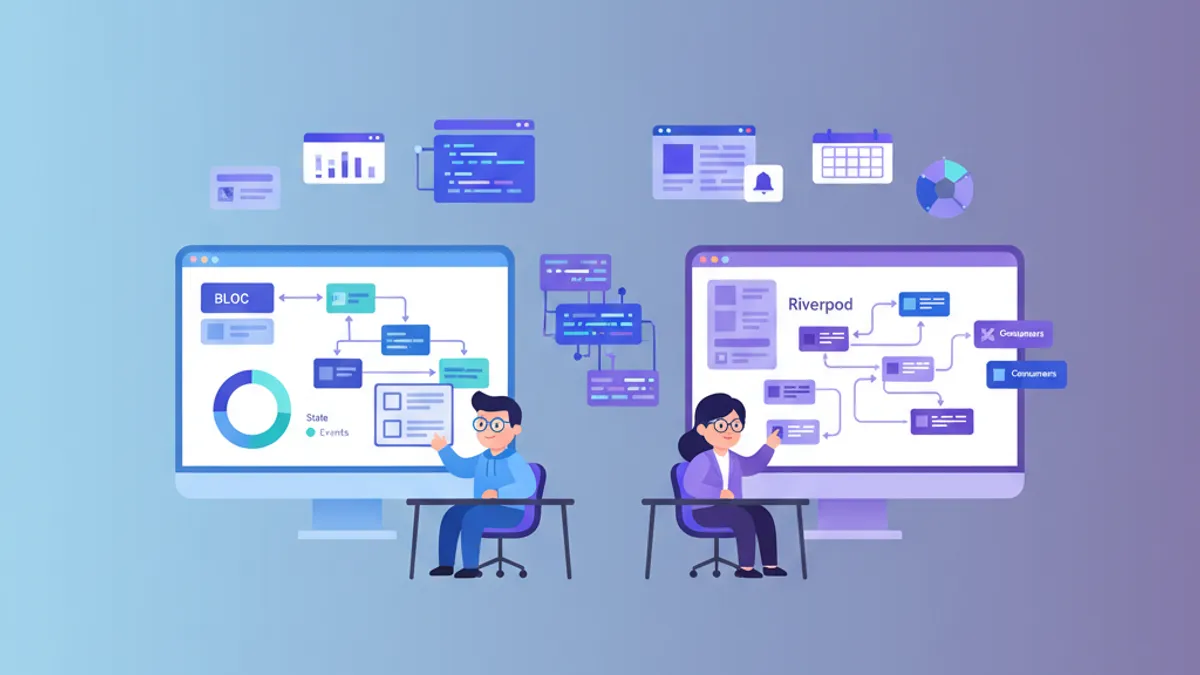
Flutter State Management: Riverpod vs BLoC - Complete Comparison Guide
In-depth comparison between Riverpod 3.x and BLoC 9.x for Flutter state management. Architecture, automatic retry, testability and use cases to choose the best solution.

Top 20 Flutter Interview Questions for Mobile Developers
Prepare for Flutter interviews with the 20 most common questions. Widgets, state management, Dart, architecture and best practices explained in detail.
Flutter: Building Your First Cross-Platform App
Complete guide to creating a cross-platform mobile application with Flutter and Dart. Widgets, state management, navigation and best practices for beginners.