Angular 19 Zoneless: Performance and Change Detection Without Zone.js
Angular zoneless change detection removes Zone.js to deliver smaller bundles, faster rendering, and explicit reactivity through signals. This deep dive covers the migration path from Zone.js to zoneless Angular, from provideExperimentalZonelessChangeDetection in Angular 19 to the stable API in Angular 20+.

Angular zoneless change detection represents the most significant architectural shift in the framework since the introduction of standalone components. By removing Zone.js entirely, Angular applications gain smaller bundles (roughly 33KB less), 30-40% fewer unnecessary change detection cycles, and clean stack traces without Zone-specific noise.
Angular 18 introduced zoneless as experimental. Angular 19 refined the experimental API with provideExperimentalZonelessChangeDetection(). Angular 20 graduated it to stable as provideZonelessChangeDetection(). Angular 21 makes zoneless the default for new projects.
How Zone.js Change Detection Works Under the Hood
Before understanding zoneless, the Zone.js mechanism deserves a clear explanation. Zone.js monkey-patches every asynchronous browser API: setTimeout, setInterval, Promise.then, addEventListener, XMLHttpRequest, and dozens more. Each time one of these APIs completes, Zone.js notifies Angular, which then runs change detection across the entire component tree.
This approach has a fundamental flaw: Zone.js has no insight into whether application state actually changed. A setTimeout used purely for animation timing still triggers a full change detection cycle. In large applications with hundreds of components, this overhead becomes measurable.
import { ApplicationConfig } from '@angular/core';
import { provideZoneChangeDetection } from '@angular/core';

export const appConfig: ApplicationConfig = {
  providers: [
    provideZoneChangeDetection({ eventCoalescing: true }),
    // Zone.js patches ~130+ browser APIs
    // Every async callback triggers change detection
  ]
};
Event coalescing (introduced in Angular 14) reduces some overhead by batching multiple events into a single change detection cycle, but the core problem remains: change detection runs far more often than necessary.
Enabling Zoneless Change Detection in Angular 19 and 20
The migration path differs depending on the Angular version. Angular 19 uses the experimental API, while Angular 20 provides the stable version.
import { ApplicationConfig } from '@angular/core';
import { provideExperimentalZonelessChangeDetection } from '@angular/core';

export const appConfig: ApplicationConfig = {
  providers: [
    provideExperimentalZonelessChangeDetection(),
    // No more Zone.js patching
  ]
};import { ApplicationConfig } from '@angular/core';
import { provideZonelessChangeDetection } from '@angular/core';
export const appConfig: ApplicationConfig = {
providers: [
provideZonelessChangeDetection(),
]
};After switching the provider, remove zone.js from the polyfills array in angular.json for both build and test targets, then uninstall the package:
# Remove zone.js polyfill from angular.json build and test targets
# Then uninstall the package
npm uninstall zone.js
The bundle size reduction is immediate: Zone.js accounts for approximately 33KB raw (10KB gzipped) of eagerly loaded code.
What Triggers Change Detection in Zoneless Mode
Without Zone.js intercepting every async operation, Angular relies on explicit notifications. The framework schedules change detection when any of these conditions occur:
- A signal read in a template updates its value
ChangeDetectorRef.markForCheck()is called (automatically byAsyncPipe)- A component input changes via
ComponentRef.setInput() - A template or host listener callback executes (click, input, etc.)
- A previously dirty view is attached to the component tree
import { Component, signal, computed } from '@angular/core';

@Component({
  selector: 'app-counter',
  template: `
    <div class="counter">
      <button (click)="decrement()">-</button>
      <span>{{ count() }}</span>
      <button (click)="increment()">+</button>
      <p>Double: {{ doubled() }}</p>
    </div>
  `
})
export class CounterComponent {
  // Signal updates automatically notify the template
  count = signal(0);
  doubled = computed(() => this.count() * 2);

  increment() {
    this.count.update(v => v + 1);
    // No markForCheck() needed - signal handles notification
  }

  decrement() {
    this.count.update(v => v - 1);
  }
}
Signals are the natural companion to zoneless mode. When a signal value changes, Angular knows exactly which templates depend on it and schedules targeted change detection only for those views.
Adopting ChangeDetectionStrategy.OnPush is a recommended step toward zoneless compatibility, but it is not strictly required. The default change detection strategy still works in zoneless mode. However, OnPush ensures components only re-render when their inputs change or markForCheck() is called, aligning naturally with the zoneless mental model.
Migrating Existing Applications: Common Pitfalls
The transition from Zone.js to zoneless is rarely a one-line change for existing applications. Several patterns that relied on Zone.js implicit behavior need explicit handling.
setTimeout and setInterval No Longer Trigger Updates
In Zone.js mode, setTimeout callbacks automatically trigger change detection. In zoneless mode, they do not.
@Component({
  selector: 'app-user-status',
  template: `<span>{{ statusMessage }}</span>`
})
export class UserStatusComponent {
  statusMessage = 'Loading...';

  ngOnInit() {
    setTimeout(() => {
      // Zone.js would trigger CD here - zoneless does NOT
      this.statusMessage = 'Ready';
    }, 2000);
  }
}import { Component, signal } from '@angular/core';
@Component({
selector: 'app-user-status',
template: `<span>{{ statusMessage() }}</span>`
})
export class UserStatusComponent {
statusMessage = signal('Loading...');
ngOnInit() {
setTimeout(() => {
// Signal update notifies Angular automatically
this.statusMessage.set('Ready');
}, 2000);
}
}Reactive Forms Need Explicit Notification
Forms state changes through FormControl.setValue() or patchValue() do not automatically trigger change detection in zoneless mode. Two approaches solve this: connecting form observables to markForCheck(), or exposing form data through signals.
import { Component, inject, signal } from '@angular/core';
import { FormControl, ReactiveFormsModule } from '@angular/forms';
import { toSignal } from '@angular/core/rxjs-interop';
import { debounceTime, distinctUntilChanged } from 'rxjs';

@Component({
  selector: 'app-search',
  imports: [ReactiveFormsModule],
  template: `
    <input [formControl]="searchControl" placeholder="Search..." />
    <p>Results for: {{ searchTerm() }}</p>
  `
})
export class SearchComponent {
  searchControl = new FormControl('');

  // Convert observable to signal for automatic template updates
  searchTerm = toSignal(
    this.searchControl.valueChanges.pipe(
      debounceTime(300),
      distinctUntilChanged()
    ),
    { initialValue: '' }
  );
}
Ready to ace your Angular interviews?
Practice with our interactive simulators, flashcards, and technical tests.
Server-Side Rendering Without Zone.js
SSR with zoneless Angular requires special attention. Zone.js previously helped Angular determine when an application reached a "stable" state suitable for serialization. Without it, the PendingTasks service fills that role.
import { Component, inject, signal } from '@angular/core';
import { PendingTasks } from '@angular/core';
import { HttpClient } from '@angular/common/http';
import { firstValueFrom } from 'rxjs';

@Component({
  selector: 'app-data-loader',
  template: `
    @if (data()) {
      <div>{{ data()!.title }}</div>
    } @else {
      <div>Loading...</div>
    }
  `
})
export class DataLoaderComponent {
  private http = inject(HttpClient);
  private pendingTasks = inject(PendingTasks);
  data = signal<{ title: string } | null>(null);

  ngOnInit() {
    // PendingTasks.run() prevents SSR serialization until complete
    this.pendingTasks.run(async () => {
      const result = await firstValueFrom(
        this.http.get<{ title: string }>('/api/data')
      );
      this.data.set(result);
    });
  }
}
Without PendingTasks, Angular would serialize the page before async data loads, sending empty content to the client.
Performance Benchmarks: Zone.js vs Zoneless
The performance gains from removing Zone.js fall into three categories:
| Metric | Zone.js | Zoneless | Improvement |
|---|---|---|---|
| Initial bundle size | +33KB raw / +10KB gzip | 0KB overhead | 100% reduction |
| Change detection cycles (typical app) | 150-300 per interaction | 5-15 per interaction | 80-95% fewer |
| Stack trace depth | 8-12 extra Zone frames | Clean native traces | Immediate clarity |
| Time to Interactive (TTI) | Baseline | 15-25% faster | Zone bootstrap eliminated |
The most dramatic improvement appears in applications with heavy async activity: HTTP polling, WebSocket connections, timers, and complex event handlers. Each of these previously triggered unnecessary change detection cycles that zoneless mode eliminates entirely.
Some third-party libraries still depend on Zone.js internally. Modal dialogs, certain Web Component wrappers, and some animation libraries may behave unexpectedly in zoneless mode. Always test library integrations thoroughly before deploying zoneless to production.
NgZone APIs That Survive the Transition
A common misconception: removing Zone.js means removing all NgZone references. This is incorrect. NgZone.run() and NgZone.runOutsideAngular() remain compatible with zoneless applications and should be kept in shared libraries. Removing them can cause performance regressions in applications that still use Zone.js and consume those libraries.
However, three NgZone observables must be eliminated:
NgZone.onMicrotaskEmpty- never emits in zoneless modeNgZone.onUnstable- never emits in zoneless modeNgZone.onStable- never emits in zoneless mode
Replace timing-dependent logic that used these observables with afterNextRender() or afterEveryRender() from @angular/core.
From Angular 19 Experimental to Angular 21 Default
The zoneless API evolution follows a clear stabilization path:
- Angular 18.1:
provideExperimentalZonelessChangeDetection()introduced as experimental - Angular 19: Experimental API refined, broader ecosystem testing
- Angular 20: Renamed to
provideZonelessChangeDetection(), graduated to stable - Angular 20.2: API fully stable with no behavioral changes expected
- Angular 21: Zoneless becomes the default for
ng newprojects, no provider call needed
For teams on Angular 19, the upgrade path is straightforward: update to Angular 20, replace provideExperimentalZonelessChangeDetection with provideZonelessChangeDetection, and remove the zone.js polyfill. Angular 19 reaches end-of-life on May 19, 2026, making this migration time-sensitive.
Preparing for Angular interviews? The Angular interview questions module on SharpSkill covers change detection patterns in depth, including zoneless scenarios that interviewers increasingly ask about. For a broader overview, see the top 25 Angular interview questions guide. The Angular Signals module also covers the reactivity model that makes zoneless possible.
Conclusion
- Removing Zone.js eliminates 33KB of bundle weight and removes the monkey-patching layer that intercepted 130+ browser APIs
- Angular signals provide the explicit reactivity model that makes zoneless practical, automatically notifying templates when state changes
- The migration requires converting
setTimeout/setIntervalpatterns, reactive forms, and timing-dependent logic to signal-based ormarkForCheck()approaches - SSR applications must adopt
PendingTasksto replace Zone.js stability detection NgZone.run()andNgZone.runOutsideAngular()should be preserved in shared libraries for backward compatibility- Angular 19's experimental API (
provideExperimentalZonelessChangeDetection) maps directly to Angular 20's stableprovideZonelessChangeDetection(), making the upgrade a rename operation - Third-party library compatibility remains the primary risk factor and requires thorough testing before production deployment
Start practicing!
Test your knowledge with our interview simulators and technical tests.
Can you spot the bug in Angular?
One real snippet, one hidden bug, one attempt a day. No account needed to try.

Written by
Anthony Fillion-MailletFounder of SharpSkill
Full-stack developer for over 10 years. Runs SharpSkill and answers for everything published here.
Updated on April 27, 2026
Tags
Share
Related articles
Angular @defer in 2026: Declarative Lazy Loading for Faster Apps
Master Angular @defer blocks for declarative lazy loading. Deep dive into triggers, prefetching, incremental hydration, SSR behavior, and real-world performance patterns.
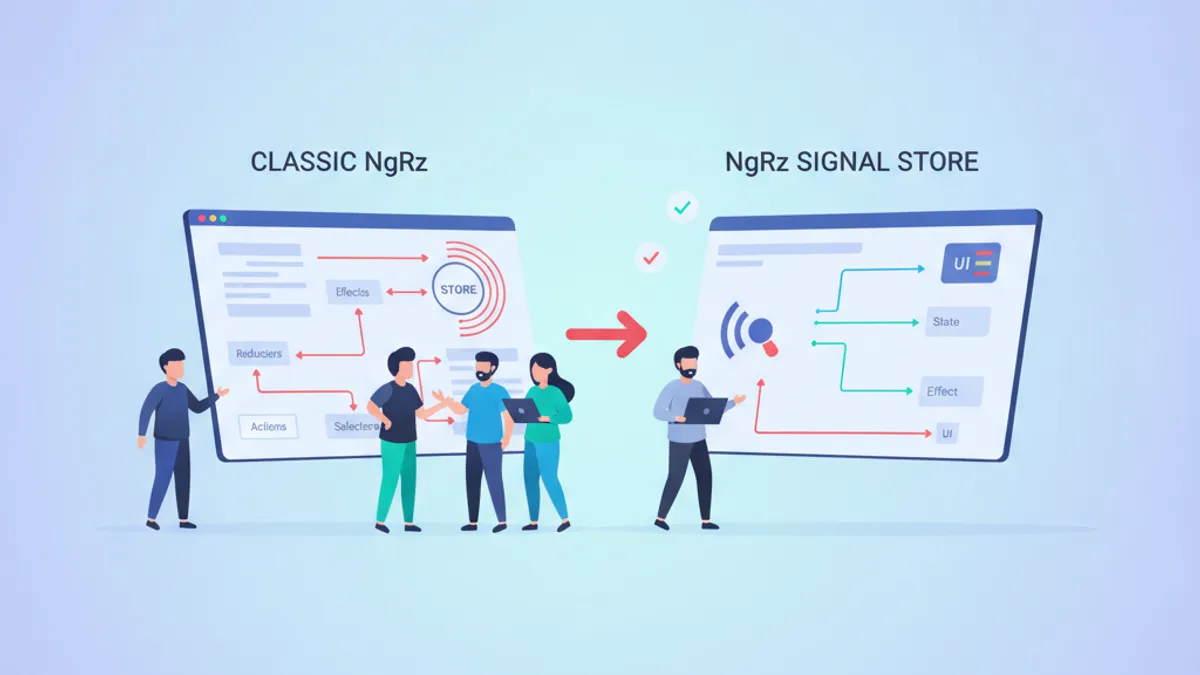
NgRx Signal Store vs Classic NgRx in 2026: Which Should You Choose?
A comprehensive comparison of NgRx Signal Store and Classic NgRx for Angular state management. Learn when to use each approach with practical code examples.

Angular 19 Interview Questions: Signals, SSR and Must-Know Concepts
The most common Angular 19 interview questions: Signals, incremental hydration, zoneless change detection, and new reactive APIs with code examples and expected answers.