Rust: Grundlagen fuer erfahrene Entwickler in 2026
Rust schnell erlernen mit vorhandenem Wissen. Ownership, Borrowing, Lifetimes und wesentliche Patterns erklaert fuer Entwickler aus C++, Java oder Python.

Rust gewinnt Jahr fuer Jahr an Bedeutung unter professionellen Entwicklern, und die Gruende liegen auf der Hand: garantierte Speichersicherheit zur Kompilierzeit, Leistung auf C++-Niveau und ein modernes, stetig wachsendes Oekosystem. Fuer Entwickler mit Erfahrung in C++, Java oder Python kann Rust anfangs ungewohnt wirken, doch die grundlegenden Konzepte werden schnell intuitiv, sobald sie verstanden sind.
Rust war 8 Jahre in Folge die beliebteste Programmiersprache auf Stack Overflow. Von Microsoft, Google, Amazon und Meta fuer kritische Komponenten eingesetzt, bietet Rust Speichersicherheit ohne Garbage Collector.
Rust-Entwicklungsumgebung einrichten
Vor dem Schreiben von Code muss Rust ueber rustup installiert werden, das offizielle Versionsverwaltungstool.
# install.sh
# Install Rust via rustup (macOS, Linux)
curl --proto '=https' --tlsv1.2 -sSf https://sh.rustup.rs | sh

# Verify installation
rustc --version
cargo --version
Cargo ist der Paketmanager und das Build-Tool von Rust. Es vereint die Funktionalitaet von npm, Maven und Make in einem einzigen kohaerenten Werkzeug.
# project-setup.sh
# Create a new project
cargo new my_project
cd my_project

# Generated structure:
# my_project/
# ├── Cargo.toml    # Manifest (like package.json)
# └── src/
#     └── main.rs   # Entry point

# Essential commands
cargo build          # Compile the project
cargo run            # Compile and run
cargo test           # Run tests
cargo check          # Check without building (faster)
Variablen und Standard-Immutabilitaet in Rust
Rust kehrt die uebliche Konvention um: Variablen sind standardmaessig unveraenderlich. Dieser Ansatz erzwingt explizites Nachdenken ueber Veraenderlichkeit und verhindert zahlreiche Fehler.
fn main() {
    // Immutable by default
    let x = 5;
    // x = 6;  // Compile error!

    // Explicitly mutable variable
    let mut y = 5;
    y = 6;  // OK

    // Shadowing: redeclaration in the same scope
    let x = x + 1;  // Creates a new variable x
    let x = x * 2;  // x is now 12

    // Shadowing also allows changing the type
    let spaces = "   ";         // &str
    let spaces = spaces.len();  // usize
}
Shadowing erstellt eine neue Variable, im Gegensatz zu mut, das den bestehenden Wert veraendert. Shadowing ermoeglicht die Transformation eines Wertes unter Beibehaltung eines klaren Namens.
Fundamentale Datentypen der Sprache Rust
Rust ist statisch typisiert mit exzellenter Typinferenz. Im Folgenden die wesentlichen primitiven Typen, die jeder Entwickler kennen sollte.
fn main() {
    // Signed integers: i8, i16, i32, i64, i128, isize
    let age: i32 = 30;

    // Unsigned integers: u8, u16, u32, u64, u128, usize
    let count: u64 = 1_000_000;  // Underscores for readability

    // Floats: f32, f64 (default)
    let pi: f64 = 3.14159;

    // Boolean
    let active: bool = true;

    // Unicode character (4 bytes)
    let emoji: char = '🦀';

    // Tuple: fixed collection of different types
    let person: (String, i32) = (String::from("Alice"), 28);
    let (name, age) = person;  // Destructuring

    // Array: fixed size, same type
    let numbers: [i32; 5] = [1, 2, 3, 4, 5];
    let first = numbers[0];

    // Slice: view into a portion of data
    let slice: &[i32] = &numbers[1..4];  // [2, 3, 4]
}
Ownership: Das revolutionaere Konzept von Rust
Ownership ist DIE Innovation von Rust. Dieses System garantiert Speichersicherheit ohne Garbage Collector, erfordert jedoch eine anfaengliche Lernkurve.
Die drei Regeln des Ownership
fn main() {
    // Rule 1: Each value has a single owner
    let s1 = String::from("hello");

    // Rule 2: When the owner goes out of scope, the value is freed
    {
        let s2 = String::from("world");
        // s2 is valid here
    }
    // s2 is dropped, no longer accessible

    // Rule 3: Only one ownership at a time (move)
    let s3 = s1;  // s1 is MOVED to s3
    // println!("{}", s1);  // Error: s1 is no longer valid!
    println!("{}", s3);     // OK: s3 is the owner
}
Move vs Clone in Rust
fn main() {
    // Simple types (stack): automatic Copy
    let x = 5;
    let y = x;  // Copy, not move
    println!("x = {}, y = {}", x, y);  // Both are valid

    // Complex types (heap): Move by default
    let s1 = String::from("hello");
    let s2 = s1;  // Move
    // s1 is no longer usable

    // Explicit clone to duplicate
    let s3 = String::from("world");
    let s4 = s3.clone();  // Deep copy
    println!("s3 = {}, s4 = {}", s3, s4);  // Both valid
}Die Uebergabe eines Wertes an eine Funktion uebertraegt das Ownership. Die Funktion wird zum Eigentuemer und der Wert ist nach dem Aufruf nicht mehr zugaenglich, es sei denn, er wird zurueckgegeben.
fn main() {
    let s = String::from("hello");
    takes_ownership(s);
    // println!("{}", s);  // Error: s has been moved

    let x = 5;
    makes_copy(x);
    println!("{}", x);  // OK: i32 implements Copy

    // To regain ownership, return the value
    let s2 = String::from("hello");
    let s3 = takes_and_gives_back(s2);
    println!("{}", s3);  // OK
}

fn takes_ownership(s: String) {
    println!("{}", s);
}  // s is dropped here

fn makes_copy(x: i32) {
    println!("{}", x);
}

fn takes_and_gives_back(s: String) -> String {
    s  // Returns ownership
}
Borrowing: Referenzen ohne Eigentumsuebergabe
Borrowing erlaubt die Nutzung eines Wertes, ohne das Ownership zu uebernehmen. Dies ist der im Alltag am haeufigsten verwendete Mechanismus in Rust.
fn main() {
    let s1 = String::from("hello");

    // Immutable reference: read-only
    let len = calculate_length(&s1);
    println!("Length of '{}': {}", s1, len);  // s1 still valid

    // Mutable reference: modification allowed
    let mut s2 = String::from("hello");
    change(&mut s2);
    println!("{}", s2);  // "hello, world"
}

fn calculate_length(s: &String) -> usize {
    s.len()
}  // s goes out of scope but doesn't drop (it's a reference)

fn change(s: &mut String) {
    s.push_str(", world");
}
Borrowing-Regeln in Rust
fn main() {
    let mut s = String::from("hello");

    // Rule 1: Multiple immutable references simultaneously OK
    let r1 = &s;
    let r2 = &s;
    println!("{} and {}", r1, r2);

    // Rule 2: ONLY ONE mutable reference at a time
    let r3 = &mut s;
    // let r4 = &mut s;  // Error: already borrowed mutably
    println!("{}", r3);

    // Rule 3: No mutable ref if immutable ref exists
    let r5 = &s;
    // let r6 = &mut s;  // Error: r5 is still active
    println!("{}", r5);

    // Once r5 is used for the last time, mutable borrow is allowed
    let r7 = &mut s;  // OK: r5 is no longer used after this
    r7.push_str("!");
}
Bereit für deine Rust-Interviews?
Übe mit unseren interaktiven Simulatoren, Flashcards und technischen Tests.
Lifetimes: Gueltigkeit von Referenzen zur Kompilierzeit
Lifetimes stellen sicher, dass Referenzen gueltig bleiben. Der Compiler leitet sie in den meisten Faellen automatisch ab, doch manchmal sind explizite Annotationen erforderlich.
// Classic error: reference to freed data
// fn dangling() -> &String {
//     let s = String::from("hello");
//     &s  // Error: s will be dropped, invalid reference!
// }

// Solution: return the owned value
fn no_dangle() -> String {
    let s = String::from("hello");
    s  // Ownership transferred, no problem
}
Explizite Lifetime-Annotationen
// The compiler can't figure out which reference will be returned
// fn longest(x: &str, y: &str) -> &str { ... }  // Error!

// Explicit annotation: return lives as long as BOTH x AND y
fn longest<'a>(x: &'a str, y: &'a str) -> &'a str {
    if x.len() > y.len() {
        x
    } else {
        y
    }
}

fn main() {
    let string1 = String::from("long string");
    let result;
    {
        let string2 = String::from("xyz");
        result = longest(&string1, &string2);
        println!("Longest: {}", result);  // OK here
    }
    // println!("{}", result);  // Error: string2 dropped
}Rust wendet Elisions-Regeln an, um Annotationen in einfachen Faellen zu vermeiden. Fuer den Einstieg genuegt es, den expliziten Fehlermeldungen des Compilers zu folgen.
Structs und Implementierungen in Rust
Structs sind die Bausteine fuer benutzerdefinierte Typen in Rust.
// Struct definition
#[derive(Debug)]  // Enables printing with {:?}
struct User {
    username: String,
    email: String,
    active: bool,
    sign_in_count: u64,
}

// Implementation block for methods
impl User {
    // Constructor (convention: fn new or descriptive name)
    fn new(username: String, email: String) -> Self {
        Self {
            username,
            email,
            active: true,
            sign_in_count: 1,
        }
    }

    // Method: takes &self (reference to instance)
    fn is_active(&self) -> bool {
        self.active
    }

    // Method with mutation: takes &mut self
    fn deactivate(&mut self) {
        self.active = false;
    }

    // Method consuming self (rare)
    fn into_username(self) -> String {
        self.username
    }
}

fn main() {
    let mut user = User::new(
        String::from("alice"),
        String::from("alice@example.com"),
    );

    println!("Active: {}", user.is_active());
    user.deactivate();
    println!("Active: {}", user.is_active());

    // Debug print
    println!("{:?}", user);
}
Enums und Pattern Matching: Algebraische Typen in Rust
Die Enums in Rust sind weitaus maechiger als in den meisten anderen Sprachen: Jede Variante kann eigene Daten enthalten.
// Simple enum
enum Direction {
    North,
    South,
    East,
    West,
}

// Enum with data (algebraic data type)
enum Message {
    Quit,
    Move { x: i32, y: i32 },
    Write(String),
    ChangeColor(u8, u8, u8),
}

impl Message {
    fn process(&self) {
        match self {
            Message::Quit => println!("Quitting"),
            Message::Move { x, y } => println!("Moving to ({}, {})", x, y),
            Message::Write(text) => println!("Writing: {}", text),
            Message::ChangeColor(r, g, b) => {
                println!("Color: rgb({}, {}, {})", r, g, b)
            }
        }
    }
}

fn main() {
    let msg = Message::Move { x: 10, y: 20 };
    msg.process();

    let msg2 = Message::Write(String::from("Hello Rust!"));
    msg2.process();
}
Option und Result: Fehlerbehandlung ohne Exceptions
use std::fs::File;
use std::io::{self, Read};

fn main() {
    // Option<T>: present or absent value (replaces null)
    let numbers = vec![1, 2, 3];
    let first: Option<&i32> = numbers.first();

    match first {
        Some(n) => println!("First: {}", n),
        None => println!("Empty list"),
    }

    // Utility methods
    let value = first.unwrap_or(&0);
    let doubled = first.map(|n| n * 2);

    // Result<T, E>: success or error
    let result = read_file("config.txt");
    match result {
        Ok(content) => println!("Content: {}", content),
        Err(e) => println!("Error: {}", e),
    }
}

fn read_file(path: &str) -> Result<String, io::Error> {
    let mut file = File::open(path)?;  // ? propagates the error
    let mut content = String::new();
    file.read_to_string(&mut content)?;
    Ok(content)
}
Der ?-Operator ist syntaktischer Zucker fuer die Fehlerpropagierung. Er gibt automatisch den Fehler zurueck, wenn das Result Err ist, und entpackt andernfalls den Ok-Wert.
Traits: Polymorphismus nach Rust-Art
Traits definieren gemeinsames Verhalten, aehnlich wie Java-Interfaces oder Swift-Protokolle.
// Trait definition
trait Summary {
    fn summarize(&self) -> String;

    // Method with default implementation
    fn preview(&self) -> String {
        format!("{}...", &self.summarize()[..50.min(self.summarize().len())])
    }
}

struct Article {
    title: String,
    author: String,
    content: String,
}

struct Tweet {
    username: String,
    content: String,
}

// Implementation for Article
impl Summary for Article {
    fn summarize(&self) -> String {
        format!("{} by {}", self.title, self.author)
    }
}

// Implementation for Tweet
impl Summary for Tweet {
    fn summarize(&self) -> String {
        format!("@{}: {}", self.username, self.content)
    }
}

// Function accepting any type implementing Summary
fn notify(item: &impl Summary) {
    println!("Breaking news: {}", item.summarize());
}

// Equivalent syntax with trait bound
fn notify_generic<T: Summary>(item: &T) {
    println!("Breaking news: {}", item.summarize());
}

fn main() {
    let article = Article {
        title: String::from("Rust 2026"),
        author: String::from("Community"),
        content: String::from("..."),
    };

    let tweet = Tweet {
        username: String::from("rustlang"),
        content: String::from("Rust is awesome!"),
    };

    notify(&article);
    notify(&tweet);
}
Wesentliche Sammlungen der Standardbibliothek
Rust stellt leistungsstarke Sammlungen in der Standardbibliothek bereit.
use std::collections::HashMap;

fn main() {
    // Vec<T>: dynamic array
    let mut numbers: Vec<i32> = Vec::new();
    numbers.push(1);
    numbers.push(2);
    numbers.push(3);

    // vec! macro for initialization
    let nums = vec![1, 2, 3, 4, 5];

    // Iteration
    for n in &nums {
        println!("{}", n);
    }

    // Functional methods
    let doubled: Vec<i32> = nums.iter().map(|x| x * 2).collect();
    let sum: i32 = nums.iter().sum();
    let evens: Vec<&i32> = nums.iter().filter(|x| *x % 2 == 0).collect();

    // String: growable UTF-8 string
    let mut s = String::from("Hello");
    s.push_str(", World!");
    s.push('!');

    // Concatenation
    let s1 = String::from("Hello, ");
    let s2 = String::from("World!");
    let s3 = s1 + &s2;  // s1 moved, s2 borrowed
    // or with format!
    let s4 = format!("{}{}", "Hello, ", "World!");

    // HashMap<K, V>
    let mut scores: HashMap<String, i32> = HashMap::new();
    scores.insert(String::from("Blue"), 10);
    scores.insert(String::from("Red"), 50);

    // Access with get (returns Option)
    if let Some(score) = scores.get("Blue") {
        println!("Blue: {}", score);
    }

    // Entry API for conditional insertion
    scores.entry(String::from("Yellow")).or_insert(25);
}
Idiomatische Fehlerbehandlung in Rust
Korrekte Fehlerbehandlung ist in Rust essenziell. Im Folgenden die empfohlenen Patterns.
use std::fs::File;
use std::io::{self, Read};
use std::num::ParseIntError;

// Define a custom error type
#[derive(Debug)]
enum AppError {
    Io(io::Error),
    Parse(ParseIntError),
    Custom(String),
}

// Implement From for automatic conversion
impl From<io::Error> for AppError {
    fn from(err: io::Error) -> Self {
        AppError::Io(err)
    }
}

impl From<ParseIntError> for AppError {
    fn from(err: ParseIntError) -> Self {
        AppError::Parse(err)
    }
}

// Function returning Result with custom error
fn read_number_from_file(path: &str) -> Result<i32, AppError> {
    let mut file = File::open(path)?;  // io::Error -> AppError
    let mut content = String::new();
    file.read_to_string(&mut content)?;
    let number: i32 = content.trim().parse()?;  // ParseIntError -> AppError
    Ok(number)
}

fn main() {
    match read_number_from_file("number.txt") {
        Ok(n) => println!("Number: {}", n),
        Err(AppError::Io(e)) => println!("IO error: {}", e),
        Err(AppError::Parse(e)) => println!("Parse error: {}", e),
        Err(AppError::Custom(msg)) => println!("Error: {}", msg),
    }
}Fuer reale Projekte vereinfachen die Crates thiserror (fuer Bibliotheken) und anyhow (fuer Anwendungen) die Fehlerbehandlung erheblich.
Integriertes Testing in der Sprache Rust
Rust integriert ein Test-Framework direkt in die Sprache.
pub fn add(a: i32, b: i32) -> i32 {
    a + b
}

pub fn divide(a: i32, b: i32) -> Result<i32, String> {
    if b == 0 {
        Err(String::from("Division by zero"))
    } else {
        Ok(a / b)
    }
}

// Test module (compiled only for `cargo test`)
#[cfg(test)]
mod tests {
    use super::*;

    #[test]
    fn test_add() {
        assert_eq!(add(2, 3), 5);
    }

    #[test]
    fn test_add_negative() {
        assert_eq!(add(-1, 1), 0);
    }

    #[test]
    fn test_divide_success() {
        assert_eq!(divide(10, 2), Ok(5));
    }

    #[test]
    fn test_divide_by_zero() {
        assert!(divide(10, 0).is_err());
    }

    #[test]
    #[should_panic(expected = "index out of bounds")]
    fn test_panic() {
        let v = vec![1, 2, 3];
        let _ = v[99];  // Panic!
    }
}
Fazit
Rust bietet ein einzigartiges Paradigma, das Speichersicherheit und hohe Leistung vereint. Die Konzepte Ownership und Borrowing wirken anfangs einschraenkend, werden aber mit der Praxis selbstverstaendlich. Der Rust-Compiler ist ein unschaetzbarer Verbuendeter: Seine Fehlermeldungen zaehlen zu den besten der Branche.
Checkliste fuer den Einstieg
- Rust ueber rustup installieren und Cargo beherrschen
- Den Unterschied zwischen Immutabilitaet und expliziter Mutabilitaet verstehen
- Die drei Regeln des Ownership verinnerlichen
- Borrowing mit
&- und&mut-Referenzen ueben OptionundResultanstelle von null und Exceptions verwenden- Tests mit
#[test]schreiben
Fang an zu üben!
Teste dein Wissen mit unseren Interview-Simulatoren und technischen Tests.
Die Rust-Community ist einladend und die Ressourcen sind umfangreich. Das offizielle Buch "The Rust Programming Language" ist kostenlos online verfuegbar. Mit diesen soliden Grundlagen steht der Weg offen, fortgeschrittene Themen wie async/await, Macros und WebAssembly zu erkunden.
Findest du den Bug in Rust?
Ein echter Codeausschnitt, ein versteckter Bug, ein Versuch pro Tag. Zum Ausprobieren ohne Konto.

Geschrieben von
Anthony Fillion-MailletGründer von SharpSkill
Seit über 10 Jahren Fullstack-Entwickler. Er leitet SharpSkill und verantwortet alles, was hier erscheint.
Aktualisiert am 1. April 2026
Tags
Teilen
Verwandte Artikel
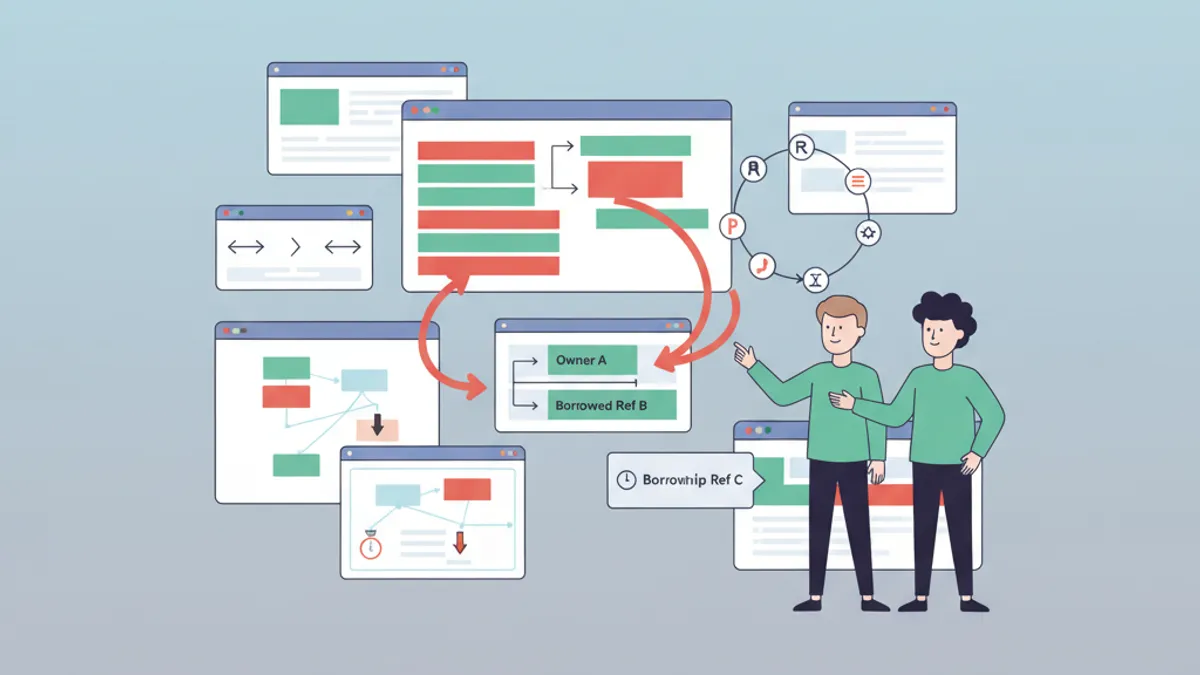
Ownership und Borrowing in Rust: Vollständiger Leitfaden
Beherrschen Sie das Ownership- und Borrowing-System von Rust. Eigentumsregeln, Referenzen, Lifetimes und fortgeschrittene Muster für die Speicherverwaltung.

Rust Interview-Fragen: Vollständiger Leitfaden 2026
Die 25 häufigsten Rust-Interviewfragen. Ownership, Borrowing, Lifetimes, Traits, Async und Concurrency mit ausführlichen Antworten und Codebeispielen.

Rust Ownership und Borrowing: Der Leitfaden, der alles verständlich macht
Rust Ownership und Borrowing praxisnah erklärt. Move-Semantik, Referenzen, Lifetimes und Borrow-Checker-Muster für sichere Speicherverwaltung in Rust.