Ownership und Borrowing in Rust: Vollständiger Leitfaden
Beherrschen Sie das Ownership- und Borrowing-System von Rust. Eigentumsregeln, Referenzen, Lifetimes und fortgeschrittene Muster für die Speicherverwaltung.
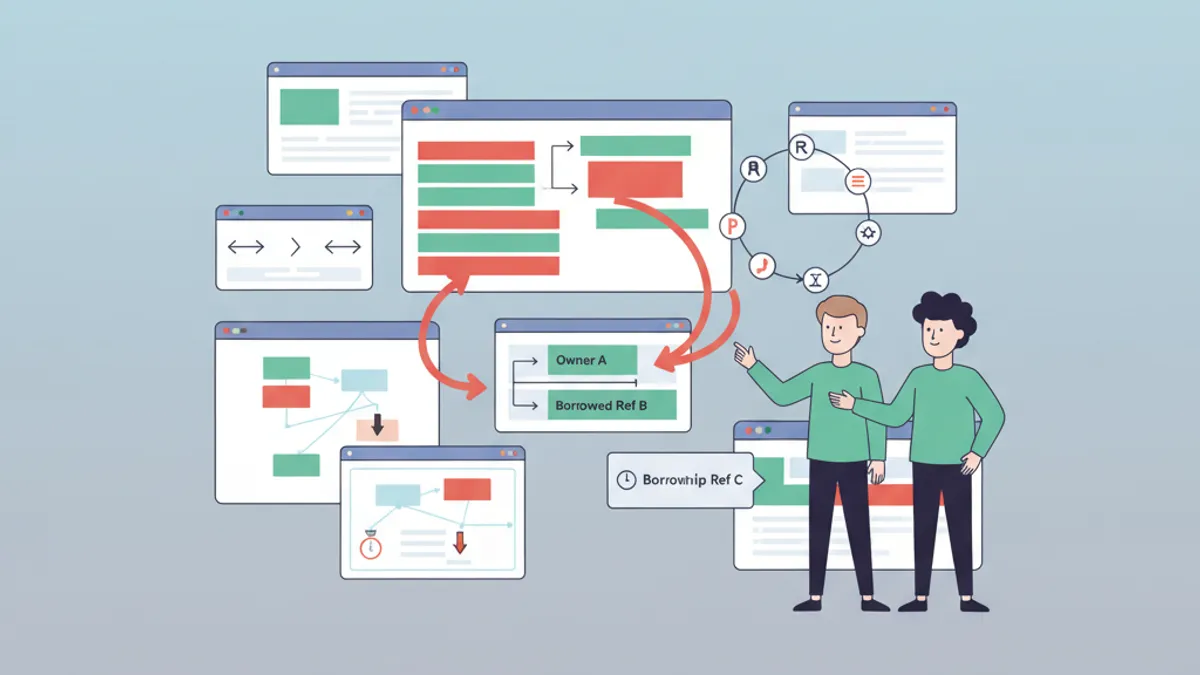
Das Ownership-System ist das, was Rust von jeder anderen Programmiersprache unterscheidet. Dieser einzigartige Ansatz garantiert Speichersicherheit ohne Garbage Collector und fängt Bugs zur Kompilierzeit statt zur Laufzeit ab. Dieser ausführliche Leitfaden behandelt die Mechanismen von Ownership und Borrowing, von den Grundlagen bis zu fortgeschrittenen Produktionsmustern.
Der Rust-Compiler agiert als anspruchsvoller Programmierassistent: Jeder zur Kompilierzeit blockierte Ownership-Fehler stellt einen potenziellen Bug dar, der in der Produktion vermieden wird.
Die drei grundlegenden Ownership-Regeln
Das Ownership-System beruht auf drei einfachen, aber strikten Regeln. Sobald diese verinnerlicht sind, wird das mentale Modell von Rust natürlich und vorhersehbar.
// Demonstration of the three fundamental rules

fn main() {
    // Rule 1: Each value has exactly ONE owner
    let s1 = String::from("hello");  // s1 is the sole owner

    // Rule 2: There can only be one owner at a time
    let s2 = s1;  // Ownership transferred (moved) from s1 to s2
    // println!("{}", s1);  // Compile ERROR: s1 no longer exists
    println!("s2 = {}", s2);  // Only s2 is valid now

    // Rule 3: When the owner goes out of scope, the value is dropped
    {
        let s3 = String::from("temporary");
        println!("s3 inside block = {}", s3);
    }  // s3 is automatically freed here (drop is called)
    // println!("{}", s3);  // ERROR: s3 no longer exists
}
Diese drei Regeln eliminieren ganze Bug-Kategorien: Use-after-free, Double-free und Speicherlecks. Der Compiler überprüft statisch, dass diese Regeln eingehalten werden.
Move vs Copy: Die Übertragungssemantik verstehen
Das Verhalten der Zuweisung hängt vom Datentyp ab. Typen, die das Copy-Trait implementieren, werden dupliziert, während andere per Move übertragen werden.
// Distinction between Copy types and Move types

fn main() {
    // Copy types: values stored on the stack, known size
    let x: i32 = 42;
    let y = x;  // x is COPIED, not moved
    println!("x = {}, y = {}", x, y);  // Both are valid

    // Other Copy types: f64, bool, char, tuples of Copy types
    let point = (3.0, 4.0);
    let point_copy = point;  // Tuple copy
    println!("Original: {:?}, Copy: {:?}", point, point_copy);

    // Move types: values on the heap, dynamic size
    let s1 = String::from("owned");
    let s2 = s1;  // s1 is MOVED to s2
    // println!("{}", s1);  // ERROR: value moved
    println!("s2 = {}", s2);

    // Vec, HashMap, Box are also Move types
    let vec1 = vec![1, 2, 3];
    let vec2 = vec1;  // Move, not copy
    // println!("{:?}", vec1);  // ERROR
    println!("vec2 = {:?}", vec2);
}

// Explicit clone to duplicate Move types
fn explicit_clone() {
    let original = String::from("important data");
    let clone = original.clone();  // Explicit duplication (memory cost)

    println!("Original: {}", original);  // Still valid
    println!("Clone: {}", clone);  // Independent copy
}
Die Move/Copy-Unterscheidung ist grundlegend: Sie bestimmt, ob die Zuweisung das Eigentum überträgt oder eine unabhängige Kopie erzeugt.
Der Aufruf von .clone() sollte bewusst erfolgen. Ein Code voller Clones kann auf ein Designproblem hindeuten. Borrowing ist oft die bessere Lösung.
Borrowing: Unveränderliche und veränderliche Referenzen
Borrowing ermöglicht den Zugriff auf einen Wert, ohne dessen Eigentum zu übernehmen. Dieser Mechanismus macht Rust-Code gleichzeitig sicher und performant.
// Immutable and mutable references

fn main() {
    let s = String::from("hello");

    // Immutable reference: read-only, multiple allowed
    let len = calculate_length(&s);  // Immutable borrow
    println!("'{}' has {} characters", s, len);  // s still valid

    // Multiple simultaneous immutable references: OK
    let r1 = &s;
    let r2 = &s;
    let r3 = &s;
    println!("r1={}, r2={}, r3={}", r1, r2, r3);
}

fn calculate_length(s: &String) -> usize {
    // s is a reference, not the owner
    s.len()
}  // s goes out of scope but doesn't drop anything (not owner)

// Mutable references: modification allowed
fn mutable_borrowing() {
    let mut s = String::from("hello");

    change(&mut s);  // Mutable borrow
    println!("After modification: {}", s);
}

fn change(s: &mut String) {
    s.push_str(", world!");  // Modification via mutable reference
}
Die goldene Regel des Borrowing: Entweder mehrere unveränderliche Referenzen ODER eine einzige veränderliche Referenz, niemals beide gleichzeitig.
Regeln des Borrow Checkers
Der Borrow Checker ist die Compiler-Komponente, die die Borrowing-Regeln überprüft. Das Verständnis seiner Fehler ermöglicht eine schnelle Problemlösung.
// Strict borrow checker rules

fn main() {
    // RULE 1: No mutable reference with immutable references
    let mut s = String::from("hello");

    let r1 = &s;      // Immutable reference: OK
    let r2 = &s;      // Another immutable reference: OK
    // let r3 = &mut s;  // ERROR: cannot borrow as mutable
    println!("{} and {}", r1, r2);

    // AFTER using r1 and r2, they are "dead"
    let r3 = &mut s;  // Now OK: r1 and r2 no longer used
    r3.push_str(" world");
    println!("{}", r3);

    // RULE 2: Only one mutable reference at a time
    let mut data = String::from("exclusive");
    let ref1 = &mut data;
    // let ref2 = &mut data;  // ERROR: already borrowed mutably
    ref1.push_str("!");
    println!("{}", ref1);
}

// RULE 3: References cannot outlive the data
fn dangling_reference_prevented() {
    let reference;
    {
        let s = String::from("short-lived");
        // reference = &s;  // ERROR: s doesn't live long enough
    }
    // s is dropped here, reference would be invalid

    // Solution: move the value out of the scope
    let owned_outside;
    {
        let s = String::from("moved out");
        owned_outside = s;  // Move, not reference
    }
    println!("{}", owned_outside);  // OK: owned_outside is the owner
}
Der Borrow Checker verwendet Non-Lexical Lifetimes (NLL): Eine Referenz gilt nur bis zu ihrer letzten Verwendung als aktiv, nicht bis zum Ende des Scopes.
Bereit für deine Rust-Interviews?
Übe mit unseren interaktiven Simulatoren, Flashcards und technischen Tests.
Lifetimes: Die Lebensdauer von Referenzen annotieren
Lifetimes sind Annotationen, die dem Compiler helfen zu überprüfen, dass Referenzen gültig bleiben. Meistens werden sie automatisch hergeleitet.
// Explicit lifetime annotations

// Without annotation: compiler infers lifetimes
fn first_word(s: &str) -> &str {
    match s.find(' ') {
        Some(i) => &s[..i],
        None => s,
    }
}

// With explicit annotation: same function
fn first_word_explicit<'a>(s: &'a str) -> &'a str {
    // 'a means: returned reference lives as long as the input
    match s.find(' ') {
        Some(i) => &s[..i],
        None => s,
    }
}

// When annotations are necessary: multiple references
fn longest<'a>(x: &'a str, y: &'a str) -> &'a str {
    // Compiler cannot guess which reference is returned
    if x.len() > y.len() {
        x
    } else {
        y
    }
}

fn main() {
    let string1 = String::from("long string");
    let result;
    {
        let string2 = String::from("xyz");
        result = longest(&string1, &string2);
        println!("Longest: {}", result);  // OK here
    }
    // println!("{}", result);  // ERROR if uncommented: string2 dropped
}
Lifetimes ändern nicht, wie lange Daten leben; sie beschreiben Beziehungen zwischen den Lebensdauern verschiedener Referenzen.
Lifetimes in Structs
Wenn ein Struct Referenzen enthält, müssen Lifetimes annotiert werden, um sicherzustellen, dass das Struct nicht länger lebt als die referenzierten Daten.
// Structs containing references

// Struct with reference: lifetime required
struct ImportantExcerpt<'a> {
    part: &'a str,  // This reference must live at least as long as the struct
}

impl<'a> ImportantExcerpt<'a> {
    // Method returning a reference with the same lifetime
    fn level(&self) -> i32 {
        3
    }

    // Elision rule: &self implies the output lifetime
    fn announce_and_return_part(&self, announcement: &str) -> &str {
        println!("Attention: {}", announcement);
        self.part  // Returns with 'a lifetime from self
    }
}

fn main() {
    let novel = String::from("Call me Ishmael. Some years ago...");
    let first_sentence = novel.split('.').next().unwrap();

    let excerpt = ImportantExcerpt {
        part: first_sentence,  // OK: novel outlives excerpt
    };

    println!("Excerpt: {}", excerpt.part);
    println!("Level: {}", excerpt.level());
}

// Static lifetime: reference valid for the entire program duration
fn static_lifetime_example() {
    let s: &'static str = "This string is in the binary";
    // String literals always have 'static lifetime
    println!("{}", s);
}
Die Lifetime-Elisionsregeln erlauben es oft, Annotationen in häufigen Fällen wegzulassen, was den Code lesbarer macht.
Fortgeschrittene Muster: Innere Veränderlichkeit
Manchmal muss die Veränderlichkeit zur Laufzeit statt zur Kompilierzeit überprüft werden. Rust bietet Typen für dieses Muster: RefCell und Cell.
// Interior mutability with RefCell and Cell

use std::cell::{Cell, RefCell};

// Cell: for Copy types, replaces the entire value
struct Counter {
    count: Cell<u32>,  // Mutable despite &self
}

impl Counter {
    fn new() -> Counter {
        Counter { count: Cell::new(0) }
    }

    fn increment(&self) {
        // Modification via immutable reference!
        self.count.set(self.count.get() + 1);
    }

    fn get(&self) -> u32 {
        self.count.get()
    }
}

// RefCell: for non-Copy types, checks at runtime
struct CachedValue {
    value: RefCell<Option<String>>,
}

impl CachedValue {
    fn new() -> CachedValue {
        CachedValue { value: RefCell::new(None) }
    }

    fn get_or_compute(&self, compute: impl FnOnce() -> String) -> String {
        // borrow() for reading, borrow_mut() for writing
        if self.value.borrow().is_none() {
            *self.value.borrow_mut() = Some(compute());
        }
        self.value.borrow().as_ref().unwrap().clone()
    }
}

fn main() {
    let counter = Counter::new();
    counter.increment();
    counter.increment();
    println!("Counter: {}", counter.get());  // 2

    let cache = CachedValue::new();
    let result = cache.get_or_compute(|| {
        println!("Expensive computation...");
        String::from("result")
    });
    println!("Value: {}", result);

    // Second call: no recomputation
    let result2 = cache.get_or_compute(|| String::from("never executed"));
    println!("Cache hit: {}", result2);
}
RefCell und Cell verlagern die Borrowing-Überprüfung in die Laufzeit. Eine Regelverletzung verursacht einen Panic statt eines Kompilierfehlers.
RefCell::borrow_mut() löst einen Panic aus, wenn der Wert bereits ausgeliehen ist. Für eine explizite Fehlerbehandlung empfiehlt sich try_borrow_mut().
Smart Pointer und Ownership
Smart Pointer wie Box, Rc und Arc bieten unterschiedliche Ownership-Strategien für spezifische Anwendungsfälle.
// Box, Rc, and Arc for different ownership patterns

use std::rc::Rc;
use std::sync::Arc;
use std::thread;

// Box: single owner, data on the heap
fn box_example() {
    let boxed = Box::new(vec![1, 2, 3, 4, 5]);
    println!("Boxed vec: {:?}", boxed);
    // Useful for: recursive types, large objects, trait objects
}

// Rc: reference counting, multiple owners (single-thread)
fn rc_example() {
    let data = Rc::new(String::from("shared data"));

    let clone1 = Rc::clone(&data);  // Increments the counter
    let clone2 = Rc::clone(&data);

    println!("Count: {}", Rc::strong_count(&data));  // 3
    println!("All share: {}, {}, {}", data, clone1, clone2);
}  // Freed when counter reaches 0

// Arc: thread-safe Rc (Atomic Reference Counting)
fn arc_example() {
    let data = Arc::new(vec![1, 2, 3]);

    let handles: Vec<_> = (0..3).map(|i| {
        let data_clone = Arc::clone(&data);
        thread::spawn(move || {
            println!("Thread {}: {:?}", i, data_clone);
        })
    }).collect();

    for handle in handles {
        handle.join().unwrap();
    }
}

fn main() {
    box_example();
    rc_example();
    arc_example();
}
Die Wahl des Smart Pointers hängt vom Ownership-Muster ab: einzigartig (Box), geteilt im Single-Thread (Rc) oder geteilt zwischen Threads (Arc).
Praktische Ownership-Muster
Hier sind gängige Muster, um Code rund um das Ownership-System zu strukturieren.
// Practical patterns for ownership management

// Pattern 1: Builder pattern with chained ownership
struct RequestBuilder {
    url: String,
    headers: Vec<(String, String)>,
    timeout: Option<u64>,
}

impl RequestBuilder {
    fn new(url: &str) -> Self {
        RequestBuilder {
            url: url.to_string(),
            headers: Vec::new(),
            timeout: None,
        }
    }

    // Consumes self and returns the new self
    fn header(mut self, key: &str, value: &str) -> Self {
        self.headers.push((key.to_string(), value.to_string()));
        self  // Returns ownership
    }

    fn timeout(mut self, seconds: u64) -> Self {
        self.timeout = Some(seconds);
        self
    }

    fn build(self) -> Request {
        Request {
            url: self.url,
            headers: self.headers,
            timeout: self.timeout.unwrap_or(30),
        }
    }
}

struct Request {
    url: String,
    headers: Vec<(String, String)>,
    timeout: u64,
}

// Pattern 2: Cow (Copy-on-Write) to avoid allocations
use std::borrow::Cow;

fn process_text(input: &str) -> Cow<str> {
    if input.contains("REPLACE") {
        // Allocation only if modification needed
        Cow::Owned(input.replace("REPLACE", "NEW"))
    } else {
        // No allocation, returns a reference
        Cow::Borrowed(input)
    }
}

// Pattern 3: Take to extract from an Option
fn extract_value(data: &mut Option<String>) -> String {
    data.take().unwrap_or_else(|| String::from("default"))
    // take() replaces with None and returns ownership of the value
}

fn main() {
    // Builder pattern
    let request = RequestBuilder::new("https://api.example.com")
        .header("Authorization", "Bearer token")
        .header("Content-Type", "application/json")
        .timeout(60)
        .build();

    println!("URL: {}, Timeout: {}s", request.url, request.timeout);

    // Cow pattern
    let text1 = process_text("hello world");  // No allocation
    let text2 = process_text("hello REPLACE");  // Allocation
    println!("{} | {}", text1, text2);

    // Take pattern
    let mut optional = Some(String::from("extracted"));
    let value = extract_value(&mut optional);
    println!("Value: {}, Option: {:?}", value, optional);  // None
}
Diese Muster nutzen das Ownership-System, um ergonomische und performante APIs zu erstellen.
Fang an zu üben!
Teste dein Wissen mit unseren Interview-Simulatoren und technischen Tests.
Fazit
Das Ownership- und Borrowing-System von Rust stellt einen Paradigmenwechsel in der Speicherverwaltung dar. Einmal beherrscht, wird es zu einem mächtigen Verbündeten, um Code zu schreiben, der sowohl performant als auch sicher ist.
Wichtige Erkenntnisse:
✅ Drei Ownership-Regeln: einzelner Eigentümer, Eigentumsübertragung, automatischer Drop
✅ Borrowing: mehrere unveränderliche Referenzen ODER eine exklusive veränderliche Referenz
✅ Lifetimes: Beziehungen zwischen Referenz-Lebensdauern annotieren
✅ Innere Veränderlichkeit: RefCell und Cell für zur Laufzeit überprüfte Veränderlichkeit
✅ Smart Pointer: Box (einzigartig), Rc (geteilt), Arc (thread-safe)
✅ Praktische Muster: Builder, Cow, Take für idiomatische APIs
Der Borrow Checker mag anfangs streng erscheinen, aber jeder Fehler, den er meldet, stellt einen potenziell vermiedenen Bug dar. Mit der Übung wird das Denken in Begriffen von Ownership natürlich und verbessert die Codequalität in allen Sprachen.
Fang an zu üben!
Teste dein Wissen mit unseren Interview-Simulatoren und technischen Tests.
Findest du den Bug in Rust?
Ein echter Codeausschnitt, ein versteckter Bug, ein Versuch pro Tag. Zum Ausprobieren ohne Konto.

Geschrieben von
Anthony Fillion-MailletGründer von SharpSkill
Seit über 10 Jahren Fullstack-Entwickler. Er leitet SharpSkill und verantwortet alles, was hier erscheint.
Aktualisiert am 29. April 2026
Tags
Teilen
Verwandte Artikel

Rust Ownership und Borrowing: Der Leitfaden, der alles verständlich macht
Rust Ownership und Borrowing praxisnah erklärt. Move-Semantik, Referenzen, Lifetimes und Borrow-Checker-Muster für sichere Speicherverwaltung in Rust.

Rust Interview-Fragen: Vollständiger Leitfaden 2026
Die 25 häufigsten Rust-Interviewfragen. Ownership, Borrowing, Lifetimes, Traits, Async und Concurrency mit ausführlichen Antworten und Codebeispielen.

Rust: Grundlagen fuer erfahrene Entwickler in 2026
Rust schnell erlernen mit vorhandenem Wissen. Ownership, Borrowing, Lifetimes und wesentliche Patterns erklaert fuer Entwickler aus C++, Java oder Python.