Go Concurrency: Goroutines and Channels - Complete Guide
Master Go concurrency with goroutines and channels. Advanced patterns, synchronization, select statements, and best practices with detailed code examples.

Concurrency stands as one of Go's greatest strengths. Unlike other languages where multithreading remains complex, Go provides an elegant model based on goroutines and channels that significantly simplifies concurrent application development.
"Don't communicate by sharing memory; share memory by communicating." This fundamental principle guides all concurrency design in Go.
Understanding Goroutines
Goroutines are lightweight threads managed by the Go runtime. They consume roughly 2 KB of stack space (compared to several MB for OS threads) and enable thousands of concurrent tasks without system overhead.
Launching a goroutine requires simply placing the go keyword before a function call. The runtime handles scheduling and distribution across available threads.
package main

import (
    "fmt"
    "time"
)

// fetchData simulates a network request
func fetchData(id int) {
    // Simulates network delay
    time.Sleep(100 * time.Millisecond)
    fmt.Printf("Data %d fetched\n", id)
}

func main() {
    // Sequential execution - 500ms total
    start := time.Now()
    for i := 1; i <= 5; i++ {
        fetchData(i)
    }
    fmt.Printf("Sequential: %v\n", time.Since(start))

    // Concurrent execution - ~100ms total
    start = time.Now()
    for i := 1; i <= 5; i++ {
        go fetchData(i) // Execute as goroutine
    }
    time.Sleep(150 * time.Millisecond) // Wait for completion
    fmt.Printf("Concurrent: %v\n", time.Since(start))
}
Concurrent execution reduces total time from 500ms to approximately 100ms. However, using time.Sleep for goroutine synchronization is not a best practice. Channels offer an elegant solution.
Channels: Communication Between Goroutines
A channel is a typed conduit for sending and receiving values between goroutines. Channels ensure synchronization: a sending goroutine waits until another receives, and vice versa.
Channel creation uses the make function. The <- operator sends and receives data depending on its placement relative to the channel.
package main

import "fmt"

// worker performs computation and returns result via channel
func worker(id int, jobs <-chan int, results chan<- int) {
    // Receives jobs until channel closes
    for job := range jobs {
        result := job * 2 // Processing
        results <- result // Send result
    }
}

func main() {
    // Create channels
    jobs := make(chan int, 10)    // Buffered channel
    results := make(chan int, 10)

    // Start 3 workers
    for w := 1; w <= 3; w++ {
        go worker(w, jobs, results)
    }

    // Send 5 jobs
    for j := 1; j <= 5; j++ {
        jobs <- j
    }
    close(jobs) // Signal end of jobs

    // Collect results
    for r := 1; r <= 5; r++ {
        result := <-results
        fmt.Printf("Result: %d\n", result)
    }
}
Directional channels (<-chan for receive, chan<- for send) enhance code safety by limiting possible operations.
Buffered vs Unbuffered Channels
The distinction between these channel types directly affects goroutine synchronization behavior.
Unbuffered channels block the sender until a receiver is ready. Buffered channels allow sending up to N values without blocking, where N represents the buffer capacity.
package main

import "fmt"

func main() {
    // Unbuffered channel - strict synchronization
    unbuffered := make(chan string)

    go func() {
        unbuffered <- "message" // Blocks until received
    }()

    msg := <-unbuffered // Unblocks the send
    fmt.Println(msg)

    // Buffered channel - capacity of 2
    buffered := make(chan int, 2)

    // These sends don't block
    buffered <- 1
    buffered <- 2
    // buffered <- 3 // Would block because buffer is full

    fmt.Println(<-buffered) // 1
    fmt.Println(<-buffered) // 2

    // Check capacity
    fmt.Printf("Length: %d, Capacity: %d\n",
        len(buffered), cap(buffered))
}
Buffered channels decouple producers and consumers, while unbuffered ones guarantee point-to-point synchronization.
A deadlock occurs when all goroutines are blocked waiting. The Go runtime detects this and terminates the program with an explicit error message.
Select: Channel Multiplexing
The select statement waits on multiple channel operations simultaneously. It resembles a switch statement for concurrent communications.
This construct is essential for handling timeouts, cancellations, and multiple communications without blocking indefinitely on a single channel.
package main

import (
    "fmt"
    "time"
)

// fetchAPI simulates an API call with variable delay
func fetchAPI(name string, delay time.Duration, ch chan<- string) {
    time.Sleep(delay)
    ch <- fmt.Sprintf("%s: data received", name)
}

func main() {
    api1 := make(chan string)
    api2 := make(chan string)

    // Launch two API calls in parallel
    go fetchAPI("API-1", 100*time.Millisecond, api1)
    go fetchAPI("API-2", 200*time.Millisecond, api2)

    // Global timeout of 150ms
    timeout := time.After(150 * time.Millisecond)

    // Collect results with timeout
    for i := 0; i < 2; i++ {
        select {
        case result := <-api1:
            fmt.Println(result)
        case result := <-api2:
            fmt.Println(result)
        case <-timeout:
            fmt.Println("Timeout - operation cancelled")
            return
        }
    }
}
The select chooses the first ready channel. If multiple are ready, the choice is pseudo-random to prevent starvation.
Ready to ace your Go interviews?
Practice with our interactive simulators, flashcards, and technical tests.
Worker Pool Pattern
The worker pool pattern distributes tasks among multiple workers, limiting concurrency and optimizing resource usage. This pattern proves indispensable for processing large amounts of data.
The implementation relies on a shared jobs channel among workers and a results channel for collection.
package main

import (
    "fmt"
    "sync"
    "time"
)

// Task represents a unit of work
type Task struct {
    ID   int
    Data string
}

// Result contains the processing result
type Result struct {
    TaskID int
    Output string
}

// worker processes received tasks
func worker(id int, tasks <-chan Task, results chan<- Result, wg *sync.WaitGroup) {
    defer wg.Done()

    for task := range tasks {
        // Simulate processing
        time.Sleep(50 * time.Millisecond)

        results <- Result{
            TaskID: task.ID,
            Output: fmt.Sprintf("Worker %d processed: %s", id, task.Data),
        }
    }
}

func main() {
    const numWorkers = 3
    const numTasks = 10

    tasks := make(chan Task, numTasks)
    results := make(chan Result, numTasks)

    var wg sync.WaitGroup

    // Start workers
    for w := 1; w <= numWorkers; w++ {
        wg.Add(1)
        go worker(w, tasks, results, &wg)
    }

    // Send tasks
    for i := 1; i <= numTasks; i++ {
        tasks <- Task{ID: i, Data: fmt.Sprintf("task-%d", i)}
    }
    close(tasks)

    // Close results channel after workers finish
    go func() {
        wg.Wait()
        close(results)
    }()

    // Collect results
    for result := range results {
        fmt.Printf("Task %d: %s\n", result.TaskID, result.Output)
    }
}
The sync.WaitGroup coordinates waiting for all workers to finish before closing the results channel.
Fan-Out/Fan-In Pattern
This pattern distributes work among multiple goroutines (fan-out) then aggregates results (fan-in). It maximizes parallelism while simplifying result collection.
package main

import (
    "fmt"
    "sync"
)

// generate produces numbers on a channel
func generate(nums ...int) <-chan int {
    out := make(chan int)
    go func() {
        for _, n := range nums {
            out <- n
        }
        close(out)
    }()
    return out
}

// square computes the square of received numbers
func square(in <-chan int) <-chan int {
    out := make(chan int)
    go func() {
        for n := range in {
            out <- n * n
        }
        close(out)
    }()
    return out
}

// merge combines multiple channels into one (fan-in)
func merge(channels ...<-chan int) <-chan int {
    out := make(chan int)
    var wg sync.WaitGroup

    // Output function for each channel
    output := func(c <-chan int) {
        defer wg.Done()
        for n := range c {
            out <- n
        }
    }

    // Launch a goroutine per channel
    wg.Add(len(channels))
    for _, c := range channels {
        go output(c)
    }

    // Close after all goroutines finish
    go func() {
        wg.Wait()
        close(out)
    }()

    return out
}

func main() {
    // Generate data
    numbers := generate(1, 2, 3, 4, 5, 6, 7, 8)

    // Fan-out: distribute to 3 workers
    sq1 := square(numbers)
    sq2 := square(numbers)
    sq3 := square(numbers)

    // Fan-in: aggregate results
    for result := range merge(sq1, sq2, sq3) {
        fmt.Println(result)
    }
}
This pattern excels for distributable CPU-bound operations and data processing pipelines.
Context for Cancellation and Deadlines
The context package standardizes cancellation, deadline, and value management across goroutines. Any long-running goroutine should accept a context as its first parameter.
package main

import (
    "context"
    "fmt"
    "time"
)

// fetchWithContext simulates a cancellable request
func fetchWithContext(ctx context.Context, url string) (string, error) {
    // Simulates a long operation
    select {
    case <-time.After(2 * time.Second):
        return fmt.Sprintf("Data from %s", url), nil
    case <-ctx.Done():
        return "", ctx.Err() // context.Canceled or context.DeadlineExceeded
    }
}

func main() {
    // Context with 500ms timeout
    ctx, cancel := context.WithTimeout(context.Background(), 500*time.Millisecond)
    defer cancel() // Release resources

    result, err := fetchWithContext(ctx, "https://api.example.com")
    if err != nil {
        fmt.Printf("Error: %v\n", err)
        return
    }
    fmt.Println(result)

    // Context with manual cancellation
    ctx2, cancel2 := context.WithCancel(context.Background())

    go func() {
        time.Sleep(100 * time.Millisecond)
        cancel2() // Explicit cancellation
    }()

    result, err = fetchWithContext(ctx2, "https://api2.example.com")
    if err != nil {
        fmt.Printf("Request cancelled: %v\n", err)
    }
}Always call defer cancel() immediately after creating a context to avoid resource leaks.
Synchronization with sync.Mutex
While channels are preferred for communication, the sync package remains necessary for protecting concurrent access to shared data structures.
package main

import (
    "fmt"
    "sync"
)

// SafeCounter is a thread-safe counter
type SafeCounter struct {
    mu    sync.Mutex
    value map[string]int
}

// Increment increments the value for a given key
func (c *SafeCounter) Increment(key string) {
    c.mu.Lock()         // Exclusive lock
    defer c.mu.Unlock() // Guaranteed unlock
    c.value[key]++
}

// Value returns the current value
func (c *SafeCounter) Value(key string) int {
    c.mu.Lock()
    defer c.mu.Unlock()
    return c.value[key]
}

func main() {
    counter := SafeCounter{value: make(map[string]int)}

    var wg sync.WaitGroup

    // 1000 concurrent increments
    for i := 0; i < 1000; i++ {
        wg.Add(1)
        go func() {
            defer wg.Done()
            counter.Increment("visits")
        }()
    }

    wg.Wait()
    fmt.Printf("Total: %d\n", counter.Value("visits")) // 1000
}
The sync.RWMutex optimizes concurrent reads with RLock()/RUnlock() for read-only operations.
Common Mistakes and Solutions
Go concurrency presents classic pitfalls. Here are the most common errors and how to avoid them.
package main

import (
    "fmt"
    "sync"
)

func main() {
    // ERROR: Loop variable capture
    // All goroutines would print the same value
    for i := 0; i < 3; i++ {
        go func() {
            fmt.Println(i) // Capture by reference - BUG
        }()
    }

    // SOLUTION: Pass value as parameter
    var wg sync.WaitGroup
    for i := 0; i < 3; i++ {
        wg.Add(1)
        go func(n int) {
            defer wg.Done()
            fmt.Println(n) // Local copy - CORRECT
        }(i)
    }
    wg.Wait()

    // ERROR: Send on nil channel
    var ch chan int
    // ch <- 1 // Blocks forever

    // SOLUTION: Always initialize with make
    ch = make(chan int, 1)
    ch <- 1
    fmt.Println(<-ch)

    // ERROR: Send on closed channel
    done := make(chan bool)
    close(done)
    // done <- true // Panic!

    // SOLUTION: Check before send or use sync.Once
    select {
    case done <- true:
        fmt.Println("Sent")
    default:
        fmt.Println("Channel closed or full")
    }
}
Data race detection uses the -race flag during compilation or testing: go test -race ./....
Start practicing!
Test your knowledge with our interview simulators and technical tests.
Conclusion
Mastering Go concurrency relies on a few key concepts that, when well understood, enable building highly performant applications.
Key takeaways:
✅ Goroutines are lightweight and cheap - creating thousands remains acceptable
✅ Channels synchronize and transfer data between goroutines
✅ The select statement handles multiple communications and timeouts
✅ The worker pool pattern limits concurrency and optimizes resources
✅ The context package standardizes cancellation and deadlines
✅ Mutexes protect shared data when channels are insufficient
✅ The -race flag detects data races during testing
The "Share memory by communicating" philosophy guides toward safer and more maintainable designs than traditional multithreading with locks.
Can you spot the bug in Go?
One real snippet, one hidden bug, one attempt a day. No account needed to try.

Written by
Anthony Fillion-MailletFounder of SharpSkill
Full-stack developer for over 10 years. Runs SharpSkill and answers for everything published here.
Updated on March 31, 2026
Tags
Share
Related articles
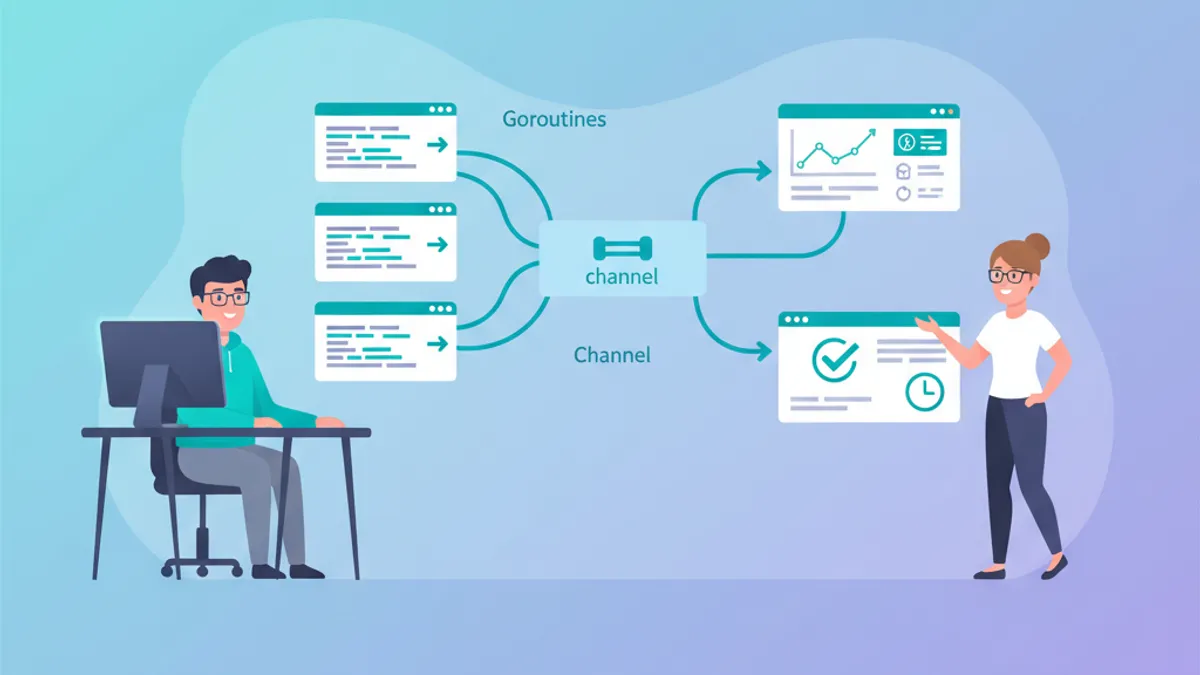
Go Technical Interview: Goroutines, Channels and Concurrency
Go interview questions on goroutines, channels, and concurrency patterns. Code examples, common pitfalls, and expert-level answers to prepare for Go technical interviews in 2026.
Top 25 Go Interview Questions: Complete Developer Guide
Ace your Go interviews with the 25 most asked questions. Master goroutines, channels, interfaces, concurrency patterns with practical code examples.
Go: Basics for Java/Python Developers in 2026
Learn Go quickly by leveraging your Java or Python experience. Goroutines, channels, interfaces and essential patterns explained for a smooth transition.