Zapytannia na spivbesidi z Rust: Povnyi posibnyk 2026
25 naiposhyrenishykh zapytan na spivbesidi z Rust. Vlastnist, zapozychennia, chasy zhyttia, treity, async/await, paralelizm z detalianymy vidpovidyamy ta prykladamy kodu.

Spivbesidy z Rust otsiniuiut rozuminnia unikalnoi systemy vlasnosti, upravlinnia pamiattiu bez zbyracha smittia ta zdatnist pysaty bezpechnyi paralelnyi kod. Tsei posibnyk okhopiuie kliuchovi zapytannia, vid osnov vlasnosti do prosunytykh shabloniv async ta paralelizmu.
Interviiuery tsiniuiut poiasnennia, shcho demonstruiut rozuminnia harantii bezpeky pamiati v Rust. Zdatnist poiasnyty, yak kompiliator zapobihaje pomylkam na etapi kompiliatsii, robyt riznytsiu.
Vlastnist ta zapozychennia
Zapytannia 1: Poiasnennia systemy vlasnosti v Rust
Vlastnist -- tse tsentralna kontseptsiia Rust, yaka umozhlyliuie upravlinnia pamiattiu bez zbyracha smittia, harantuiuchy bezpeku pamiati na etapi kompiliatsii.
// The three fundamental rules of ownership

fn main() {
    // Rule 1: Each value has a single owner
    let s1 = String::from("hello");  // s1 is the owner

    // Rule 2: Only one variable can own a value at a time
    let s2 = s1;  // s1 is MOVED to s2
    // println!("{}", s1);  // ERROR: s1 is no longer valid
    println!("{}", s2);  // OK: s2 is now the owner

    // Rule 3: When the owner goes out of scope, the value is dropped
    {
        let s3 = String::from("world");
        // s3 is valid here
    }  // s3 goes out of scope, memory is automatically freed

    // Copy types: simple types are copied, not moved
    let x = 5;
    let y = x;  // x is COPIED, not moved
    println!("x = {}, y = {}", x, y);  // Both are valid
}

// Move in action with functions
fn take_ownership(s: String) {
    // s takes ownership of the String
    println!("{}", s);
}  // s is dropped here, memory freed

fn makes_copy(i: i32) {
    // i is a copy of the argument
    println!("{}", i);
}  // i goes out of scope, nothing special (Copy type)

fn ownership_with_functions() {
    let s = String::from("hello");
    take_ownership(s);  // s is moved into the function
    // println!("{}", s);  // ERROR: s is no longer valid

    let x = 5;
    makes_copy(x);  // x is copied
    println!("{}", x);  // OK: x is still valid
}
Vlastnist usuvaje typovi pomylky pamiati: use-after-free, double-free ta vytoky pamiati. Kompiliator harantuie tsi vlastyvosti na etapi kompiliatsii.
Zapytannia 2: Riznytsia mizh nemutoiuvanym ta mutoiuvanym zapozychenniam
Zapozychennia dozvoliaie vykorystovuvaty znachennia bez pereimiannia vlasnosti, z suvorymy pravilamy zapobihannia perehoniv danykh.
// Immutable and mutable references

fn main() {
    let mut s = String::from("hello");

    // IMMUTABLE REFERENCES (&T)
    // Can coexist in unlimited numbers
    let r1 = &s;  // immutable reference
    let r2 = &s;  // another immutable reference
    println!("{} and {}", r1, r2);  // OK

    // MUTABLE REFERENCE (&mut T)
    // Only one at a time, and no simultaneous immutable references
    let r3 = &mut s;  // mutable reference
    // let r4 = &s;  // ERROR: cannot have both immutable and mutable
    // let r5 = &mut s;  // ERROR: only one mutable reference allowed
    r3.push_str(" world");
    println!("{}", r3);

    // Reference scopes are limited to their last use
    let r6 = &s;  // OK because r3 is no longer used
    println!("{}", r6);
}

// Practical example: modifying a struct
struct User {
    name: String,
    age: u32,
}

impl User {
    // &self: read-only access
    fn get_name(&self) -> &str {
        &self.name
    }

    // &mut self: modification access
    fn set_name(&mut self, name: String) {
        self.name = name;
    }

    // self: takes ownership (consumes the instance)
    fn into_name(self) -> String {
        self.name  // The User instance no longer exists after this
    }
}

fn borrowing_with_structs() {
    let mut user = User {
        name: String::from("Alice"),
        age: 30,
    };

    // Reading
    println!("Name: {}", user.get_name());

    // Modifying
    user.set_name(String::from("Bob"));

    // Consuming
    let name = user.into_name();
    // user.age;  // ERROR: user has been consumed
}
Tsi pravyla harantuiut vidsunist perehoniv danykh na etapi kompiliatsii. Zhodna insha mova ne proponuie tsiei harantii bez pozhertvy produktyvnistiu.
Z Rust 2018 kompiliator vykorystovuie NLL (Non-Lexical Lifetimes) dlia tochnishoho vyznachennia, koly posylannia bilshe ne vykorystovuietsia, shcho zabezpechuie bilshu hnuchkist.
Zapytannia 3: Chasy zhyttia ta koly ikh potribno anotuivaty
Chasy zhyttia -- tse anotatsii, yaki povidomliaiut kompiliatoru pro te, yak dovho posylannia ye diisnymy, zapobihaiuchy vysychym posylanniam.
// Understanding and annotating lifetimes

// ERROR: dangling reference
// fn dangling() -> &String {
//     let s = String::from("hello");
//     &s  // s is dropped at function end, reference invalid
// }

// The compiler often infers lifetimes automatically
fn first_word(s: &str) -> &str {
    // Elided lifetime: compiler understands the return
    // has the same lifetime as the input
    match s.find(' ') {
        Some(i) => &s[..i],
        None => s,
    }
}

// Explicit annotation needed with multiple references
fn longest<'a>(x: &'a str, y: &'a str) -> &'a str {
    // 'a means: the return lives at least as long
    // as the shorter of the two inputs
    if x.len() > y.len() { x } else { y }
}

fn lifetime_example() {
    let string1 = String::from("long string");
    let result;

    {
        let string2 = String::from("xyz");
        result = longest(&string1, &string2);
        println!("Longest: {}", result);  // OK here
    }
    // println!("{}", result);  // ERROR: string2 is dropped
}

// Lifetimes in structs
struct ImportantExcerpt<'a> {
    part: &'a str,  // Struct cannot outlive part
}

impl<'a> ImportantExcerpt<'a> {
    // Method returning a reference with the same lifetime
    fn level(&self) -> i32 {
        3
    }

    // Elided lifetime for &self returning a new reference
    fn announce_and_return_part(&self, announcement: &str) -> &str {
        println!("Attention: {}", announcement);
        self.part  // Returns with lifetime 'a
    }
}

// Static lifetime: lives for the entire program duration
fn static_lifetime() {
    let s: &'static str = "hello";  // Stored in the binary

    // Constants have implicit 'static lifetime
    const MAX_POINTS: u32 = 100_000;
}

// Combining lifetimes and generics
fn longest_with_announcement<'a, T>(
    x: &'a str,
    y: &'a str,
    ann: T,
) -> &'a str
where
    T: std::fmt::Display,
{
    println!("Announcement: {}", ann);
    if x.len() > y.len() { x } else { y }
}
Chasy zhyttia pereviriaiutsia na etapi kompiliatsii. Yakshcho kod kompiluietsia, posylannia harantovano diisni.
Treity ta heneriky
Zapytannia 4: Yak pratsiuiut treity v Rust
Treity vyznachaiut spilnu povedinku mizh riznymy typamy, podibno do interfeisiv, ale z dodatkovymy mozhlyvostiamy.
// Defining and implementing traits

// Trait definition
trait Summary {
    // Required method (no body)
    fn summarize(&self) -> String;

    // Method with default implementation
    fn summarize_author(&self) -> String {
        String::from("(Anonymous)")
    }

    // Default method that calls a required method
    fn full_summary(&self) -> String {
        format!("By {} - {}", self.summarize_author(), self.summarize())
    }
}

// Implementation for different types
struct NewsArticle {
    headline: String,
    location: String,
    author: String,
    content: String,
}

impl Summary for NewsArticle {
    fn summarize(&self) -> String {
        format!("{}, by {} ({})", self.headline, self.author, self.location)
    }

    fn summarize_author(&self) -> String {
        format!("@{}", self.author)
    }
}

struct Tweet {
    username: String,
    content: String,
    reply: bool,
    retweet: bool,
}

impl Summary for Tweet {
    fn summarize(&self) -> String {
        format!("{}: {}", self.username, self.content)
    }
}

// Trait bounds: constraining generics
fn notify<T: Summary>(item: &T) {
    println!("Breaking news! {}", item.summarize());
}

// Alternative syntax with where
fn notify_verbose<T>(item: &T)
where
    T: Summary,
{
    println!("Breaking news! {}", item.summarize());
}

// Multiple trait bounds
fn notify_complex<T: Summary + Clone + std::fmt::Display>(item: &T) {
    println!("{}", item);
}

// Return a type that implements a trait
fn create_summarizable() -> impl Summary {
    Tweet {
        username: String::from("rust_lang"),
        content: String::from("Rust 2026 is amazing!"),
        reply: false,
        retweet: false,
    }
}
Treity zabezpechuiut polimorfizm bez uspadkuvannia klasiv, viddaiuchy perevahu kompozytsii nad uspadkuvanniam.
Zapytannia 5: Riznytsia mizh statychnoiu ta dynamichnoiu henerychnostiiu
Rust proponuie dva pidkhody do polimorfizmu: monomorfizatsiiu (statychnu) ta treit-obiekty (dynamichnu).
// Static vs dynamic dispatch

trait Animal {
    fn speak(&self) -> String;
    fn name(&self) -> &str;
}

struct Dog { name: String }
struct Cat { name: String }

impl Animal for Dog {
    fn speak(&self) -> String { String::from("Woof!") }
    fn name(&self) -> &str { &self.name }
}

impl Animal for Cat {
    fn speak(&self) -> String { String::from("Meow!") }
    fn name(&self) -> &str { &self.name }
}

// STATIC DISPATCH (monomorphization)
// Compiler generates a version for each concrete type
fn make_speak_static<T: Animal>(animal: &T) {
    // At compile time, becomes make_speak_Dog and make_speak_Cat
    println!("{} says {}", animal.name(), animal.speak());
}

// Advantages: inlining possible, no runtime overhead
// Disadvantages: larger binary, type must be known at compile time

// DYNAMIC DISPATCH (trait objects)
// Uses a vtable to resolve methods at runtime
fn make_speak_dynamic(animal: &dyn Animal) {
    // Resolved via a pointer table (vtable) at runtime
    println!("{} says {}", animal.name(), animal.speak());
}

// Advantages: can store different types, smaller binary
// Disadvantages: indirection overhead, no inlining

fn main() {
    let dog = Dog { name: String::from("Rex") };
    let cat = Cat { name: String::from("Whiskers") };

    // Static: type is known at compile time
    make_speak_static(&dog);
    make_speak_static(&cat);

    // Dynamic: type is resolved at runtime
    make_speak_dynamic(&dog);
    make_speak_dynamic(&cat);

    // Heterogeneous collection (requires dynamic dispatch)
    let animals: Vec<Box<dyn Animal>> = vec![
        Box::new(Dog { name: String::from("Buddy") }),
        Box::new(Cat { name: String::from("Luna") }),
    ];

    for animal in animals.iter() {
        println!("{} says {}", animal.name(), animal.speak());
    }
}

// Object safety: not all traits can become trait objects
trait ObjectSafe {
    fn method(&self);
    // No Self in return type
    // No generic parameters
}

// NOT object safe (cannot be dyn NotObjectSafe)
trait NotObjectSafe {
    fn create() -> Self;  // Self in return
    fn generic<T>(&self, t: T);  // Generic
}
Statychnyi dispatch perezhahuietsia z tochky zoru produktyvnosti. Dynamichnyi dispatch korysnym dlia heterohennykh kolektsii ta hnuchkosti.
Готовий до співбесід з Rust?
Практикуйся з нашими інтерактивними симуляторами, flashcards та технічними тестами.
Obrobka pomylok
Zapytannia 6: Obrobka pomylok za dopomohoiu Result ta Option
V Rust nemaje vyniatk. Obrobka pomylok zdiisniuietsia cherez typy Result<T, E> ta Option<T> z zividstavlenniam shabloniv.
// Idiomatic error handling in Rust

use std::fs::File;
use std::io::{self, Read};

// Option<T>: presence or absence of a value
fn find_user(id: u32) -> Option<String> {
    match id {
        1 => Some(String::from("Alice")),
        2 => Some(String::from("Bob")),
        _ => None,  // No user found
    }
}

// Result<T, E>: success or error
fn divide(a: f64, b: f64) -> Result<f64, String> {
    if b == 0.0 {
        Err(String::from("Division by zero"))
    } else {
        Ok(a / b)
    }
}

fn option_combinators() {
    let user = find_user(1);

    // Pattern matching
    match user {
        Some(name) => println!("Found: {}", name),
        None => println!("Not found"),
    }

    // unwrap_or: default value
    let name = find_user(99).unwrap_or(String::from("Unknown"));

    // map: transform the value if present
    let upper = find_user(1).map(|n| n.to_uppercase());

    // and_then (flatMap): chain Options
    let first_char = find_user(1).and_then(|n| n.chars().next());

    // if let: simplified pattern matching
    if let Some(name) = find_user(2) {
        println!("User 2 is {}", name);
    }
}

fn result_handling() -> Result<(), Box<dyn std::error::Error>> {
    // The ? operator propagates errors automatically
    let result = divide(10.0, 2.0)?;
    println!("Result: {}", result);

    // Equivalent to:
    // let result = match divide(10.0, 2.0) {
    //     Ok(v) => v,
    //     Err(e) => return Err(e.into()),
    // };

    Ok(())
}

// File reading with error propagation
fn read_file_contents(path: &str) -> Result<String, io::Error> {
    let mut file = File::open(path)?;  // Propagates error if failure
    let mut contents = String::new();
    file.read_to_string(&mut contents)?;
    Ok(contents)
}

// Custom errors
#[derive(Debug)]
enum AppError {
    IoError(io::Error),
    ParseError(String),
    NotFound(String),
}

impl std::fmt::Display for AppError {
    fn fmt(&self, f: &mut std::fmt::Formatter) -> std::fmt::Result {
        match self {
            AppError::IoError(e) => write!(f, "IO error: {}", e),
            AppError::ParseError(s) => write!(f, "Parse error: {}", s),
            AppError::NotFound(s) => write!(f, "Not found: {}", s),
        }
    }
}

impl std::error::Error for AppError {}

// Automatic conversion with From
impl From<io::Error> for AppError {
    fn from(error: io::Error) -> Self {
        AppError::IoError(error)
    }
}

fn complex_operation() -> Result<String, AppError> {
    let contents = std::fs::read_to_string("config.txt")?;  // Auto-convert

    if contents.is_empty() {
        return Err(AppError::NotFound(String::from("Config is empty")));
    }

    Ok(contents)
}
Operator ? robyt kod zviaznym, odnochasno vymahaiiuchy iavnu obrobku pomylok. Zhodnykh nespodivanka pid chas vykonannia.
unwrap() ta expect() vyklykaiut panic, yakshcho znachennia ye None abo Err. Ikh slid zalyshaty dlia prototypuvannia abo sytuatsii, de nevdacha nemozhlyva. U produktsii peredzhahuietsia poshyrennia za dopomohoiu ? abo kombinatoriv.
Zapytannia 7: Stvorennia vlasrnykh pomylok z thiserror
Biblioteka thiserror sproshchuie stvorennia erhonomichnykh vlasnykh pomylok.
// Custom errors with thiserror

use thiserror::Error;

// Error definition with derive macro
#[derive(Error, Debug)]
pub enum DataStoreError {
    #[error("connection failed: {0}")]
    ConnectionFailed(String),

    #[error("query failed: {query}")]
    QueryFailed { query: String, source: std::io::Error },

    #[error("record not found: id={id}")]
    NotFound { id: u64 },

    #[error("invalid data: {0}")]
    InvalidData(#[from] serde_json::Error),

    #[error(transparent)]  // Delegates Display to source
    Other(#[from] anyhow::Error),
}

// Implementation with rich context
pub struct DataStore {
    connection_string: String,
}

impl DataStore {
    pub fn connect(conn_str: &str) -> Result<Self, DataStoreError> {
        if conn_str.is_empty() {
            return Err(DataStoreError::ConnectionFailed(
                "Empty connection string".into()
            ));
        }
        Ok(Self { connection_string: conn_str.to_string() })
    }

    pub fn get_record(&self, id: u64) -> Result<Record, DataStoreError> {
        // Query simulation
        if id == 0 {
            return Err(DataStoreError::NotFound { id });
        }
        Ok(Record { id, data: format!("Record {}", id) })
    }
}

pub struct Record {
    pub id: u64,
    pub data: String,
}

// Usage with anyhow for applications
use anyhow::{Context, Result};

fn application_code() -> Result<()> {
    let store = DataStore::connect("postgres://localhost/db")
        .context("Failed to connect to database")?;

    let record = store.get_record(42)
        .context("Failed to fetch user record")?;

    println!("Got: {}", record.data);
    Ok(())
}

// Pattern: converting errors with context
fn read_config() -> Result<Config> {
    let contents = std::fs::read_to_string("config.toml")
        .context("Failed to read config file")?;

    let config: Config = toml::from_str(&contents)
        .context("Failed to parse config file")?;

    Ok(config)
}

#[derive(Debug)]
struct Config {
    // ...
}
thiserror idealnyi dlia bibliotek (typovani pomylky), a anyhow pidkhodyt dlia zastosunkiv (maksymalna hnuchkist).
Rozumni vkazivnyky
Zapytannia 8: Poiasnennia Box, Rc, Arc ta RefCell
Rozumni vkazivnyky keruiut pamiattiu kupy ta umozhlyliuiut shablony, yaki prosta vlastnist ne pidtrymuie.
// Main smart pointers in Rust

use std::rc::Rc;
use std::sync::Arc;
use std::cell::RefCell;

// BOX<T>: heap allocation
// Used for: recursive types, large types, trait objects
fn box_example() {
    // Simple heap allocation
    let b = Box::new(5);
    println!("b = {}", b);

    // Recursive type (impossible without Box)
    #[derive(Debug)]
    enum List {
        Cons(i32, Box<List>),
        Nil,
    }

    let list = List::Cons(1,
        Box::new(List::Cons(2,
            Box::new(List::Cons(3,
                Box::new(List::Nil))))));
    println!("{:?}", list);
}

// RC<T>: Reference Counting (single-threaded)
// Multiple owners for the same data
fn rc_example() {
    let data = Rc::new(vec![1, 2, 3]);

    // Clone increments the reference counter
    let data_clone1 = Rc::clone(&data);  // count = 2
    let data_clone2 = Rc::clone(&data);  // count = 3

    println!("Reference count: {}", Rc::strong_count(&data));  // 3

    // Each clone can read the data
    println!("data_clone1: {:?}", data_clone1);

    // Data is freed when the last Rc is dropped
}

// ARC<T>: Atomic Reference Counting (thread-safe)
// Like Rc but usable across threads
fn arc_example() {
    use std::thread;

    let data = Arc::new(vec![1, 2, 3, 4, 5]);
    let mut handles = vec![];

    for i in 0..3 {
        let data_clone = Arc::clone(&data);
        let handle = thread::spawn(move || {
            // Each thread has its own Arc
            println!("Thread {}: {:?}", i, data_clone);
        });
        handles.push(handle);
    }

    for handle in handles {
        handle.join().unwrap();
    }
}

// REFCELL<T>: Interior Mutability
// Allows mutation even with an immutable reference
fn refcell_example() {
    let data = RefCell::new(5);

    // borrow() returns an immutable reference
    println!("Value: {}", *data.borrow());

    // borrow_mut() returns a mutable reference
    *data.borrow_mut() += 1;
    println!("After mutation: {}", *data.borrow());

    // Borrowing rules are checked at RUNTIME
    // Panics if rules are violated
    // let r1 = data.borrow();
    // let r2 = data.borrow_mut();  // PANIC: already borrowed
}

// Common combination: Rc<RefCell<T>>
// Multiple owners with possible mutation
fn rc_refcell_example() {
    #[derive(Debug)]
    struct Node {
        value: i32,
        children: Vec<Rc<RefCell<Node>>>,
    }

    let node1 = Rc::new(RefCell::new(Node {
        value: 1,
        children: vec![],
    }));

    let node2 = Rc::new(RefCell::new(Node {
        value: 2,
        children: vec![Rc::clone(&node1)],  // node1 is child of node2
    }));

    // Modify node1 from anywhere
    node1.borrow_mut().value = 10;

    println!("node2 child value: {}",
        node2.borrow().children[0].borrow().value);  // 10
}

// For threads: Arc<Mutex<T>> or Arc<RwLock<T>>
fn arc_mutex_example() {
    use std::sync::Mutex;
    use std::thread;

    let counter = Arc::new(Mutex::new(0));
    let mut handles = vec![];

    for _ in 0..10 {
        let counter = Arc::clone(&counter);
        let handle = thread::spawn(move || {
            let mut num = counter.lock().unwrap();
            *num += 1;
        });
        handles.push(handle);
    }

    for handle in handles {
        handle.join().unwrap();
    }

    println!("Final count: {}", *counter.lock().unwrap());  // 10
}
Vybir pravilnoho rozumnoho vkazivnyka zalezhyt vid kontekstu: Box dlia prostoi alokatsii na kupi, Rc/Arc dlia spilnoho vykorystannia, RefCell/Mutex dlia vnutrishnoi mutoiuvanosti.
Paralelizm
Zapytannia 9: Yak Rust harantuie bezpeku potokiv
Systema typiv Rust zapobihaje perehoniv danykh na etapi kompiliatsii za dopomohoiu treitiv Send ta Sync.
// Concurrent safety guarantees

use std::thread;
use std::sync::{Arc, Mutex, mpsc};

// SEND: a type can be transferred to another thread
// SYNC: a type can be shared between threads via references

// Most types are Send and Sync automatically
// Exceptions: Rc (not Send/Sync), RefCell (not Sync), raw pointers

fn send_example() {
    let data = vec![1, 2, 3];

    // Vec is Send, so it can be moved to another thread
    let handle = thread::spawn(move || {
        println!("Data in thread: {:?}", data);
    });

    handle.join().unwrap();
}

// The compiler prevents concurrency errors
fn compile_time_safety() {
    // This would NOT compile:
    // let data = std::rc::Rc::new(5);
    // thread::spawn(move || {
    //     println!("{}", data);  // ERROR: Rc is not Send
    // });

    // Solution: use Arc
    let data = Arc::new(5);
    let data_clone = Arc::clone(&data);

    thread::spawn(move || {
        println!("{}", data_clone);  // OK: Arc is Send
    });
}

// Mutex for thread-safe shared mutation
fn mutex_pattern() {
    let counter = Arc::new(Mutex::new(0));
    let mut handles = vec![];

    for _ in 0..10 {
        let counter = Arc::clone(&counter);
        let handle = thread::spawn(move || {
            // lock() blocks until exclusive access is obtained
            let mut num = counter.lock().unwrap();
            *num += 1;
            // MutexGuard is dropped here, releasing the lock
        });
        handles.push(handle);
    }

    for handle in handles {
        handle.join().unwrap();
    }

    println!("Result: {}", *counter.lock().unwrap());
}

// RwLock for multiple reads / exclusive write
fn rwlock_example() {
    use std::sync::RwLock;

    let data = Arc::new(RwLock::new(vec![1, 2, 3]));
    let mut handles = vec![];

    // Multiple simultaneous readers
    for i in 0..3 {
        let data = Arc::clone(&data);
        handles.push(thread::spawn(move || {
            let read = data.read().unwrap();
            println!("Reader {}: {:?}", i, *read);
        }));
    }

    // Only one writer at a time
    {
        let data = Arc::clone(&data);
        handles.push(thread::spawn(move || {
            let mut write = data.write().unwrap();
            write.push(4);
            println!("Writer added 4");
        }));
    }

    for handle in handles {
        handle.join().unwrap();
    }
}

// Channels for inter-thread communication
fn channel_example() {
    let (tx, rx) = mpsc::channel();  // Multi-producer, single-consumer

    // Clone the sender for multiple producers
    let tx1 = tx.clone();
    thread::spawn(move || {
        tx1.send("from thread 1").unwrap();
    });

    thread::spawn(move || {
        tx.send("from thread 2").unwrap();
    });

    // Receive messages
    for received in rx {
        println!("Got: {}", received);
    }
}
"Bezstrashna paralelinist": yakshcho kod kompiluietsia, perehoniv danykh nemaje. Kompiliator ye pershoiu liniieiu oborony.
Yakshcho potik panikuie, utrymiiuiuchy Mutex, Mutex staje "otruenym". Nastupni vyklyky lock() povertaiut pomylku, yaku mozhna vidnovyty za dopomohoiu into_inner().
Zapytannia 10: Yak pratsiuie async/await u Rust
Async u Rust bazuietsia na zero-cost Futures, bez vbudovanoho v movu runtime.
// Asynchronous programming in Rust

use tokio::time::{sleep, Duration};

// async fn returns a Future that must be executed
async fn fetch_data(url: &str) -> Result<String, reqwest::Error> {
    // await suspends execution without blocking the thread
    let response = reqwest::get(url).await?;
    let body = response.text().await?;
    Ok(body)
}

// Futures are lazy: nothing executes without await or poll
async fn lazy_example() {
    let future = async {
        println!("This won't print yet");
    };
    // Nothing happened

    future.await;  // Now it executes
}

// Parallel execution of futures
async fn parallel_execution() {
    // join! executes multiple futures in parallel
    let (result1, result2) = tokio::join!(
        fetch_data("https://api.example.com/1"),
        fetch_data("https://api.example.com/2"),
    );

    println!("Results: {:?}, {:?}", result1, result2);
}

// select! for the first completed future
async fn race_example() {
    tokio::select! {
        result = fetch_data("https://api1.example.com") => {
            println!("API 1 responded first: {:?}", result);
        }
        result = fetch_data("https://api2.example.com") => {
            println!("API 2 responded first: {:?}", result);
        }
        _ = sleep(Duration::from_secs(5)) => {
            println!("Timeout!");
        }
    }
}

// Streams: asynchronous iterators
use tokio_stream::StreamExt;

async fn stream_example() {
    let mut stream = tokio_stream::iter(vec![1, 2, 3, 4, 5]);

    while let Some(value) = stream.next().await {
        println!("Got: {}", value);
    }
}

// Spawn for background tasks
async fn spawn_tasks() {
    let handle = tokio::spawn(async {
        sleep(Duration::from_secs(1)).await;
        "Task completed"
    });

    println!("Task spawned, doing other work...");

    let result = handle.await.unwrap();
    println!("Result: {}", result);
}

// Entry point with tokio
#[tokio::main]
async fn main() {
    // The tokio runtime executes futures
    parallel_execution().await;
}

// Alternative: multi-threaded or single-threaded runtime
#[tokio::main(flavor = "current_thread")]
async fn main_single_thread() {
    // Everything runs on a single thread
}

#[tokio::main(flavor = "multi_thread", worker_threads = 4)]
async fn main_multi_thread() {
    // Pool of 4 worker threads
}
Rust async pratsiuie za pryntsypom "prynesy svii runtime": tokio, async-std abo smol. Tsia hnuchkist dozvoliaie optymizatsii pid konkretni vypadky vykorystannia.
Готовий до співбесід з Rust?
Практикуйся з нашими інтерактивними симуляторами, flashcards та технічними тестами.
Prosunuti shablony
Zapytannia 11: Shablon Builder u Rust
Shablon Builder ye idiomatychnym u Rust dlia pobudovy skladnykh struktur z bahatioma optsionalnymy poliamy.
// Idiomatic Builder pattern in Rust

#[derive(Debug, Clone)]
pub struct Server {
    host: String,
    port: u16,
    max_connections: usize,
    timeout_seconds: u64,
    tls_enabled: bool,
    tls_cert_path: Option<String>,
}

// Builder with consuming approach (ownership)
#[derive(Default)]
pub struct ServerBuilder {
    host: String,
    port: u16,
    max_connections: usize,
    timeout_seconds: u64,
    tls_enabled: bool,
    tls_cert_path: Option<String>,
}

impl ServerBuilder {
    pub fn new() -> Self {
        Self {
            host: String::from("localhost"),
            port: 8080,
            max_connections: 100,
            timeout_seconds: 30,
            tls_enabled: false,
            tls_cert_path: None,
        }
    }

    // Each method takes self and returns Self for chaining
    pub fn host(mut self, host: impl Into<String>) -> Self {
        self.host = host.into();
        self
    }

    pub fn port(mut self, port: u16) -> Self {
        self.port = port;
        self
    }

    pub fn max_connections(mut self, max: usize) -> Self {
        self.max_connections = max;
        self
    }

    pub fn timeout(mut self, seconds: u64) -> Self {
        self.timeout_seconds = seconds;
        self
    }

    pub fn enable_tls(mut self, cert_path: impl Into<String>) -> Self {
        self.tls_enabled = true;
        self.tls_cert_path = Some(cert_path.into());
        self
    }

    // build() consumes the builder and creates the final structure
    pub fn build(self) -> Result<Server, String> {
        if self.tls_enabled && self.tls_cert_path.is_none() {
            return Err("TLS enabled but no certificate path provided".into());
        }

        Ok(Server {
            host: self.host,
            port: self.port,
            max_connections: self.max_connections,
            timeout_seconds: self.timeout_seconds,
            tls_enabled: self.tls_enabled,
            tls_cert_path: self.tls_cert_path,
        })
    }
}

// Fluent usage
fn create_server() -> Result<Server, String> {
    ServerBuilder::new()
        .host("0.0.0.0")
        .port(443)
        .max_connections(1000)
        .timeout(60)
        .enable_tls("/etc/ssl/cert.pem")
        .build()
}

// Alternative with derive macro (typed-builder crate)
// #[derive(TypedBuilder)]
// pub struct Config {
//     #[builder(default = "localhost".to_string())]
//     host: String,
//     #[builder(default = 8080)]
//     port: u16,
// }

// Pattern with type-level validation (typestate pattern)
pub struct Unvalidated;
pub struct Validated;

pub struct Request<State = Unvalidated> {
    url: String,
    method: String,
    headers: Vec<(String, String)>,
    _state: std::marker::PhantomData<State>,
}

impl Request<Unvalidated> {
    pub fn new(url: &str) -> Self {
        Self {
            url: url.to_string(),
            method: "GET".to_string(),
            headers: vec![],
            _state: std::marker::PhantomData,
        }
    }

    pub fn method(mut self, method: &str) -> Self {
        self.method = method.to_string();
        self
    }

    // validate() changes the state type
    pub fn validate(self) -> Result<Request<Validated>, String> {
        if self.url.is_empty() {
            return Err("URL cannot be empty".into());
        }
        Ok(Request {
            url: self.url,
            method: self.method,
            headers: self.headers,
            _state: std::marker::PhantomData,
        })
    }
}

impl Request<Validated> {
    // send() is only available on validated requests
    pub async fn send(self) -> Result<Response, reqwest::Error> {
        // Implementation...
        todo!()
    }
}

struct Response;
Shablon typestate harantuie na etapi kompiliatsii, shcho pevni operatsii mozhna vyklykaty lyshe v pravilnomu stani.
Zapytannia 12: Implementatsiia treitu dlia zovnishnikh typiv
"Pravylo syrity" zaboroniaie implementatsiiu zovnishnoho treitu dlia zovnishnoho typu, ale isnuiut rishennia.
// The Newtype pattern to work around the orphan rule

use std::fmt;

// ORPHAN RULE: cannot implement Display (std) for Vec (std)
// impl fmt::Display for Vec<i32> { ... }  // ERROR

// SOLUTION 1: Newtype wrapper
struct Wrapper(Vec<String>);

impl fmt::Display for Wrapper {
    fn fmt(&self, f: &mut fmt::Formatter) -> fmt::Result {
        write!(f, "[{}]", self.0.join(", "))
    }
}

fn newtype_example() {
    let w = Wrapper(vec![
        String::from("hello"),
        String::from("world"),
    ]);
    println!("{}", w);  // [hello, world]
}

// Transparent access with Deref
use std::ops::Deref;

impl Deref for Wrapper {
    type Target = Vec<String>;

    fn deref(&self) -> &Self::Target {
        &self.0
    }
}

fn deref_example() {
    let w = Wrapper(vec![String::from("test")]);
    println!("Length: {}", w.len());  // Calls Vec::len via Deref
}

// SOLUTION 2: Extension trait (to add methods)
trait VecExt<T> {
    fn first_or_default(&self) -> Option<&T>;
}

impl<T> VecExt<T> for Vec<T> {
    fn first_or_default(&self) -> Option<&T> {
        self.first()
    }
}

fn extension_trait_example() {
    let v = vec![1, 2, 3];
    println!("First: {:?}", v.first_or_default());
}

// Newtype with domain semantics
#[derive(Debug, Clone, PartialEq, Eq, Hash)]
struct Email(String);

impl Email {
    pub fn new(email: &str) -> Result<Self, &'static str> {
        if email.contains('@') && email.contains('.') {
            Ok(Self(email.to_string()))
        } else {
            Err("Invalid email format")
        }
    }

    pub fn as_str(&self) -> &str {
        &self.0
    }
}

impl fmt::Display for Email {
    fn fmt(&self, f: &mut fmt::Formatter) -> fmt::Result {
        write!(f, "{}", self.0)
    }
}

#[derive(Debug, Clone, PartialEq, Eq, PartialOrd, Ord)]
struct UserId(u64);

impl UserId {
    pub fn new(id: u64) -> Self {
        Self(id)
    }
}

// Newtypes add type safety without runtime overhead
fn process_user(id: UserId, email: Email) {
    println!("Processing user {} with email {}", id.0, email);
}

fn type_safety_example() {
    let id = UserId::new(42);
    let email = Email::new("user@example.com").unwrap();

    process_user(id, email);

    // This would not compile:
    // process_user(email, id);  // Types reversed
    // process_user(UserId::new(42), "string");  // String instead of Email
}
Newtype ne maiut nakladnykh vytrat pid chas vykonannia zavdiaky harantii identychnoho predstavlennia v pamiati.
Zapytannia 13: Vykorystannia protsedurnykh makrosiv
Protsedurni makrosy dozvoliaiut henermuvaty kod na etapi kompiliatsii, zokrema koristuvatski derive.
// Understanding procedural macros

// Proc macros are defined in a separate crate with proc-macro = true

// Crate: my_derive (Cargo.toml: proc-macro = true)
use proc_macro::TokenStream;
use quote::quote;
use syn::{parse_macro_input, DeriveInput};

// DERIVE MACRO: #[derive(MyTrait)]
#[proc_macro_derive(MyDebug)]
pub fn my_debug_derive(input: TokenStream) -> TokenStream {
    // Parse input as a type definition
    let input = parse_macro_input!(input as DeriveInput);
    let name = input.ident;

    // Generate implementation code
    let expanded = quote! {
        impl std::fmt::Debug for #name {
            fn fmt(&self, f: &mut std::fmt::Formatter) -> std::fmt::Result {
                write!(f, stringify!(#name))
            }
        }
    };

    TokenStream::from(expanded)
}

// ATTRIBUTE MACRO: #[my_attribute]
#[proc_macro_attribute]
pub fn route(attr: TokenStream, item: TokenStream) -> TokenStream {
    // attr contains the attribute arguments
    // item contains the annotated element (function, struct, etc.)

    let method_path = attr.to_string();  // "GET, /users"
    let input = parse_macro_input!(item as syn::ItemFn);
    let fn_name = &input.sig.ident;

    let expanded = quote! {
        #input

        // Additionally generated code
        fn register_#fn_name() {
            println!("Registered route: {}", #method_path);
        }
    };

    TokenStream::from(expanded)
}

// FUNCTION-LIKE MACRO: my_macro!(...)
#[proc_macro]
pub fn make_answer(_input: TokenStream) -> TokenStream {
    "fn answer() -> u32 { 42 }".parse().unwrap()
}

// --- Usage in client code ---

// Derive macro
#[derive(MyDebug)]
struct Point {
    x: i32,
    y: i32,
}

// Attribute macro
#[route("GET", "/users")]
fn get_users() -> Vec<User> {
    vec![]
}

// Function-like macro
make_answer!();  // Generates fn answer() -> u32 { 42 }

fn main() {
    let p = Point { x: 1, y: 2 };
    println!("{:?}", p);  // Uses our MyDebug

    println!("Answer: {}", answer());  // 42
}

struct User;
Protsedurni makrosy ye potuzhnym instrumentom dlia povtoriuvanoho kodu: serializatsiia, veb-marshrutyzatsiia, validatsiia toshcho.
Bezpeka pamiati ta unsafe
Zapytannia 14: Koly ta yak vykorystovuvaty unsafe
Blok unsafe dozvoliaie obkhodity pevni perevirky kompilatora dlia nyzkoryvnevogo kodu.
// Understanding unsafe and its guarantees

// The 5 superpowers of unsafe:
// 1. Dereference raw pointers
// 2. Call unsafe functions
// 3. Access/modify mutable static variables
// 4. Implement unsafe traits
// 5. Access union fields

// RAW POINTERS
fn raw_pointers() {
    let mut num = 5;

    // Creating raw pointers is safe
    let r1 = &num as *const i32;
    let r2 = &mut num as *mut i32;

    // Dereferencing requires unsafe
    unsafe {
        println!("r1 is: {}", *r1);
        *r2 = 10;
        println!("r2 is: {}", *r2);
    }
}

// UNSAFE FUNCTION
// The function guarantees safety IF preconditions are met
unsafe fn dangerous() {
    // Code that assumes the caller verified invariants
}

fn call_dangerous() {
    // Must be in an unsafe block
    unsafe {
        dangerous();
    }
}

// SAFE ABSTRACTION over unsafe code
fn split_at_mut(values: &mut [i32], mid: usize) -> (&mut [i32], &mut [i32]) {
    let len = values.len();
    let ptr = values.as_mut_ptr();

    assert!(mid <= len);  // Runtime check

    unsafe {
        // We know the two slices don't overlap
        (
            std::slice::from_raw_parts_mut(ptr, mid),
            std::slice::from_raw_parts_mut(ptr.add(mid), len - mid),
        )
    }
}

// FFI: calling C code
extern "C" {
    fn abs(input: i32) -> i32;
}

fn call_c_function() {
    unsafe {
        println!("Absolute value: {}", abs(-3));
    }
}

// Export a function for C
#[no_mangle]
pub extern "C" fn call_from_c() {
    println!("Called from C!");
}

// MUTABLE STATIC
static mut COUNTER: u32 = 0;

fn increment_counter() {
    unsafe {
        COUNTER += 1;
        println!("COUNTER: {}", COUNTER);
    }
}

// UNSAFE TRAIT
unsafe trait Dangerous {
    // Implementers guarantee invariants
}

unsafe impl Dangerous for i32 {
    // Implementer asserts respecting the trait's invariants
}

// Practical example: structure with internal pointer
pub struct MyVec<T> {
    ptr: *mut T,
    len: usize,
    capacity: usize,
}

impl<T> MyVec<T> {
    pub fn new() -> Self {
        Self {
            ptr: std::ptr::null_mut(),
            len: 0,
            capacity: 0,
        }
    }

    pub fn push(&mut self, value: T) {
        if self.len == self.capacity {
            self.grow();
        }

        unsafe {
            std::ptr::write(self.ptr.add(self.len), value);
        }
        self.len += 1;
    }

    fn grow(&mut self) {
        // Unsafe allocation/reallocation...
    }
}

impl<T> Drop for MyVec<T> {
    fn drop(&mut self) {
        unsafe {
            // Properly free memory
            for i in 0..self.len {
                std::ptr::drop_in_place(self.ptr.add(i));
            }
            if self.capacity > 0 {
                let layout = std::alloc::Layout::array::<T>(self.capacity).unwrap();
                std::alloc::dealloc(self.ptr as *mut u8, layout);
            }
        }
    }
}Poverkhniu unsafe kodu slid minimizuvaty. Unsafe kod maje buty inkapsuliovanyi u bezpechni abstraktsii, yaki harantuiut invarianty. Unsafe kod nikoly ne povynen poshkodzhuvaty navkolyshniu bezpechnu pamiat.
Zapytannia 15: Yak pratsiuie borrow checker
Borrow checker -- tse sertse kompilatora Rust, yake perevyriaie pravyla vlasnosti ta zapozychennia.
// Understanding how the borrow checker works

fn borrow_checker_basics() {
    let mut v = vec![1, 2, 3];

    // RULE 1: Either multiple immutable references or one mutable
    let r1 = &v;
    let r2 = &v;
    println!("{:?} {:?}", r1, r2);  // OK: multiple immutable references

    // From here, r1 and r2 are no longer used (NLL)

    let r3 = &mut v;  // OK thanks to Non-Lexical Lifetimes
    r3.push(4);
}

// The borrow checker tracks lifetimes
fn lifetime_tracking() {
    let mut data = String::from("hello");

    let slice = &data[..];  // Immutable borrow starts
    // data.push_str(" world");  // ERROR: cannot mutate during borrow
    println!("{}", slice);  // Last use of slice

    data.push_str(" world");  // OK: borrow ended
}

// Common problems and solutions
mod common_patterns {
    // Problem: borrowing two mutable fields
    struct Data {
        field1: Vec<i32>,
        field2: Vec<i32>,
    }

    fn problem(data: &mut Data) {
        // This sometimes doesn't compile directly:
        // let f1 = &mut data.field1;
        // let f2 = &mut data.field2;

        // Solution: destructuring
        let Data { field1, field2 } = data;
        field1.push(1);
        field2.push(2);
    }

    // Problem: iterate and modify
    fn iterate_and_modify() {
        let mut v = vec![1, 2, 3, 4, 5];

        // Does not compile:
        // for &x in &v {
        //     if x % 2 == 0 {
        //         v.push(x * 2);  // ERROR: borrowed by iterator
        //     }
        // }

        // Solution 1: collect indices first
        let to_add: Vec<i32> = v.iter()
            .filter(|&&x| x % 2 == 0)
            .map(|&x| x * 2)
            .collect();
        v.extend(to_add);

        // Solution 2: use explicit indices
        let len = v.len();
        for i in 0..len {
            if v[i] % 2 == 0 {
                let new_val = v[i] * 2;
                v.push(new_val);
            }
        }
    }

    // Problem: self-referential struct
    // struct SelfRef {
    //     data: String,
    //     slice: &str,  // Reference to data - IMPOSSIBLE
    // }

    // Solution: use indices or crates like ouroboros
    struct SafeSelfRef {
        data: String,
        slice_start: usize,
        slice_end: usize,
    }

    impl SafeSelfRef {
        fn get_slice(&self) -> &str {
            &self.data[self.slice_start..self.slice_end]
        }
    }
}

// Patterns to work around limitations
mod workarounds {
    use std::cell::RefCell;

    // Interior mutability when borrow checker is too restrictive
    struct Graph {
        nodes: RefCell<Vec<Node>>,
    }

    struct Node {
        value: i32,
    }

    impl Graph {
        fn add_node(&self, value: i32) {
            // Mutation possible despite &self
            self.nodes.borrow_mut().push(Node { value });
        }

        fn get_node(&self, index: usize) -> Option<i32> {
            self.nodes.borrow().get(index).map(|n| n.value)
        }
    }
}
Borrow checker mozhe zdavatysia obmezhuvaiuchym na pochatkm, ale tsi obmezhtennia usuvaiut tsili katehoriiu pomylok, prysutni v inshykh movakh.
Vysnovok
Spivbesidy z Rust otsiniuiut hlyboke rozuminnia systemy vlasnosti, harantii bezpeky pamiati ta zdatnist pysaty paralelnyi kod bez perehoniv danykh. Ovolodinnia tsymy kontseptsiiamy vyrizniaje rozrobnykiv, yaki mozhut vykorystovuvaty unikalni perevahy Rust.
Kontronyi spysok pidhotovky
- Rozuminnia vlasnosti, zapozychennia ta triokh fundamentalnykh pravyl
- Znannia koly ta yak anotuvaty chasy zhyttia
- Ovolodinnia treitamy ta riznytsieiu mizh statychnym i dynamichnym dispatch
- Idiomatychna obrobka pomylok z Result ta Option
- Vybir pravilnoho rozumnoho vkazivnyka dlia kontekstu
- Napysannia paralelnoho kodu z Arc, Mutex ta kanalamy
- Rozuminnia async/await ta runtime, takykh yak tokio
- Znannia koly ta yak bezpechno vykorystovuvaty unsafe
Починай практикувати!
Перевір свої знання з нашими симуляторами співбесід та технічними тестами.
Pidhotovka do spivbesid z Rust vymahaie praktyky z unikanymy kontseptsiiamy vlasnosti movy. Vpravy na Exercism, osobysti proiekty ta vnesok u ekosystemu Rust zmitsniuiut tsi znannia dlia naivymoghlyvishykh tekhnichnykh spivbesid.
Чи знайдеш ти помилку в Rust?
Справжній фрагмент коду, прихована помилка, одна спроба на день. Щоб спробувати, акаунт не потрібен.

Автор:
Anthony Fillion-MailletЗасновник SharpSkill
Fullstack-розробник понад 10 років. Керує SharpSkill і відповідає за все, що тут публікується.
Оновлено 1 квітня 2026 р.
Теги
Поділитися
Пов'язані статті
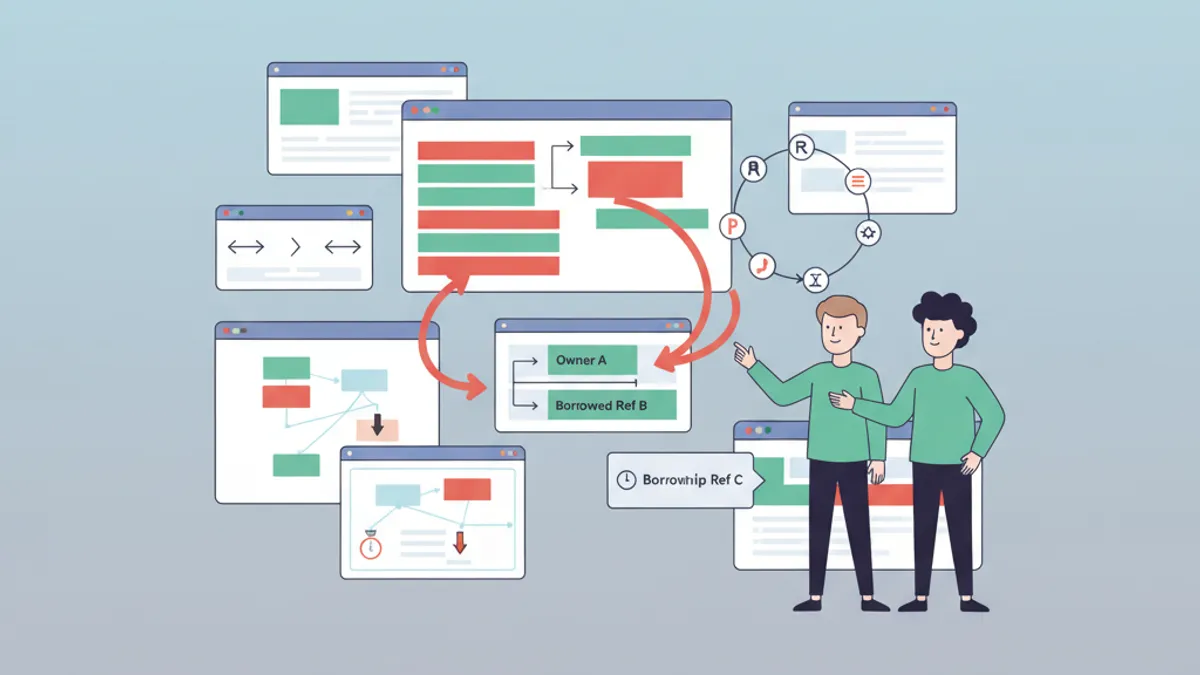
Ownership і Borrowing у Rust: Повний Посібник
Опануйте систему ownership і borrowing у Rust. Правила власності, посилання, lifetime та просунуті патерни управління пам'яттю.

Rust: Основи для досвідчених розробників у 2026 році
Швидке освоєння Rust з використанням наявного досвіду програмування. Власність, запозичення, часи життя та ключові патерни для розробників, які переходять з C++, Java або Python.

Розумні вказівники в Rust: Box, Rc, Arc і RefCell у 2026
Розумні вказівники Rust Box, Rc, Arc і RefCell з поясненнями, компільованими прикладами 2026 року, таблицею вибору та типовими питаннями співбесід.