Ownership i Borrowing w Rust: Kompletny Przewodnik
Opanuj system ownership i borrowing w Rust. Zasady własności, referencje, lifetime i zaawansowane wzorce zarządzania pamięcią.
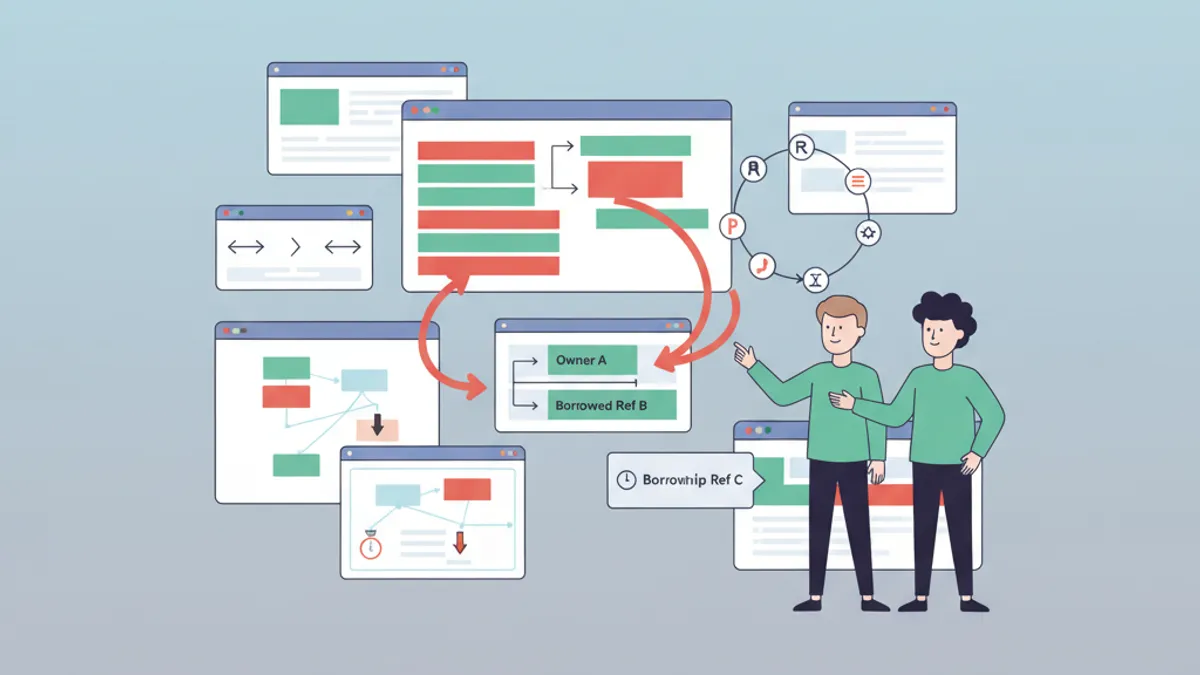
System ownership to to, co odróżnia Rust od każdego innego języka programowania. To unikalne podejście gwarantuje bezpieczeństwo pamięci bez garbage collectora, wychwytując błędy w czasie kompilacji zamiast w czasie wykonania. Ten szczegółowy przewodnik omawia mechanizmy ownership i borrowing, od podstaw po zaawansowane wzorce produkcyjne.
Kompilator Rusta działa jak wymagający asystent programisty: każdy błąd ownership zablokowany w czasie kompilacji oznacza potencjalny błąd uniknięty na produkcji.
Trzy Fundamentalne Zasady Ownership
System ownership opiera się na trzech prostych, ale rygorystycznych zasadach. Po ich zinternalizowaniu mentalny model Rusta staje się naturalny i przewidywalny.
// Demonstration of the three fundamental rules

fn main() {
    // Rule 1: Each value has exactly ONE owner
    let s1 = String::from("hello");  // s1 is the sole owner

    // Rule 2: There can only be one owner at a time
    let s2 = s1;  // Ownership transferred (moved) from s1 to s2
    // println!("{}", s1);  // Compile ERROR: s1 no longer exists
    println!("s2 = {}", s2);  // Only s2 is valid now

    // Rule 3: When the owner goes out of scope, the value is dropped
    {
        let s3 = String::from("temporary");
        println!("s3 inside block = {}", s3);
    }  // s3 is automatically freed here (drop is called)
    // println!("{}", s3);  // ERROR: s3 no longer exists
}
Te trzy zasady eliminują całe kategorie błędów: use-after-free, double-free i wycieki pamięci. Kompilator weryfikuje statycznie, że zasady te są przestrzegane.
Move vs Copy: Zrozumienie Semantyki Przekazywania
Zachowanie przypisania zależy od typu danych. Typy implementujące trait Copy są duplikowane, podczas gdy pozostałe podlegają operacji move.
// Distinction between Copy types and Move types

fn main() {
    // Copy types: values stored on the stack, known size
    let x: i32 = 42;
    let y = x;  // x is COPIED, not moved
    println!("x = {}, y = {}", x, y);  // Both are valid

    // Other Copy types: f64, bool, char, tuples of Copy types
    let point = (3.0, 4.0);
    let point_copy = point;  // Tuple copy
    println!("Original: {:?}, Copy: {:?}", point, point_copy);

    // Move types: values on the heap, dynamic size
    let s1 = String::from("owned");
    let s2 = s1;  // s1 is MOVED to s2
    // println!("{}", s1);  // ERROR: value moved
    println!("s2 = {}", s2);

    // Vec, HashMap, Box are also Move types
    let vec1 = vec![1, 2, 3];
    let vec2 = vec1;  // Move, not copy
    // println!("{:?}", vec1);  // ERROR
    println!("vec2 = {:?}", vec2);
}

// Explicit clone to duplicate Move types
fn explicit_clone() {
    let original = String::from("important data");
    let clone = original.clone();  // Explicit duplication (memory cost)

    println!("Original: {}", original);  // Still valid
    println!("Clone: {}", clone);  // Independent copy
}
Rozróżnienie Move/Copy jest fundamentalne: określa, czy przypisanie przekazuje własność, czy tworzy niezależną kopię.
Wywołanie .clone() powinno być świadome. Kod przepełniony klonami może wskazywać na problem projektowy. Borrowing jest często lepszym rozwiązaniem.
Borrowing: Referencje Niemutowalne i Mutowalne
Borrowing pozwala na dostęp do wartości bez przejmowania jej własności. Mechanizm ten sprawia, że kod Rusta jest jednocześnie bezpieczny i wydajny.
// Immutable and mutable references

fn main() {
    let s = String::from("hello");

    // Immutable reference: read-only, multiple allowed
    let len = calculate_length(&s);  // Immutable borrow
    println!("'{}' has {} characters", s, len);  // s still valid

    // Multiple simultaneous immutable references: OK
    let r1 = &s;
    let r2 = &s;
    let r3 = &s;
    println!("r1={}, r2={}, r3={}", r1, r2, r3);
}

fn calculate_length(s: &String) -> usize {
    // s is a reference, not the owner
    s.len()
}  // s goes out of scope but doesn't drop anything (not owner)

// Mutable references: modification allowed
fn mutable_borrowing() {
    let mut s = String::from("hello");

    change(&mut s);  // Mutable borrow
    println!("After modification: {}", s);
}

fn change(s: &mut String) {
    s.push_str(", world!");  // Modification via mutable reference
}
Złota zasada borrowing: albo wiele referencji niemutowalnych ALBO jedna referencja mutowalna, nigdy obie jednocześnie.
Zasady Borrow Checkera
Borrow checker to komponent kompilatora, który weryfikuje zasady borrowing. Zrozumienie jego błędów pozwala szybko rozwiązywać problemy.
// Strict borrow checker rules

fn main() {
    // RULE 1: No mutable reference with immutable references
    let mut s = String::from("hello");

    let r1 = &s;      // Immutable reference: OK
    let r2 = &s;      // Another immutable reference: OK
    // let r3 = &mut s;  // ERROR: cannot borrow as mutable
    println!("{} and {}", r1, r2);

    // AFTER using r1 and r2, they are "dead"
    let r3 = &mut s;  // Now OK: r1 and r2 no longer used
    r3.push_str(" world");
    println!("{}", r3);

    // RULE 2: Only one mutable reference at a time
    let mut data = String::from("exclusive");
    let ref1 = &mut data;
    // let ref2 = &mut data;  // ERROR: already borrowed mutably
    ref1.push_str("!");
    println!("{}", ref1);
}

// RULE 3: References cannot outlive the data
fn dangling_reference_prevented() {
    let reference;
    {
        let s = String::from("short-lived");
        // reference = &s;  // ERROR: s doesn't live long enough
    }
    // s is dropped here, reference would be invalid

    // Solution: move the value out of the scope
    let owned_outside;
    {
        let s = String::from("moved out");
        owned_outside = s;  // Move, not reference
    }
    println!("{}", owned_outside);  // OK: owned_outside is the owner
}
Borrow checker używa Non-Lexical Lifetimes (NLL): referencja jest uważana za aktywną tylko do swojego ostatniego użycia, a nie do końca scope'a.
Gotowy na rozmowy o Rust?
Ćwicz z naszymi interaktywnymi symulatorami, flashcards i testami technicznymi.
Lifetime: Adnotowanie Czasu Życia Referencji
Lifetime to adnotacje pomagające kompilatorowi zweryfikować, że referencje pozostają poprawne. Najczęściej są wnioskowane automatycznie.
// Explicit lifetime annotations

// Without annotation: compiler infers lifetimes
fn first_word(s: &str) -> &str {
    match s.find(' ') {
        Some(i) => &s[..i],
        None => s,
    }
}

// With explicit annotation: same function
fn first_word_explicit<'a>(s: &'a str) -> &'a str {
    // 'a means: returned reference lives as long as the input
    match s.find(' ') {
        Some(i) => &s[..i],
        None => s,
    }
}

// When annotations are necessary: multiple references
fn longest<'a>(x: &'a str, y: &'a str) -> &'a str {
    // Compiler cannot guess which reference is returned
    if x.len() > y.len() {
        x
    } else {
        y
    }
}

fn main() {
    let string1 = String::from("long string");
    let result;
    {
        let string2 = String::from("xyz");
        result = longest(&string1, &string2);
        println!("Longest: {}", result);  // OK here
    }
    // println!("{}", result);  // ERROR if uncommented: string2 dropped
}
Lifetime nie zmieniają tego, jak długo żyją dane; opisują relacje między czasami życia różnych referencji.
Lifetime w Strukturach
Gdy struktura zawiera referencje, lifetime muszą być zaadnotowane, aby zagwarantować, że struktura nie przeżyje danych, do których się odwołuje.
// Structs containing references

// Struct with reference: lifetime required
struct ImportantExcerpt<'a> {
    part: &'a str,  // This reference must live at least as long as the struct
}

impl<'a> ImportantExcerpt<'a> {
    // Method returning a reference with the same lifetime
    fn level(&self) -> i32 {
        3
    }

    // Elision rule: &self implies the output lifetime
    fn announce_and_return_part(&self, announcement: &str) -> &str {
        println!("Attention: {}", announcement);
        self.part  // Returns with 'a lifetime from self
    }
}

fn main() {
    let novel = String::from("Call me Ishmael. Some years ago...");
    let first_sentence = novel.split('.').next().unwrap();

    let excerpt = ImportantExcerpt {
        part: first_sentence,  // OK: novel outlives excerpt
    };

    println!("Excerpt: {}", excerpt.part);
    println!("Level: {}", excerpt.level());
}

// Static lifetime: reference valid for the entire program duration
fn static_lifetime_example() {
    let s: &'static str = "This string is in the binary";
    // String literals always have 'static lifetime
    println!("{}", s);
}
Reguły elizji lifetime często pozwalają pominąć adnotacje w typowych przypadkach, czyniąc kod bardziej czytelnym.
Zaawansowane Wzorce: Wewnętrzna Mutowalność
Czasami mutowalność musi być sprawdzana w czasie wykonania, a nie kompilacji. Rust udostępnia typy dla tego wzorca: RefCell i Cell.
// Interior mutability with RefCell and Cell

use std::cell::{Cell, RefCell};

// Cell: for Copy types, replaces the entire value
struct Counter {
    count: Cell<u32>,  // Mutable despite &self
}

impl Counter {
    fn new() -> Counter {
        Counter { count: Cell::new(0) }
    }

    fn increment(&self) {
        // Modification via immutable reference!
        self.count.set(self.count.get() + 1);
    }

    fn get(&self) -> u32 {
        self.count.get()
    }
}

// RefCell: for non-Copy types, checks at runtime
struct CachedValue {
    value: RefCell<Option<String>>,
}

impl CachedValue {
    fn new() -> CachedValue {
        CachedValue { value: RefCell::new(None) }
    }

    fn get_or_compute(&self, compute: impl FnOnce() -> String) -> String {
        // borrow() for reading, borrow_mut() for writing
        if self.value.borrow().is_none() {
            *self.value.borrow_mut() = Some(compute());
        }
        self.value.borrow().as_ref().unwrap().clone()
    }
}

fn main() {
    let counter = Counter::new();
    counter.increment();
    counter.increment();
    println!("Counter: {}", counter.get());  // 2

    let cache = CachedValue::new();
    let result = cache.get_or_compute(|| {
        println!("Expensive computation...");
        String::from("result")
    });
    println!("Value: {}", result);

    // Second call: no recomputation
    let result2 = cache.get_or_compute(|| String::from("never executed"));
    println!("Cache hit: {}", result2);
}
RefCell i Cell przenoszą weryfikację borrowing do czasu wykonania. Naruszenie zasady powoduje panic zamiast błędu kompilacji.
RefCell::borrow_mut() powoduje panic, jeśli wartość jest już pożyczona. Warto używać try_borrow_mut() dla jawnej obsługi błędów.
Smart Pointery i Ownership
Smart pointery takie jak Box, Rc i Arc oferują różne strategie ownership dla konkretnych przypadków użycia.
// Box, Rc, and Arc for different ownership patterns

use std::rc::Rc;
use std::sync::Arc;
use std::thread;

// Box: single owner, data on the heap
fn box_example() {
    let boxed = Box::new(vec![1, 2, 3, 4, 5]);
    println!("Boxed vec: {:?}", boxed);
    // Useful for: recursive types, large objects, trait objects
}

// Rc: reference counting, multiple owners (single-thread)
fn rc_example() {
    let data = Rc::new(String::from("shared data"));

    let clone1 = Rc::clone(&data);  // Increments the counter
    let clone2 = Rc::clone(&data);

    println!("Count: {}", Rc::strong_count(&data));  // 3
    println!("All share: {}, {}, {}", data, clone1, clone2);
}  // Freed when counter reaches 0

// Arc: thread-safe Rc (Atomic Reference Counting)
fn arc_example() {
    let data = Arc::new(vec![1, 2, 3]);

    let handles: Vec<_> = (0..3).map(|i| {
        let data_clone = Arc::clone(&data);
        thread::spawn(move || {
            println!("Thread {}: {:?}", i, data_clone);
        })
    }).collect();

    for handle in handles {
        handle.join().unwrap();
    }
}

fn main() {
    box_example();
    rc_example();
    arc_example();
}
Wybór smart pointera zależy od wzorca ownership: unikalny (Box), współdzielony jednowątkowo (Rc) lub współdzielony wielowątkowo (Arc).
Praktyczne Wzorce Ownership
Oto popularne wzorce do strukturyzowania kodu wokół systemu ownership.
// Practical patterns for ownership management

// Pattern 1: Builder pattern with chained ownership
struct RequestBuilder {
    url: String,
    headers: Vec<(String, String)>,
    timeout: Option<u64>,
}

impl RequestBuilder {
    fn new(url: &str) -> Self {
        RequestBuilder {
            url: url.to_string(),
            headers: Vec::new(),
            timeout: None,
        }
    }

    // Consumes self and returns the new self
    fn header(mut self, key: &str, value: &str) -> Self {
        self.headers.push((key.to_string(), value.to_string()));
        self  // Returns ownership
    }

    fn timeout(mut self, seconds: u64) -> Self {
        self.timeout = Some(seconds);
        self
    }

    fn build(self) -> Request {
        Request {
            url: self.url,
            headers: self.headers,
            timeout: self.timeout.unwrap_or(30),
        }
    }
}

struct Request {
    url: String,
    headers: Vec<(String, String)>,
    timeout: u64,
}

// Pattern 2: Cow (Copy-on-Write) to avoid allocations
use std::borrow::Cow;

fn process_text(input: &str) -> Cow<str> {
    if input.contains("REPLACE") {
        // Allocation only if modification needed
        Cow::Owned(input.replace("REPLACE", "NEW"))
    } else {
        // No allocation, returns a reference
        Cow::Borrowed(input)
    }
}

// Pattern 3: Take to extract from an Option
fn extract_value(data: &mut Option<String>) -> String {
    data.take().unwrap_or_else(|| String::from("default"))
    // take() replaces with None and returns ownership of the value
}

fn main() {
    // Builder pattern
    let request = RequestBuilder::new("https://api.example.com")
        .header("Authorization", "Bearer token")
        .header("Content-Type", "application/json")
        .timeout(60)
        .build();

    println!("URL: {}, Timeout: {}s", request.url, request.timeout);

    // Cow pattern
    let text1 = process_text("hello world");  // No allocation
    let text2 = process_text("hello REPLACE");  // Allocation
    println!("{} | {}", text1, text2);

    // Take pattern
    let mut optional = Some(String::from("extracted"));
    let value = extract_value(&mut optional);
    println!("Value: {}, Option: {:?}", value, optional);  // None
}
Te wzorce wykorzystują system ownership do tworzenia ergonomicznych i wydajnych API.
Zacznij ćwiczyć!
Sprawdź swoją wiedzę z naszymi symulatorami rozmów i testami technicznymi.
Podsumowanie
System ownership i borrowing w Rust stanowi zmianę paradygmatu w zarządzaniu pamięcią. Po opanowaniu staje się potężnym sprzymierzeńcem w pisaniu kodu jednocześnie wydajnego i bezpiecznego.
Kluczowe punkty do zapamiętania:
✅ Trzy zasady ownership: jeden właściciel, przekazywanie własności, automatyczny drop
✅ Borrowing: wiele referencji niemutowalnych ALBO jedna wyłączna referencja mutowalna
✅ Lifetime: adnotowanie relacji między czasami życia referencji
✅ Wewnętrzna mutowalność: RefCell i Cell dla mutowalności weryfikowanej w runtime
✅ Smart pointery: Box (unikalny), Rc (współdzielony), Arc (thread-safe)
✅ Wzorce praktyczne: Builder, Cow, Take dla idiomatycznych API
Borrow checker może wydawać się rygorystyczny na początku, ale każdy zgłoszony błąd to potencjalnie uniknięty bug. Z praktyką myślenie w kategoriach ownership staje się naturalne i poprawia jakość kodu we wszystkich językach.
Zacznij ćwiczyć!
Sprawdź swoją wiedzę z naszymi symulatorami rozmów i testami technicznymi.
Znajdziesz błąd w Rust?
Prawdziwy fragment kodu, ukryty błąd, jedna próba dziennie. Bez konta, żeby spróbować.

Autor:
Anthony Fillion-MailletZałożyciel SharpSkill
Programista fullstack od ponad 10 lat. Prowadzi SharpSkill i odpowiada za wszystko, co się tu ukazuje.
Zaktualizowano 29 kwietnia 2026
Tagi
Udostępnij
Powiązane artykuły

Ownership i Borrowing w Rust: Kompletny przewodnik po zarządzaniu pamięcią
Szczegółowy przewodnik po systemie ownership i borrowing w Rust. Semantyka przenoszenia, pożyczanie niemutowalne i mutowalne, czasy życia referencji oraz typowe wzorce stosowane w praktyce i na rozmowach kwalifikacyjnych.

Pytania rekrutacyjne Rust: Kompletny przewodnik 2026
25 najczesciej zadawanych pytan rekrutacyjnych z Rust. Wlasnosc, pozyczanie, czasy zycia, cechy, async/await, wspolbieznosc z odpowiedziami i przykladami kodu.

Rust: Podstawy dla Doswiadczonych Programistow w 2026
Szybka nauka Rust z wykorzystaniem dotychczasowej wiedzy. Ownership, borrowing, lifetimes i kluczowe wzorce wyjasnione dla programistow przechodzacych z C++, Javy lub Pythona.