Ownership dan Borrowing di Rust: Panduan Lengkap
Kuasai sistem ownership dan borrowing Rust. Aturan kepemilikan, referensi, lifetime, dan pola manajemen memori tingkat lanjut.
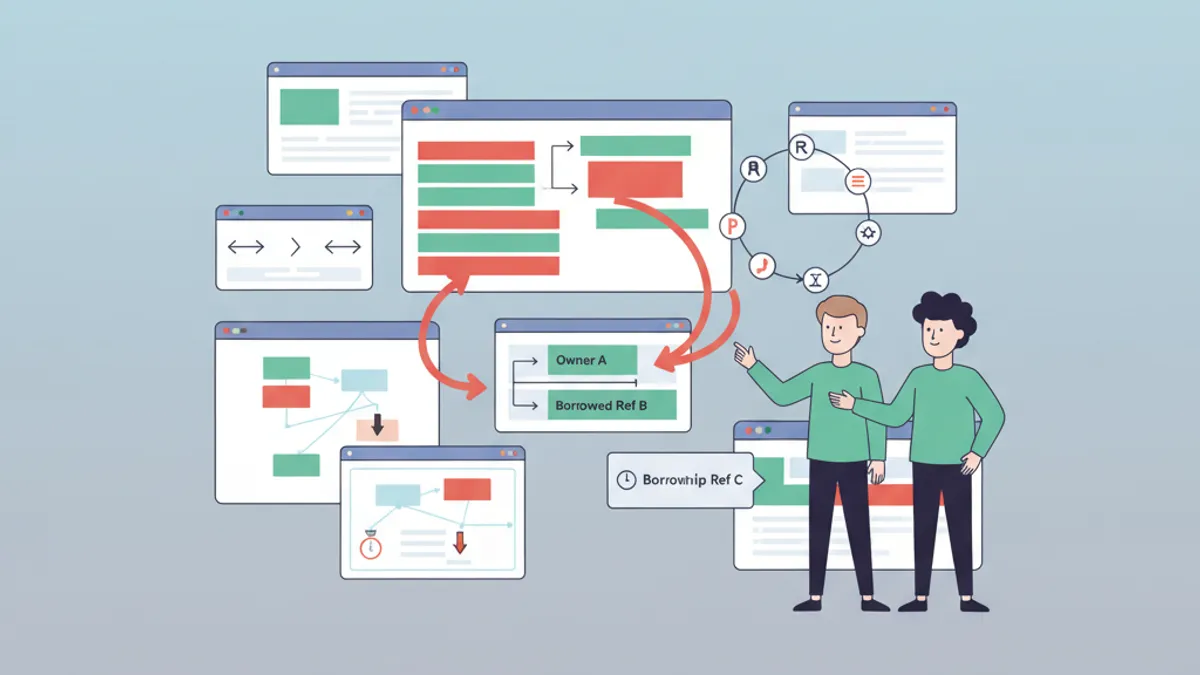
Sistem ownership adalah hal yang membedakan Rust dari bahasa pemrograman lainnya. Pendekatan unik ini menjamin keamanan memori tanpa garbage collector, menangkap bug pada waktu kompilasi alih-alih waktu eksekusi. Panduan mendalam ini membahas mekanisme ownership dan borrowing, dari dasar hingga pola produksi tingkat lanjut.
Kompiler Rust bertindak sebagai asisten pemrograman yang menuntut: setiap kesalahan ownership yang diblokir pada waktu kompilasi mewakili potensi bug yang dicegah di produksi.
Tiga Aturan Fundamental Ownership
Sistem ownership bertumpu pada tiga aturan sederhana namun ketat. Setelah aturan ini diinternalisasi, model mental Rust menjadi alami dan dapat diprediksi.
// Demonstration of the three fundamental rules

fn main() {
    // Rule 1: Each value has exactly ONE owner
    let s1 = String::from("hello");  // s1 is the sole owner

    // Rule 2: There can only be one owner at a time
    let s2 = s1;  // Ownership transferred (moved) from s1 to s2
    // println!("{}", s1);  // Compile ERROR: s1 no longer exists
    println!("s2 = {}", s2);  // Only s2 is valid now

    // Rule 3: When the owner goes out of scope, the value is dropped
    {
        let s3 = String::from("temporary");
        println!("s3 inside block = {}", s3);
    }  // s3 is automatically freed here (drop is called)
    // println!("{}", s3);  // ERROR: s3 no longer exists
}
Ketiga aturan ini menghilangkan seluruh kategori bug: use-after-free, double-free, dan kebocoran memori. Kompiler memverifikasi secara statis bahwa aturan ini dipatuhi.
Move vs Copy: Memahami Semantik Transfer
Perilaku assignment bergantung pada tipe data. Tipe yang mengimplementasikan trait Copy diduplikasi, sementara yang lain ditransfer melalui move.
// Distinction between Copy types and Move types

fn main() {
    // Copy types: values stored on the stack, known size
    let x: i32 = 42;
    let y = x;  // x is COPIED, not moved
    println!("x = {}, y = {}", x, y);  // Both are valid

    // Other Copy types: f64, bool, char, tuples of Copy types
    let point = (3.0, 4.0);
    let point_copy = point;  // Tuple copy
    println!("Original: {:?}, Copy: {:?}", point, point_copy);

    // Move types: values on the heap, dynamic size
    let s1 = String::from("owned");
    let s2 = s1;  // s1 is MOVED to s2
    // println!("{}", s1);  // ERROR: value moved
    println!("s2 = {}", s2);

    // Vec, HashMap, Box are also Move types
    let vec1 = vec![1, 2, 3];
    let vec2 = vec1;  // Move, not copy
    // println!("{:?}", vec1);  // ERROR
    println!("vec2 = {:?}", vec2);
}

// Explicit clone to duplicate Move types
fn explicit_clone() {
    let original = String::from("important data");
    let clone = original.clone();  // Explicit duplication (memory cost)

    println!("Original: {}", original);  // Still valid
    println!("Clone: {}", clone);  // Independent copy
}
Perbedaan Move/Copy bersifat fundamental: menentukan apakah assignment mentransfer kepemilikan atau membuat salinan independen.
Memanggil .clone() harus disengaja. Kode yang penuh dengan clone mungkin menunjukkan masalah desain. Borrowing seringkali merupakan solusi yang lebih baik.
Borrowing: Referensi Immutable dan Mutable
Borrowing memungkinkan akses ke nilai tanpa mengambil kepemilikannya. Mekanisme ini membuat kode Rust sekaligus aman dan berkinerja tinggi.
// Immutable and mutable references

fn main() {
    let s = String::from("hello");

    // Immutable reference: read-only, multiple allowed
    let len = calculate_length(&s);  // Immutable borrow
    println!("'{}' has {} characters", s, len);  // s still valid

    // Multiple simultaneous immutable references: OK
    let r1 = &s;
    let r2 = &s;
    let r3 = &s;
    println!("r1={}, r2={}, r3={}", r1, r2, r3);
}

fn calculate_length(s: &String) -> usize {
    // s is a reference, not the owner
    s.len()
}  // s goes out of scope but doesn't drop anything (not owner)

// Mutable references: modification allowed
fn mutable_borrowing() {
    let mut s = String::from("hello");

    change(&mut s);  // Mutable borrow
    println!("After modification: {}", s);
}

fn change(s: &mut String) {
    s.push_str(", world!");  // Modification via mutable reference
}
Aturan emas borrowing: bisa banyak referensi immutable ATAU satu referensi mutable, tidak pernah keduanya secara bersamaan.
Aturan Borrow Checker
Borrow checker adalah komponen kompiler yang memverifikasi aturan borrowing. Memahami kesalahannya memungkinkan penyelesaian masalah yang cepat.
// Strict borrow checker rules

fn main() {
    // RULE 1: No mutable reference with immutable references
    let mut s = String::from("hello");

    let r1 = &s;      // Immutable reference: OK
    let r2 = &s;      // Another immutable reference: OK
    // let r3 = &mut s;  // ERROR: cannot borrow as mutable
    println!("{} and {}", r1, r2);

    // AFTER using r1 and r2, they are "dead"
    let r3 = &mut s;  // Now OK: r1 and r2 no longer used
    r3.push_str(" world");
    println!("{}", r3);

    // RULE 2: Only one mutable reference at a time
    let mut data = String::from("exclusive");
    let ref1 = &mut data;
    // let ref2 = &mut data;  // ERROR: already borrowed mutably
    ref1.push_str("!");
    println!("{}", ref1);
}

// RULE 3: References cannot outlive the data
fn dangling_reference_prevented() {
    let reference;
    {
        let s = String::from("short-lived");
        // reference = &s;  // ERROR: s doesn't live long enough
    }
    // s is dropped here, reference would be invalid

    // Solution: move the value out of the scope
    let owned_outside;
    {
        let s = String::from("moved out");
        owned_outside = s;  // Move, not reference
    }
    println!("{}", owned_outside);  // OK: owned_outside is the owner
}
Borrow checker menggunakan Non-Lexical Lifetimes (NLL): sebuah referensi dianggap aktif hanya hingga penggunaan terakhirnya, bukan hingga akhir scope.
Siap menguasai wawancara Rust Anda?
Berlatih dengan simulator interaktif, flashcards, dan tes teknis kami.
Lifetime: Menganotasi Durasi Referensi
Lifetime adalah anotasi yang membantu kompiler memverifikasi bahwa referensi tetap valid. Sebagian besar waktu, mereka disimpulkan secara otomatis.
// Explicit lifetime annotations

// Without annotation: compiler infers lifetimes
fn first_word(s: &str) -> &str {
    match s.find(' ') {
        Some(i) => &s[..i],
        None => s,
    }
}

// With explicit annotation: same function
fn first_word_explicit<'a>(s: &'a str) -> &'a str {
    // 'a means: returned reference lives as long as the input
    match s.find(' ') {
        Some(i) => &s[..i],
        None => s,
    }
}

// When annotations are necessary: multiple references
fn longest<'a>(x: &'a str, y: &'a str) -> &'a str {
    // Compiler cannot guess which reference is returned
    if x.len() > y.len() {
        x
    } else {
        y
    }
}

fn main() {
    let string1 = String::from("long string");
    let result;
    {
        let string2 = String::from("xyz");
        result = longest(&string1, &string2);
        println!("Longest: {}", result);  // OK here
    }
    // println!("{}", result);  // ERROR if uncommented: string2 dropped
}
Lifetime tidak mengubah berapa lama data hidup; mereka menggambarkan hubungan antara durasi hidup berbagai referensi.
Lifetime dalam Struct
Ketika struct berisi referensi, lifetime harus dianotasi untuk menjamin bahwa struct tidak hidup lebih lama dari data yang direferensikan.
// Structs containing references

// Struct with reference: lifetime required
struct ImportantExcerpt<'a> {
    part: &'a str,  // This reference must live at least as long as the struct
}

impl<'a> ImportantExcerpt<'a> {
    // Method returning a reference with the same lifetime
    fn level(&self) -> i32 {
        3
    }

    // Elision rule: &self implies the output lifetime
    fn announce_and_return_part(&self, announcement: &str) -> &str {
        println!("Attention: {}", announcement);
        self.part  // Returns with 'a lifetime from self
    }
}

fn main() {
    let novel = String::from("Call me Ishmael. Some years ago...");
    let first_sentence = novel.split('.').next().unwrap();

    let excerpt = ImportantExcerpt {
        part: first_sentence,  // OK: novel outlives excerpt
    };

    println!("Excerpt: {}", excerpt.part);
    println!("Level: {}", excerpt.level());
}

// Static lifetime: reference valid for the entire program duration
fn static_lifetime_example() {
    let s: &'static str = "This string is in the binary";
    // String literals always have 'static lifetime
    println!("{}", s);
}
Aturan elisi lifetime sering memungkinkan menghilangkan anotasi dalam kasus umum, sehingga kode menjadi lebih mudah dibaca.
Pola Tingkat Lanjut: Mutabilitas Internal
Kadang-kadang mutabilitas harus diverifikasi pada waktu eksekusi alih-alih waktu kompilasi. Rust menyediakan tipe untuk pola ini: RefCell dan Cell.
// Interior mutability with RefCell and Cell

use std::cell::{Cell, RefCell};

// Cell: for Copy types, replaces the entire value
struct Counter {
    count: Cell<u32>,  // Mutable despite &self
}

impl Counter {
    fn new() -> Counter {
        Counter { count: Cell::new(0) }
    }

    fn increment(&self) {
        // Modification via immutable reference!
        self.count.set(self.count.get() + 1);
    }

    fn get(&self) -> u32 {
        self.count.get()
    }
}

// RefCell: for non-Copy types, checks at runtime
struct CachedValue {
    value: RefCell<Option<String>>,
}

impl CachedValue {
    fn new() -> CachedValue {
        CachedValue { value: RefCell::new(None) }
    }

    fn get_or_compute(&self, compute: impl FnOnce() -> String) -> String {
        // borrow() for reading, borrow_mut() for writing
        if self.value.borrow().is_none() {
            *self.value.borrow_mut() = Some(compute());
        }
        self.value.borrow().as_ref().unwrap().clone()
    }
}

fn main() {
    let counter = Counter::new();
    counter.increment();
    counter.increment();
    println!("Counter: {}", counter.get());  // 2

    let cache = CachedValue::new();
    let result = cache.get_or_compute(|| {
        println!("Expensive computation...");
        String::from("result")
    });
    println!("Value: {}", result);

    // Second call: no recomputation
    let result2 = cache.get_or_compute(|| String::from("never executed"));
    println!("Cache hit: {}", result2);
}
RefCell dan Cell memindahkan pemeriksaan borrowing ke waktu eksekusi. Pelanggaran aturan menyebabkan panic alih-alih kesalahan kompilasi.
RefCell::borrow_mut() menyebabkan panic jika nilai sudah dipinjam. Sebaiknya gunakan try_borrow_mut() untuk penanganan kesalahan eksplisit.
Smart Pointer dan Ownership
Smart pointer seperti Box, Rc, dan Arc menawarkan strategi ownership yang berbeda untuk kasus penggunaan tertentu.
// Box, Rc, and Arc for different ownership patterns

use std::rc::Rc;
use std::sync::Arc;
use std::thread;

// Box: single owner, data on the heap
fn box_example() {
    let boxed = Box::new(vec![1, 2, 3, 4, 5]);
    println!("Boxed vec: {:?}", boxed);
    // Useful for: recursive types, large objects, trait objects
}

// Rc: reference counting, multiple owners (single-thread)
fn rc_example() {
    let data = Rc::new(String::from("shared data"));

    let clone1 = Rc::clone(&data);  // Increments the counter
    let clone2 = Rc::clone(&data);

    println!("Count: {}", Rc::strong_count(&data));  // 3
    println!("All share: {}, {}, {}", data, clone1, clone2);
}  // Freed when counter reaches 0

// Arc: thread-safe Rc (Atomic Reference Counting)
fn arc_example() {
    let data = Arc::new(vec![1, 2, 3]);

    let handles: Vec<_> = (0..3).map(|i| {
        let data_clone = Arc::clone(&data);
        thread::spawn(move || {
            println!("Thread {}: {:?}", i, data_clone);
        })
    }).collect();

    for handle in handles {
        handle.join().unwrap();
    }
}

fn main() {
    box_example();
    rc_example();
    arc_example();
}
Pilihan smart pointer bergantung pada pola ownership: tunggal (Box), berbagi single-thread (Rc), atau berbagi multi-thread (Arc).
Pola Ownership Praktis
Berikut adalah pola umum untuk menyusun kode di sekitar sistem ownership.
// Practical patterns for ownership management

// Pattern 1: Builder pattern with chained ownership
struct RequestBuilder {
    url: String,
    headers: Vec<(String, String)>,
    timeout: Option<u64>,
}

impl RequestBuilder {
    fn new(url: &str) -> Self {
        RequestBuilder {
            url: url.to_string(),
            headers: Vec::new(),
            timeout: None,
        }
    }

    // Consumes self and returns the new self
    fn header(mut self, key: &str, value: &str) -> Self {
        self.headers.push((key.to_string(), value.to_string()));
        self  // Returns ownership
    }

    fn timeout(mut self, seconds: u64) -> Self {
        self.timeout = Some(seconds);
        self
    }

    fn build(self) -> Request {
        Request {
            url: self.url,
            headers: self.headers,
            timeout: self.timeout.unwrap_or(30),
        }
    }
}

struct Request {
    url: String,
    headers: Vec<(String, String)>,
    timeout: u64,
}

// Pattern 2: Cow (Copy-on-Write) to avoid allocations
use std::borrow::Cow;

fn process_text(input: &str) -> Cow<str> {
    if input.contains("REPLACE") {
        // Allocation only if modification needed
        Cow::Owned(input.replace("REPLACE", "NEW"))
    } else {
        // No allocation, returns a reference
        Cow::Borrowed(input)
    }
}

// Pattern 3: Take to extract from an Option
fn extract_value(data: &mut Option<String>) -> String {
    data.take().unwrap_or_else(|| String::from("default"))
    // take() replaces with None and returns ownership of the value
}

fn main() {
    // Builder pattern
    let request = RequestBuilder::new("https://api.example.com")
        .header("Authorization", "Bearer token")
        .header("Content-Type", "application/json")
        .timeout(60)
        .build();

    println!("URL: {}, Timeout: {}s", request.url, request.timeout);

    // Cow pattern
    let text1 = process_text("hello world");  // No allocation
    let text2 = process_text("hello REPLACE");  // Allocation
    println!("{} | {}", text1, text2);

    // Take pattern
    let mut optional = Some(String::from("extracted"));
    let value = extract_value(&mut optional);
    println!("Value: {}, Option: {:?}", value, optional);  // None
}
Pola-pola ini memanfaatkan sistem ownership untuk membuat API yang ergonomis dan berkinerja tinggi.
Mulai berlatih!
Uji pengetahuan Anda dengan simulator wawancara dan tes teknis kami.
Kesimpulan
Sistem ownership dan borrowing Rust merepresentasikan pergeseran paradigma dalam manajemen memori. Setelah dikuasai, sistem ini menjadi sekutu yang kuat untuk menulis kode yang sekaligus berkinerja tinggi dan aman.
Poin kunci yang perlu diingat:
✅ Tiga aturan ownership: pemilik tunggal, transfer kepemilikan, drop otomatis
✅ Borrowing: banyak referensi immutable ATAU satu referensi mutable eksklusif
✅ Lifetime: menganotasi hubungan antara durasi hidup referensi
✅ Mutabilitas internal: RefCell dan Cell untuk mutabilitas yang diverifikasi pada waktu eksekusi
✅ Smart pointer: Box (tunggal), Rc (berbagi), Arc (thread-safe)
✅ Pola praktis: Builder, Cow, Take untuk API idiomatis
Borrow checker mungkin terlihat ketat pada awalnya, tetapi setiap kesalahan yang dilaporkan mewakili bug potensial yang dihindari. Dengan latihan, berpikir dalam istilah ownership menjadi alami dan meningkatkan kualitas kode di semua bahasa.
Mulai berlatih!
Uji pengetahuan Anda dengan simulator wawancara dan tes teknis kami.
Bisakah kamu menemukan bug di Rust?
Satu potongan kode nyata, satu bug tersembunyi, satu percobaan per hari. Tanpa akun untuk mencoba.

Ditulis oleh
Anthony Fillion-MailletPendiri SharpSkill
Developer fullstack selama lebih dari 10 tahun. Ia menjalankan SharpSkill dan bertanggung jawab atas semua yang diterbitkan di sini.
Diperbarui 29 April 2026
Tag
Bagikan
Artikel terkait

Memahami Ownership dan Borrowing di Rust: Panduan Lengkap untuk Developer
Pelajari konsep ownership, borrowing, dan lifetime di Rust secara mendalam. Artikel ini membahas aturan kepemilikan, referensi, serta pola-pola umum yang sering muncul dalam wawancara teknis.

Pertanyaan Wawancara Rust: Panduan Lengkap 2026
25 pertanyaan wawancara Rust yang paling sering ditanyakan. Ownership, borrowing, lifetime, trait, async dan concurrency dengan jawaban detail serta contoh kode.
Rust: Dasar-Dasar untuk Pengembang Berpengalaman di 2026
Pelajari Rust dengan cepat menggunakan pengalaman pemrograman yang sudah dimiliki. Ownership, borrowing, lifetime, dan pola-pola penting dijelaskan untuk pengembang yang beralih dari C++, Java, atau Python.