Ownership and Borrowing in Rust: Complete Guide
Master Rust's ownership and borrowing system. Understand property rules, references, lifetimes, and advanced memory management patterns.
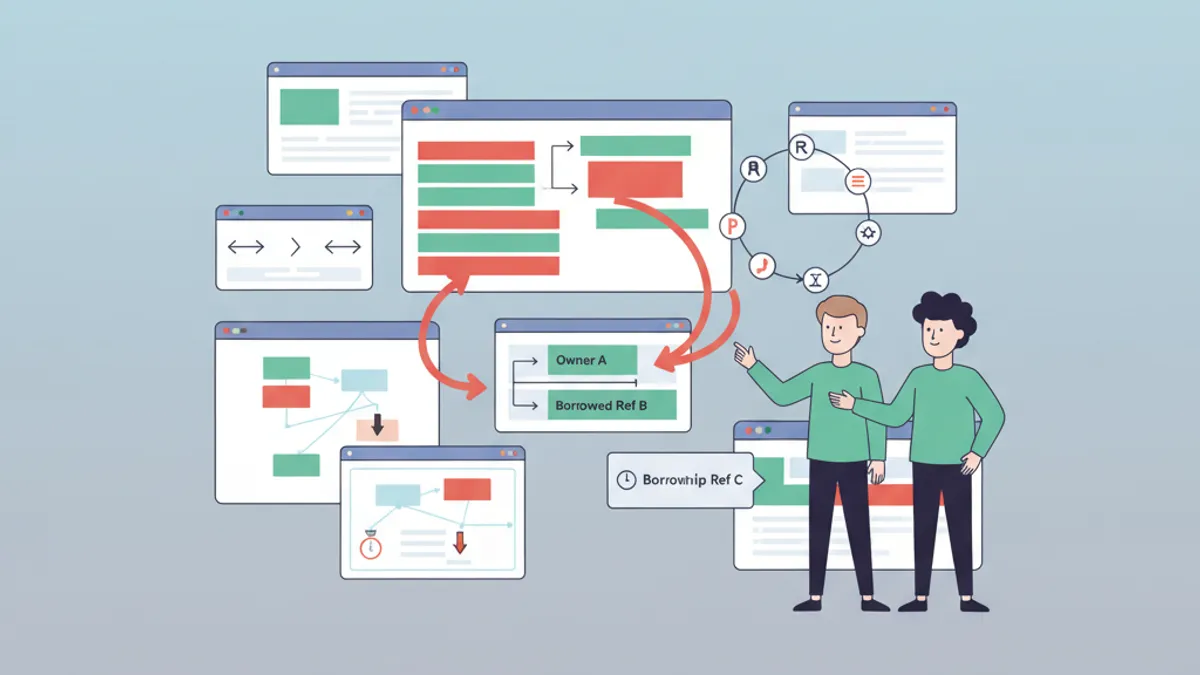
The ownership system is what sets Rust apart from every other programming language. This unique approach guarantees memory safety without a garbage collector, catching bugs at compile time rather than runtime. This in-depth guide explores ownership and borrowing mechanisms, from fundamentals to advanced production patterns.
The Rust compiler acts as a demanding programming assistant: every ownership error blocked at compile time represents a potential bug prevented in production.
The Three Fundamental Rules of Ownership
The ownership system rests on three simple but strict rules. Once these rules are internalized, Rust's mental model becomes natural and predictable.
// Demonstration of the three fundamental rules

fn main() {
    // Rule 1: Each value has exactly ONE owner
    let s1 = String::from("hello");  // s1 is the sole owner

    // Rule 2: There can only be one owner at a time
    let s2 = s1;  // Ownership transferred (moved) from s1 to s2
    // println!("{}", s1);  // Compile ERROR: s1 no longer exists
    println!("s2 = {}", s2);  // Only s2 is valid now

    // Rule 3: When the owner goes out of scope, the value is dropped
    {
        let s3 = String::from("temporary");
        println!("s3 inside block = {}", s3);
    }  // s3 is automatically freed here (drop is called)
    // println!("{}", s3);  // ERROR: s3 no longer exists
}
These three rules eliminate entire categories of bugs: use-after-free, double-free, and memory leaks. The compiler statically verifies that these rules are followed.
Move vs Copy: Understanding Transfer Semantics
Assignment behavior depends on the data type. Types that implement the Copy trait are duplicated, while others are moved.
// Distinction between Copy types and Move types

fn main() {
    // Copy types: values stored on the stack, known size
    let x: i32 = 42;
    let y = x;  // x is COPIED, not moved
    println!("x = {}, y = {}", x, y);  // Both are valid

    // Other Copy types: f64, bool, char, tuples of Copy types
    let point = (3.0, 4.0);
    let point_copy = point;  // Tuple copy
    println!("Original: {:?}, Copy: {:?}", point, point_copy);

    // Move types: values on the heap, dynamic size
    let s1 = String::from("owned");
    let s2 = s1;  // s1 is MOVED to s2
    // println!("{}", s1);  // ERROR: value moved
    println!("s2 = {}", s2);

    // Vec, HashMap, Box are also Move types
    let vec1 = vec![1, 2, 3];
    let vec2 = vec1;  // Move, not copy
    // println!("{:?}", vec1);  // ERROR
    println!("vec2 = {:?}", vec2);
}

// Explicit clone to duplicate Move types
fn explicit_clone() {
    let original = String::from("important data");
    let clone = original.clone();  // Explicit duplication (memory cost)

    println!("Original: {}", original);  // Still valid
    println!("Clone: {}", clone);  // Independent copy
}
The Move/Copy distinction is fundamental: it determines whether assignment transfers ownership or creates an independent copy.
Calling .clone() should be intentional. Code filled with clones may indicate a design problem. Borrowing is often a better solution.
Borrowing: Immutable and Mutable References
Borrowing allows access to a value without taking ownership. This mechanism makes Rust code both safe and performant.
// Immutable and mutable references

fn main() {
    let s = String::from("hello");

    // Immutable reference: read-only, multiple allowed
    let len = calculate_length(&s);  // Immutable borrow
    println!("'{}' has {} characters", s, len);  // s still valid

    // Multiple simultaneous immutable references: OK
    let r1 = &s;
    let r2 = &s;
    let r3 = &s;
    println!("r1={}, r2={}, r3={}", r1, r2, r3);
}

fn calculate_length(s: &String) -> usize {
    // s is a reference, not the owner
    s.len()
}  // s goes out of scope but doesn't drop anything (not owner)

// Mutable references: modification allowed
fn mutable_borrowing() {
    let mut s = String::from("hello");

    change(&mut s);  // Mutable borrow
    println!("After modification: {}", s);
}

fn change(s: &mut String) {
    s.push_str(", world!");  // Modification via mutable reference
}
The golden rule of borrowing: either multiple immutable references OR a single mutable reference, never both simultaneously.
Borrow Checker Rules
The borrow checker is the compiler component that verifies borrowing rules. Understanding its errors enables quick problem resolution.
// Strict borrow checker rules

fn main() {
    // RULE 1: No mutable reference with immutable references
    let mut s = String::from("hello");

    let r1 = &s;      // Immutable reference: OK
    let r2 = &s;      // Another immutable reference: OK
    // let r3 = &mut s;  // ERROR: cannot borrow as mutable
    println!("{} and {}", r1, r2);

    // AFTER using r1 and r2, they are "dead"
    let r3 = &mut s;  // Now OK: r1 and r2 no longer used
    r3.push_str(" world");
    println!("{}", r3);

    // RULE 2: Only one mutable reference at a time
    let mut data = String::from("exclusive");
    let ref1 = &mut data;
    // let ref2 = &mut data;  // ERROR: already borrowed mutably
    ref1.push_str("!");
    println!("{}", ref1);
}

// RULE 3: References cannot outlive the data
fn dangling_reference_prevented() {
    let reference;
    {
        let s = String::from("short-lived");
        // reference = &s;  // ERROR: s doesn't live long enough
    }
    // s is dropped here, reference would be invalid

    // Solution: move the value out of the scope
    let owned_outside;
    {
        let s = String::from("moved out");
        owned_outside = s;  // Move, not reference
    }
    println!("{}", owned_outside);  // OK: owned_outside is the owner
}
The borrow checker uses Non-Lexical Lifetimes (NLL): a reference is considered active only until its last use, not until the end of the scope.
Ready to ace your Rust interviews?
Practice with our interactive simulators, flashcards, and technical tests.
Lifetimes: Annotating Reference Duration
Lifetimes are annotations that help the compiler verify references remain valid. Most of the time, they are inferred automatically.
// Explicit lifetime annotations

// Without annotation: compiler infers lifetimes
fn first_word(s: &str) -> &str {
    match s.find(' ') {
        Some(i) => &s[..i],
        None => s,
    }
}

// With explicit annotation: same function
fn first_word_explicit<'a>(s: &'a str) -> &'a str {
    // 'a means: returned reference lives as long as the input
    match s.find(' ') {
        Some(i) => &s[..i],
        None => s,
    }
}

// When annotations are necessary: multiple references
fn longest<'a>(x: &'a str, y: &'a str) -> &'a str {
    // Compiler cannot guess which reference is returned
    if x.len() > y.len() {
        x
    } else {
        y
    }
}

fn main() {
    let string1 = String::from("long string");
    let result;
    {
        let string2 = String::from("xyz");
        result = longest(&string1, &string2);
        println!("Longest: {}", result);  // OK here
    }
    // println!("{}", result);  // ERROR if uncommented: string2 dropped
}
Lifetimes don't change how long data lives; they describe relationships between lifetimes of different references.
Lifetimes in Structs
When a struct contains references, lifetimes must be annotated to guarantee the struct doesn't outlive the referenced data.
// Structs containing references

// Struct with reference: lifetime required
struct ImportantExcerpt<'a> {
    part: &'a str,  // This reference must live at least as long as the struct
}

impl<'a> ImportantExcerpt<'a> {
    // Method returning a reference with the same lifetime
    fn level(&self) -> i32 {
        3
    }

    // Elision rule: &self implies the output lifetime
    fn announce_and_return_part(&self, announcement: &str) -> &str {
        println!("Attention: {}", announcement);
        self.part  // Returns with 'a lifetime from self
    }
}

fn main() {
    let novel = String::from("Call me Ishmael. Some years ago...");
    let first_sentence = novel.split('.').next().unwrap();

    let excerpt = ImportantExcerpt {
        part: first_sentence,  // OK: novel outlives excerpt
    };

    println!("Excerpt: {}", excerpt.part);
    println!("Level: {}", excerpt.level());
}

// Static lifetime: reference valid for the entire program duration
fn static_lifetime_example() {
    let s: &'static str = "This string is in the binary";
    // String literals always have 'static lifetime
    println!("{}", s);
}
Lifetime elision rules often allow omitting annotations in common cases, making code more readable.
Advanced Patterns: Interior Mutability
Sometimes mutability must be checked at runtime rather than compile time. Rust provides types for this pattern: RefCell and Cell.
// Interior mutability with RefCell and Cell

use std::cell::{Cell, RefCell};

// Cell: for Copy types, replaces the entire value
struct Counter {
    count: Cell<u32>,  // Mutable despite &self
}

impl Counter {
    fn new() -> Counter {
        Counter { count: Cell::new(0) }
    }

    fn increment(&self) {
        // Modification via immutable reference!
        self.count.set(self.count.get() + 1);
    }

    fn get(&self) -> u32 {
        self.count.get()
    }
}

// RefCell: for non-Copy types, checks at runtime
struct CachedValue {
    value: RefCell<Option<String>>,
}

impl CachedValue {
    fn new() -> CachedValue {
        CachedValue { value: RefCell::new(None) }
    }

    fn get_or_compute(&self, compute: impl FnOnce() -> String) -> String {
        // borrow() for reading, borrow_mut() for writing
        if self.value.borrow().is_none() {
            *self.value.borrow_mut() = Some(compute());
        }
        self.value.borrow().as_ref().unwrap().clone()
    }
}

fn main() {
    let counter = Counter::new();
    counter.increment();
    counter.increment();
    println!("Counter: {}", counter.get());  // 2

    let cache = CachedValue::new();
    let result = cache.get_or_compute(|| {
        println!("Expensive computation...");
        String::from("result")
    });
    println!("Value: {}", result);

    // Second call: no recomputation
    let result2 = cache.get_or_compute(|| String::from("never executed"));
    println!("Cache hit: {}", result2);
}
RefCell and Cell move borrow checking to runtime. A rule violation causes a panic rather than a compile error.
RefCell::borrow_mut() panics if the value is already borrowed. Use try_borrow_mut() for explicit error handling.
Smart Pointers and Ownership
Smart pointers like Box, Rc, and Arc offer different ownership strategies for specific use cases.
// Box, Rc, and Arc for different ownership patterns

use std::rc::Rc;
use std::sync::Arc;
use std::thread;

// Box: single owner, data on the heap
fn box_example() {
    let boxed = Box::new(vec![1, 2, 3, 4, 5]);
    println!("Boxed vec: {:?}", boxed);
    // Useful for: recursive types, large objects, trait objects
}

// Rc: reference counting, multiple owners (single-thread)
fn rc_example() {
    let data = Rc::new(String::from("shared data"));

    let clone1 = Rc::clone(&data);  // Increments the counter
    let clone2 = Rc::clone(&data);

    println!("Count: {}", Rc::strong_count(&data));  // 3
    println!("All share: {}, {}, {}", data, clone1, clone2);
}  // Freed when counter reaches 0

// Arc: thread-safe Rc (Atomic Reference Counting)
fn arc_example() {
    let data = Arc::new(vec![1, 2, 3]);

    let handles: Vec<_> = (0..3).map(|i| {
        let data_clone = Arc::clone(&data);
        thread::spawn(move || {
            println!("Thread {}: {:?}", i, data_clone);
        })
    }).collect();

    for handle in handles {
        handle.join().unwrap();
    }
}

fn main() {
    box_example();
    rc_example();
    arc_example();
}
Smart pointer choice depends on the ownership pattern: unique (Box), shared single-thread (Rc), or shared multi-thread (Arc).
Practical Ownership Patterns
Here are common patterns for structuring code around the ownership system.
// Practical patterns for ownership management

// Pattern 1: Builder pattern with chained ownership
struct RequestBuilder {
    url: String,
    headers: Vec<(String, String)>,
    timeout: Option<u64>,
}

impl RequestBuilder {
    fn new(url: &str) -> Self {
        RequestBuilder {
            url: url.to_string(),
            headers: Vec::new(),
            timeout: None,
        }
    }

    // Consumes self and returns the new self
    fn header(mut self, key: &str, value: &str) -> Self {
        self.headers.push((key.to_string(), value.to_string()));
        self  // Returns ownership
    }

    fn timeout(mut self, seconds: u64) -> Self {
        self.timeout = Some(seconds);
        self
    }

    fn build(self) -> Request {
        Request {
            url: self.url,
            headers: self.headers,
            timeout: self.timeout.unwrap_or(30),
        }
    }
}

struct Request {
    url: String,
    headers: Vec<(String, String)>,
    timeout: u64,
}

// Pattern 2: Cow (Copy-on-Write) to avoid allocations
use std::borrow::Cow;

fn process_text(input: &str) -> Cow<str> {
    if input.contains("REPLACE") {
        // Allocation only if modification needed
        Cow::Owned(input.replace("REPLACE", "NEW"))
    } else {
        // No allocation, returns a reference
        Cow::Borrowed(input)
    }
}

// Pattern 3: Take to extract from an Option
fn extract_value(data: &mut Option<String>) -> String {
    data.take().unwrap_or_else(|| String::from("default"))
    // take() replaces with None and returns ownership of the value
}

fn main() {
    // Builder pattern
    let request = RequestBuilder::new("https://api.example.com")
        .header("Authorization", "Bearer token")
        .header("Content-Type", "application/json")
        .timeout(60)
        .build();

    println!("URL: {}, Timeout: {}s", request.url, request.timeout);

    // Cow pattern
    let text1 = process_text("hello world");  // No allocation
    let text2 = process_text("hello REPLACE");  // Allocation
    println!("{} | {}", text1, text2);

    // Take pattern
    let mut optional = Some(String::from("extracted"));
    let value = extract_value(&mut optional);
    println!("Value: {}, Option: {:?}", value, optional);  // None
}
These patterns leverage the ownership system to create ergonomic and performant APIs.
Start practicing!
Test your knowledge with our interview simulators and technical tests.
Conclusion
Rust's ownership and borrowing system represents a paradigm shift in memory management. Once mastered, it becomes a powerful ally for writing code that is both performant and safe.
Key takeaways:
✅ Three ownership rules: single owner, ownership transfer, automatic drop
✅ Borrowing: multiple immutable references OR one exclusive mutable reference
✅ Lifetimes: annotate relationships between reference lifetimes
✅ Interior mutability: RefCell and Cell for runtime-checked mutability
✅ Smart pointers: Box (unique), Rc (shared), Arc (thread-safe)
✅ Practical patterns: Builder, Cow, Take for idiomatic APIs
The borrow checker may seem strict at first, but every error it flags represents a potential bug avoided. With practice, thinking in terms of ownership becomes natural and improves code quality across all languages.
Start practicing!
Test your knowledge with our interview simulators and technical tests.
Can you spot the bug in Rust?
One real snippet, one hidden bug, one attempt a day. No account needed to try.

Written by
Anthony Fillion-MailletFounder of SharpSkill
Full-stack developer for over 10 years. Runs SharpSkill and answers for everything published here.
Updated on March 28, 2026
Tags
Share
Related articles

Rust Ownership and Borrowing: The Guide That Demystifies Everything
Master Rust ownership and borrowing with practical examples. Understand move semantics, references, lifetimes, and the borrow checker to write safe, efficient Rust code.

Rust Interview Questions: Complete Guide 2026
The 25 most common Rust interview questions. Ownership, borrowing, lifetimes, traits, async and concurrency with detailed answers and code examples.

Rust: Basics for Experienced Developers in 2026
Learn Rust quickly by leveraging your existing knowledge. Ownership, borrowing, lifetimes, and essential patterns explained for developers coming from C++, Java, or Python.