Perguntas de Entrevista sobre Laravel e PHP: As 25 Principais em 2026
As 25 perguntas mais comuns em entrevistas sobre Laravel e PHP. Eloquent ORM, middleware, artisan, filas, testes e arquitetura com respostas detalhadas e exemplos de codigo.

As entrevistas de Laravel avaliam o dominio do framework PHP mais popular, a compreensao do ORM Eloquent, a arquitetura MVC e a capacidade de construir aplicacoes robustas e manteniveis. Este guia cobre as 25 perguntas mais frequentes, desde os fundamentos do Laravel ate padroes avancados de deploy em producao.
Os entrevistadores valorizam candidatos que explicam as decisoes arquiteturais do Laravel. Compreender por que o framework adota certas convencoes (Convention over Configuration, Service Container) faz uma diferenca real nas entrevistas.
Fundamentos do Laravel
Pergunta 1: Explicar o ciclo de vida de uma requisicao no Laravel
O ciclo de vida de uma requisicao no Laravel percorre diversas camadas antes de chegar ao controller. Compreender esse ciclo e essencial para depuracao e otimizacao de desempenho.
// Entry point for all HTTP requests
require __DIR__.'/../vendor/autoload.php';

// Load the Laravel application
$app = require_once __DIR__.'/../bootstrap/app.php';

// The HTTP kernel handles the request
$kernel = $app->make(Illuminate\Contracts\Http\Kernel::class);
$response = $kernel->handle(
    $request = Illuminate\Http\Request::capture()
);
$response->send();
$kernel->terminate($request, $response);
O ciclo completo: index.php -> autoload -> bootstrap -> service providers -> middlewares -> routing -> controller -> response -> terminate. Cada etapa pode ser interceptada e personalizada.
Pergunta 2: O que e o Service Container e como funciona a injecao de dependencias?
O Service Container e o nucleo do Laravel. Ele gerencia a instanciacao de classes e resolve automaticamente as dependencias por meio de injecao via construtor.
// Service with automatically injected dependencies
namespace App\Services;

use App\Contracts\PaymentGatewayInterface;
use App\Repositories\OrderRepository;
use Illuminate\Support\Facades\Log;

class PaymentService
{
    public function __construct(
        private PaymentGatewayInterface $gateway, // Interface resolved by container
        private OrderRepository $orders           // Concrete class auto-resolved
    ) {}

    public function processPayment(int $orderId, float $amount): bool
    {
        $order = $this->orders->find($orderId);

        try {
            $result = $this->gateway->charge($amount, $order->customer);
            $order->markAsPaid($result->transactionId);
            return true;
        } catch (PaymentException $e) {
            Log::error('Payment failed', ['order' => $orderId, 'error' => $e->getMessage()]);
            return false;
        }
    }
}// Binding an interface to a concrete implementation
public function register(): void
{
// Simple binding: new instance on each injection
$this->app->bind(
PaymentGatewayInterface::class,
StripeGateway::class
);
// Singleton: same instance shared everywhere
$this->app->singleton(
CacheService::class,
fn($app) => new CacheService($app['config']['cache.driver'])
);
}A injecao de dependencias desacopla as classes e facilita os testes unitarios por meio de mocking.
Pergunta 3: Qual e a diferenca entre Facades e injecao de dependencias?
As Facades oferecem sintaxe estatica para acessar servicos do container, enquanto a injecao de dependencias torna as dependencias explicitas.
// Using Facades: concise syntax but implicit dependencies
use Illuminate\Support\Facades\Cache;
use Illuminate\Support\Facades\Log;

class ReportController extends Controller
{
    public function generate()
    {
        // Facades: static access to services
        $data = Cache::remember('report_data', 3600, fn() => $this->fetchData());
        Log::info('Report generated');
        return view('report', compact('data'));
    }
}

// Dependency Injection: explicit and testable dependencies
use Illuminate\Contracts\Cache\Repository as CacheContract;
use Psr\Log\LoggerInterface;

class ReportController extends Controller
{
    public function __construct(
        private CacheContract $cache,
        private LoggerInterface $logger
    ) {}

    public function generate()
    {
        // Same functionality, explicit dependencies
        $data = $this->cache->remember('report_data', 3600, fn() => $this->fetchData());
        $this->logger->info('Report generated');
        return view('report', compact('data'));
    }
}
Recomenda-se a injecao de dependencias em classes de negocio para facilitar os testes. Facades sao adequadas para helpers e codigo ad-hoc.
Pergunta 4: Como funcionam os Service Providers no Laravel?
Os Service Providers sao o ponto central de configuracao da aplicacao. Cada provider registra servicos, configura bindings e inicializa componentes.
namespace App\Providers;

use Illuminate\Support\ServiceProvider;
use App\Services\PaymentService;
use App\Contracts\PaymentGatewayInterface;
use App\Gateways\StripeGateway;

class PaymentServiceProvider extends ServiceProvider
{
    // Register method: bindings and registrations
    // Don't access other services here (not yet loaded)
    public function register(): void
    {
        $this->app->singleton(PaymentGatewayInterface::class, function ($app) {
            return new StripeGateway(
                config('services.stripe.key'),
                config('services.stripe.secret')
            );
        });
    }

    // Boot method: initialization after all providers
    // Full access to all application services
    public function boot(): void
    {
        // Register macros, event listeners, routes, etc.
        $this->loadRoutesFrom(__DIR__.'/../routes/payment.php');
        $this->loadViewsFrom(__DIR__.'/../resources/views', 'payment');

        // Publish files for packages
        $this->publishes([
            __DIR__.'/../config/payment.php' => config_path('payment.php'),
        ], 'payment-config');
    }
}
Ordem de execucao: primeiro todos os metodos register(), depois todos os metodos boot(). Essa ordem garante que as dependencias estejam disponiveis durante o boot.
Eloquent ORM
Pergunta 5: Explicar os relacionamentos do Eloquent e suas diferencas
O Eloquent fornece diversos tipos de relacionamentos para modelar as associacoes entre tabelas. Cada tipo possui casos de uso especificos.
class User extends Model
{
    // A user has one profile (1:1)
    public function profile(): HasOne
    {
        return $this->hasOne(Profile::class);
    }

    // A user has many articles (1:N)
    public function articles(): HasMany
    {
        return $this->hasMany(Article::class);
    }

    // A user has many roles via pivot table (N:N)
    public function roles(): BelongsToMany
    {
        return $this->belongsToMany(Role::class)
            ->withPivot('assigned_at')        // Additional pivot columns
            ->withTimestamps();                // created_at/updated_at on pivot
    }

    // A user has many comments through articles (HasManyThrough)
    public function comments(): HasManyThrough
    {
        return $this->hasManyThrough(
            Comment::class,    // Final model
            Article::class     // Intermediate model
        );
    }
}

// app/Models/Article.php
class Article extends Model
{
    // An article belongs to a user (inverse of hasMany)
    public function author(): BelongsTo
    {
        return $this->belongsTo(User::class, 'user_id');
    }

    // Polymorphic relationship: an article can have tags, like other models
    public function tags(): MorphToMany
    {
        return $this->morphToMany(Tag::class, 'taggable');
    }
}
Os relacionamentos polimorficos (morphOne, morphMany, morphToMany) permitem que um modelo se associe a multiplos tipos de modelos por meio de um unico relacionamento.
Pergunta 6: O que e o problema N+1 e como resolve-lo com Eager Loading?
O problema N+1 ocorre quando uma consulta principal gera N consultas adicionais para carregar relacionamentos. E a causa mais comum de lentidao em aplicacoes Laravel.
// ❌ PROBLEM: N+1 queries
// 1 query for articles + 1 query PER article for the author
$articles = Article::all();
foreach ($articles as $article) {
    echo $article->author->name; // SQL query on each iteration!
}

// ✅ SOLUTION 1: with() - Eager Loading
// Only 2 queries (articles + users with IN clause)
$articles = Article::with('author')->get();
foreach ($articles as $article) {
    echo $article->author->name; // Already loaded, no query
}

// ✅ SOLUTION 2: Nested Eager Loading
// Loads articles, their authors, and author roles
$articles = Article::with(['author.roles', 'comments.user'])->get();

// ✅ SOLUTION 3: Eager Loading with constraints
$articles = Article::with([
    'comments' => function ($query) {
        $query->where('approved', true)
              ->orderBy('created_at', 'desc')
              ->limit(5);
    }
])->get();

// ✅ SOLUTION 4: Default Eager Loading in the model
class Article extends Model
{
    // These relationships are always loaded automatically
    protected $with = ['author', 'category'];
}
O comando php artisan telescope:prune com Laravel Telescope permite detectar problemas N+1 durante o desenvolvimento.
Pergunta 7: Como criar Query Scopes e quando utiliza-los?
Os Query Scopes encapsulam condicoes de consulta reutilizaveis no nivel do modelo, tornando o codigo mais legivel e DRY.
class Article extends Model
{
    // Global Scope: automatically applied to ALL queries
    protected static function booted(): void
    {
        // Excludes soft-deleted articles by default
        static::addGlobalScope('published', function (Builder $builder) {
            $builder->where('status', 'published');
        });
    }

    // Local Scope: called explicitly via scopeScopeName
    public function scopePopular(Builder $query, int $minViews = 1000): Builder
    {
        return $query->where('view_count', '>=', $minViews);
    }

    public function scopeByAuthor(Builder $query, User $author): Builder
    {
        return $query->where('user_id', $author->id);
    }

    public function scopeRecent(Builder $query, int $days = 7): Builder
    {
        return $query->where('created_at', '>=', now()->subDays($days));
    }

    public function scopeWithStats(Builder $query): Builder
    {
        return $query->withCount('comments')
                     ->withSum('reactions', 'score');
    }
}

// Usage: fluent scope chaining
$articles = Article::popular(500)
    ->recent(30)
    ->byAuthor($user)
    ->withStats()
    ->orderByDesc('comment_count')
    ->paginate(20);

// Ignore a Global Scope
$allArticles = Article::withoutGlobalScope('published')->get();
Os scopes locais melhoram a legibilidade e centralizam a logica de consultas. Os scopes globais sao adequados para multi-tenancy ou soft delete.
Pronto para mandar bem nas entrevistas de Laravel?
Pratique com nossos simuladores interativos, flashcards e testes tecnicos.
Middleware e Routing
Pergunta 8: Como funcionam os Middlewares no Laravel?
Os middlewares filtram as requisicoes HTTP recebidas e podem modificar as respostas enviadas. Cada requisicao percorre uma pilha de middlewares.
namespace App\Http\Middleware;

use Closure;
use Illuminate\Http\Request;
use Symfony\Component\HttpFoundation\Response;

class CheckSubscription
{
    public function handle(Request $request, Closure $next, string $plan = 'basic'): Response
    {
        $user = $request->user();

        // Check before the controller
        if (!$user || !$user->hasActiveSubscription($plan)) {
            if ($request->expectsJson()) {
                return response()->json(['error' => 'Subscription required'], 403);
            }
            return redirect()->route('subscription.plans');
        }

        // Pass to next middleware or controller
        $response = $next($request);

        // Modify response after the controller
        $response->headers->set('X-Subscription-Plan', $user->subscription->plan);

        return $response;
    }
}

// bootstrap/app.php (Laravel 11+)
return Application::configure(basePath: dirname(__DIR__))
    ->withMiddleware(function (Middleware $middleware) {
        // Global middleware (all requests)
        $middleware->append(LogRequestMiddleware::class);

        // Aliases for use in routes
        $middleware->alias([
            'subscription' => CheckSubscription::class,
            'role' => EnsureUserHasRole::class,
        ]);

        // Middleware groups
        $middleware->group('api', [
            ThrottleRequests::class.':api',
            SubstituteBindings::class,
        ]);
});// Applying middlewares to routes
Route::middleware(['auth', 'subscription:premium'])->group(function () {
Route::get('/dashboard', DashboardController::class);
Route::resource('projects', ProjectController::class);
});A ordem dos middlewares importa: sao executados de cima para baixo na entrada e de baixo para cima na saida.
Pergunta 9: Explicar Route Model Binding e suas variantes
Route Model Binding injeta automaticamente modelos Eloquent nos controllers com base nos parametros da URL.
// Implicit binding: Laravel automatically resolves by ID
Route::get('/articles/{article}', [ArticleController::class, 'show']);

// Binding by slug instead of ID
Route::get('/articles/{article:slug}', [ArticleController::class, 'show']);

// Binding with relationship (automatic scope)
Route::get('/users/{user}/articles/{article}', function (User $user, Article $article) {
    // Laravel automatically verifies that the article belongs to the user
    return $article;
})->scopeBindings();class Article extends Model
{
// Customize the default resolution key
public function getRouteKeyName(): string
{
return 'slug'; // Resolves by slug instead of id
}
// Customize the resolution query
public function resolveRouteBinding($value, $field = null): ?Model
{
return $this->where($field ?? 'slug', $value)
->where('status', 'published')
->firstOrFail();
}
}// Explicit custom binding
public function boot(): void
{
Route::bind('article', function (string $value) {
return Article::where('slug', $value)
->published()
->with('author')
->firstOrFail();
});
}Route Model Binding reduz codigo repetitivo e centraliza a logica de resolucao.
Filas e Jobs
Pergunta 10: Como implementar Jobs e Filas no Laravel?
As filas permitem adiar tarefas pesadas para execucao em segundo plano, melhorando a responsividade da aplicacao.
namespace App\Jobs;

use App\Models\Podcast;
use App\Services\AudioProcessor;
use Illuminate\Bus\Queueable;
use Illuminate\Contracts\Queue\ShouldQueue;
use Illuminate\Foundation\Bus\Dispatchable;
use Illuminate\Queue\InteractsWithQueue;
use Illuminate\Queue\SerializesModels;

class ProcessPodcast implements ShouldQueue
{
    use Dispatchable, InteractsWithQueue, Queueable, SerializesModels;

    // Number of attempts before final failure
    public int $tries = 3;

    // Timeout in seconds
    public int $timeout = 600;

    // Delay between attempts (exponential backoff)
    public array $backoff = [30, 60, 120];

    public function __construct(
        public Podcast $podcast
    ) {}

    public function handle(AudioProcessor $processor): void
    {
        // The job executes in the background
        $processor->transcode($this->podcast->audio_path);
        $processor->generateWaveform($this->podcast);

        $this->podcast->update(['status' => 'processed']);
    }

    // Failure handling
    public function failed(\Throwable $exception): void
    {
        $this->podcast->update(['status' => 'failed']);
        // Admin notification, logging, etc.
    }

    // Conditions for retrying the job
    public function retryUntil(): \DateTime
    {
        return now()->addHours(24);
    }
}// Dispatching the job
ProcessPodcast::dispatch($podcast); // Default queue
ProcessPodcast::dispatch($podcast)->onQueue('audio'); // Specific queue
ProcessPodcast::dispatch($podcast)->delay(now()->addMinutes(10)); // Delay
// Job chaining (sequential execution)
Bus::chain([
new ProcessPodcast($podcast),
new GenerateThumbnail($podcast),
new NotifySubscribers($podcast),
])->dispatch();
// Job batch (parallel execution with tracking)
Bus::batch([
new ProcessPodcast($podcast1),
new ProcessPodcast($podcast2),
new ProcessPodcast($podcast3),
])->then(function (Batch $batch) {
// All jobs succeeded
})->catch(function (Batch $batch, \Throwable $e) {
// First failure
})->finally(function (Batch $batch) {
// All jobs finished (success or failure)
})->dispatch();O worker e iniciado com php artisan queue:work --queue=high,default para processar multiplas filas por prioridade.
Pergunta 11: Qual e a diferenca entre Jobs, Events e Listeners?
Os tres conceitos desacoplam o codigo, mas com intencoes diferentes.
// Jobs: single task to execute
// Used for heavy or deferred operations
class SendWelcomeEmail implements ShouldQueue
{
    public function handle(Mailer $mailer): void
    {
        $mailer->send(new WelcomeEmail($this->user));
    }
}

// Events: notification that something happened
// The event contains only data, not logic
class UserRegistered
{
    public function __construct(
        public User $user,
        public string $source
    ) {}
}

// Listeners: react to events
// An event can have multiple listeners
class SendWelcomeNotification implements ShouldQueue
{
    public function handle(UserRegistered $event): void
    {
        $event->user->notify(new WelcomeNotification());
    }
}

class TrackRegistration
{
    public function handle(UserRegistered $event): void
    {
        Analytics::track('user_registered', [
            'user_id' => $event->user->id,
            'source' => $event->source,
        ]);
    }
}protected $listen = [
UserRegistered::class => [
SendWelcomeNotification::class, // Queued
TrackRegistration::class, // Sync
CreateDefaultSettings::class, // Sync
],
];
// Triggering the event
event(new UserRegistered($user, 'web'));
// Or
UserRegistered::dispatch($user, 'web');Os eventos favorecem uma arquitetura desacoplada: o codigo que dispara o evento desconhece suas consequencias.
Seguranca e Autenticacao
Pergunta 12: Como o Laravel protege contra ataques CSRF?
O Laravel gera automaticamente um token CSRF unico por sessao e verifica esse token em cada requisicao POST, PUT, PATCH, DELETE.
// In Blade forms
<form method="POST" action="/profile">
    @csrf  {{-- Generates a hidden field with the token --}}
    @method('PUT')  {{-- HTTP method spoofing --}}
    <input type="text" name="name" value="{{ $user->name }}">
    <button type="submit">Update</button>
</form>

// For AJAX requests, the token is in the meta tag
<meta name="csrf-token" content="{{ csrf_token() }}">

// Axios configuration to automatically send the token
axios.defaults.headers.common['X-CSRF-TOKEN'] =
document.querySelector('meta[name="csrf-token"]').content;// Exclude routes from CSRF verification (external webhooks)
return Application::configure(basePath: dirname(__DIR__))
->withMiddleware(function (Middleware $middleware) {
$middleware->validateCsrfTokens(except: [
'stripe/webhook', // Stripe webhook authenticated by signature
'api/*', // API authenticated by token
]);
});Nunca se deve desativar a protecao CSRF globalmente. Excecoes devem ser usadas apenas para endpoints autenticados de outra forma.
Pergunta 13: Como implementar autenticacao com Laravel Sanctum?
O Laravel Sanctum fornece autenticacao leve para SPAs, aplicativos moveis e APIs baseadas em tokens.
// Installation and configuration
// php artisan install:api (Laravel 11+)

// app/Models/User.php
use Laravel\Sanctum\HasApiTokens;

class User extends Authenticatable
{
    use HasApiTokens, HasFactory, Notifiable;
}class AuthController extends Controller
{
public function login(Request $request): JsonResponse
{
$credentials = $request->validate([
'email' => 'required|email',
'password' => 'required',
]);
if (!Auth::attempt($credentials)) {
return response()->json(['message' => 'Invalid credentials'], 401);
}
$user = Auth::user();
// Create a token with abilities (permissions)
$token = $user->createToken('api-token', [
'articles:read',
'articles:write',
'profile:update',
]);
return response()->json([
'user' => $user,
'token' => $token->plainTextToken,
]);
}
public function logout(Request $request): JsonResponse
{
// Revoke the current token
$request->user()->currentAccessToken()->delete();
// Or revoke all tokens
// $request->user()->tokens()->delete();
return response()->json(['message' => 'Logged out']);
}
}
// routes/api.php
Route::post('/login', [AuthController::class, 'login']);
Route::middleware('auth:sanctum')->group(function () {
Route::get('/user', fn(Request $r) => $r->user());
Route::post('/logout', [AuthController::class, 'logout']);
// Ability verification
Route::middleware('ability:articles:write')->group(function () {
Route::post('/articles', [ArticleController::class, 'store']);
});
});O Sanctum tambem suporta autenticacao por cookies para SPAs do mesmo dominio, fornecendo protecao CSRF automatica.
Pergunta 14: Como proteger uma API com Policies e Gates?
Policies e Gates centralizam a logica de autorizacao, separando as regras de negocio dos controllers.
namespace App\Policies;

use App\Models\Article;
use App\Models\User;

class ArticlePolicy
{
    // Pre-check: admins have all rights
    public function before(User $user, string $ability): ?bool
    {
        if ($user->isAdmin()) {
            return true; // Allow everything
        }
        return null; // Continue to specific method
    }

    public function view(?User $user, Article $article): bool
    {
        // Published articles visible to all
        if ($article->status === 'published') {
            return true;
        }
        // Drafts visible only to author
        return $user?->id === $article->user_id;
    }

    public function update(User $user, Article $article): bool
    {
        return $user->id === $article->user_id;
    }

    public function delete(User $user, Article $article): bool
    {
        return $user->id === $article->user_id
            && $article->comments()->count() === 0;
    }
}class ArticleController extends Controller
{
public function update(Request $request, Article $article)
{
// Check policy, throws 403 if unauthorized
$this->authorize('update', $article);
$article->update($request->validated());
return redirect()->route('articles.show', $article);
}
}
// In Blade
@can('update', $article)
<a href="{{ route('articles.edit', $article) }}">Edit</a>
@endcan
// Gates for non-model authorizations
Gate::define('access-admin', function (User $user) {
return $user->role === 'admin';
});
// Usage
if (Gate::allows('access-admin')) {
// ...
}Policies estao vinculadas a um modelo, Gates sao para autorizacoes gerais.
Validacao e Formularios
Pergunta 15: Como criar regras de validacao personalizadas?
O Laravel oferece diversas formas de criar validacoes personalizadas conforme a complexidade e os requisitos de reutilizacao.
// Custom rule as a class (reusable)
namespace App\Rules;

use Closure;
use Illuminate\Contracts\Validation\ValidationRule;

class StrongPassword implements ValidationRule
{
    public function validate(string $attribute, mixed $value, Closure $fail): void
    {
        $errors = [];

        if (strlen($value) < 12) {
            $errors[] = 'at least 12 characters';
        }
        if (!preg_match('/[A-Z]/', $value)) {
            $errors[] = 'at least one uppercase letter';
        }
        if (!preg_match('/[a-z]/', $value)) {
            $errors[] = 'at least one lowercase letter';
        }
        if (!preg_match('/[0-9]/', $value)) {
            $errors[] = 'at least one digit';
        }
        if (!preg_match('/[@$!%*?&#]/', $value)) {
            $errors[] = 'at least one special character';
        }

        if (!empty($errors)) {
            $fail("The password must contain: " . implode(', ', $errors) . '.');
        }
    }
}// Form Request with complex validation
namespace App\Http\Requests;
use App\Rules\StrongPassword;
use Illuminate\Foundation\Http\FormRequest;
class RegisterRequest extends FormRequest
{
public function authorize(): bool
{
return true; // Or authorization logic
}
public function rules(): array
{
return [
'name' => ['required', 'string', 'max:255'],
'email' => ['required', 'email', 'unique:users,email'],
'password' => ['required', 'confirmed', new StrongPassword()],
'company' => ['required_if:account_type,business', 'string'],
'vat_number' => [
'nullable',
'string',
// Closure for inline validation
function ($attribute, $value, $fail) {
if ($value && !$this->isValidVatNumber($value)) {
$fail('The VAT number is invalid.');
}
},
],
];
}
public function messages(): array
{
return [
'email.unique' => 'This email address is already in use.',
'password.confirmed' => 'The passwords do not match.',
];
}
protected function prepareForValidation(): void
{
// Normalization before validation
$this->merge([
'email' => strtolower(trim($this->email)),
]);
}
}Os Form Requests centralizam a validacao, a autorizacao e as mensagens de erro, aliviando os controllers.
Pronto para mandar bem nas entrevistas de Laravel?
Pratique com nossos simuladores interativos, flashcards e testes tecnicos.
Testes
Pergunta 16: Como estruturar os testes no Laravel?
O Laravel fornece o PHPUnit com helpers dedicados para testar diferentes camadas da aplicacao.
namespace Tests\Feature;

use App\Models\Article;
use App\Models\User;
use Illuminate\Foundation\Testing\RefreshDatabase;
use Tests\TestCase;

class ArticleControllerTest extends TestCase
{
    use RefreshDatabase; // Resets DB between each test

    public function test_guest_can_view_published_articles(): void
    {
        $article = Article::factory()->published()->create();

        $response = $this->get('/articles/' . $article->slug);

        $response->assertStatus(200);
        $response->assertSee($article->title);
    }

    public function test_authenticated_user_can_create_article(): void
    {
        $user = User::factory()->create();

        $response = $this->actingAs($user)
            ->post('/articles', [
                'title' => 'My new article',
                'content' => 'Test content',
            ]);

        $response->assertRedirect();
        $this->assertDatabaseHas('articles', [
            'title' => 'My new article',
            'user_id' => $user->id,
        ]);
    }

    public function test_user_cannot_update_others_article(): void
    {
        $owner = User::factory()->create();
        $other = User::factory()->create();
        $article = Article::factory()->for($owner)->create();

        $response = $this->actingAs($other)
            ->put('/articles/' . $article->id, [
                'title' => 'Modified title',
            ]);

        $response->assertStatus(403);
    }
}namespace Tests\Unit\Services;
use App\Services\PaymentService;
use App\Contracts\PaymentGatewayInterface;
use App\Repositories\OrderRepository;
use Mockery;
use Tests\TestCase;
class PaymentServiceTest extends TestCase
{
public function test_process_payment_charges_correct_amount(): void
{
// Mock dependencies
$gateway = Mockery::mock(PaymentGatewayInterface::class);
$gateway->shouldReceive('charge')
->once()
->with(99.99, Mockery::any())
->andReturn((object) ['transactionId' => 'tx_123']);
$orders = Mockery::mock(OrderRepository::class);
$orders->shouldReceive('find')
->with(1)
->andReturn($this->createOrder());
$service = new PaymentService($gateway, $orders);
$result = $service->processPayment(1, 99.99);
$this->assertTrue($result);
}
}Recomenda-se separar os testes Feature (HTTP, integracao) dos testes Unit (classes isoladas com mocks).
Pergunta 17: Como usar Factories e Seeders de forma eficaz?
As Factories geram dados de teste realistas, os Seeders populam o banco de dados.
namespace Database\Factories;

use App\Models\Article;
use App\Models\User;
use Illuminate\Database\Eloquent\Factories\Factory;

class ArticleFactory extends Factory
{
    protected $model = Article::class;

    public function definition(): array
    {
        return [
            'user_id' => User::factory(),
            'title' => fake()->sentence(6),
            'slug' => fake()->unique()->slug(),
            'content' => fake()->paragraphs(5, true),
            'status' => 'draft',
            'view_count' => fake()->numberBetween(0, 10000),
            'created_at' => fake()->dateTimeBetween('-1 year'),
        ];
    }

    // States for different configurations
    public function published(): static
    {
        return $this->state(fn(array $attr) => [
            'status' => 'published',
            'published_at' => fake()->dateTimeBetween('-6 months'),
        ]);
    }

    public function draft(): static
    {
        return $this->state(['status' => 'draft', 'published_at' => null]);
    }

    public function popular(): static
    {
        return $this->state(['view_count' => fake()->numberBetween(10000, 100000)]);
    }

    // Relationship configuration
    public function configure(): static
    {
        return $this->afterCreating(function (Article $article) {
            // Create tags after article creation
            $article->tags()->attach(
                \App\Models\Tag::factory()->count(3)->create()
            );
        });
    }
}

// Usage in tests
$article = Article::factory()->published()->create();
$articles = Article::factory()->count(10)->for($user)->create();
$articleWithComments = Article::factory()
    ->has(Comment::factory()->count(5))
    ->create();
Os states permitem criar variacoes sem duplicar a logica da factory.
Arquitetura e Padroes
Pergunta 18: Como implementar o padrao Repository no Laravel?
O padrao Repository abstrai o acesso a dados e facilita os testes ao permitir mockar as consultas.
namespace App\Contracts;

use App\Models\Article;
use Illuminate\Pagination\LengthAwarePaginator;

interface ArticleRepositoryInterface
{
    public function find(int $id): ?Article;
    public function findBySlug(string $slug): ?Article;
    public function getPublished(int $perPage = 20): LengthAwarePaginator;
    public function getByAuthor(int $userId, int $perPage = 20): LengthAwarePaginator;
    public function create(array $data): Article;
    public function update(Article $article, array $data): Article;
    public function delete(Article $article): bool;
}namespace App\Repositories;
use App\Contracts\ArticleRepositoryInterface;
use App\Models\Article;
use Illuminate\Pagination\LengthAwarePaginator;
class EloquentArticleRepository implements ArticleRepositoryInterface
{
public function __construct(
private Article $model
) {}
public function find(int $id): ?Article
{
return $this->model->with('author')->find($id);
}
public function findBySlug(string $slug): ?Article
{
return $this->model
->where('slug', $slug)
->with(['author', 'tags'])
->firstOrFail();
}
public function getPublished(int $perPage = 20): LengthAwarePaginator
{
return $this->model
->published()
->with('author')
->orderByDesc('published_at')
->paginate($perPage);
}
public function create(array $data): Article
{
return $this->model->create($data);
}
public function update(Article $article, array $data): Article
{
$article->update($data);
return $article->fresh();
}
public function delete(Article $article): bool
{
return $article->delete();
}
}
// Binding in the ServiceProvider
$this->app->bind(
ArticleRepositoryInterface::class,
EloquentArticleRepository::class
);O padrao Repository e util para aplicacoes complexas, mas pode ser excessivo em projetos simples. Convem avaliar a relacao custo/beneficio.
Pergunta 19: Como lidar com transacoes e concorrencia no Laravel?
As transacoes garantem a integridade dos dados durante multiplas operacoes. O Laravel simplifica seu gerenciamento.
use Illuminate\Support\Facades\DB;

class OrderService
{
    public function processOrder(Cart $cart, User $user): Order
    {
        // Transaction with closure: automatic rollback on exception
        return DB::transaction(function () use ($cart, $user) {
            // Create the order
            $order = Order::create([
                'user_id' => $user->id,
                'total' => $cart->total(),
                'status' => 'pending',
            ]);

            // Create order items
            foreach ($cart->items as $item) {
                $order->items()->create([
                    'product_id' => $item->product_id,
                    'quantity' => $item->quantity,
                    'price' => $item->product->price,
                ]);

                // Decrement stock with pessimistic locking
                $product = Product::lockForUpdate()->find($item->product_id);

                if ($product->stock < $item->quantity) {
                    throw new InsufficientStockException($product);
                }

                $product->decrement('stock', $item->quantity);
            }

            // Clear the cart
            $cart->clear();

            return $order;
        }, attempts: 3); // 3 attempts in case of deadlock
    }

    public function updateOrderStatus(Order $order, string $status): void
    {
        // Optimistic locking with version/timestamp
        $updated = DB::table('orders')
            ->where('id', $order->id)
            ->where('updated_at', $order->updated_at) // Version check
            ->update([
                'status' => $status,
                'updated_at' => now(),
            ]);

        if ($updated === 0) {
            throw new ConcurrencyException('The order was modified in the meantime');
        }
    }
}
lockForUpdate() previne leituras concorrentes durante a transacao. Deve ser usado com moderacao para evitar deadlocks.
Pergunta 20: Como implementar caching de forma eficaz no Laravel?
O caching melhora drasticamente o desempenho ao evitar consultas repetitivas.
// Caching strategies
use Illuminate\Support\Facades\Cache;

class ArticleService
{
    public function getPopularArticles(): Collection
    {
        // Cache-Aside: check cache, otherwise load and store
        return Cache::remember('articles:popular', 3600, function () {
            return Article::published()
                ->popular()
                ->with('author')
                ->limit(10)
                ->get();
        });
    }

    public function getArticle(string $slug): Article
    {
        // Cache by dynamic key
        return Cache::remember("article:{$slug}", 1800, function () use ($slug) {
            return Article::where('slug', $slug)
                ->with(['author', 'comments.user'])
                ->firstOrFail();
        });
    }

    public function updateArticle(Article $article, array $data): Article
    {
        $article->update($data);

        // Cache invalidation after modification
        Cache::forget("article:{$article->slug}");
        Cache::forget('articles:popular');

        // Tags for grouped invalidation (Redis only)
        Cache::tags(['articles', "user:{$article->user_id}"])->flush();

        return $article;
    }

    public function getArticleWithLock(int $id): Article
    {
        // Atomic lock to avoid cache stampede
        return Cache::lock("article-lock:{$id}", 10)->block(5, function () use ($id) {
            return Cache::remember("article:{$id}", 3600, fn() => Article::findOrFail($id));
        });
    }
}'stores' => [
'redis' => [
'driver' => 'redis',
'connection' => 'cache',
'lock_connection' => 'default',
],
],Recomenda-se usar cache tags para invalidacao agrupada eficiente. E preciso ter cuidado com cache stampedes durante expiracoes simultaneas.
Desempenho e Otimizacao
Pergunta 21: Como otimizar o desempenho de uma aplicacao Laravel?
A otimizacao abrange varios niveis: consultas, cache, configuracao e infraestrutura.
$articles = Article::query()
    ->select(['id', 'title', 'slug', 'published_at', 'user_id']) // Specific columns
    ->with(['author:id,name,avatar'])  // Selective eager loading
    ->withCount('comments')             // Count in one query
    ->published()
    ->latest('published_at')
    ->cursorPaginate(20);               // Cursor pagination (more performant)

// 2. Chunking for mass operations
Article::query()
    ->where('status', 'published')
    ->chunkById(1000, function ($articles) {
        foreach ($articles as $article) {
            // Processing in batches of 1000
            ProcessArticle::dispatch($article);
        }
    });

// 3. Mass update without models
Article::where('published_at', '<', now()->subYear())
->update(['status' => 'archived']); // Single SQL query# Optimization commands for production
php artisan config:cache # Cache configuration
php artisan route:cache # Cache routes
php artisan view:cache # Compile Blade views
php artisan event:cache # Cache event mappings
php artisan optimize # Run all optimizations
# Optimized autoloader
composer install --optimize-autoloader --no-devEssas otimizacoes podem reduzir o tempo de inicializacao em 50% ou mais em producao.
Pergunta 22: Como depurar e perfilar uma aplicacao Laravel?
O Laravel oferece diversas ferramentas para identificar problemas de desempenho e bugs.
// Laravel Telescope for development debugging
// Captures requests, jobs, exceptions, etc.

// Query debugging
DB::enableQueryLog();
$articles = Article::with('author')->get();
$queries = DB::getQueryLog();
dump($queries); // Shows all SQL queries

// Debug bar integrated with Blade
@dump($variable)   // Display and continue
@dd($variable)     // Dump and die

// Structured logging
use Illuminate\Support\Facades\Log;

Log::channel('slack')->critical('Payment failed', [
    'user_id' => $user->id,
    'amount' => $amount,
    'error' => $exception->getMessage(),
    'trace' => $exception->getTraceAsString(),
]);

// Context logging
Log::withContext(['request_id' => request()->id()]);
Log::info('Processing order', ['order_id' => $order->id]);'channels' => [
'stack' => [
'driver' => 'stack',
'channels' => ['daily', 'slack'],
'ignore_exceptions' => false,
],
'daily' => [
'driver' => 'daily',
'path' => storage_path('logs/laravel.log'),
'level' => 'debug',
'days' => 14,
],
],Recomenda-se o Telescope em desenvolvimento e um APM (New Relic, Datadog) em producao para monitoramento continuo.
Deploy e Producao
Pergunta 23: Como gerenciar migrations em producao sem downtime?
As migrations em producao requerem atencao especial para evitar interrupcoes do servico.
// Safe migration: add a nullable column first
public function up(): void
{
    Schema::table('users', function (Blueprint $table) {
        // Step 1: Add nullable column
        $table->string('role')->nullable()->after('email');
    });
}

// Step 2: Data migration (separate job)
// php artisan tinker
// User::whereNull('role')->update(['role' => 'user']);

// Step 3: Second migration for constraint
public function up(): void
{
    Schema::table('users', function (Blueprint $table) {
        $table->string('role')->nullable(false)->default('user')->change();
    });
}// For column deletions (3 deployments)
// Deployment 1: Stop using the column in code
// Deployment 2: Delete the column
Schema::table('users', function (Blueprint $table) {
$table->dropColumn('deprecated_field');
});
// Migration with timeout for large tables
public function up(): void
{
DB::statement('SET lock_timeout TO \'5s\'');
Schema::table('large_table', function (Blueprint $table) {
$table->index('status'); // Concurrent index if PostgreSQL
});
}A estrategia "expand-contract" permite adicionar colunas sem downtime: adicionar nullable -> migrar dados -> tornar non-nullable.
Pergunta 24: Como configurar o Laravel para alta disponibilidade?
Uma arquitetura de alta disponibilidade requer separar os componentes stateless e gerenciar o estado compartilhado.
'driver' => env('SESSION_DRIVER', 'redis'),
'connection' => 'session',

// config/cache.php - Shared cache
'default' => env('CACHE_DRIVER', 'redis'),

// config/queue.php - Redis queues for distribution
'default' => env('QUEUE_CONNECTION', 'redis'),
'connections' => [
    'redis' => [
        'driver' => 'redis',
        'connection' => 'default',
        'queue' => 'default',
        'retry_after' => 90,
        'block_for' => null,
    ],
],

// config/filesystems.php - S3 storage for files
'disks' => [
    's3' => [
        'driver' => 's3',
        'key' => env('AWS_ACCESS_KEY_ID'),
        'secret' => env('AWS_SECRET_ACCESS_KEY'),
        'region' => env('AWS_DEFAULT_REGION'),
        'bucket' => env('AWS_BUCKET'),
    ],
],// Health check endpoint for load balancer
Route::get('/health', function () {
try {
DB::connection()->getPdo();
Cache::store('redis')->ping();
return response()->json(['status' => 'healthy']);
} catch (\Exception $e) {
return response()->json(['status' => 'unhealthy'], 503);
}
});Cada instancia deve ser stateless. Sessoes, cache e filas devem usar Redis ou um armazenamento compartilhado.
Pergunta 25: Quais sao as melhores praticas de deploy no Laravel?
Um deploy robusto combina automacao, verificacoes e rollback simples.
# deploy.sh - Typical deployment script
#!/bin/bash
set -e

echo "Pulling latest code..."
git pull origin main

echo "Installing dependencies..."
composer install --no-dev --optimize-autoloader

echo "Running migrations..."
php artisan migrate --force

echo "Caching configuration..."
php artisan config:cache
php artisan route:cache
php artisan view:cache
php artisan event:cache

echo "Restarting queue workers..."
php artisan queue:restart

echo "Clearing old cache..."
php artisan cache:clear

echo "Deployment complete!"APP_ENV=production
APP_DEBUG=false
APP_KEY=base64:... # Generated with php artisan key:generate
LOG_CHANNEL=stack
LOG_LEVEL=warning
# Never expose credentials in plain text
# Use secret managers (Vault, AWS Secrets Manager)Checklist de deploy:
- php artisan config:cache - Cachear configuracao
- php artisan route:cache - Cachear rotas
- php artisan view:cache - Compilar views
- composer install --no-dev - Dependencias de producao
- Testes automatizados antes do deploy
- Health checks configurados
- Monitoramento e alertas ativos
Conclusao
Estas 25 perguntas cobrem os aspectos essenciais das entrevistas sobre Laravel e PHP, desde os fundamentos do Service Container ate os padroes de deploy em producao.
Checklist de preparacao:
- Service Container e injecao de dependencias
- Eloquent ORM: relacionamentos, scopes, eager loading
- Middleware, routing e seguranca
- Filas, jobs e eventos assincronos
- Testes: Feature tests, Unit tests, Factories
- Padroes avancados: Repository, Transacoes, Caching
- Deploy: migrations, otimizacao, alta disponibilidade
Cada pergunta merece uma exploracao mais profunda com a documentacao oficial do Laravel. Os entrevistadores valorizam candidatos que conhecem as sutilezas do framework e conseguem justificar suas decisoes tecnicas.
Comece a praticar!
Teste seus conhecimentos com nossos simuladores de entrevista e testes tecnicos.
Você saberia encontrar o bug em Laravel?
Um trecho real, um bug escondido, uma tentativa por dia. Sem conta para testar.

Escrito por
Anthony Fillion-MailletFundador da SharpSkill
Desenvolvedor fullstack há mais de 10 anos. Dirige a SharpSkill e responde por tudo o que é publicado aqui.
Atualizado em 12 de abril de 2026
Tags
Compartilhar
Artigos relacionados

Soluções Laravel: Padrões Avançados, Depuração e Perguntas de Entrevista 2026
Dominar soluções Laravel com padrões arquiteturais avançados, técnicas de depuração e conhecimentos essenciais para entrevistas. Classes de serviço, padrão Repository, depuração com Telescope e perguntas frequentes.
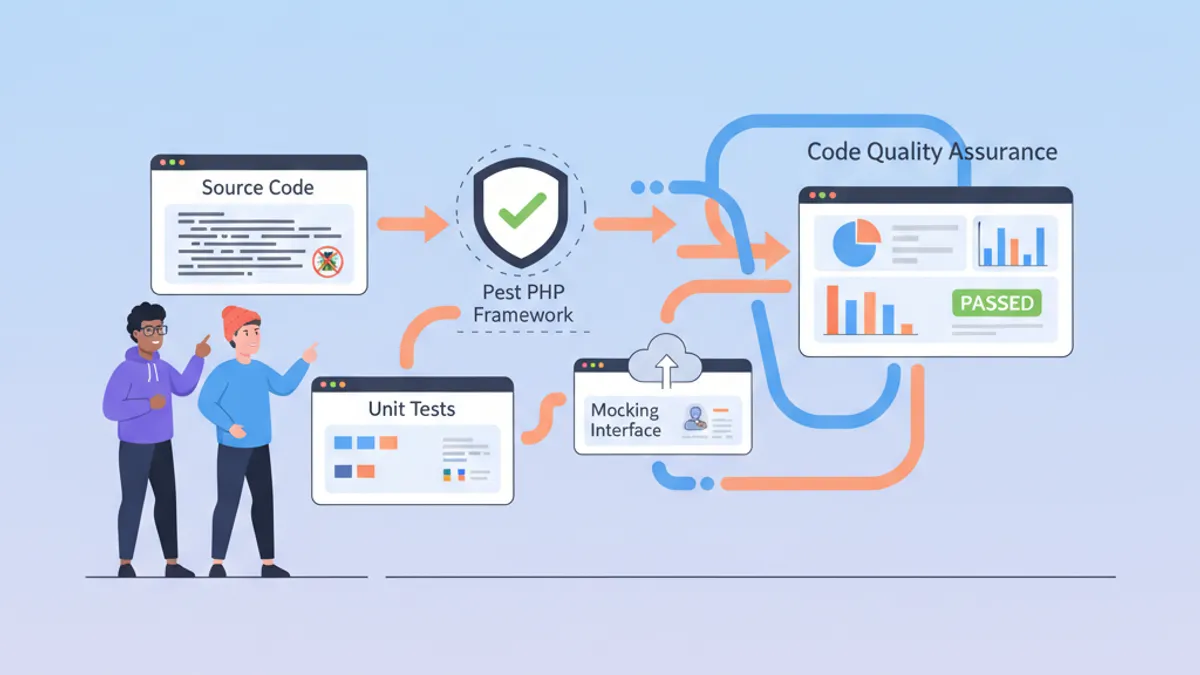
Testes no Laravel com Pest 5 em 2026: TIA, Mocking e Perguntas de Entrevista
Domine as melhores praticas de testes no Laravel com Pest 5, Test Impact Analysis, Mockery, fakes de facades e testes de arquitetura. Aborda testes unitarios, testes de feature, estrategias de mocking e perguntas comuns de entrevistas para desenvolvedores Laravel.

Eloquent ORM: padrões e otimizações para Laravel
Domine o Eloquent ORM com padrões avançados e técnicas de otimização. Eager loading, query scopes, accessors, mutators e performance para aplicações Laravel.