Rust: Basiskennis voor Ervaren Ontwikkelaars in 2026
Rust snel leren door bestaande kennis te benutten. Ownership, borrowing, lifetimes en essentiele patronen uitgelegd voor ontwikkelaars afkomstig uit C++, Java of Python.

Rust wint jaar na jaar aan populariteit onder professionele ontwikkelaars, en de redenen liggen voor de hand: gegarandeerde geheugenveiligheid tijdens compilatie, prestaties op C++-niveau en een modern, groeiend ecosysteem. Voor ontwikkelaars met ervaring in C++, Java of Python kan Rust in het begin verwarrend aanvoelen, maar de fundamentele concepten worden snel intuïtief zodra ze begrepen zijn.
Rust is 8 opeenvolgende jaren de meest geliefde programmeertaal op Stack Overflow geweest. Geadopteerd door Microsoft, Google, Amazon en Meta voor kritieke componenten, biedt Rust geheugenveiligheid zonder garbage collector.
De Rust-Ontwikkelomgeving Opzetten
Voordat er code geschreven kan worden, moet Rust geinstalleerd worden via rustup, het officiele versiebeheer-hulpmiddel.
# install.sh
# Install Rust via rustup (macOS, Linux)
curl --proto '=https' --tlsv1.2 -sSf https://sh.rustup.rs | sh

# Verify installation
rustc --version
cargo --version
Cargo is de pakketbeheerder en het buildgereedschap van Rust. Het combineert de functionaliteit van npm, Maven en Make in een enkel samenhangend hulpmiddel.
# project-setup.sh
# Create a new project
cargo new my_project
cd my_project

# Generated structure:
# my_project/
# ├── Cargo.toml    # Manifest (like package.json)
# └── src/
#     └── main.rs   # Entry point

# Essential commands
cargo build          # Compile the project
cargo run            # Compile and run
cargo test           # Run tests
cargo check          # Check without building (faster)
Variabelen en Standaard Onveranderlijkheid
Rust keert de gebruikelijke conventie om: variabelen zijn standaard onveranderlijk (immutable). Deze aanpak dwingt expliciet nadenken over veranderlijkheid af en voorkomt veel voorkomende bugs.
fn main() {
    // Immutable by default
    let x = 5;
    // x = 6;  // Compile error!

    // Explicitly mutable variable
    let mut y = 5;
    y = 6;  // OK

    // Shadowing: redeclaration in the same scope
    let x = x + 1;  // Creates a new variable x
    let x = x * 2;  // x is now 12

    // Shadowing also allows changing the type
    let spaces = "   ";         // &str
    let spaces = spaces.len();  // usize
}
Shadowing maakt een nieuwe variabele aan, in tegenstelling tot mut dat de bestaande waarde wijzigt. Shadowing maakt het mogelijk een waarde te transformeren terwijl een duidelijke naam behouden blijft.
Fundamentele Datatypes
Rust is statisch getypeerd met uitstekende type-inferentie. Hier volgen de essentiele primitieve types.
fn main() {
    // Signed integers: i8, i16, i32, i64, i128, isize
    let age: i32 = 30;

    // Unsigned integers: u8, u16, u32, u64, u128, usize
    let count: u64 = 1_000_000;  // Underscores for readability

    // Floats: f32, f64 (default)
    let pi: f64 = 3.14159;

    // Boolean
    let active: bool = true;

    // Unicode character (4 bytes)
    let emoji: char = '🦀';

    // Tuple: fixed collection of different types
    let person: (String, i32) = (String::from("Alice"), 28);
    let (name, age) = person;  // Destructuring

    // Array: fixed size, same type
    let numbers: [i32; 5] = [1, 2, 3, 4, 5];
    let first = numbers[0];

    // Slice: view into a portion of data
    let slice: &[i32] = &numbers[1..4];  // [2, 3, 4]
}
Ownership: Het Revolutionaire Concept
Ownership is DE innovatie van Rust. Dit systeem garandeert geheugenveiligheid zonder garbage collector, ten koste van een initiele leercurve.
De Drie Regels van Ownership
fn main() {
    // Rule 1: Each value has a single owner
    let s1 = String::from("hello");

    // Rule 2: When the owner goes out of scope, the value is freed
    {
        let s2 = String::from("world");
        // s2 is valid here
    }
    // s2 is dropped, no longer accessible

    // Rule 3: Only one ownership at a time (move)
    let s3 = s1;  // s1 is MOVED to s3
    // println!("{}", s1);  // Error: s1 is no longer valid!
    println!("{}", s3);     // OK: s3 is the owner
}
Move vs Clone
fn main() {
    // Simple types (stack): automatic Copy
    let x = 5;
    let y = x;  // Copy, not move
    println!("x = {}, y = {}", x, y);  // Both are valid

    // Complex types (heap): Move by default
    let s1 = String::from("hello");
    let s2 = s1;  // Move
    // s1 is no longer usable

    // Explicit clone to duplicate
    let s3 = String::from("world");
    let s4 = s3.clone();  // Deep copy
    println!("s3 = {}, s4 = {}", s3, s4);  // Both valid
}Het doorgeven van een waarde aan een functie draagt het ownership over. De functie wordt de eigenaar en de waarde is na de aanroep niet meer toegankelijk, tenzij deze wordt teruggegeven.
fn main() {
    let s = String::from("hello");
    takes_ownership(s);
    // println!("{}", s);  // Error: s has been moved

    let x = 5;
    makes_copy(x);
    println!("{}", x);  // OK: i32 implements Copy

    // To regain ownership, return the value
    let s2 = String::from("hello");
    let s3 = takes_and_gives_back(s2);
    println!("{}", s3);  // OK
}

fn takes_ownership(s: String) {
    println!("{}", s);
}  // s is dropped here

fn makes_copy(x: i32) {
    println!("{}", x);
}

fn takes_and_gives_back(s: String) -> String {
    s  // Returns ownership
}
Borrowing: Referenties Zonder Overdracht
Borrowing maakt het mogelijk een waarde te gebruiken zonder het ownership over te nemen. Dit is het meest gebruikte mechanisme in Rust.
fn main() {
    let s1 = String::from("hello");

    // Immutable reference: read-only
    let len = calculate_length(&s1);
    println!("Length of '{}': {}", s1, len);  // s1 still valid

    // Mutable reference: modification allowed
    let mut s2 = String::from("hello");
    change(&mut s2);
    println!("{}", s2);  // "hello, world"
}

fn calculate_length(s: &String) -> usize {
    s.len()
}  // s goes out of scope but doesn't drop (it's a reference)

fn change(s: &mut String) {
    s.push_str(", world");
}
Regels van Borrowing
fn main() {
    let mut s = String::from("hello");

    // Rule 1: Multiple immutable references simultaneously OK
    let r1 = &s;
    let r2 = &s;
    println!("{} and {}", r1, r2);

    // Rule 2: ONLY ONE mutable reference at a time
    let r3 = &mut s;
    // let r4 = &mut s;  // Error: already borrowed mutably
    println!("{}", r3);

    // Rule 3: No mutable ref if immutable ref exists
    let r5 = &s;
    // let r6 = &mut s;  // Error: r5 is still active
    println!("{}", r5);

    // Once r5 is used for the last time, mutable borrow is allowed
    let r7 = &mut s;  // OK: r5 is no longer used after this
    r7.push_str("!");
}
Klaar om je Rust gesprekken te halen?
Oefen met onze interactieve simulatoren, flashcards en technische tests.
Lifetimes: Geldigheid van Referenties Waarborgen
Lifetimes zorgen ervoor dat referenties geldig blijven. De compiler leidt ze vaak automatisch af, maar soms is een expliciete annotatie noodzakelijk.
// Classic error: reference to freed data
// fn dangling() -> &String {
//     let s = String::from("hello");
//     &s  // Error: s will be dropped, invalid reference!
// }

// Solution: return the owned value
fn no_dangle() -> String {
    let s = String::from("hello");
    s  // Ownership transferred, no problem
}
Lifetime-Annotaties
// The compiler can't figure out which reference will be returned
// fn longest(x: &str, y: &str) -> &str { ... }  // Error!

// Explicit annotation: return lives as long as BOTH x AND y
fn longest<'a>(x: &'a str, y: &'a str) -> &'a str {
    if x.len() > y.len() {
        x
    } else {
        y
    }
}

fn main() {
    let string1 = String::from("long string");
    let result;
    {
        let string2 = String::from("xyz");
        result = longest(&string1, &string2);
        println!("Longest: {}", result);  // OK here
    }
    // println!("{}", result);  // Error: string2 dropped
}Rust past elisieregels toe om eenvoudige gevallen niet te hoeven annoteren. Voor beginners volstaat het om de expliciete meldingen van de compiler te volgen.
Structs en Implementaties
Structs vormen de bouwstenen voor aangepaste types in Rust.
// Struct definition
#[derive(Debug)]  // Enables printing with {:?}
struct User {
    username: String,
    email: String,
    active: bool,
    sign_in_count: u64,
}

// Implementation block for methods
impl User {
    // Constructor (convention: fn new or descriptive name)
    fn new(username: String, email: String) -> Self {
        Self {
            username,
            email,
            active: true,
            sign_in_count: 1,
        }
    }

    // Method: takes &self (reference to instance)
    fn is_active(&self) -> bool {
        self.active
    }

    // Method with mutation: takes &mut self
    fn deactivate(&mut self) {
        self.active = false;
    }

    // Method consuming self (rare)
    fn into_username(self) -> String {
        self.username
    }
}

fn main() {
    let mut user = User::new(
        String::from("alice"),
        String::from("alice@example.com"),
    );

    println!("Active: {}", user.is_active());
    user.deactivate();
    println!("Active: {}", user.is_active());

    // Debug print
    println!("{:?}", user);
}
Enums en Pattern Matching
Rust-enums zijn aanzienlijk krachtiger dan in de meeste andere talen: elke variant kan gegevens bevatten.
// Simple enum
enum Direction {
    North,
    South,
    East,
    West,
}

// Enum with data (algebraic data type)
enum Message {
    Quit,
    Move { x: i32, y: i32 },
    Write(String),
    ChangeColor(u8, u8, u8),
}

impl Message {
    fn process(&self) {
        match self {
            Message::Quit => println!("Quitting"),
            Message::Move { x, y } => println!("Moving to ({}, {})", x, y),
            Message::Write(text) => println!("Writing: {}", text),
            Message::ChangeColor(r, g, b) => {
                println!("Color: rgb({}, {}, {})", r, g, b)
            }
        }
    }
}

fn main() {
    let msg = Message::Move { x: 10, y: 20 };
    msg.process();

    let msg2 = Message::Write(String::from("Hello Rust!"));
    msg2.process();
}
Option en Result: Foutafhandeling
use std::fs::File;
use std::io::{self, Read};

fn main() {
    // Option<T>: present or absent value (replaces null)
    let numbers = vec![1, 2, 3];
    let first: Option<&i32> = numbers.first();

    match first {
        Some(n) => println!("First: {}", n),
        None => println!("Empty list"),
    }

    // Utility methods
    let value = first.unwrap_or(&0);
    let doubled = first.map(|n| n * 2);

    // Result<T, E>: success or error
    let result = read_file("config.txt");
    match result {
        Ok(content) => println!("Content: {}", content),
        Err(e) => println!("Error: {}", e),
    }
}

fn read_file(path: &str) -> Result<String, io::Error> {
    let mut file = File::open(path)?;  // ? propagates the error
    let mut content = String::new();
    file.read_to_string(&mut content)?;
    Ok(content)
}
De ?-operator is syntactische suiker voor foutpropagatie. Het retourneert automatisch de fout als het Result Err is, anders wordt de Ok-waarde uitgepakt.
Traits: Polymorfisme op z'n Rust
Traits defnieren gedeeld gedrag, vergelijkbaar met Java-interfaces of Swift-protocollen.
// Trait definition
trait Summary {
    fn summarize(&self) -> String;

    // Method with default implementation
    fn preview(&self) -> String {
        format!("{}...", &self.summarize()[..50.min(self.summarize().len())])
    }
}

struct Article {
    title: String,
    author: String,
    content: String,
}

struct Tweet {
    username: String,
    content: String,
}

// Implementation for Article
impl Summary for Article {
    fn summarize(&self) -> String {
        format!("{} by {}", self.title, self.author)
    }
}

// Implementation for Tweet
impl Summary for Tweet {
    fn summarize(&self) -> String {
        format!("@{}: {}", self.username, self.content)
    }
}

// Function accepting any type implementing Summary
fn notify(item: &impl Summary) {
    println!("Breaking news: {}", item.summarize());
}

// Equivalent syntax with trait bound
fn notify_generic<T: Summary>(item: &T) {
    println!("Breaking news: {}", item.summarize());
}

fn main() {
    let article = Article {
        title: String::from("Rust 2026"),
        author: String::from("Community"),
        content: String::from("..."),
    };

    let tweet = Tweet {
        username: String::from("rustlang"),
        content: String::from("Rust is awesome!"),
    };

    notify(&article);
    notify(&tweet);
}
Essentiele Collecties in de Standaardbibliotheek
Rust biedt krachtige collecties in de standaardbibliotheek.
use std::collections::HashMap;

fn main() {
    // Vec<T>: dynamic array
    let mut numbers: Vec<i32> = Vec::new();
    numbers.push(1);
    numbers.push(2);
    numbers.push(3);

    // vec! macro for initialization
    let nums = vec![1, 2, 3, 4, 5];

    // Iteration
    for n in &nums {
        println!("{}", n);
    }

    // Functional methods
    let doubled: Vec<i32> = nums.iter().map(|x| x * 2).collect();
    let sum: i32 = nums.iter().sum();
    let evens: Vec<&i32> = nums.iter().filter(|x| *x % 2 == 0).collect();

    // String: growable UTF-8 string
    let mut s = String::from("Hello");
    s.push_str(", World!");
    s.push('!');

    // Concatenation
    let s1 = String::from("Hello, ");
    let s2 = String::from("World!");
    let s3 = s1 + &s2;  // s1 moved, s2 borrowed
    // or with format!
    let s4 = format!("{}{}", "Hello, ", "World!");

    // HashMap<K, V>
    let mut scores: HashMap<String, i32> = HashMap::new();
    scores.insert(String::from("Blue"), 10);
    scores.insert(String::from("Red"), 50);

    // Access with get (returns Option)
    if let Some(score) = scores.get("Blue") {
        println!("Blue: {}", score);
    }

    // Entry API for conditional insertion
    scores.entry(String::from("Yellow")).or_insert(25);
}
Idiomatische Foutafhandeling in Rust
Correcte foutafhandeling is essentieel in Rust. Hier volgen de aanbevolen patronen.
use std::fs::File;
use std::io::{self, Read};
use std::num::ParseIntError;

// Define a custom error type
#[derive(Debug)]
enum AppError {
    Io(io::Error),
    Parse(ParseIntError),
    Custom(String),
}

// Implement From for automatic conversion
impl From<io::Error> for AppError {
    fn from(err: io::Error) -> Self {
        AppError::Io(err)
    }
}

impl From<ParseIntError> for AppError {
    fn from(err: ParseIntError) -> Self {
        AppError::Parse(err)
    }
}

// Function returning Result with custom error
fn read_number_from_file(path: &str) -> Result<i32, AppError> {
    let mut file = File::open(path)?;  // io::Error -> AppError
    let mut content = String::new();
    file.read_to_string(&mut content)?;
    let number: i32 = content.trim().parse()?;  // ParseIntError -> AppError
    Ok(number)
}

fn main() {
    match read_number_from_file("number.txt") {
        Ok(n) => println!("Number: {}", n),
        Err(AppError::Io(e)) => println!("IO error: {}", e),
        Err(AppError::Parse(e)) => println!("Parse error: {}", e),
        Err(AppError::Custom(msg)) => println!("Error: {}", msg),
    }
}Voor echte projecten vereenvoudigen de thiserror-crate (voor bibliotheken) en anyhow (voor applicaties) de foutafhandeling aanzienlijk.
Geintegreerd Testen in Rust
Rust integreert een testframework rechtstreeks in de taal.
pub fn add(a: i32, b: i32) -> i32 {
    a + b
}

pub fn divide(a: i32, b: i32) -> Result<i32, String> {
    if b == 0 {
        Err(String::from("Division by zero"))
    } else {
        Ok(a / b)
    }
}

// Test module (compiled only for `cargo test`)
#[cfg(test)]
mod tests {
    use super::*;

    #[test]
    fn test_add() {
        assert_eq!(add(2, 3), 5);
    }

    #[test]
    fn test_add_negative() {
        assert_eq!(add(-1, 1), 0);
    }

    #[test]
    fn test_divide_success() {
        assert_eq!(divide(10, 2), Ok(5));
    }

    #[test]
    fn test_divide_by_zero() {
        assert!(divide(10, 0).is_err());
    }

    #[test]
    #[should_panic(expected = "index out of bounds")]
    fn test_panic() {
        let v = vec![1, 2, 3];
        let _ = v[99];  // Panic!
    }
}
Conclusie
Rust biedt een uniek paradigma dat geheugenveiligheid en hoge prestaties combineert. De concepten van ownership en borrowing voelen aanvankelijk beperkend aan, maar worden met oefening volkomen natuurlijk. De Rust-compiler is een onmisbare bondgenoot: de foutmeldingen behoren tot de beste in de branche.
Checklist om te Beginnen
- Rust installeren via rustup en Cargo beheersen
- Het verschil tussen onveranderlijkheid en expliciete veranderlijkheid begrijpen
- De drie regels van ownership beheersen
- Borrowing oefenen met
&- en&mut-referenties OptionenResultgebruiken in plaats van null en exceptions- Tests schrijven met
#[test]
Begin met oefenen!
Test je kennis met onze gespreksimulatoren en technische tests.
De Rust-gemeenschap is gastvrij en de beschikbare bronnen zijn overvloedig. Het officiele boek "The Rust Programming Language" is gratis online beschikbaar. Met deze solide basis vormen geavanceerde onderwerpen zoals async/await, macro's en WebAssembly de logische volgende stap.
Zie jij de bug in Rust?
Een echt codefragment, een verborgen bug, één poging per dag. Zonder account uit te proberen.

Geschreven door
Anthony Fillion-MailletOprichter van SharpSkill
Al meer dan 10 jaar fullstack-ontwikkelaar. Hij leidt SharpSkill en staat in voor alles wat hier verschijnt.
Bijgewerkt op 1 april 2026
Tags
Delen
Gerelateerde artikelen
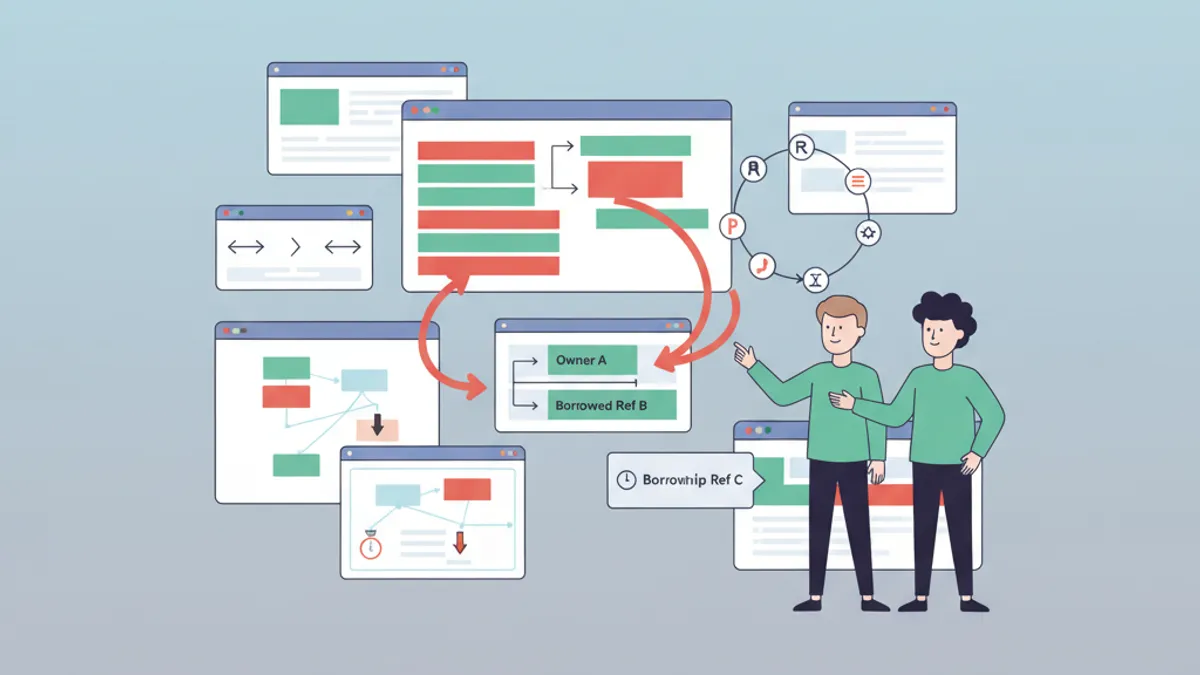
Ownership en Borrowing in Rust: Volledige Gids
Beheers het ownership- en borrowing-systeem van Rust. Eigendomsregels, referenties, lifetimes en geavanceerde patronen voor geheugenbeheer.

Rust Sollicitatievragen: Complete Gids 2026
De 25 meest gestelde Rust-sollicitatievragen. Ownership, borrowing, lifetimes, traits, async en concurrency met uitgebreide antwoorden en codevoorbeelden.

Rust Ownership en Borrowing: De Gids Die Alles Ontraadselt
Beheers Rust ownership en borrowing met praktische voorbeelden. Begrijp move-semantiek, referenties, lifetimes en de borrow checker om veilige, performante Rust-code te schrijven.