Ownership e Borrowing in Rust: Guida Completa
Padroneggia il sistema di ownership e borrowing di Rust. Regole di proprietà, riferimenti, lifetime e pattern avanzati di gestione della memoria.
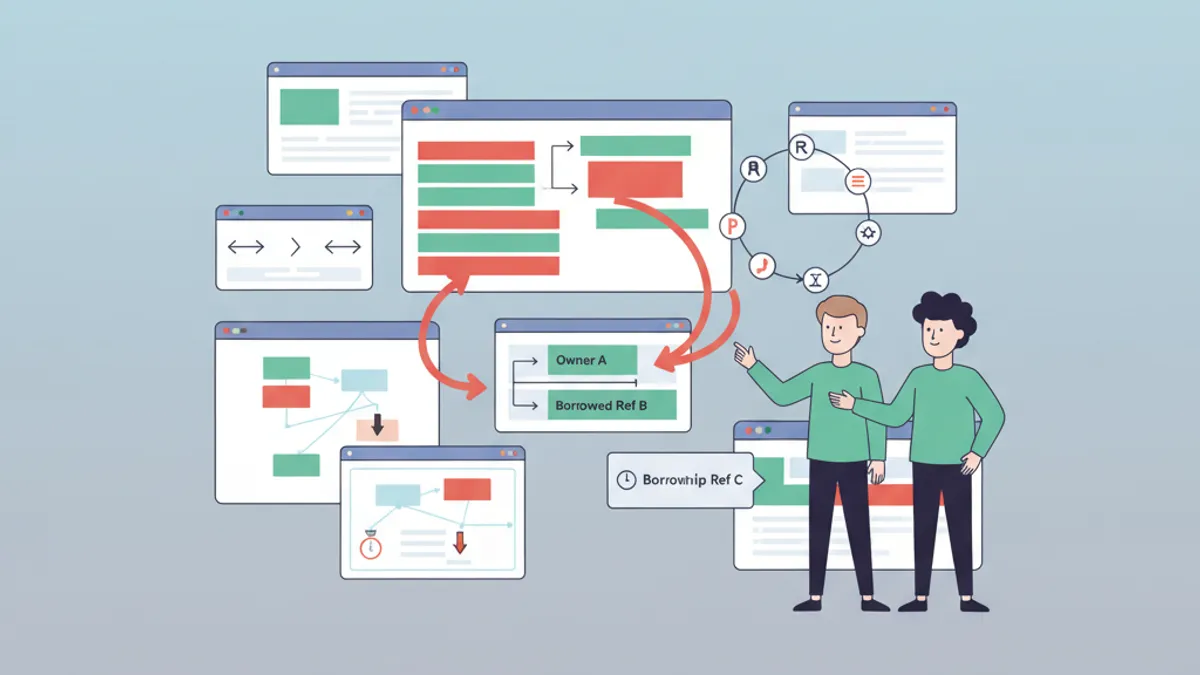
Il sistema di ownership è ciò che distingue Rust da qualsiasi altro linguaggio di programmazione. Questo approccio unico garantisce la sicurezza della memoria senza garbage collector, intercettando i bug in fase di compilazione anziché in esecuzione. Questa guida approfondita esplora i meccanismi di ownership e borrowing, dai fondamenti ai pattern avanzati di produzione.
Il compilatore Rust agisce come un assistente di programmazione esigente: ogni errore di ownership bloccato in fase di compilazione rappresenta un potenziale bug evitato in produzione.
Le Tre Regole Fondamentali dell'Ownership
Il sistema di ownership si basa su tre regole semplici ma rigorose. Una volta interiorizzate, il modello mentale di Rust diventa naturale e prevedibile.
// Demonstration of the three fundamental rules

fn main() {
    // Rule 1: Each value has exactly ONE owner
    let s1 = String::from("hello");  // s1 is the sole owner

    // Rule 2: There can only be one owner at a time
    let s2 = s1;  // Ownership transferred (moved) from s1 to s2
    // println!("{}", s1);  // Compile ERROR: s1 no longer exists
    println!("s2 = {}", s2);  // Only s2 is valid now

    // Rule 3: When the owner goes out of scope, the value is dropped
    {
        let s3 = String::from("temporary");
        println!("s3 inside block = {}", s3);
    }  // s3 is automatically freed here (drop is called)
    // println!("{}", s3);  // ERROR: s3 no longer exists
}
Queste tre regole eliminano intere categorie di bug: use-after-free, double-free e memory leak. Il compilatore verifica staticamente che queste regole siano rispettate.
Move vs Copy: Comprendere la Semantica del Trasferimento
Il comportamento dell'assegnazione dipende dal tipo di dato. I tipi che implementano il trait Copy vengono duplicati, mentre gli altri vengono trasferiti tramite move.
// Distinction between Copy types and Move types

fn main() {
    // Copy types: values stored on the stack, known size
    let x: i32 = 42;
    let y = x;  // x is COPIED, not moved
    println!("x = {}, y = {}", x, y);  // Both are valid

    // Other Copy types: f64, bool, char, tuples of Copy types
    let point = (3.0, 4.0);
    let point_copy = point;  // Tuple copy
    println!("Original: {:?}, Copy: {:?}", point, point_copy);

    // Move types: values on the heap, dynamic size
    let s1 = String::from("owned");
    let s2 = s1;  // s1 is MOVED to s2
    // println!("{}", s1);  // ERROR: value moved
    println!("s2 = {}", s2);

    // Vec, HashMap, Box are also Move types
    let vec1 = vec![1, 2, 3];
    let vec2 = vec1;  // Move, not copy
    // println!("{:?}", vec1);  // ERROR
    println!("vec2 = {:?}", vec2);
}

// Explicit clone to duplicate Move types
fn explicit_clone() {
    let original = String::from("important data");
    let clone = original.clone();  // Explicit duplication (memory cost)

    println!("Original: {}", original);  // Still valid
    println!("Clone: {}", clone);  // Independent copy
}
La distinzione Move/Copy è fondamentale: determina se l'assegnazione trasferisce la proprietà o crea una copia indipendente.
Chiamare .clone() deve essere intenzionale. Un codice pieno di clone può indicare un problema di design. Il borrowing è spesso una soluzione migliore.
Borrowing: Riferimenti Immutabili e Mutabili
Il borrowing permette di accedere a un valore senza prenderne la proprietà. Questo meccanismo rende il codice Rust al tempo stesso sicuro e performante.
// Immutable and mutable references

fn main() {
    let s = String::from("hello");

    // Immutable reference: read-only, multiple allowed
    let len = calculate_length(&s);  // Immutable borrow
    println!("'{}' has {} characters", s, len);  // s still valid

    // Multiple simultaneous immutable references: OK
    let r1 = &s;
    let r2 = &s;
    let r3 = &s;
    println!("r1={}, r2={}, r3={}", r1, r2, r3);
}

fn calculate_length(s: &String) -> usize {
    // s is a reference, not the owner
    s.len()
}  // s goes out of scope but doesn't drop anything (not owner)

// Mutable references: modification allowed
fn mutable_borrowing() {
    let mut s = String::from("hello");

    change(&mut s);  // Mutable borrow
    println!("After modification: {}", s);
}

fn change(s: &mut String) {
    s.push_str(", world!");  // Modification via mutable reference
}
La regola d'oro del borrowing: o riferimenti immutabili multipli OPPURE un singolo riferimento mutabile, mai entrambi simultaneamente.
Regole del Borrow Checker
Il borrow checker è il componente del compilatore che verifica le regole di borrowing. Comprenderne gli errori permette di risolvere rapidamente i problemi.
// Strict borrow checker rules

fn main() {
    // RULE 1: No mutable reference with immutable references
    let mut s = String::from("hello");

    let r1 = &s;      // Immutable reference: OK
    let r2 = &s;      // Another immutable reference: OK
    // let r3 = &mut s;  // ERROR: cannot borrow as mutable
    println!("{} and {}", r1, r2);

    // AFTER using r1 and r2, they are "dead"
    let r3 = &mut s;  // Now OK: r1 and r2 no longer used
    r3.push_str(" world");
    println!("{}", r3);

    // RULE 2: Only one mutable reference at a time
    let mut data = String::from("exclusive");
    let ref1 = &mut data;
    // let ref2 = &mut data;  // ERROR: already borrowed mutably
    ref1.push_str("!");
    println!("{}", ref1);
}

// RULE 3: References cannot outlive the data
fn dangling_reference_prevented() {
    let reference;
    {
        let s = String::from("short-lived");
        // reference = &s;  // ERROR: s doesn't live long enough
    }
    // s is dropped here, reference would be invalid

    // Solution: move the value out of the scope
    let owned_outside;
    {
        let s = String::from("moved out");
        owned_outside = s;  // Move, not reference
    }
    println!("{}", owned_outside);  // OK: owned_outside is the owner
}
Il borrow checker utilizza i Non-Lexical Lifetimes (NLL): un riferimento è considerato attivo solo fino al suo ultimo utilizzo, non fino alla fine dello scope.
Pronto a superare i tuoi colloqui su Rust?
Pratica con i nostri simulatori interattivi, flashcards e test tecnici.
Lifetime: Annotare la Durata dei Riferimenti
I lifetime sono annotazioni che aiutano il compilatore a verificare che i riferimenti rimangano validi. Nella maggior parte dei casi vengono dedotti automaticamente.
// Explicit lifetime annotations

// Without annotation: compiler infers lifetimes
fn first_word(s: &str) -> &str {
    match s.find(' ') {
        Some(i) => &s[..i],
        None => s,
    }
}

// With explicit annotation: same function
fn first_word_explicit<'a>(s: &'a str) -> &'a str {
    // 'a means: returned reference lives as long as the input
    match s.find(' ') {
        Some(i) => &s[..i],
        None => s,
    }
}

// When annotations are necessary: multiple references
fn longest<'a>(x: &'a str, y: &'a str) -> &'a str {
    // Compiler cannot guess which reference is returned
    if x.len() > y.len() {
        x
    } else {
        y
    }
}

fn main() {
    let string1 = String::from("long string");
    let result;
    {
        let string2 = String::from("xyz");
        result = longest(&string1, &string2);
        println!("Longest: {}", result);  // OK here
    }
    // println!("{}", result);  // ERROR if uncommented: string2 dropped
}
I lifetime non cambiano la durata di vita dei dati; descrivono le relazioni tra le durate di vita di riferimenti diversi.
Lifetime nelle Struct
Quando una struct contiene riferimenti, i lifetime devono essere annotati per garantire che la struct non sopravviva ai dati referenziati.
// Structs containing references

// Struct with reference: lifetime required
struct ImportantExcerpt<'a> {
    part: &'a str,  // This reference must live at least as long as the struct
}

impl<'a> ImportantExcerpt<'a> {
    // Method returning a reference with the same lifetime
    fn level(&self) -> i32 {
        3
    }

    // Elision rule: &self implies the output lifetime
    fn announce_and_return_part(&self, announcement: &str) -> &str {
        println!("Attention: {}", announcement);
        self.part  // Returns with 'a lifetime from self
    }
}

fn main() {
    let novel = String::from("Call me Ishmael. Some years ago...");
    let first_sentence = novel.split('.').next().unwrap();

    let excerpt = ImportantExcerpt {
        part: first_sentence,  // OK: novel outlives excerpt
    };

    println!("Excerpt: {}", excerpt.part);
    println!("Level: {}", excerpt.level());
}

// Static lifetime: reference valid for the entire program duration
fn static_lifetime_example() {
    let s: &'static str = "This string is in the binary";
    // String literals always have 'static lifetime
    println!("{}", s);
}
Le regole di elisione dei lifetime spesso permettono di omettere le annotazioni nei casi comuni, rendendo il codice più leggibile.
Pattern Avanzati: Mutabilità Interna
A volte la mutabilità deve essere verificata in fase di esecuzione anziché di compilazione. Rust fornisce tipi per questo pattern: RefCell e Cell.
// Interior mutability with RefCell and Cell

use std::cell::{Cell, RefCell};

// Cell: for Copy types, replaces the entire value
struct Counter {
    count: Cell<u32>,  // Mutable despite &self
}

impl Counter {
    fn new() -> Counter {
        Counter { count: Cell::new(0) }
    }

    fn increment(&self) {
        // Modification via immutable reference!
        self.count.set(self.count.get() + 1);
    }

    fn get(&self) -> u32 {
        self.count.get()
    }
}

// RefCell: for non-Copy types, checks at runtime
struct CachedValue {
    value: RefCell<Option<String>>,
}

impl CachedValue {
    fn new() -> CachedValue {
        CachedValue { value: RefCell::new(None) }
    }

    fn get_or_compute(&self, compute: impl FnOnce() -> String) -> String {
        // borrow() for reading, borrow_mut() for writing
        if self.value.borrow().is_none() {
            *self.value.borrow_mut() = Some(compute());
        }
        self.value.borrow().as_ref().unwrap().clone()
    }
}

fn main() {
    let counter = Counter::new();
    counter.increment();
    counter.increment();
    println!("Counter: {}", counter.get());  // 2

    let cache = CachedValue::new();
    let result = cache.get_or_compute(|| {
        println!("Expensive computation...");
        String::from("result")
    });
    println!("Value: {}", result);

    // Second call: no recomputation
    let result2 = cache.get_or_compute(|| String::from("never executed"));
    println!("Cache hit: {}", result2);
}
RefCell e Cell spostano la verifica del borrowing al runtime. Una violazione di regola provoca un panic invece di un errore di compilazione.
RefCell::borrow_mut() provoca un panic se il valore è già preso in prestito. Conviene usare try_borrow_mut() per una gestione esplicita degli errori.
Smart Pointer e Ownership
Gli smart pointer come Box, Rc e Arc offrono diverse strategie di ownership per casi d'uso specifici.
// Box, Rc, and Arc for different ownership patterns

use std::rc::Rc;
use std::sync::Arc;
use std::thread;

// Box: single owner, data on the heap
fn box_example() {
    let boxed = Box::new(vec![1, 2, 3, 4, 5]);
    println!("Boxed vec: {:?}", boxed);
    // Useful for: recursive types, large objects, trait objects
}

// Rc: reference counting, multiple owners (single-thread)
fn rc_example() {
    let data = Rc::new(String::from("shared data"));

    let clone1 = Rc::clone(&data);  // Increments the counter
    let clone2 = Rc::clone(&data);

    println!("Count: {}", Rc::strong_count(&data));  // 3
    println!("All share: {}, {}, {}", data, clone1, clone2);
}  // Freed when counter reaches 0

// Arc: thread-safe Rc (Atomic Reference Counting)
fn arc_example() {
    let data = Arc::new(vec![1, 2, 3]);

    let handles: Vec<_> = (0..3).map(|i| {
        let data_clone = Arc::clone(&data);
        thread::spawn(move || {
            println!("Thread {}: {:?}", i, data_clone);
        })
    }).collect();

    for handle in handles {
        handle.join().unwrap();
    }
}

fn main() {
    box_example();
    rc_example();
    arc_example();
}
La scelta dello smart pointer dipende dal pattern di ownership: unico (Box), condiviso single-thread (Rc) o condiviso multi-thread (Arc).
Pattern Pratici di Ownership
Di seguito alcuni pattern comuni per strutturare il codice attorno al sistema di ownership.
// Practical patterns for ownership management

// Pattern 1: Builder pattern with chained ownership
struct RequestBuilder {
    url: String,
    headers: Vec<(String, String)>,
    timeout: Option<u64>,
}

impl RequestBuilder {
    fn new(url: &str) -> Self {
        RequestBuilder {
            url: url.to_string(),
            headers: Vec::new(),
            timeout: None,
        }
    }

    // Consumes self and returns the new self
    fn header(mut self, key: &str, value: &str) -> Self {
        self.headers.push((key.to_string(), value.to_string()));
        self  // Returns ownership
    }

    fn timeout(mut self, seconds: u64) -> Self {
        self.timeout = Some(seconds);
        self
    }

    fn build(self) -> Request {
        Request {
            url: self.url,
            headers: self.headers,
            timeout: self.timeout.unwrap_or(30),
        }
    }
}

struct Request {
    url: String,
    headers: Vec<(String, String)>,
    timeout: u64,
}

// Pattern 2: Cow (Copy-on-Write) to avoid allocations
use std::borrow::Cow;

fn process_text(input: &str) -> Cow<str> {
    if input.contains("REPLACE") {
        // Allocation only if modification needed
        Cow::Owned(input.replace("REPLACE", "NEW"))
    } else {
        // No allocation, returns a reference
        Cow::Borrowed(input)
    }
}

// Pattern 3: Take to extract from an Option
fn extract_value(data: &mut Option<String>) -> String {
    data.take().unwrap_or_else(|| String::from("default"))
    // take() replaces with None and returns ownership of the value
}

fn main() {
    // Builder pattern
    let request = RequestBuilder::new("https://api.example.com")
        .header("Authorization", "Bearer token")
        .header("Content-Type", "application/json")
        .timeout(60)
        .build();

    println!("URL: {}, Timeout: {}s", request.url, request.timeout);

    // Cow pattern
    let text1 = process_text("hello world");  // No allocation
    let text2 = process_text("hello REPLACE");  // Allocation
    println!("{} | {}", text1, text2);

    // Take pattern
    let mut optional = Some(String::from("extracted"));
    let value = extract_value(&mut optional);
    println!("Value: {}, Option: {:?}", value, optional);  // None
}
Questi pattern sfruttano il sistema di ownership per creare API ergonomiche e performanti.
Inizia a praticare!
Metti alla prova le tue conoscenze con i nostri simulatori di colloquio e test tecnici.
Conclusione
Il sistema di ownership e borrowing di Rust rappresenta un cambio di paradigma nella gestione della memoria. Una volta padroneggiato, diventa un alleato potente per scrivere codice al tempo stesso performante e sicuro.
Punti chiave da ricordare:
✅ Tre regole di ownership: proprietario unico, trasferimento di proprietà, drop automatico
✅ Borrowing: riferimenti immutabili multipli OPPURE un riferimento mutabile esclusivo
✅ Lifetime: annotare le relazioni tra le durate dei riferimenti
✅ Mutabilità interna: RefCell e Cell per mutabilità verificata a runtime
✅ Smart pointer: Box (unico), Rc (condiviso), Arc (thread-safe)
✅ Pattern pratici: Builder, Cow, Take per API idiomatiche
Il borrow checker può sembrare rigido all'inizio, ma ogni errore segnalato rappresenta un potenziale bug evitato. Con la pratica, ragionare in termini di ownership diventa naturale e migliora la qualità del codice in tutti i linguaggi.
Inizia a praticare!
Metti alla prova le tue conoscenze con i nostri simulatori di colloquio e test tecnici.
Sapresti trovare il bug in Rust?
Uno snippet reale, un bug nascosto, un tentativo al giorno. Senza account per provare.

Scritto da
Anthony Fillion-MailletFondatore di SharpSkill
Sviluppatore fullstack da oltre 10 anni. Guida SharpSkill e risponde di tutto ciò che vi viene pubblicato.
Aggiornato il 29 aprile 2026
Tag
Condividi
Articoli correlati

Ownership e Borrowing in Rust: la guida completa per padroneggiare la gestione della memoria
Una guida approfondita su ownership e borrowing in Rust con esempi pratici. Move semantics, riferimenti, lifetimes e borrow checker per scrivere codice sicuro ed efficiente.

Domande Colloquio Rust: Guida Completa 2026
Le 25 domande più comuni nei colloqui Rust. Ownership, borrowing, lifetimes, traits, async e concurrency con risposte dettagliate ed esempi di codice.

Rust: Fondamenti per Sviluppatori Esperti nel 2026
Imparare Rust rapidamente sfruttando le competenze esistenti. Ownership, borrowing, lifetimes e pattern essenziali spiegati per sviluppatori provenienti da C++, Java o Python.