Rust面接質問:2026年版完全ガイド
Rustの技術面接で頻出の25問を完全網羅。所有権、借用、ライフタイム、トレイト、async/await、並行処理について詳細な回答とコード例付きで解説します。

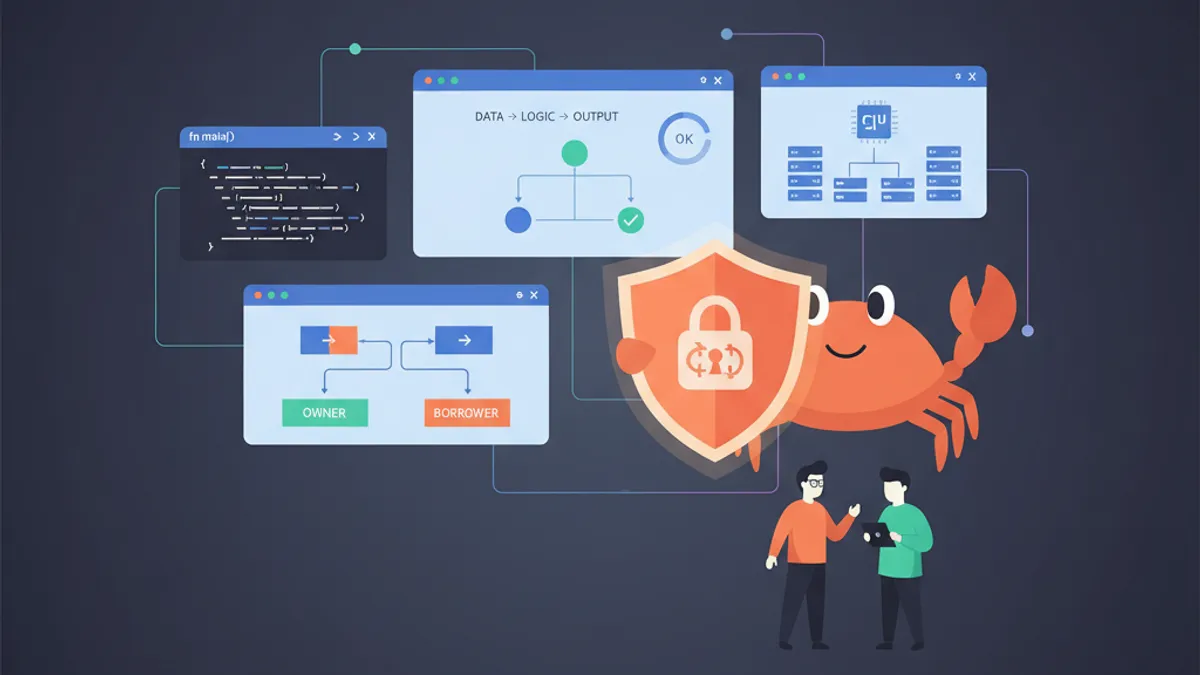
Rustの技術面接では、言語固有の所有権システム、ガベージコレクタを使用しないメモリ管理、安全な並行コードの記述能力が評価されます。本ガイドでは、所有権の基礎から高度なasync・並行処理パターンまで、必須の質問を網羅しています。
面接官はRustのメモリ安全性保証に対する理解を示す説明を重視します。コンパイラがコンパイル時にバグを防止する仕組みを説明できることが合否を分けます。
所有権と借用
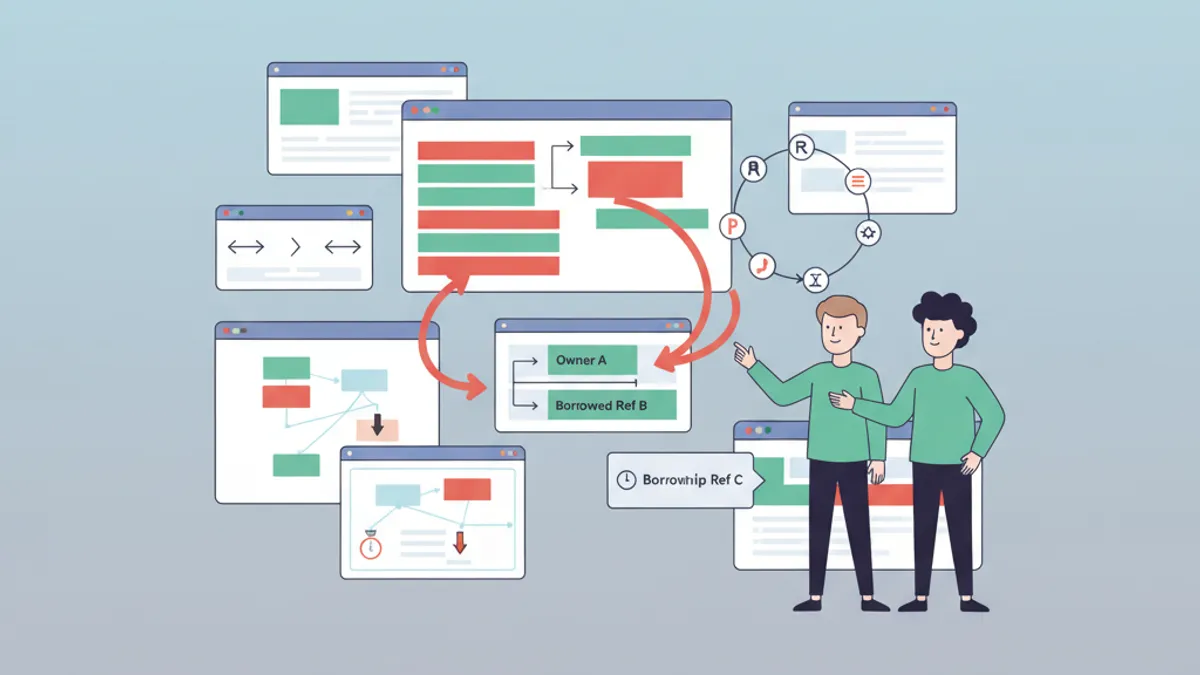
質問1:Rustの所有権システムについて説明してください
所有権はRustの中核概念であり、ガベージコレクタを使用せずにコンパイル時のメモリ安全性を保証するメモリ管理を実現します。
// The three fundamental rules of ownership

fn main() {
    // Rule 1: Each value has a single owner
    let s1 = String::from("hello");  // s1 is the owner

    // Rule 2: Only one variable can own a value at a time
    let s2 = s1;  // s1 is MOVED to s2
    // println!("{}", s1);  // ERROR: s1 is no longer valid
    println!("{}", s2);  // OK: s2 is now the owner

    // Rule 3: When the owner goes out of scope, the value is dropped
    {
        let s3 = String::from("world");
        // s3 is valid here
    }  // s3 goes out of scope, memory is automatically freed

    // Copy types: simple types are copied, not moved
    let x = 5;
    let y = x;  // x is COPIED, not moved
    println!("x = {}, y = {}", x, y);  // Both are valid
}

// Move in action with functions
fn take_ownership(s: String) {
    // s takes ownership of the String
    println!("{}", s);
}  // s is dropped here, memory freed

fn makes_copy(i: i32) {
    // i is a copy of the argument
    println!("{}", i);
}  // i goes out of scope, nothing special (Copy type)

fn ownership_with_functions() {
    let s = String::from("hello");
    take_ownership(s);  // s is moved into the function
    // println!("{}", s);  // ERROR: s is no longer valid

    let x = 5;
    makes_copy(x);  // x is copied
    println!("{}", x);  // OK: x is still valid
}
所有権により、use-after-free、double-free、メモリリークといった一般的なメモリバグが排除されます。コンパイラがこれらの特性をコンパイル時に保証します。
質問2:不変借用と可変借用の違いは何ですか
借用は所有権を取得せずに値を使用する仕組みであり、データ競合を防ぐための厳格なルールがあります。
// Immutable and mutable references

fn main() {
    let mut s = String::from("hello");

    // IMMUTABLE REFERENCES (&T)
    // Can coexist in unlimited numbers
    let r1 = &s;  // immutable reference
    let r2 = &s;  // another immutable reference
    println!("{} and {}", r1, r2);  // OK

    // MUTABLE REFERENCE (&mut T)
    // Only one at a time, and no simultaneous immutable references
    let r3 = &mut s;  // mutable reference
    // let r4 = &s;  // ERROR: cannot have both immutable and mutable
    // let r5 = &mut s;  // ERROR: only one mutable reference allowed
    r3.push_str(" world");
    println!("{}", r3);

    // Reference scopes are limited to their last use
    let r6 = &s;  // OK because r3 is no longer used
    println!("{}", r6);
}

// Practical example: modifying a struct
struct User {
    name: String,
    age: u32,
}

impl User {
    // &self: read-only access
    fn get_name(&self) -> &str {
        &self.name
    }

    // &mut self: modification access
    fn set_name(&mut self, name: String) {
        self.name = name;
    }

    // self: takes ownership (consumes the instance)
    fn into_name(self) -> String {
        self.name  // The User instance no longer exists after this
    }
}

fn borrowing_with_structs() {
    let mut user = User {
        name: String::from("Alice"),
        age: 30,
    };

    // Reading
    println!("Name: {}", user.get_name());

    // Modifying
    user.set_name(String::from("Bob"));

    // Consuming
    let name = user.into_name();
    // user.age;  // ERROR: user has been consumed
}
これらのルールにより、コンパイル時にデータ競合の不在が保証されます。パフォーマンスを犠牲にせずにこの保証を提供する言語は他にありません。
Rust 2018以降、コンパイラはNLL(Non-Lexical Lifetimes)を使用して参照が使用されなくなるタイミングをより正確に判定し、柔軟性が向上しています。
質問3:ライフタイムとは何か、いつアノテーションが必要ですか
ライフタイムは参照の有効期間をコンパイラに伝えるアノテーションであり、ダングリング参照を防止します。
// Understanding and annotating lifetimes

// ERROR: dangling reference
// fn dangling() -> &String {
//     let s = String::from("hello");
//     &s  // s is dropped at function end, reference invalid
// }

// The compiler often infers lifetimes automatically
fn first_word(s: &str) -> &str {
    // Elided lifetime: compiler understands the return
    // has the same lifetime as the input
    match s.find(' ') {
        Some(i) => &s[..i],
        None => s,
    }
}

// Explicit annotation needed with multiple references
fn longest<'a>(x: &'a str, y: &'a str) -> &'a str {
    // 'a means: the return lives at least as long
    // as the shorter of the two inputs
    if x.len() > y.len() { x } else { y }
}

fn lifetime_example() {
    let string1 = String::from("long string");
    let result;

    {
        let string2 = String::from("xyz");
        result = longest(&string1, &string2);
        println!("Longest: {}", result);  // OK here
    }
    // println!("{}", result);  // ERROR: string2 is dropped
}

// Lifetimes in structs
struct ImportantExcerpt<'a> {
    part: &'a str,  // Struct cannot outlive part
}

impl<'a> ImportantExcerpt<'a> {
    // Method returning a reference with the same lifetime
    fn level(&self) -> i32 {
        3
    }

    // Elided lifetime for &self returning a new reference
    fn announce_and_return_part(&self, announcement: &str) -> &str {
        println!("Attention: {}", announcement);
        self.part  // Returns with lifetime 'a
    }
}

// Static lifetime: lives for the entire program duration
fn static_lifetime() {
    let s: &'static str = "hello";  // Stored in the binary

    // Constants have implicit 'static lifetime
    const MAX_POINTS: u32 = 100_000;
}

// Combining lifetimes and generics
fn longest_with_announcement<'a, T>(
    x: &'a str,
    y: &'a str,
    ann: T,
) -> &'a str
where
    T: std::fmt::Display,
{
    println!("Announcement: {}", ann);
    if x.len() > y.len() { x } else { y }
}
ライフタイムはコンパイル時に検証されます。コードがコンパイルされれば、参照の有効性が保証されます。
トレイトとジェネリクス
質問4:Rustのトレイトはどのように機能しますか
トレイトは異なる型間で共有される振る舞いを定義するもので、インターフェースに類似しつつ追加機能を持ちます。
// Defining and implementing traits

// Trait definition
trait Summary {
    // Required method (no body)
    fn summarize(&self) -> String;

    // Method with default implementation
    fn summarize_author(&self) -> String {
        String::from("(Anonymous)")
    }

    // Default method that calls a required method
    fn full_summary(&self) -> String {
        format!("By {} - {}", self.summarize_author(), self.summarize())
    }
}

// Implementation for different types
struct NewsArticle {
    headline: String,
    location: String,
    author: String,
    content: String,
}

impl Summary for NewsArticle {
    fn summarize(&self) -> String {
        format!("{}, by {} ({})", self.headline, self.author, self.location)
    }

    fn summarize_author(&self) -> String {
        format!("@{}", self.author)
    }
}

struct Tweet {
    username: String,
    content: String,
    reply: bool,
    retweet: bool,
}

impl Summary for Tweet {
    fn summarize(&self) -> String {
        format!("{}: {}", self.username, self.content)
    }
}

// Trait bounds: constraining generics
fn notify<T: Summary>(item: &T) {
    println!("Breaking news! {}", item.summarize());
}

// Alternative syntax with where
fn notify_verbose<T>(item: &T)
where
    T: Summary,
{
    println!("Breaking news! {}", item.summarize());
}

// Multiple trait bounds
fn notify_complex<T: Summary + Clone + std::fmt::Display>(item: &T) {
    println!("{}", item);
}

// Return a type that implements a trait
fn create_summarizable() -> impl Summary {
    Tweet {
        username: String::from("rust_lang"),
        content: String::from("Rust 2026 is amazing!"),
        reply: false,
        retweet: false,
    }
}
トレイトはクラス継承を用いずにポリモーフィズムを実現し、継承よりもコンポジションを重視します。
質問5:静的ディスパッチと動的ディスパッチの違いを説明してください
Rustはポリモーフィズムに対して、モノモーフィゼーション(静的)とトレイトオブジェクト(動的)の2つのアプローチを提供しています。
// Static vs dynamic dispatch

trait Animal {
    fn speak(&self) -> String;
    fn name(&self) -> &str;
}

struct Dog { name: String }
struct Cat { name: String }

impl Animal for Dog {
    fn speak(&self) -> String { String::from("Woof!") }
    fn name(&self) -> &str { &self.name }
}

impl Animal for Cat {
    fn speak(&self) -> String { String::from("Meow!") }
    fn name(&self) -> &str { &self.name }
}

// STATIC DISPATCH (monomorphization)
// Compiler generates a version for each concrete type
fn make_speak_static<T: Animal>(animal: &T) {
    // At compile time, becomes make_speak_Dog and make_speak_Cat
    println!("{} says {}", animal.name(), animal.speak());
}

// Advantages: inlining possible, no runtime overhead
// Disadvantages: larger binary, type must be known at compile time

// DYNAMIC DISPATCH (trait objects)
// Uses a vtable to resolve methods at runtime
fn make_speak_dynamic(animal: &dyn Animal) {
    // Resolved via a pointer table (vtable) at runtime
    println!("{} says {}", animal.name(), animal.speak());
}

// Advantages: can store different types, smaller binary
// Disadvantages: indirection overhead, no inlining

fn main() {
    let dog = Dog { name: String::from("Rex") };
    let cat = Cat { name: String::from("Whiskers") };

    // Static: type is known at compile time
    make_speak_static(&dog);
    make_speak_static(&cat);

    // Dynamic: type is resolved at runtime
    make_speak_dynamic(&dog);
    make_speak_dynamic(&cat);

    // Heterogeneous collection (requires dynamic dispatch)
    let animals: Vec<Box<dyn Animal>> = vec![
        Box::new(Dog { name: String::from("Buddy") }),
        Box::new(Cat { name: String::from("Luna") }),
    ];

    for animal in animals.iter() {
        println!("{} says {}", animal.name(), animal.speak());
    }
}

// Object safety: not all traits can become trait objects
trait ObjectSafe {
    fn method(&self);
    // No Self in return type
    // No generic parameters
}

// NOT object safe (cannot be dyn NotObjectSafe)
trait NotObjectSafe {
    fn create() -> Self;  // Self in return
    fn generic<T>(&self, t: T);  // Generic
}
パフォーマンスを重視する場合は静的ディスパッチが適しています。異種コレクションや柔軟性が必要な場合は動的ディスパッチが有用です。
Rustの面接対策はできていますか?
インタラクティブなシミュレーター、flashcards、技術テストで練習しましょう。
エラーハンドリング
質問6:ResultとOptionによるエラー処理の方法は
Rustには例外がありません。エラー処理はResult<T, E>とOption<T>型をパターンマッチングで行います。
// Idiomatic error handling in Rust

use std::fs::File;
use std::io::{self, Read};

// Option<T>: presence or absence of a value
fn find_user(id: u32) -> Option<String> {
    match id {
        1 => Some(String::from("Alice")),
        2 => Some(String::from("Bob")),
        _ => None,  // No user found
    }
}

// Result<T, E>: success or error
fn divide(a: f64, b: f64) -> Result<f64, String> {
    if b == 0.0 {
        Err(String::from("Division by zero"))
    } else {
        Ok(a / b)
    }
}

fn option_combinators() {
    let user = find_user(1);

    // Pattern matching
    match user {
        Some(name) => println!("Found: {}", name),
        None => println!("Not found"),
    }

    // unwrap_or: default value
    let name = find_user(99).unwrap_or(String::from("Unknown"));

    // map: transform the value if present
    let upper = find_user(1).map(|n| n.to_uppercase());

    // and_then (flatMap): chain Options
    let first_char = find_user(1).and_then(|n| n.chars().next());

    // if let: simplified pattern matching
    if let Some(name) = find_user(2) {
        println!("User 2 is {}", name);
    }
}

fn result_handling() -> Result<(), Box<dyn std::error::Error>> {
    // The ? operator propagates errors automatically
    let result = divide(10.0, 2.0)?;
    println!("Result: {}", result);

    // Equivalent to:
    // let result = match divide(10.0, 2.0) {
    //     Ok(v) => v,
    //     Err(e) => return Err(e.into()),
    // };

    Ok(())
}

// File reading with error propagation
fn read_file_contents(path: &str) -> Result<String, io::Error> {
    let mut file = File::open(path)?;  // Propagates error if failure
    let mut contents = String::new();
    file.read_to_string(&mut contents)?;
    Ok(contents)
}

// Custom errors
#[derive(Debug)]
enum AppError {
    IoError(io::Error),
    ParseError(String),
    NotFound(String),
}

impl std::fmt::Display for AppError {
    fn fmt(&self, f: &mut std::fmt::Formatter) -> std::fmt::Result {
        match self {
            AppError::IoError(e) => write!(f, "IO error: {}", e),
            AppError::ParseError(s) => write!(f, "Parse error: {}", s),
            AppError::NotFound(s) => write!(f, "Not found: {}", s),
        }
    }
}

impl std::error::Error for AppError {}

// Automatic conversion with From
impl From<io::Error> for AppError {
    fn from(error: io::Error) -> Self {
        AppError::IoError(error)
    }
}

fn complex_operation() -> Result<String, AppError> {
    let contents = std::fs::read_to_string("config.txt")?;  // Auto-convert

    if contents.is_empty() {
        return Err(AppError::NotFound(String::from("Config is empty")));
    }

    Ok(contents)
}?演算子によりコードが簡潔になりつつ、明示的なエラー処理が強制されます。実行時に予期しないエラーが発生することはありません。
unwrap()とexpect()はNoneまたはErrの場合にパニックを起こします。プロトタイピングや失敗が不可能な場合にのみ使用してください。本番環境では?によるプロパゲーションまたはコンビネータの使用が推奨されます。
質問7:thiserrorを使ったカスタムエラーの作成方法は
thiserrorクレートはエルゴノミックなカスタムエラーの作成を簡素化します。
// Custom errors with thiserror

use thiserror::Error;

// Error definition with derive macro
#[derive(Error, Debug)]
pub enum DataStoreError {
    #[error("connection failed: {0}")]
    ConnectionFailed(String),

    #[error("query failed: {query}")]
    QueryFailed { query: String, source: std::io::Error },

    #[error("record not found: id={id}")]
    NotFound { id: u64 },

    #[error("invalid data: {0}")]
    InvalidData(#[from] serde_json::Error),

    #[error(transparent)]  // Delegates Display to source
    Other(#[from] anyhow::Error),
}

// Implementation with rich context
pub struct DataStore {
    connection_string: String,
}

impl DataStore {
    pub fn connect(conn_str: &str) -> Result<Self, DataStoreError> {
        if conn_str.is_empty() {
            return Err(DataStoreError::ConnectionFailed(
                "Empty connection string".into()
            ));
        }
        Ok(Self { connection_string: conn_str.to_string() })
    }

    pub fn get_record(&self, id: u64) -> Result<Record, DataStoreError> {
        // Query simulation
        if id == 0 {
            return Err(DataStoreError::NotFound { id });
        }
        Ok(Record { id, data: format!("Record {}", id) })
    }
}

pub struct Record {
    pub id: u64,
    pub data: String,
}

// Usage with anyhow for applications
use anyhow::{Context, Result};

fn application_code() -> Result<()> {
    let store = DataStore::connect("postgres://localhost/db")
        .context("Failed to connect to database")?;

    let record = store.get_record(42)
        .context("Failed to fetch user record")?;

    println!("Got: {}", record.data);
    Ok(())
}

// Pattern: converting errors with context
fn read_config() -> Result<Config> {
    let contents = std::fs::read_to_string("config.toml")
        .context("Failed to read config file")?;

    let config: Config = toml::from_str(&contents)
        .context("Failed to parse config file")?;

    Ok(config)
}

#[derive(Debug)]
struct Config {
    // ...
}thiserrorはライブラリ向け(型付きエラー)に最適であり、anyhowはアプリケーション向け(最大限の柔軟性)に適しています。
スマートポインタ
質問8:Box、Rc、Arc、RefCellについて説明してください
スマートポインタはヒープメモリを管理し、単純な所有権では実現できないパターンを可能にします。
// Main smart pointers in Rust

use std::rc::Rc;
use std::sync::Arc;
use std::cell::RefCell;

// BOX<T>: heap allocation
// Used for: recursive types, large types, trait objects
fn box_example() {
    // Simple heap allocation
    let b = Box::new(5);
    println!("b = {}", b);

    // Recursive type (impossible without Box)
    #[derive(Debug)]
    enum List {
        Cons(i32, Box<List>),
        Nil,
    }

    let list = List::Cons(1,
        Box::new(List::Cons(2,
            Box::new(List::Cons(3,
                Box::new(List::Nil))))));
    println!("{:?}", list);
}

// RC<T>: Reference Counting (single-threaded)
// Multiple owners for the same data
fn rc_example() {
    let data = Rc::new(vec![1, 2, 3]);

    // Clone increments the reference counter
    let data_clone1 = Rc::clone(&data);  // count = 2
    let data_clone2 = Rc::clone(&data);  // count = 3

    println!("Reference count: {}", Rc::strong_count(&data));  // 3

    // Each clone can read the data
    println!("data_clone1: {:?}", data_clone1);

    // Data is freed when the last Rc is dropped
}

// ARC<T>: Atomic Reference Counting (thread-safe)
// Like Rc but usable across threads
fn arc_example() {
    use std::thread;

    let data = Arc::new(vec![1, 2, 3, 4, 5]);
    let mut handles = vec![];

    for i in 0..3 {
        let data_clone = Arc::clone(&data);
        let handle = thread::spawn(move || {
            // Each thread has its own Arc
            println!("Thread {}: {:?}", i, data_clone);
        });
        handles.push(handle);
    }

    for handle in handles {
        handle.join().unwrap();
    }
}

// REFCELL<T>: Interior Mutability
// Allows mutation even with an immutable reference
fn refcell_example() {
    let data = RefCell::new(5);

    // borrow() returns an immutable reference
    println!("Value: {}", *data.borrow());

    // borrow_mut() returns a mutable reference
    *data.borrow_mut() += 1;
    println!("After mutation: {}", *data.borrow());

    // Borrowing rules are checked at RUNTIME
    // Panics if rules are violated
    // let r1 = data.borrow();
    // let r2 = data.borrow_mut();  // PANIC: already borrowed
}

// Common combination: Rc<RefCell<T>>
// Multiple owners with possible mutation
fn rc_refcell_example() {
    #[derive(Debug)]
    struct Node {
        value: i32,
        children: Vec<Rc<RefCell<Node>>>,
    }

    let node1 = Rc::new(RefCell::new(Node {
        value: 1,
        children: vec![],
    }));

    let node2 = Rc::new(RefCell::new(Node {
        value: 2,
        children: vec![Rc::clone(&node1)],  // node1 is child of node2
    }));

    // Modify node1 from anywhere
    node1.borrow_mut().value = 10;

    println!("node2 child value: {}",
        node2.borrow().children[0].borrow().value);  // 10
}

// For threads: Arc<Mutex<T>> or Arc<RwLock<T>>
fn arc_mutex_example() {
    use std::sync::Mutex;
    use std::thread;

    let counter = Arc::new(Mutex::new(0));
    let mut handles = vec![];

    for _ in 0..10 {
        let counter = Arc::clone(&counter);
        let handle = thread::spawn(move || {
            let mut num = counter.lock().unwrap();
            *num += 1;
        });
        handles.push(handle);
    }

    for handle in handles {
        handle.join().unwrap();
    }

    println!("Final count: {}", *counter.lock().unwrap());  // 10
}状況に応じて適切なスマートポインタを選択します。単純なヒープ割り当てにはBox、共有にはRc/Arc、内部可変性にはRefCell/Mutexが適しています。
並行処理
質問9:Rustはどのようにスレッド安全性を保証しますか
Rustの型システムはSendトレイトとSyncトレイトを通じて、コンパイル時にデータ競合を防止します。
// Concurrent safety guarantees

use std::thread;
use std::sync::{Arc, Mutex, mpsc};

// SEND: a type can be transferred to another thread
// SYNC: a type can be shared between threads via references

// Most types are Send and Sync automatically
// Exceptions: Rc (not Send/Sync), RefCell (not Sync), raw pointers

fn send_example() {
    let data = vec![1, 2, 3];

    // Vec is Send, so it can be moved to another thread
    let handle = thread::spawn(move || {
        println!("Data in thread: {:?}", data);
    });

    handle.join().unwrap();
}

// The compiler prevents concurrency errors
fn compile_time_safety() {
    // This would NOT compile:
    // let data = std::rc::Rc::new(5);
    // thread::spawn(move || {
    //     println!("{}", data);  // ERROR: Rc is not Send
    // });

    // Solution: use Arc
    let data = Arc::new(5);
    let data_clone = Arc::clone(&data);

    thread::spawn(move || {
        println!("{}", data_clone);  // OK: Arc is Send
    });
}

// Mutex for thread-safe shared mutation
fn mutex_pattern() {
    let counter = Arc::new(Mutex::new(0));
    let mut handles = vec![];

    for _ in 0..10 {
        let counter = Arc::clone(&counter);
        let handle = thread::spawn(move || {
            // lock() blocks until exclusive access is obtained
            let mut num = counter.lock().unwrap();
            *num += 1;
            // MutexGuard is dropped here, releasing the lock
        });
        handles.push(handle);
    }

    for handle in handles {
        handle.join().unwrap();
    }

    println!("Result: {}", *counter.lock().unwrap());
}

// RwLock for multiple reads / exclusive write
fn rwlock_example() {
    use std::sync::RwLock;

    let data = Arc::new(RwLock::new(vec![1, 2, 3]));
    let mut handles = vec![];

    // Multiple simultaneous readers
    for i in 0..3 {
        let data = Arc::clone(&data);
        handles.push(thread::spawn(move || {
            let read = data.read().unwrap();
            println!("Reader {}: {:?}", i, *read);
        }));
    }

    // Only one writer at a time
    {
        let data = Arc::clone(&data);
        handles.push(thread::spawn(move || {
            let mut write = data.write().unwrap();
            write.push(4);
            println!("Writer added 4");
        }));
    }

    for handle in handles {
        handle.join().unwrap();
    }
}

// Channels for inter-thread communication
fn channel_example() {
    let (tx, rx) = mpsc::channel();  // Multi-producer, single-consumer

    // Clone the sender for multiple producers
    let tx1 = tx.clone();
    thread::spawn(move || {
        tx1.send("from thread 1").unwrap();
    });

    thread::spawn(move || {
        tx.send("from thread 2").unwrap();
    });

    // Receive messages
    for received in rx {
        println!("Got: {}", received);
    }
}
「恐れのない並行処理」:コードがコンパイルされれば、データ競合は存在しません。コンパイラが最初の防御線となります。
スレッドがMutexを保持した状態でパニックすると、Mutexは「ポイズン」状態になります。その後のlock()呼び出しはエラーを返しますが、into_inner()で回復できます。
質問10:Rustのasync/awaitはどのように機能しますか
Rustの非同期処理はゼロコストFutureに基づいており、言語にランタイムが組み込まれていません。
// Asynchronous programming in Rust

use tokio::time::{sleep, Duration};

// async fn returns a Future that must be executed
async fn fetch_data(url: &str) -> Result<String, reqwest::Error> {
    // await suspends execution without blocking the thread
    let response = reqwest::get(url).await?;
    let body = response.text().await?;
    Ok(body)
}

// Futures are lazy: nothing executes without await or poll
async fn lazy_example() {
    let future = async {
        println!("This won't print yet");
    };
    // Nothing happened

    future.await;  // Now it executes
}

// Parallel execution of futures
async fn parallel_execution() {
    // join! executes multiple futures in parallel
    let (result1, result2) = tokio::join!(
        fetch_data("https://api.example.com/1"),
        fetch_data("https://api.example.com/2"),
    );

    println!("Results: {:?}, {:?}", result1, result2);
}

// select! for the first completed future
async fn race_example() {
    tokio::select! {
        result = fetch_data("https://api1.example.com") => {
            println!("API 1 responded first: {:?}", result);
        }
        result = fetch_data("https://api2.example.com") => {
            println!("API 2 responded first: {:?}", result);
        }
        _ = sleep(Duration::from_secs(5)) => {
            println!("Timeout!");
        }
    }
}

// Streams: asynchronous iterators
use tokio_stream::StreamExt;

async fn stream_example() {
    let mut stream = tokio_stream::iter(vec![1, 2, 3, 4, 5]);

    while let Some(value) = stream.next().await {
        println!("Got: {}", value);
    }
}

// Spawn for background tasks
async fn spawn_tasks() {
    let handle = tokio::spawn(async {
        sleep(Duration::from_secs(1)).await;
        "Task completed"
    });

    println!("Task spawned, doing other work...");

    let result = handle.await.unwrap();
    println!("Result: {}", result);
}

// Entry point with tokio
#[tokio::main]
async fn main() {
    // The tokio runtime executes futures
    parallel_execution().await;
}

// Alternative: multi-threaded or single-threaded runtime
#[tokio::main(flavor = "current_thread")]
async fn main_single_thread() {
    // Everything runs on a single thread
}

#[tokio::main(flavor = "multi_thread", worker_threads = 4)]
async fn main_multi_thread() {
    // Pool of 4 worker threads
}
Rustの非同期処理は「ランタイムは自分で用意する」方式です。tokio、async-std、smolなど、ユースケースに応じた最適化が可能です。
Rustの面接対策はできていますか?
インタラクティブなシミュレーター、flashcards、技術テストで練習しましょう。
高度なパターン
質問11:RustにおけるBuilderパターンについて説明してください
Builderパターンは、多数のオプションフィールドを持つ複雑な構造体を構築するためのRustのイディオマティックなパターンです。
// Idiomatic Builder pattern in Rust

#[derive(Debug, Clone)]
pub struct Server {
    host: String,
    port: u16,
    max_connections: usize,
    timeout_seconds: u64,
    tls_enabled: bool,
    tls_cert_path: Option<String>,
}

// Builder with consuming approach (ownership)
#[derive(Default)]
pub struct ServerBuilder {
    host: String,
    port: u16,
    max_connections: usize,
    timeout_seconds: u64,
    tls_enabled: bool,
    tls_cert_path: Option<String>,
}

impl ServerBuilder {
    pub fn new() -> Self {
        Self {
            host: String::from("localhost"),
            port: 8080,
            max_connections: 100,
            timeout_seconds: 30,
            tls_enabled: false,
            tls_cert_path: None,
        }
    }

    // Each method takes self and returns Self for chaining
    pub fn host(mut self, host: impl Into<String>) -> Self {
        self.host = host.into();
        self
    }

    pub fn port(mut self, port: u16) -> Self {
        self.port = port;
        self
    }

    pub fn max_connections(mut self, max: usize) -> Self {
        self.max_connections = max;
        self
    }

    pub fn timeout(mut self, seconds: u64) -> Self {
        self.timeout_seconds = seconds;
        self
    }

    pub fn enable_tls(mut self, cert_path: impl Into<String>) -> Self {
        self.tls_enabled = true;
        self.tls_cert_path = Some(cert_path.into());
        self
    }

    // build() consumes the builder and creates the final structure
    pub fn build(self) -> Result<Server, String> {
        if self.tls_enabled && self.tls_cert_path.is_none() {
            return Err("TLS enabled but no certificate path provided".into());
        }

        Ok(Server {
            host: self.host,
            port: self.port,
            max_connections: self.max_connections,
            timeout_seconds: self.timeout_seconds,
            tls_enabled: self.tls_enabled,
            tls_cert_path: self.tls_cert_path,
        })
    }
}

// Fluent usage
fn create_server() -> Result<Server, String> {
    ServerBuilder::new()
        .host("0.0.0.0")
        .port(443)
        .max_connections(1000)
        .timeout(60)
        .enable_tls("/etc/ssl/cert.pem")
        .build()
}

// Alternative with derive macro (typed-builder crate)
// #[derive(TypedBuilder)]
// pub struct Config {
//     #[builder(default = "localhost".to_string())]
//     host: String,
//     #[builder(default = 8080)]
//     port: u16,
// }

// Pattern with type-level validation (typestate pattern)
pub struct Unvalidated;
pub struct Validated;

pub struct Request<State = Unvalidated> {
    url: String,
    method: String,
    headers: Vec<(String, String)>,
    _state: std::marker::PhantomData<State>,
}

impl Request<Unvalidated> {
    pub fn new(url: &str) -> Self {
        Self {
            url: url.to_string(),
            method: "GET".to_string(),
            headers: vec![],
            _state: std::marker::PhantomData,
        }
    }

    pub fn method(mut self, method: &str) -> Self {
        self.method = method.to_string();
        self
    }

    // validate() changes the state type
    pub fn validate(self) -> Result<Request<Validated>, String> {
        if self.url.is_empty() {
            return Err("URL cannot be empty".into());
        }
        Ok(Request {
            url: self.url,
            method: self.method,
            headers: self.headers,
            _state: std::marker::PhantomData,
        })
    }
}

impl Request<Validated> {
    // send() is only available on validated requests
    pub async fn send(self) -> Result<Response, reqwest::Error> {
        // Implementation...
        todo!()
    }
}

struct Response;
Typestateパターンにより、特定の操作が正しい状態でのみ呼び出されることがコンパイル時に保証されます。
質問12:外部型にトレイトを実装する方法は
「オーファンルール」は外部トレイトを外部型に実装することを禁止していますが、回避策が存在します。
// The Newtype pattern to work around the orphan rule

use std::fmt;

// ORPHAN RULE: cannot implement Display (std) for Vec (std)
// impl fmt::Display for Vec<i32> { ... }  // ERROR

// SOLUTION 1: Newtype wrapper
struct Wrapper(Vec<String>);

impl fmt::Display for Wrapper {
    fn fmt(&self, f: &mut fmt::Formatter) -> fmt::Result {
        write!(f, "[{}]", self.0.join(", "))
    }
}

fn newtype_example() {
    let w = Wrapper(vec![
        String::from("hello"),
        String::from("world"),
    ]);
    println!("{}", w);  // [hello, world]
}

// Transparent access with Deref
use std::ops::Deref;

impl Deref for Wrapper {
    type Target = Vec<String>;

    fn deref(&self) -> &Self::Target {
        &self.0
    }
}

fn deref_example() {
    let w = Wrapper(vec![String::from("test")]);
    println!("Length: {}", w.len());  // Calls Vec::len via Deref
}

// SOLUTION 2: Extension trait (to add methods)
trait VecExt<T> {
    fn first_or_default(&self) -> Option<&T>;
}

impl<T> VecExt<T> for Vec<T> {
    fn first_or_default(&self) -> Option<&T> {
        self.first()
    }
}

fn extension_trait_example() {
    let v = vec![1, 2, 3];
    println!("First: {:?}", v.first_or_default());
}

// Newtype with domain semantics
#[derive(Debug, Clone, PartialEq, Eq, Hash)]
struct Email(String);

impl Email {
    pub fn new(email: &str) -> Result<Self, &'static str> {
        if email.contains('@') && email.contains('.') {
            Ok(Self(email.to_string()))
        } else {
            Err("Invalid email format")
        }
    }

    pub fn as_str(&self) -> &str {
        &self.0
    }
}

impl fmt::Display for Email {
    fn fmt(&self, f: &mut fmt::Formatter) -> fmt::Result {
        write!(f, "{}", self.0)
    }
}

#[derive(Debug, Clone, PartialEq, Eq, PartialOrd, Ord)]
struct UserId(u64);

impl UserId {
    pub fn new(id: u64) -> Self {
        Self(id)
    }
}

// Newtypes add type safety without runtime overhead
fn process_user(id: UserId, email: Email) {
    println!("Processing user {} with email {}", id.0, email);
}

fn type_safety_example() {
    let id = UserId::new(42);
    let email = Email::new("user@example.com").unwrap();

    process_user(id, email);

    // This would not compile:
    // process_user(email, id);  // Types reversed
    // process_user(UserId::new(42), "string");  // String instead of Email
}
Newtypeはメモリ表現の同一性保証により、実行時コストがゼロです。
質問13:手続き型マクロの使い方は
手続き型マクロはコンパイル時にコードを生成する機能であり、カスタムderive等で利用されます。
// Understanding procedural macros

// Proc macros are defined in a separate crate with proc-macro = true

// Crate: my_derive (Cargo.toml: proc-macro = true)
use proc_macro::TokenStream;
use quote::quote;
use syn::{parse_macro_input, DeriveInput};

// DERIVE MACRO: #[derive(MyTrait)]
#[proc_macro_derive(MyDebug)]
pub fn my_debug_derive(input: TokenStream) -> TokenStream {
    // Parse input as a type definition
    let input = parse_macro_input!(input as DeriveInput);
    let name = input.ident;

    // Generate implementation code
    let expanded = quote! {
        impl std::fmt::Debug for #name {
            fn fmt(&self, f: &mut std::fmt::Formatter) -> std::fmt::Result {
                write!(f, stringify!(#name))
            }
        }
    };

    TokenStream::from(expanded)
}

// ATTRIBUTE MACRO: #[my_attribute]
#[proc_macro_attribute]
pub fn route(attr: TokenStream, item: TokenStream) -> TokenStream {
    // attr contains the attribute arguments
    // item contains the annotated element (function, struct, etc.)

    let method_path = attr.to_string();  // "GET, /users"
    let input = parse_macro_input!(item as syn::ItemFn);
    let fn_name = &input.sig.ident;

    let expanded = quote! {
        #input

        // Additionally generated code
        fn register_#fn_name() {
            println!("Registered route: {}", #method_path);
        }
    };

    TokenStream::from(expanded)
}

// FUNCTION-LIKE MACRO: my_macro!(...)
#[proc_macro]
pub fn make_answer(_input: TokenStream) -> TokenStream {
    "fn answer() -> u32 { 42 }".parse().unwrap()
}

// --- Usage in client code ---

// Derive macro
#[derive(MyDebug)]
struct Point {
    x: i32,
    y: i32,
}

// Attribute macro
#[route("GET", "/users")]
fn get_users() -> Vec<User> {
    vec![]
}

// Function-like macro
make_answer!();  // Generates fn answer() -> u32 { 42 }

fn main() {
    let p = Point { x: 1, y: 2 };
    println!("{:?}", p);  // Uses our MyDebug

    println!("Answer: {}", answer());  // 42
}

struct User;
手続き型マクロは繰り返しコードに対して強力な機能を発揮します。シリアライゼーション、Webルーティング、バリデーションなどが典型的な用途です。
メモリ安全性とunsafe
質問14:unsafeを使用するタイミングと方法は
unsafeブロックは低レベルコードに対してコンパイラの特定のチェックをバイパスすることを許可します。
// Understanding unsafe and its guarantees

// The 5 superpowers of unsafe:
// 1. Dereference raw pointers
// 2. Call unsafe functions
// 3. Access/modify mutable static variables
// 4. Implement unsafe traits
// 5. Access union fields

// RAW POINTERS
fn raw_pointers() {
    let mut num = 5;

    // Creating raw pointers is safe
    let r1 = &num as *const i32;
    let r2 = &mut num as *mut i32;

    // Dereferencing requires unsafe
    unsafe {
        println!("r1 is: {}", *r1);
        *r2 = 10;
        println!("r2 is: {}", *r2);
    }
}

// UNSAFE FUNCTION
// The function guarantees safety IF preconditions are met
unsafe fn dangerous() {
    // Code that assumes the caller verified invariants
}

fn call_dangerous() {
    // Must be in an unsafe block
    unsafe {
        dangerous();
    }
}

// SAFE ABSTRACTION over unsafe code
fn split_at_mut(values: &mut [i32], mid: usize) -> (&mut [i32], &mut [i32]) {
    let len = values.len();
    let ptr = values.as_mut_ptr();

    assert!(mid <= len);  // Runtime check

    unsafe {
        // We know the two slices don't overlap
        (
            std::slice::from_raw_parts_mut(ptr, mid),
            std::slice::from_raw_parts_mut(ptr.add(mid), len - mid),
        )
    }
}

// FFI: calling C code
extern "C" {
    fn abs(input: i32) -> i32;
}

fn call_c_function() {
    unsafe {
        println!("Absolute value: {}", abs(-3));
    }
}

// Export a function for C
#[no_mangle]
pub extern "C" fn call_from_c() {
    println!("Called from C!");
}

// MUTABLE STATIC
static mut COUNTER: u32 = 0;

fn increment_counter() {
    unsafe {
        COUNTER += 1;
        println!("COUNTER: {}", COUNTER);
    }
}

// UNSAFE TRAIT
unsafe trait Dangerous {
    // Implementers guarantee invariants
}

unsafe impl Dangerous for i32 {
    // Implementer asserts respecting the trait's invariants
}

// Practical example: structure with internal pointer
pub struct MyVec<T> {
    ptr: *mut T,
    len: usize,
    capacity: usize,
}

impl<T> MyVec<T> {
    pub fn new() -> Self {
        Self {
            ptr: std::ptr::null_mut(),
            len: 0,
            capacity: 0,
        }
    }

    pub fn push(&mut self, value: T) {
        if self.len == self.capacity {
            self.grow();
        }

        unsafe {
            std::ptr::write(self.ptr.add(self.len), value);
        }
        self.len += 1;
    }

    fn grow(&mut self) {
        // Unsafe allocation/reallocation...
    }
}

impl<T> Drop for MyVec<T> {
    fn drop(&mut self) {
        unsafe {
            // Properly free memory
            for i in 0..self.len {
                std::ptr::drop_in_place(self.ptr.add(i));
            }
            if self.capacity > 0 {
                let layout = std::alloc::Layout::array::<T>(self.capacity).unwrap();
                std::alloc::dealloc(self.ptr as *mut u8, layout);
            }
        }
    }
}unsafeコードの範囲を最小化してください。unsafeコードは不変条件を保証する安全な抽象の中にカプセル化します。unsafeコードが周囲の安全なメモリを破壊してはなりません。
質問15:借用チェッカーはどのように機能しますか
借用チェッカーはRustコンパイラの中核であり、所有権と借用のルールを検証します。
// Understanding how the borrow checker works

fn borrow_checker_basics() {
    let mut v = vec![1, 2, 3];

    // RULE 1: Either multiple immutable references or one mutable
    let r1 = &v;
    let r2 = &v;
    println!("{:?} {:?}", r1, r2);  // OK: multiple immutable references

    // From here, r1 and r2 are no longer used (NLL)

    let r3 = &mut v;  // OK thanks to Non-Lexical Lifetimes
    r3.push(4);
}

// The borrow checker tracks lifetimes
fn lifetime_tracking() {
    let mut data = String::from("hello");

    let slice = &data[..];  // Immutable borrow starts
    // data.push_str(" world");  // ERROR: cannot mutate during borrow
    println!("{}", slice);  // Last use of slice

    data.push_str(" world");  // OK: borrow ended
}

// Common problems and solutions
mod common_patterns {
    // Problem: borrowing two mutable fields
    struct Data {
        field1: Vec<i32>,
        field2: Vec<i32>,
    }

    fn problem(data: &mut Data) {
        // This sometimes doesn't compile directly:
        // let f1 = &mut data.field1;
        // let f2 = &mut data.field2;

        // Solution: destructuring
        let Data { field1, field2 } = data;
        field1.push(1);
        field2.push(2);
    }

    // Problem: iterate and modify
    fn iterate_and_modify() {
        let mut v = vec![1, 2, 3, 4, 5];

        // Does not compile:
        // for &x in &v {
        //     if x % 2 == 0 {
        //         v.push(x * 2);  // ERROR: borrowed by iterator
        //     }
        // }

        // Solution 1: collect indices first
        let to_add: Vec<i32> = v.iter()
            .filter(|&&x| x % 2 == 0)
            .map(|&x| x * 2)
            .collect();
        v.extend(to_add);

        // Solution 2: use explicit indices
        let len = v.len();
        for i in 0..len {
            if v[i] % 2 == 0 {
                let new_val = v[i] * 2;
                v.push(new_val);
            }
        }
    }

    // Problem: self-referential struct
    // struct SelfRef {
    //     data: String,
    //     slice: &str,  // Reference to data - IMPOSSIBLE
    // }

    // Solution: use indices or crates like ouroboros
    struct SafeSelfRef {
        data: String,
        slice_start: usize,
        slice_end: usize,
    }

    impl SafeSelfRef {
        fn get_slice(&self) -> &str {
            &self.data[self.slice_start..self.slice_end]
        }
    }
}

// Patterns to work around limitations
mod workarounds {
    use std::cell::RefCell;

    // Interior mutability when borrow checker is too restrictive
    struct Graph {
        nodes: RefCell<Vec<Node>>,
    }

    struct Node {
        value: i32,
    }

    impl Graph {
        fn add_node(&self, value: i32) {
            // Mutation possible despite &self
            self.nodes.borrow_mut().push(Node { value });
        }

        fn get_node(&self, index: usize) -> Option<i32> {
            self.nodes.borrow().get(index).map(|n| n.value)
        }
    }
}
借用チェッカーは最初は制約が厳しく感じられますが、これらの制約により、他の言語で発生するバグのカテゴリ全体が排除されます。
まとめ
Rustの技術面接では、所有権システムの深い理解、メモリ安全性の保証、データ競合のない並行コードの記述能力が評価されます。これらの概念を習得することが、Rustの固有の利点を活用できる開発者を見分ける鍵となります。
面接準備チェックリスト
- 所有権、借用、3つの基本ルールの理解
- ライフタイムのアノテーションが必要なタイミングと方法の把握
- トレイトと静的・動的ディスパッチの違いの習得
- ResultとOptionによるイディオマティックなエラー処理
- 状況に応じた適切なスマートポインタの選択
- Arc、Mutex、チャネルを使った並行コードの記述
- async/awaitとtokio等のランタイムの理解
- unsafeの安全な使用タイミングと方法の把握
今すぐ練習を始めましょう!
面接シミュレーターと技術テストで知識をテストしましょう。
Rust面接の準備には、言語固有の所有権概念の練習が不可欠です。Exercismでの演習、個人プロジェクト、Rustエコシステムへの貢献が、最も要求の厳しい技術面接に向けた知識の定着に有効です。
Rust のバグを見つけられますか
実際のコード、隠れたバグ、1日1回。アカウントなしで試せます。

執筆
Anthony Fillion-MailletSharpSkill 創業者
10 年以上フルスタック開発に携わっています。SharpSkill を運営し、ここで公開される内容に責任を負っています。
2026年4月1日 更新
タグ
共有