Swift における Combine vs async/await:段階的な移行パターン
Swift で Combine から async/await への移行を進めるための完全ガイド:段階的な戦略、ブリッジングパターン、iOS コードベースにおけるパラダイムの共存。
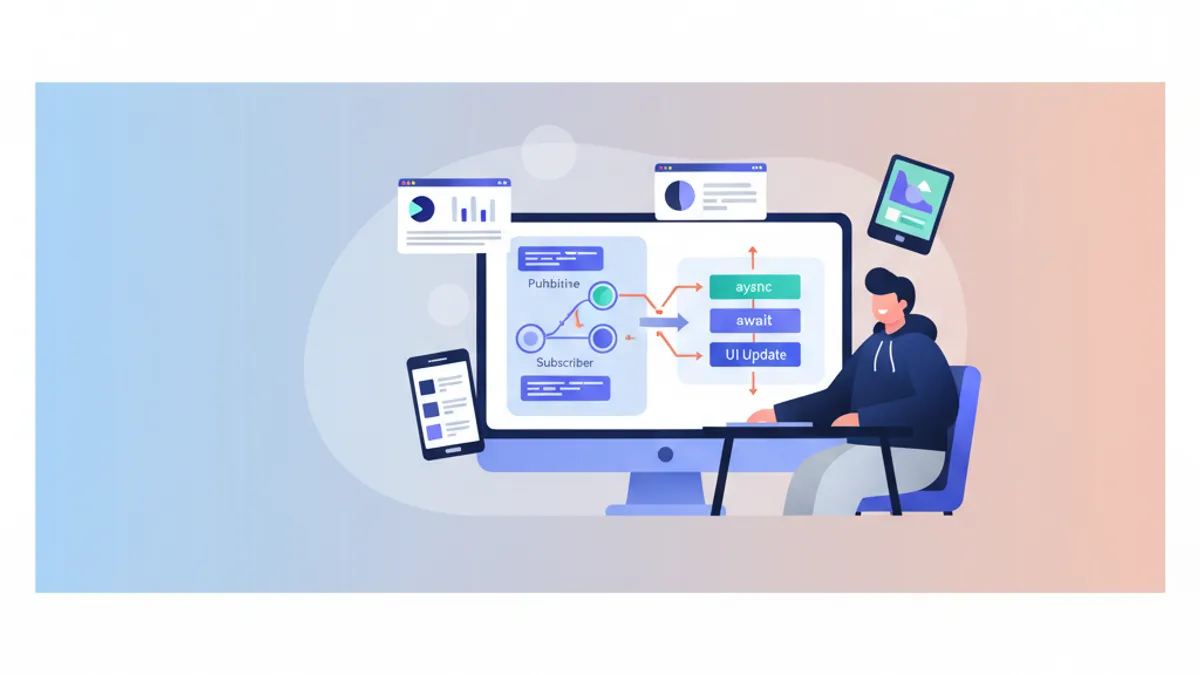
async/await を備えた Swift Concurrency の登場により、iOS における非同期プログラミングの実践が大きく変化しました。Combine を利用しているプロジェクトにとって、移行の問題は自然と浮上します。すべて書き直す必要があるのでしょうか。両方のアプローチは共存できるのでしょうか。スムーズな移行を可能にするパターンとは何でしょうか。本ガイドは段階的な移行戦略を探り、Combine を急に放棄することなく async/await を採用できるようにします。
本ガイドでは、Combine から async/await への段階的な移行のための具体的なパターンを、双方向ブリッジングの例と既存コードベースに適した共存戦略とともに紹介します。
根本的な違いを理解する
移行を始める前に、Combine と async/await の違いを理解することが不可欠です。これら二つのアプローチは異なるニーズに応えるものであり、いくつかのユースケースは引き続き Combine の方が適しています。
Combine のメンタルモデル
Combine はデータストリームのモデルに基づいています。Publisher が時間とともに値を放出し、オペレーターがそれらの値を変換し、Subscriber が最終結果を受け取ります。このモデルは UI イベント、通知、WebSocket のような連続的なストリームに優れています。
// Event stream with Combine - stream-based model
import Combine

class SearchViewModel {
    @Published var searchText = ""
    private var cancellables = Set<AnyCancellable>()

    // Combine excels for continuous streams with transformations
    func setupSearch() {
        $searchText
            // Wait 300ms pause in typing
            .debounce(for: .milliseconds(300), scheduler: RunLoop.main)
            // Ignore consecutive duplicates
            .removeDuplicates()
            // Filter searches that are too short
            .filter { $0.count >= 3 }
            // Transform text into network request
            .flatMap { query in
                self.searchAPI(query: query)
                    // Local error handling
                    .catch { _ in Just([]) }
            }
            // Final subscription
            .sink { results in
                self.updateUI(with: results)
            }
            .store(in: &cancellables)
    }

    private func searchAPI(query: String) -> AnyPublisher<[SearchResult], Error> {
        // Network implementation
    }
}
このコードは Combine の強みを示しています。すなわち、宣言的なオペレーターを連結して連続的なイベントストリームを処理することです。
async/await のメンタルモデル
async/await は逐次的なモデルを採用しています。操作が始まり、コードはその結果を待ち、その後継続します。このモデルは、独立したネットワーク要求やファイルの読み込みのような単発的な操作に対してより直感的です。
// One-off operations with async/await - sequential model
import Foundation

actor SearchService {
    // async/await excels for sequential operations
    func performSearch(query: String) async throws -> [SearchResult] {
        // Pre-validation - clear sequential reading
        guard query.count >= 3 else {
            return []
        }

        // Network request with await
        let url = URL(string: "https://api.example.com/search?q=\(query)")!
        let (data, response) = try await URLSession.shared.data(from: url)

        // Response verification
        guard let httpResponse = response as? HTTPURLResponse,
              httpResponse.statusCode == 200 else {
            throw SearchError.invalidResponse
        }

        // Result decoding
        let results = try JSONDecoder().decode([SearchResult].self, from: data)
        return results
    }
}
読み取りは線形であり、エラーは try によって自然に伝播し、実行の流れはすぐに理解できます。
Combine は連続的なストリーム(UI イベント、タイマー、WebSocket)に対して引き続き有効です。async/await は単発的な操作(API 要求、ファイル読み込み、独立した計算)により適しています。
Combine から async/await へのブリッジング
移行の最初のステップは、しばしば既存の Publisher を async/await のコードで消費することにあります。Swift はこのブリッジングのためにネイティブのツールを提供しています。
Publisher.values で AsyncSequence を使用する
Swift 5.5 以降、すべての Publisher は AsyncPublisher を返す .values プロパティを公開しています。この非同期シーケンスにより、放出された値を for await ループで反復処理できます。
// Publisher → AsyncSequence conversion via .values
import Combine

class NotificationObserver {
    private let notificationPublisher: AnyPublisher<Notification, Never>

    init() {
        // Existing Combine Publisher
        notificationPublisher = NotificationCenter.default
            .publisher(for: UIApplication.didBecomeActiveNotification)
            .eraseToAnyPublisher()
    }

    // Consuming the Publisher with async/await
    func observeNotifications() async {
        // .values converts the Publisher to AsyncSequence
        for await notification in notificationPublisher.values {
            // Process each notification
            await handleAppBecameActive(notification)
        }
        // This line is never reached for an infinite Publisher
    }

    private func handleAppBecameActive(_ notification: Notification) async {
        // Async processing logic
    }
}
このアプローチは元の Publisher を保持しつつ、非同期コンテキストでの消費を可能にします。
firstValue で単一の値を取得する
単一の値を放出する Publisher(ネットワーク要求のような)に対しては、.values.first(where:) プロパティやカスタムの拡張機能がブリッジングを簡素化します。
// Extension to extract a single value from a Publisher
import Combine

extension Publisher where Failure == Never {
    // Awaits and returns the first emitted value
    var firstValue: Output {
        get async {
            await withCheckedContinuation { continuation in
                var cancellable: AnyCancellable?
                cancellable = self.first()
                    .sink { value in
                        continuation.resume(returning: value)
                        cancellable?.cancel()
                    }
            }
        }
    }
}

extension Publisher {
    // Throwing version for Publishers with errors
    var firstValueThrowing: Output {
        get async throws {
            try await withCheckedThrowingContinuation { continuation in
                var cancellable: AnyCancellable?
                cancellable = self.first()
                    .sink(
                        receiveCompletion: { completion in
                            if case .failure(let error) = completion {
                                continuation.resume(throwing: error)
                            }
                            cancellable?.cancel()
                        },
                        receiveValue: { value in
                            continuation.resume(returning: value)
                        }
                    )
            }
        }
    }
}

// Usage in async code
class UserRepository {
    private let apiClient: APIClient

    func fetchCurrentUser() async throws -> User {
        // Consume an existing Publisher asynchronously
        try await apiClient.userPublisher().firstValueThrowing
    }
}
この拡張機能はブリッジングの複雑さをカプセル化し、クリーンな API を提供します。
iOSの面接対策はできていますか?
インタラクティブなシミュレーター、flashcards、技術テストで練習しましょう。
async/await から Combine へのブリッジング
逆方向の移行も同様に必要です。すなわち、既存の Combine パイプラインで async コードを消費することです。
async 関数から Publisher を作成する
最も直接的なアプローチは、async 呼び出しをカプセル化するために Future と Task を組み合わせて使用します。
// async → Publisher conversion via Future
import Combine

extension Publisher {
    // async flatMap operator for Combine pipelines
    func asyncMap<T>(
        _ transform: @escaping (Output) async throws -> T
    ) -> AnyPublisher<T, Error> {
        flatMap { value in
            Future { promise in
                Task {
                    do {
                        // Execute the async transformation
                        let result = try await transform(value)
                        promise(.success(result))
                    } catch {
                        promise(.failure(error))
                    }
                }
            }
        }
        .eraseToAnyPublisher()
    }
}

// Usage in a Combine pipeline
class ImageProcessor {
    @Published var selectedImageURL: URL?
    private var cancellables = Set<AnyCancellable>()

    func setupProcessingPipeline() {
        $selectedImageURL
            .compactMap { $0 }
            // Use an async function in the Combine pipeline
            .asyncMap { url in
                // downloadImage is an async function
                try await self.downloadImage(from: url)
            }
            .asyncMap { imageData in
                // processImage is also async
                try await self.processImage(imageData)
            }
            .receive(on: DispatchQueue.main)
            .sink(
                receiveCompletion: { completion in
                    if case .failure(let error) = completion {
                        print("Error: \(error)")
                    }
                },
                receiveValue: { processedImage in
                    self.displayImage(processedImage)
                }
            )
            .store(in: &cancellables)
    }

    private func downloadImage(from url: URL) async throws -> Data {
        let (data, _) = try await URLSession.shared.data(from: url)
        return data
    }

    private func processImage(_ data: Data) async throws -> UIImage {
        // Async image processing
    }
}
Async ストリーム用のカスタム Publisher
より高度なニーズには、カスタム Publisher が完全な AsyncSequence ストリームをカプセル化できます。
// Publisher wrapper for AsyncSequence
import Combine

struct AsyncSequencePublisher<S: AsyncSequence>: Publisher {
    typealias Output = S.Element
    typealias Failure = Error

    private let sequence: S

    init(_ sequence: S) {
        self.sequence = sequence
    }

    func receive<Sub>(subscriber: Sub) where Sub: Subscriber,
                                              Failure == Sub.Failure,
                                              Output == Sub.Input {
        let subscription = AsyncSubscription(
            sequence: sequence,
            subscriber: subscriber
        )
        subscriber.receive(subscription: subscription)
    }
}

private final class AsyncSubscription<S: AsyncSequence, Sub: Subscriber>: Subscription
where Sub.Input == S.Element, Sub.Failure == Error {

    private var task: Task<Void, Never>?
    private var subscriber: Sub?
    private let sequence: S

    init(sequence: S, subscriber: Sub) {
        self.sequence = sequence
        self.subscriber = subscriber
    }

    func request(_ demand: Subscribers.Demand) {
        // Start asynchronous iteration
        task = Task {
            do {
                for try await element in sequence {
                    // Check subscription is still active
                    guard subscriber != nil else { break }
                    _ = subscriber?.receive(element)
                }
                subscriber?.receive(completion: .finished)
            } catch {
                subscriber?.receive(completion: .failure(error))
            }
        }
    }

    func cancel() {
        task?.cancel()
        subscriber = nil
    }
}

// Convenience extension for any AsyncSequence
extension AsyncSequence {
    var publisher: AsyncSequencePublisher<Self> {
        AsyncSequencePublisher(self)
    }
}
コードベースにおける共存戦略
大規模なコードベースの完全な移行には時間がかかります。Combine と async/await を調和的に共存させるためのパターンを以下に示します。
抽象化を伴うレイヤードアーキテクチャ
実装を抽象化するプロトコルを定義することで、呼び出し元のコードを変更せずに段階的な移行が可能になります。
// Abstraction enabling two implementations
import Combine

// Protocol defining the contract
protocol UserRepositoryProtocol {
    // Modern async interface
    func fetchUser(id: String) async throws -> User

    // Legacy Combine interface (optional with default implementation)
    func fetchUserPublisher(id: String) -> AnyPublisher<User, Error>
}

// Default Publisher implementation based on async
extension UserRepositoryProtocol {
    func fetchUserPublisher(id: String) -> AnyPublisher<User, Error> {
        Future { promise in
            Task {
                do {
                    let user = try await self.fetchUser(id: id)
                    promise(.success(user))
                } catch {
                    promise(.failure(error))
                }
            }
        }
        .eraseToAnyPublisher()
    }
}

// Modern implementation - async first
class UserRepository: UserRepositoryProtocol {
    private let apiClient: APIClient

    init(apiClient: APIClient) {
        self.apiClient = apiClient
    }

    func fetchUser(id: String) async throws -> User {
        // Native async implementation
        let url = URL(string: "https://api.example.com/users/\(id)")!
        let (data, _) = try await URLSession.shared.data(from: url)
        return try JSONDecoder().decode(User.self, from: data)
    }

    // fetchUserPublisher is provided by the default extension
}
このアプローチにより、新しい呼び出し元は async/await を使用でき、レガシーコードは引き続き Publisher を使用できます。
ブリッジングの際、作成された Task はそれを作成したオブジェクトより長く生存することがあります。メモリリークを避けるために、常に [weak self] を使用するか、タスクを明示的にキャンセルすることが望ましいです。
ハイブリッド ViewModel
ViewModel は移行期間中、両方のインターフェースを公開できます。
// ViewModel supporting both Combine and async/await
import Combine
import SwiftUI

@MainActor
class ProfileViewModel: ObservableObject {
    // Published state for SwiftUI (Combine)
    @Published private(set) var user: User?
    @Published private(set) var isLoading = false
    @Published private(set) var errorMessage: String?

    private let repository: UserRepositoryProtocol
    private var cancellables = Set<AnyCancellable>()
    private var loadTask: Task<Void, Never>?

    init(repository: UserRepositoryProtocol) {
        self.repository = repository
    }

    // Async interface for modern UIKit or SwiftUI with .task
    func loadUser(id: String) async {
        isLoading = true
        errorMessage = nil

        do {
            user = try await repository.fetchUser(id: id)
        } catch {
            errorMessage = error.localizedDescription
        }

        isLoading = false
    }

    // Combine interface for legacy code
    func loadUserPublisher(id: String) {
        isLoading = true
        errorMessage = nil

        repository.fetchUserPublisher(id: id)
            .receive(on: DispatchQueue.main)
            .sink(
                receiveCompletion: { [weak self] completion in
                    self?.isLoading = false
                    if case .failure(let error) = completion {
                        self?.errorMessage = error.localizedDescription
                    }
                },
                receiveValue: { [weak self] user in
                    self?.user = user
                }
            )
            .store(in: &cancellables)
    }

    // Clean cancellation
    func cancelLoading() {
        loadTask?.cancel()
        cancellables.removeAll()
        isLoading = false
    }
}
一般的な Combine オペレーターの移行
いくつかの Combine オペレーターには async/await に直接の対応がありません。これらを再現する方法を以下に示します。
async による Debounce 相当
// Debounce implementation with async/await
import Foundation

actor Debouncer {
    private var task: Task<Void, Never>?
    private let duration: Duration

    init(duration: Duration) {
        self.duration = duration
    }

    // Cancels previous execution and schedules a new one
    func debounce(_ operation: @escaping @Sendable () async -> Void) {
        task?.cancel()

        task = Task {
            do {
                // Wait for the specified duration
                try await Task.sleep(for: duration)
                // Execute operation if not cancelled
                await operation()
            } catch {
                // Task cancelled - expected behavior
            }
        }
    }
}

// Usage in a ViewModel
@MainActor
class SearchViewModel: ObservableObject {
    @Published var searchText = ""
    @Published private(set) var results: [SearchResult] = []

    private let debouncer = Debouncer(duration: .milliseconds(300))
    private let searchService: SearchService

    init(searchService: SearchService) {
        self.searchService = searchService
    }

    func onSearchTextChanged(_ text: String) {
        Task {
            await debouncer.debounce { [weak self] in
                guard let self else { return }
                await self.performSearch(text)
            }
        }
    }

    private func performSearch(_ query: String) async {
        guard query.count >= 3 else {
            results = []
            return
        }

        do {
            results = try await searchService.search(query: query)
        } catch {
            // Error handling
        }
    }
}
TaskGroup による Merge 相当
// Combining multiple async streams with TaskGroup
import Foundation

struct AsyncMerge {
    // Executes multiple async operations in parallel and returns all results
    static func merge<T>(
        _ operations: [@Sendable () async throws -> T]
    ) async throws -> [T] {
        try await withThrowingTaskGroup(of: T.self) { group in
            // Launch all operations in parallel
            for operation in operations {
                group.addTask {
                    try await operation()
                }
            }

            // Collect results
            var results: [T] = []
            for try await result in group {
                results.append(result)
            }
            return results
        }
    }

    // Streaming version that emits results as they arrive
    static func mergeStream<T: Sendable>(
        _ operations: [@Sendable () async throws -> T]
    ) -> AsyncThrowingStream<T, Error> {
        AsyncThrowingStream { continuation in
            Task {
                await withThrowingTaskGroup(of: T.self) { group in
                    for operation in operations {
                        group.addTask {
                            try await operation()
                        }
                    }

                    do {
                        for try await result in group {
                            continuation.yield(result)
                        }
                        continuation.finish()
                    } catch {
                        continuation.finish(throwing: error)
                    }
                }
            }
        }
    }
}

// Usage
class DataAggregator {
    func fetchAllData() async throws -> AggregatedData {
        // Execute three requests in parallel
        let results = try await AsyncMerge.merge([
            { try await self.fetchUsers() },
            { try await self.fetchPosts() },
            { try await self.fetchComments() }
        ])

        return AggregatedData(
            users: results[0] as! [User],
            posts: results[1] as! [Post],
            comments: results[2] as! [Comment]
        )
    }
}
iOSの面接対策はできていますか?
インタラクティブなシミュレーター、flashcards、技術テストで練習しましょう。
Combine が依然として好まれるユースケース
async/await の利点にもかかわらず、いくつかのシナリオは引き続き Combine の方が適しています。
リアクティブな UI イベントストリーム
SwiftUI と UIKit は連続的なイベントストリームを生成し、そこでは Combine オペレーター(debounce、throttle、combineLatest)が輝きを放ちます。
// Combine remains optimal for reactive UI events
import Combine
import SwiftUI

class FormViewModel: ObservableObject {
    @Published var email = ""
    @Published var password = ""
    @Published var confirmPassword = ""

    // Derived states computed via Combine
    @Published private(set) var isEmailValid = false
    @Published private(set) var isPasswordStrong = false
    @Published private(set) var passwordsMatch = false
    @Published private(set) var canSubmit = false

    private var cancellables = Set<AnyCancellable>()

    init() {
        setupValidation()
    }

    private func setupValidation() {
        // Email validation with debounce
        $email
            .debounce(for: .milliseconds(300), scheduler: RunLoop.main)
            .map { email in
                let regex = /^[\w-\.]+@([\w-]+\.)+[\w-]{2,4}$/
                return email.wholeMatch(of: regex) != nil
            }
            .assign(to: &$isEmailValid)

        // Password strength validation
        $password
            .map { password in
                password.count >= 8 &&
                password.rangeOfCharacter(from: .uppercaseLetters) != nil &&
                password.rangeOfCharacter(from: .decimalDigits) != nil
            }
            .assign(to: &$isPasswordStrong)

        // Password matching
        Publishers.CombineLatest($password, $confirmPassword)
            .map { password, confirm in
                !password.isEmpty && password == confirm
            }
            .assign(to: &$passwordsMatch)

        // Final combination to enable submit button
        Publishers.CombineLatest3($isEmailValid, $isPasswordStrong, $passwordsMatch)
            .map { $0 && $1 && $2 }
            .assign(to: &$canSubmit)
    }
}
この宣言的なパターンは async/await ではかなり冗長になります。
WebSocket 接続の管理
WebSocket は連続的にメッセージを放出するため、Combine にとって自然なユースケースです。
// WebSocket with Combine for continuous stream
import Combine
import Foundation

class WebSocketManager: ObservableObject {
    @Published private(set) var messages: [ChatMessage] = []
    @Published private(set) var connectionState: ConnectionState = .disconnected

    private var webSocketTask: URLSessionWebSocketTask?
    private let messageSubject = PassthroughSubject<ChatMessage, Never>()
    private var cancellables = Set<AnyCancellable>()

    // Exposed Publisher for consumers
    var messagePublisher: AnyPublisher<ChatMessage, Never> {
        messageSubject.eraseToAnyPublisher()
    }

    func connect(to url: URL) {
        webSocketTask = URLSession.shared.webSocketTask(with: url)
        webSocketTask?.resume()
        connectionState = .connected

        // Start reception loop
        receiveMessages()

        // Message processing pipeline
        messageSubject
            // Buffer messages to avoid too frequent UI updates
            .collect(.byTime(RunLoop.main, .milliseconds(100)))
            // Accumulate in history
            .scan([ChatMessage]()) { accumulated, new in
                accumulated + new
            }
            .assign(to: &$messages)
    }

    private func receiveMessages() {
        webSocketTask?.receive { [weak self] result in
            switch result {
            case .success(let message):
                if case .string(let text) = message,
                   let data = text.data(using: .utf8),
                   let chatMessage = try? JSONDecoder().decode(ChatMessage.self, from: data) {
                    self?.messageSubject.send(chatMessage)
                }
                // Continue reception
                self?.receiveMessages()

            case .failure(let error):
                self?.connectionState = .error(error.localizedDescription)
            }
        }
    }
}
段階的移行のチェックリスト
移行を成功させるためには、体系的なアプローチが必要です。推奨される段階を以下に示します。
フェーズ 1:準備
- ✅ コードベースで使用されている Publisher を特定する
- ✅ 分類する:連続的なストリーム vs 単発的な操作
- ✅ ブリッジング拡張を作成する(firstValue、asyncMap)
- ✅ リポジトリ用の抽象プロトコルを定義する
フェーズ 2:単発的な操作の移行
- ✅ 単純なネットワーク要求を async/await に変換する
- ✅ ファイル読み込みを移行する
- ✅ データベース操作を変換する
- ✅ デフォルト実装を介して Publisher を保持する
フェーズ 3:ViewModel の適応
- ✅ 既存の ViewModel に async メソッドを追加する
- ✅ 新しい画面では SwiftUI で
.taskを使用する - ✅ 互換性のために @Published バインディングを維持する
フェーズ 4:クリーンアップ
- ✅ 不要になった Combine メソッドを削除する
- ✅ 使用されていないブリッジング拡張を削除する
- ✅ 意図的に保持された Combine パターンを文書化する
結論
Combine から async/await への移行は、現代的な Swift プロジェクトにとって自然な進化を表しています。双方向のブリッジングパターンを使用した段階的なアプローチにより、急激な断絶なしに async/await の利点を採用できます。
覚えておくべき重要なポイント:
- ✅ Combine と async/await は異なるニーズに応える
- ✅
.valuesは Publisher を AsyncSequence に変換する - ✅
Future+Taskは async コードを Publisher にカプセル化する - ✅ 抽象プロトコルは共存を容易にする
- ✅ Combine はリアクティブな UI ストリームに対して引き続き有効
- ✅ debounce のようなオペレーターは async で再作成可能
- ✅ 段階的な移行は退行リスクを減らす
目標は Combine を排除することではなく、それぞれのコンテキストに適したツールを選ぶことです。すなわち、単発的な操作には async/await、連続的なイベントストリームには Combine です。
今すぐ練習を始めましょう!
面接シミュレーターと技術テストで知識をテストしましょう。
iOS のバグを見つけられますか
実際のコード、隠れたバグ、1日1回。アカウントなしで試せます。

執筆
Anthony Fillion-MailletSharpSkill 創業者
10 年以上フルスタック開発に携わっています。SharpSkill を運営し、ここで公開される内容に責任を負っています。
2026年5月1日 更新
タグ
共有
関連記事
Core DataからSwiftDataへの移行:ステップバイステップガイド2026
iOSアプリをCore DataからSwiftDataへ移行するための完全ガイドです。実践的な例、共存戦略、ベストプラクティスを網羅しています。

2026年のiOSアクセシビリティ面接質問: VoiceOverとDynamic Type
iOS面接に向け、VoiceOver、Dynamic Type、セマンティックtraits、監査などアクセシビリティの重要質問を解説します。

Swift Macros:メタプログラミングの実践例
Swift Macros の完全ガイドです。Swift 6 の body マクロ(SE-0415)を含む freestanding と attached マクロの作成、swift-syntax を用いた AST 操作、ボイラープレートを排除する実践的なコード例をまとめています。